
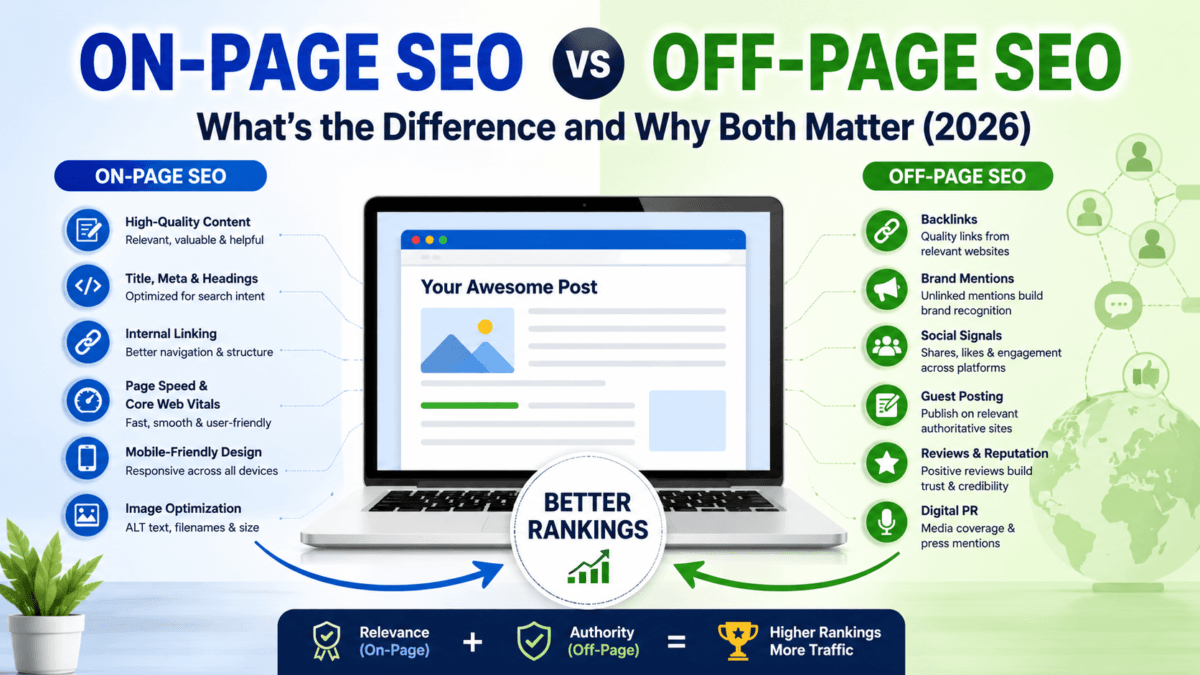
Image : Difference Between On Page SEO And Off Page SEO
Search Engine Optimization (SEO) plays a crucial role in determining how visible your website is on search engines like Google and Bing — and increasingly, in whether AI tools mention you at all. SEO is broadly divided into two core areas: On-Page SEO and Off-Page SEO.
Understanding the difference between them is essential if you want to build long-term organic traffic, improve rankings, and create a website that both users and search engines trust. This updated guide covers what’s changed in 2026 — Core Web Vitals’ bigger role, E-E-A-T’s expanded weight, and how off-page signals now stretch beyond backlinks into brand mentions AI tools can recognize even without a link.
In this guide, we’ll cover:
- Clear definitions of On-Page and Off-Page SEO, with examples
- What’s changed for each in 2026
- Key differences, side by side
- Which to focus on first
Table of Contents
Also read : Social Channels in Search Console: How Google’s Platform Properties Actually Work
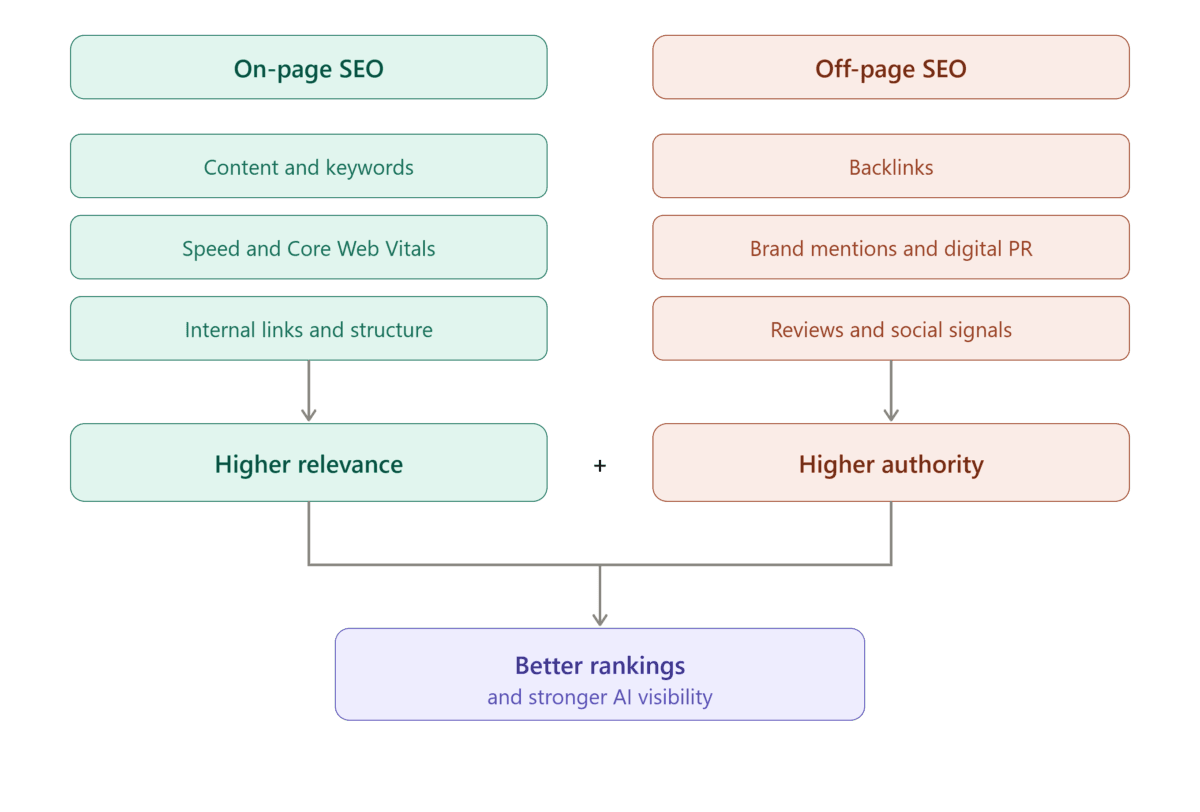
At a Glance
On-Page SEO
- Happens on your website
- Improves relevance
- Completely under your control
Off-Page SEO
- Happens outside your website
- Builds authority
- Depends on others
What is On Page SEO?
On-Page SEO refers to all optimization activities performed inside your website to improve rankings and user experience. It focuses on making your content clear, relevant, fast, and easy for both search engines and readers to understand.
Common On-Page SEO Techniques
- Keyword optimization in titles, headings, and content
- Meta title and meta description optimization
- Clean URL structure and internal linking
- Image optimization (ALT text and file names)
- Mobile-friendly and responsive design
- Page speed and Core Web Vitals
- High-quality, genuinely helpful content
On-page SEO is fully under your control and forms the foundation of every successful SEO strategy.
If you’re using Rank Math for SEO, our detailed guide on on-page SEO with Rank Math covers focus keywords, schema markup, Instant Indexing, and how to prepare content for AI search — all using the free version.
What’s changed for On-Page SEO in 2026
Core Web Vitals carry more weight than before. INP (Interaction to Next Paint) replaced FID as the responsiveness metric. Page experience, including Core Web Vitals, remains an important ranking consideration and can help differentiate pages of similar relevance and quality — especially in competitive niches.
E-E-A-T has expanded. Google’s quality rater guidelines now go further into demonstrating real experience, not just expertise — first-hand testing, original screenshots, and named authorship matter more than ever. This rewards exactly the kind of hands-on, tested content that separates a genuine review from a rewritten press release.
Content depth over keyword density. Search has moved further toward topic and intent matching rather than exact-match keyword repetition — covering a subject thoroughly in your own words outperforms stuffing a page with variations of the same phrase.
A quick example
Imagine two websites publish near-identical laptop reviews. Website A loads in 1.5 seconds, uses original photos, and links to related buying guides. Website B loads in 6 seconds and reuses the manufacturer’s stock description. Even before either site earns a single backlink, Website A already has a real on-page advantage — it’s faster, more original, and easier for both readers and search engines to trust.
🛠️ Free Technical SEO Tools on TechMitra
Optimize your crawlability and structured data with our suite of privacy-first, browser-based webmaster tools:
What is Off-Page SEO?
Off-Page SEO includes all actions taken outside your website to improve authority, trust, and reputation. Search engines use these signals to evaluate how credible your site is compared to competitors.
Common Off-Page SEO Techniques
- High-quality backlink building
- Social media sharing and visibility
- Brand mentions and citations
- Guest posting on relevant websites
- Forum and community engagement
- Digital PR
Off-page SEO is about earning trust, not controlling it.
What’s changed for Off-Page SEO in 2026
Unlinked brand mentions may contribute to broader entity recognition and online reputation, particularly when they appear on authoritative, relevant websites. Google hasn’t explicitly confirmed unlinked mentions as a direct ranking signal, but many SEO practitioners see them as part of how search engines build a picture of a brand’s credibility. They can also improve visibility in AI systems that recognize entities across multiple sources — ChatGPT, Perplexity, and similar tools can pick up on your brand from a mention alone, without needing a clickable link to find you.
Quality has pulled further ahead of quantity. A single editorial link from a respected, topically relevant site continues to outweigh large volumes of low-authority links — and that gap has only widened as detection of manufactured link patterns has improved.
Reputation signals matter more. Reviews, sentiment, and how a brand is discussed across the web now feed into how search engines and AI tools judge trustworthiness — not just how many sites link to you.
Also Read : AI Performance Tab in Bing Webmaster Tools: What It Is & Why It Matters for SEO in 2026
On Page SEO And Off Page SEO Differences
| Feature | On-Page SEO | Off-Page SEO |
|---|---|---|
| Location of work | Inside your website | Outside your website |
| Control | Fully controllable | Depends on third parties |
| Main focus | Content and structure | Authority and trust |
| Examples | Titles, content, keywords, Core Web Vitals | Backlinks, mentions, digital PR |
| Typical tools | Rank Math, Yoast, PageSpeed Insights | Ahrefs, Semrush, Google Search Console |
Why You Need Both
On-page SEO ensures your website is:
- Crawlable
- Fast
- Relevant
- User-friendly
Off-page SEO helps search engines and AI tools trust your website.
A well-optimized page with no authority behind it still struggles to rank. A high-authority site with weak on-page SEO also underperforms. Balanced SEO = sustainable rankings.
Which Should You Focus on First?
Always start with On-Page SEO.
Before building backlinks or promoting content, make sure:
- Pages load fast and pass Core Web Vitals
- Content genuinely satisfies search intent
- Keywords are placed naturally, not stuffed
- Internal links are logical and helpful
Once that foundation is solid, off-page efforts have something worth linking to — and mentioning.
AI search tools increasingly cite websites that demonstrate expertise, clear structure, and consistent brand recognition across the web. Traditional SEO remains important, but building a trustworthy online presence now improves both search rankings and AI visibility. If you want the full picture on optimizing specifically for AI tools, see our LLM SEO guide.
Final Thoughts
The core relationship between on-page and off-page SEO hasn’t changed: on-page makes your site clear and crawlable, off-page builds the trust that lets it rank. What’s shifted in 2026 is how much weight real experience (not just claimed expertise) and unlinked brand recognition now carry — both are signals that reward genuine, tested content over volume tactics.
SEO is not a one-time task. It requires ongoing updates, monitoring, and continuous improvement.
Technical SEO sits underneath both of these — see our Technical SEO Checklist guide for the infrastructure side: site speed, crawlability, and indexing.
FAQs
Q1: Which is more important — On-Page or Off-Page SEO?
Both are equally important. On-page builds relevance and clarity; off-page builds trust and authority.
Q2: Can I rank on Google with only On-Page SEO?
Yes, for low-competition keywords. Competitive terms generally need off-page authority as well.
Q3: How long does Off-Page SEO take to show results?
Usually 2–6 months, depending on your niche and the quality of backlinks and mentions earned.
Q4: Do unlinked brand mentions actually help rankings?
Growing evidence suggests yes — search engines can identify and credit brand mentions even without a hyperlink, using natural language processing to connect the mention to your site as an entity.
Q5: Has Core Web Vitals become more important in 2026?
INP replaced FID as the responsiveness metric. Page experience, including Core Web Vitals, remains an important ranking consideration and can help differentiate pages of similar relevance and quality, particularly in competitive niches.
Q6: What’s the single best way to improve On-Page SEO right now?
Focus on genuine depth and first-hand experience in your content — Google’s expanded E-E-A-T guidelines increasingly reward real testing and original insight over rewritten or generic content.
Key Takeaways
- On-page SEO improves relevance
- Off-page SEO builds authority
- Strong rankings require both
- Start with on-page before investing in link building
- Real experience and trustworthy content matter more than ever

Ayush Singhal is the founder and chief editor of TechMitra.in — a tech hub dedicated to simplifying gadgets, AI tools, and smart innovations for everyday users. With over 15 years of business experience, a Bachelor of Computer Applications (BCA) degree, and 5 years of hands-on experience running an electronics retail shop, Ayush brings real-world gadget knowledge and a genuine passion for emerging technology.
At TechMitra, he covers everything from AI breakthroughs and gadget reviews to app guides, mobile tips, and digital how-tos. His goal is simple — to make tech easy, useful, and enjoyable for everyone. When he’s not testing the latest devices or exploring AI trends, Ayush spends his time crafting tutorials that help readers make smarter digital choices.
📍 Based in Lucknow, India
💡 Focus Areas: Tech News • AI Tools • Gadgets • Digital How-Tos
📧 Contact: Get in touch →
🔗 Full Bio: https://techmitra.in/about-us/