

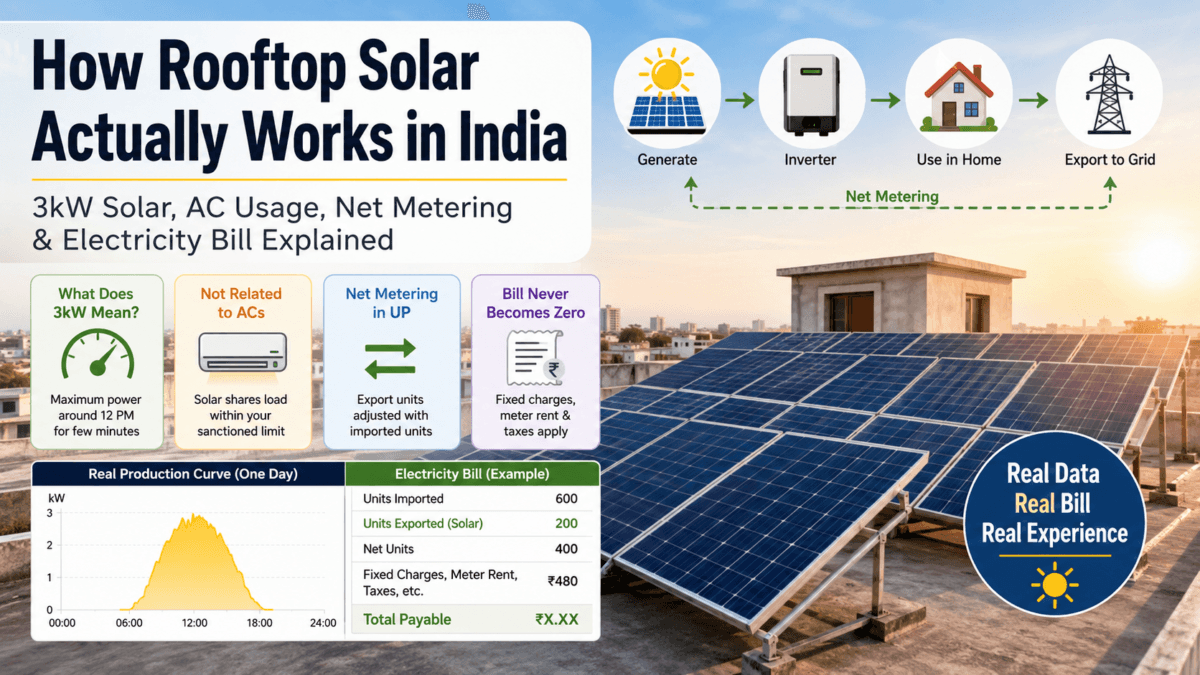
How Rooftop Solar Works in India: Net Metering & Electricity Bill Explained
Rooftop solar is growing fast in India, especially after the launch of PM Surya Ghar Yojana. Yet most homeowners are still confused about how an on-grid system actually behaves once it is on the roof. People keep asking the same questions. Can a 3kW plant run three ACs? Does solar power the house directly? What does “3kW” even mean? Why does an electricity bill still arrive after installing solar? And how does net metering work?
I have been using a rooftop solar system at my own home in Lucknow for a long time now, and I found that many videos and articles either oversimplify these things or get them wrong. So in this article I will explain everything in simple language, using my real production graph and real UPPCL bills.
Also read: My 3 kW Solar Rooftop Plant Review: PM Surya Ghar Yojana Cost, Performance and Savings
Table of Contents
Also Read : My 3 kW Solar Rooftop Plant Review – pM surya ghar yojna Cost, Performance & Savings
What Does “3 kW” Mean in a Rooftop Solar Plant?
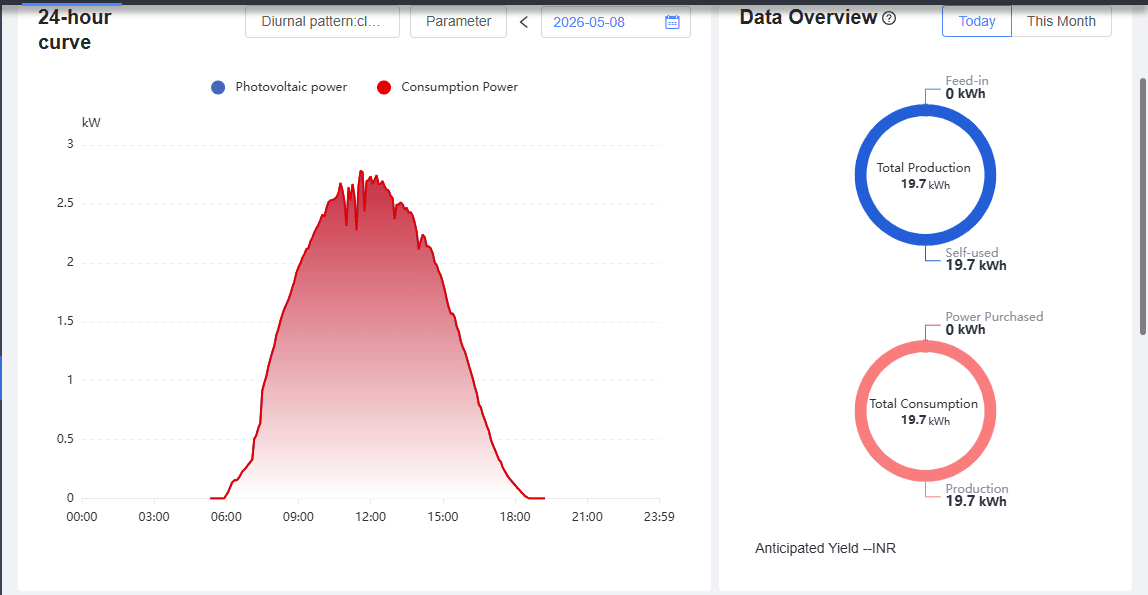
Many people believe a 3kW system produces 3 kW of power continuously, all day long. It does not. The 3kW rating is the maximum power the plant can deliver at one instant under ideal conditions. That peak usually comes only around 12 PM to 1 PM, and often lasts for a short time.
The rest of the day, generation keeps changing. It starts slowly after sunrise, climbs towards noon, touches its peak briefly, and then falls again towards the evening. The graph below is the real production curve of my own 3.39kW system in Uttar Pradesh, and you can see this shape clearly.
A small technical note that avoids a lot of confusion: solar panels are rated in kWp (the DC rating of the panels), while the inverter is rated in kW (its AC output). When someone says “3kW solar plant”, they usually mean the system category, and the panels and inverter may be sized a little differently.
Why Solar Panels Rarely Reach Full Rated Capacity
The rated figure is measured in laboratory conditions, and a real rooftop almost never matches them. Dust on the panels, high summer temperatures, cloud cover, the direction and tilt of the roof, inverter efficiency, wiring losses and the changing season all take a small bite out of the output. That is why even a healthy system seldom touches its full rating, and why you should think in terms of units generated per day rather than the headline kW number.
Why Installers Put More Than 3kW of Panels on a 3kW System
If you look at many installations, the panel capacity is slightly higher than the inverter rating. Mine is a good example: 6 panels of 565 W each give 3,390 W, or about 3.39 kWp, even though it is sold as a 3kW system.
This is deliberate. Because heat, dust and low morning and evening sunlight reduce what panels deliver, a little extra panel capacity helps the system produce more useful energy across the whole day, instead of only at noon.
Also Read : 11 Facts About Solar Rooftop Plants Every Indian Homeowner Must Know (Real Experience Based)
Can a 3kW Solar Plant Run 3 ACs?
This is probably the biggest misconception about rooftop solar. The size of your solar plant does not decide how many ACs or appliances you can run. What decides it is your sanctioned load, the load limit approved by the electricity department for your connection.
Many people think that installing 3kW of solar lets them run 3kW of appliances with no limit. In an on-grid system, solar generation and sanctioned load are two separate things.
Here is how the sharing works in practice. Suppose your panels are producing 2 kW at the moment, and your home is using 3 kW. Solar supplies the 2 kW, and the remaining 1 kW comes from the grid automatically, with no switching on your side. If your home uses less than solar is producing, the extra goes out to the grid and is counted under net metering.
So can three ACs run on a 3kW plant? A 1.5 ton inverter AC typically draws somewhere around 1 to 1.5 kW while running, depending on the model and the temperature (check the label on your AC). Three ACs together, plus a geyser, pump or microwave, can easily cross 4 kW. Solar will cover part of that during the day and the grid will cover the rest. The real question is whether the total demand stays within your sanctioned load.
If your demand regularly goes beyond the sanctioned load, the department can levy extra charges or a penalty, or ask you to increase your load. This has nothing to do with the solar plant itself. Solar simply helps supply the load, it does not raise your limit.
The two are linked in one place, though. Under rooftop solar rules and subsidy schemes such as PM Surya Ghar Yojana, the capacity you are allowed to install depends on your sanctioned load. That is why many families first increase their sanctioned load and only then go for a bigger plant. You can read the official conditions in the PM Surya Ghar scheme guidelines.
How Net Metering Works in Uttar Pradesh
Most on-grid rooftop systems in Uttar Pradesh work on net metering. Your home uses solar power first, whatever you do not use is exported to the grid, and at the end of the billing cycle the exported units are adjusted against the units you imported.
Take a simple example. Your plant generates 500 units in a month. Your home uses 300 of them directly and exports the other 200. During the same month you also imported 600 units from the power corporation, mostly in the evening and at night. The bill is then built on 600 − 200 = 400 units.
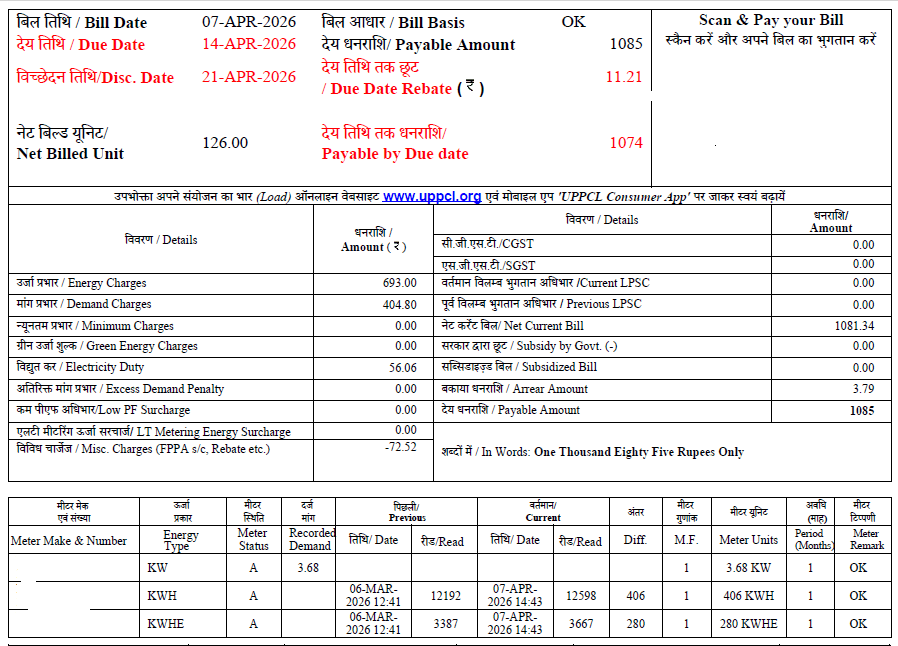
Here is a real case from my own bill. In this month I imported 406 units and exported 280 units, so the net billed units came to 126.
Now the opposite situation. Suppose you imported 150 units but exported 200. Your exported units are higher, so billed units are zero, and the extra 50 units are carried forward and adjusted in the next month’s bill.
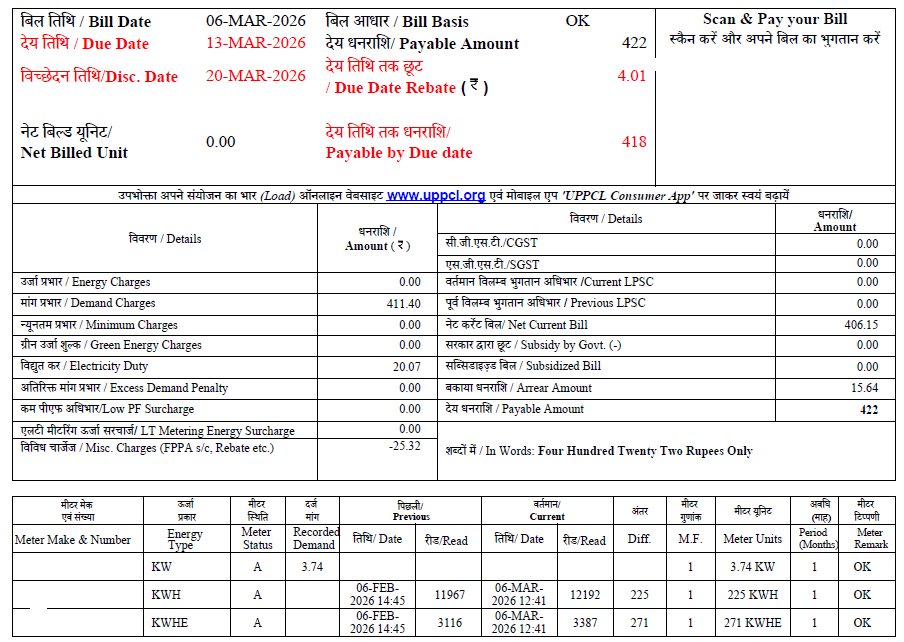
This is exactly what happened in another of my bills. I imported 225 units and exported 271 units, so net billed units were zero. I still had to pay ₹422, and I will explain why in the next section.
UP’s own policy details are available on the UPNEDA solar policy page.
Why Your Bill Shows Fewer Exported Units Than Your Solar App
Another thing that confuses new solar owners is that the bill shows only the exported units, not the total your panels generated. If your house consumes all the solar power the moment it is produced, nothing goes to the grid, and the export column (KWH Export or KWHE) can even show zero, although the plant worked all day.
This does not mean your solar power is being ignored. It was used directly by your appliances, which is the best use of it. The benefit shows up as lower imported units. Suppose a house used to take 500 units from the grid. After solar, it uses 300 units straight from the panels during the day and takes only 200 from the grid, so the bill records 200 imported units. That is why the monitoring app of your inverter often shows far more generation than the exported units on your bill.
Why Your Electricity Bill Is Not Zero After Solar
This is the question I get most often, and the answer is actually simple. Your monthly bill has two parts.
Monthly bill = charge for net billed units + fixed charge (rental).
Start with the first part. Net billed units are, in plain terms, your total consumption minus your total solar generation. Suppose your solar produces about 13 units a day, which is roughly 390 units a month, and your home consumes 500 units. You will be billed for the remaining 110 units, at the normal slab rates. The solar did its job, but it did not cover everything you used.
Now the second part. Even when billed units become zero, the fixed charge still comes. In my Lucknow bills, from about December to March my solar units are higher than my consumption, because winter means lower AC use. In those months my net units are zero, and I pay only the fixed charge, which is ₹422 for my 4kW sanctioned load. The fixed charge depends on your sanctioned load, so someone with a smaller or larger connection will pay a different amount, and tariffs can change with new orders.
Here is the whole idea in one small table, using 390 units of generation in both cases.
| Month A | Month B | |
|---|---|---|
| Home consumption | 500 units | 300 units |
| Solar generation | 390 units | 390 units |
| Net billed units | 110 | 0 (90 carried forward) |
| What you pay | Charge for 110 units + fixed charge | Fixed charge only |
Two more things can keep your bill above zero. If your system is smaller than your yearly consumption, some units will always be billed. And your usage and your generation do not move together through the year: summer ACs push consumption up, while monsoon clouds and dust bring generation down, so the same system can show billed units in some months and none in others.
What Happens on 31 March?
Surplus units are carried forward from month to month, but not forever. In Uttar Pradesh the adjustment year closes on 31 March and starts fresh on 1 April. So surplus built up in the winter months cannot be counted on to cover next summer’s AC usage.
Units that are still unadjusted at the end of the year are settled as per the UPERC regulations, at a rate fixed by the regulator, which is much lower than the tariff you pay for electricity. For this reason it rarely makes sense to oversize your plant hoping to earn from the surplus. It is smarter to size the system according to your yearly consumption.
Also read: Solar Rooftop Plant Maintenance Guide: Cleaning Tips to Maximize Solar Output
Does Rooftop Solar Work at Night?
No. A normal on-grid system produces electricity only while the sun is shining. At night your home switches to grid power automatically, with no action needed from you. Unless you add batteries or use a hybrid system, rooftop solar will not supply power after sunset. An on-grid system also shuts down during a power cut for safety reasons, so it will not run your home when the grid is off.
Final Thoughts
Rooftop solar is one of the best long-term ways to cut electricity costs in India, but it helps to know what it really does. A 3kW plant does not generate 3kW all day. Solar generation and sanctioned load are different things. Net metering adjusts what you export against what you import, and your bill will almost never be completely zero, because the fixed charge is there every month.
So the real benefit of rooftop solar is not free unlimited electricity. It is a big, lasting reduction in your electricity bill, along with cleaner energy, and once you understand these basics you can plan your system size and your expectations correctly.in electricity costs while using cleaner energy.

Ayush Singhal is the founder and chief editor of TechMitra.in — a tech hub dedicated to simplifying gadgets, AI tools, and smart innovations for everyday users. With over 15 years of business experience, a Bachelor of Computer Applications (BCA) degree, and 5 years of hands-on experience running an electronics retail shop, Ayush brings real-world gadget knowledge and a genuine passion for emerging technology.
At TechMitra, he covers everything from AI breakthroughs and gadget reviews to app guides, mobile tips, and digital how-tos. His goal is simple — to make tech easy, useful, and enjoyable for everyone. When he’s not testing the latest devices or exploring AI trends, Ayush spends his time crafting tutorials that help readers make smarter digital choices.
📍 Based in Lucknow, India
💡 Focus Areas: Tech News • AI Tools • Gadgets • Digital How-Tos
📧 Contact: Get in touch →
🔗 Full Bio: https://techmitra.in/about-us/