
Updated July 26, 2026 | Originally published November 2025
You searched something like “best processor 2026” or “create a table ranking every processor” and landed here — so let’s skip the preamble. Below is a single ranked pc and mobile processor ranking table covering every major mobile, laptop, and desktop processor worth knowing about right now, followed by the deep dives, gaming picks, and buying advice for whichever category you actually came for.
If you just want the answer: the Snapdragon 8 Elite Gen 5 leads Android flagships overall, the Apple A19 Pro leads iPhones, the AMD Ryzen 7 9800X3D leads desktop gaming, and the Snapdragon X2 Elite Extreme leads Windows-on-ARM laptops. Read on for why, and for where your budget actually fits.
What’s new in this update (July 2026): AMD’s 9950X3D and dual-cache 9950X3D2 are now the top AMD desktop picks; Intel’s aggressively priced Core Ultra 7 270K Plus is shaking up the desktop value conversation; Xiaomi’s first true in-house flagship chip, the XRING O1, has entered the top mobile tier; and new independent thermal testing shows the Dimensity 9500 actually holding sustained gaming performance better than the Snapdragon 8 Elite Gen 5, reversing what most reviews assumed a few months ago.
Jump to what you need
Also Read : What Is Copilot+ PC in Windows? Features, Benefits & Top Picks
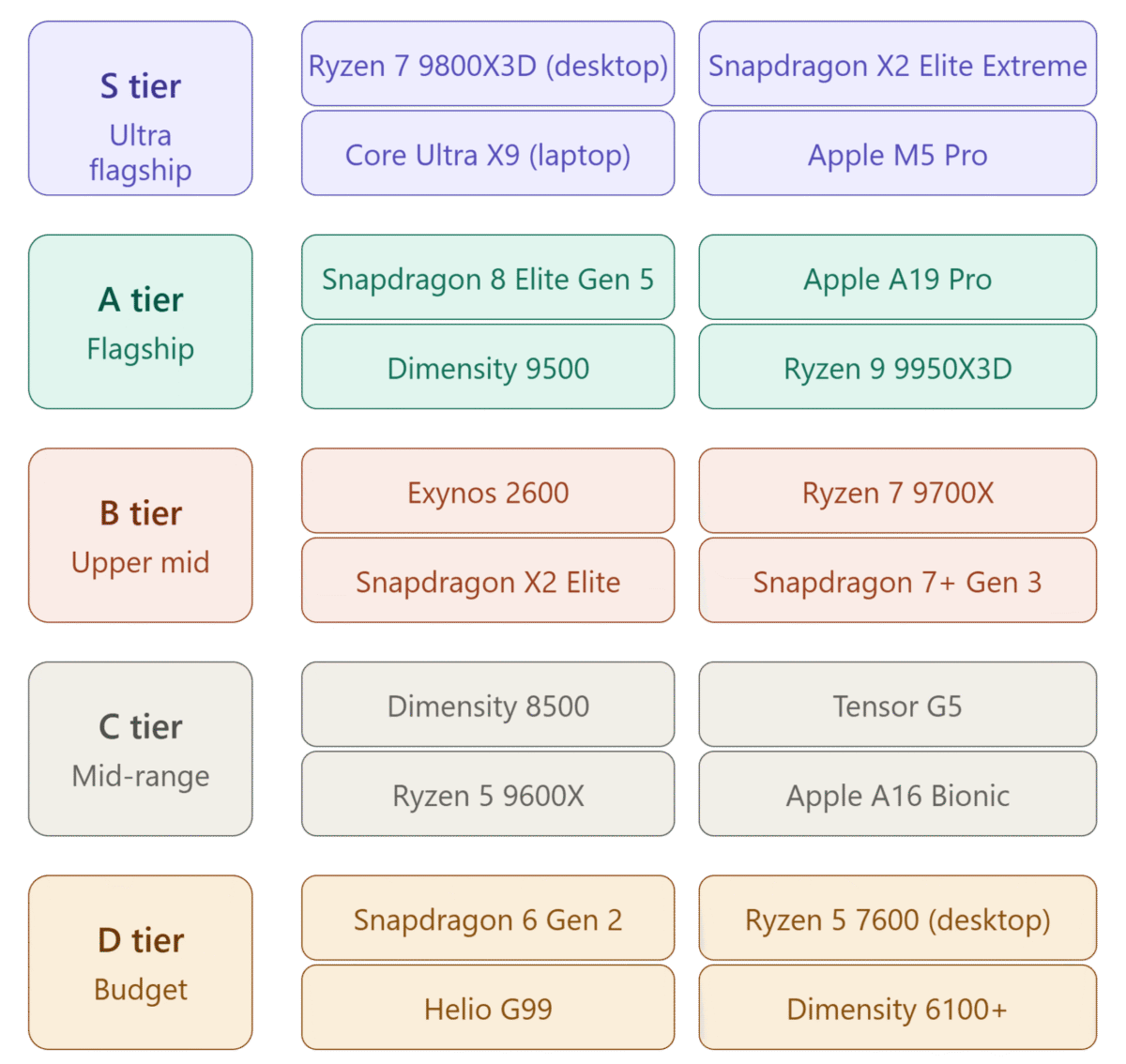
The PC & Mobile Processor Ranking Master Table: Every Processor, Top to Bottom
This table spans phone, laptop, and desktop chips together, tiered by real-world performance class — not by brand. Use it to answer “is my phone’s chip actually stronger than that laptop’s chip” or to see where any processor sits relative to everything else on the market.
Jump to: Ryzen 7 9800X3D · Snapdragon X2 Elite Extreme · Snapdragon 8 Elite Gen 5 · Dimensity 9500 · Apple A19 Pro · Ryzen 9 9950X3D · Ryzen AI 9 HX 370
| Tier | Processor | Category | Brand | Why It’s Here |
|---|---|---|---|---|
| S — Ultra Flagship | Ryzen 7 9800X3D | Desktop | AMD | Fastest gaming CPU on the market, full stop |
| S — Ultra Flagship | Core Ultra X9 (Panther Lake) | Laptop | Intel | Best all-round flagship laptop chip, strong iGPU |
| S — Ultra Flagship | Snapdragon X2 Elite Extreme | Laptop (ARM) | Qualcomm | 18-core ARM chip, beats older x86 flagships in single-thread |
| S — Ultra Flagship | Apple M5 Pro | Laptop SoC | Apple | Best chip for creative/video work on a laptop |
| A — Flagship | Snapdragon 8 Elite Gen 5 | Mobile | Qualcomm | Best overall Android chip — CPU, AI, sustained gaming |
| A — Flagship | Dimensity 9500 | Mobile | MediaTek | Best mobile GPU, most well-rounded chip in independent testing |
| A — Flagship | Apple A19 Pro | Mobile | Apple | Fastest single-core mobile chip, coolest running |
| A — Flagship | Xiaomi XRING O1 | Mobile | Xiaomi | Xiaomi’s first true flagship in-house chip, strong AI push |
| A — Flagship | Ryzen AI 9 HX 370 | Laptop | AMD | Best Windows laptop chip for creators, strong multi-core |
| A — Flagship | Ryzen 9 9950X3D | Desktop | AMD | AMD’s best all-round chip — 3D V-Cache plus full 16-core productivity muscle |
| A — Flagship | Apple M5 | Laptop SoC | Apple | Best efficiency chip for everyday MacBook Air use |
| B — Upper Mid | Exynos 2600 | Mobile | Samsung | Samsung’s first 2nm chip, big step up from Exynos 2400 |
| B — Upper Mid | Core Ultra 9 285H | Laptop | Intel | Still common in 2025–26 gaming laptops, proven platform |
| B — Upper Mid | Snapdragon X2 Elite | Laptop (ARM) | Qualcomm | Excellent battery life, near-flagship performance |
| B — Upper Mid | Ryzen 7 9700X | Desktop | AMD | 8-core Zen 5, great gaming value |
| B — Upper Mid | Snapdragon 7+ Gen 3 | Mobile | Qualcomm | Best mid-range gaming chip available |
| C — Mid-Range | Dimensity 8500 | Mobile | MediaTek | Punches above its weight, excellent efficiency |
| C — Mid-Range | Tensor G5 | Mobile | Strong AI/camera features, weak raw performance | |
| C — Mid-Range | Ryzen 5 9600X | Desktop | AMD | Best value 6-core for 1080p/1440p gaming |
| C — Mid-Range | Apple A16 Bionic | Mobile | Apple | Still powers non-Pro iPhones, beats Android mid-range |
| D — Budget | Snapdragon 6 Gen 2 | Mobile | Qualcomm | Best budget 5G chip for everyday tasks |
| D — Budget | Dimensity 6100+ | Mobile | MediaTek | Good connectivity, casual gaming only |
| D — Budget | Helio G99 | Mobile | MediaTek | Best budget 4G chip still in wide use |
| D — Budget | Ryzen 5 7600 | Desktop | AMD | Cheapest solid entry into modern AM5 gaming |
A quick note on how to read this: a “Flagship” phone chip and a “Flagship” laptop chip aren’t doing the same job — a phone chip has to fit in a fanless 8mm body, a laptop chip gets active cooling and 5x the power budget. The tiers reflect how each chip performs within its own category, not a literal “this phone chip beats this laptop chip” claim. Scroll down for category-specific comparisons if that’s what you’re after.
Desktop Processors: The Full Table
Desktop CPUs are judged differently — no battery life to worry about, and gaming vs. productivity often points to different winners.
| Processor | Segment | Best For | Notes |
|---|---|---|---|
| Ryzen 9 9950X3D2 | Ultra Flagship | Absolute peak gaming + productivity | Dual 3D V-Cache chiplets, 208MB cache, 200W TDP; modest gains over 9950X3D at a much higher price |
| Ryzen 7 9800X3D | Flagship Gaming | Pure gaming performance | 3D V-Cache; ~24% faster than Core Ultra 9 285K averaged across a 45-game test suite (TechSpot, “AMD Ryzen 7 9800X3D vs. Intel Core Ultra 9 285K”); still the best value gaming flagship |
| Ryzen 9 9950X3D | Flagship Productivity + Gaming | Best all-rounder for creators who also game | 16 cores, Zen 5, adds 3D V-Cache on top of 9950X’s productivity power |
| Core Ultra 9 285K | Flagship Productivity | Multi-threaded productivity work | Strong in productivity; Intel has acknowledged gaming performance issues on Arrow Lake |
| Core Ultra 7 270K Plus | Upper Mid (High Value) | Budget-conscious performance builds | Surprisingly close to the 9950X3D in raw CPU tests at roughly half the price; still loses in gaming due to no 3D V-Cache equivalent |
| Core i9-14900K | High-End (Previous Gen) | Gaming and content creation | Still widely available and capable; high power draw |
| Ryzen 7 9700X | Upper Mid | High-refresh 1080p/1440p gaming | 8-core Zen 5, efficient, excellent multitasking |
| Ryzen 5 9600X | Mid-Range | Best value gaming build | 6-core Zen 5, handles all modern games with a good GPU |
| Core i5-13400F | Budget/Mid | Budget gaming rigs | Popular, still widely sold, good value |
| Ryzen 5 7600 | Budget | Entry into AM5 platform | Cheapest sensible path into a modern, upgradeable platform |
The honest desktop story right now: AMD’s 3D V-Cache lineup still dominates gaming outright — nothing from Intel currently touches the 9800X3D or 9950X3D in CPU-limited titles. What’s changed recently is the value equation: Intel’s new Core Ultra 7 270K Plus (~$339–349) trades blows with the far pricier 9950X3D in pure CPU benchmarks and even edges ahead in a few productivity tests, per early independent reviews, though it still falls behind in gaming specifically. If gaming is your priority, AMD remains the clear pick. If you want near-flagship CPU performance on a budget and don’t game competitively, the 270K Plus is worth a serious look — a genuine shift from a few months ago. Intel’s next real architectural jump, Nova Lake (Core Ultra 400 series), isn’t landing until 2027, so nothing changes on that front for a while.
Mobile Flagship Chips: Head-to-Head
The flagship fight in 2026 is closer than the marketing suggests, and each chip actually wins a different thing. The three benchmarked below (Snapdragon, Dimensity, Apple) remain the ones with the most independent testing data, but it’s no longer strictly a three-horse race — Samsung’s Exynos 2600 (its first 2nm chip) has closed the gap significantly, and Xiaomi’s XRING O1, its first serious in-house flagship silicon, has entered the conversation for Xiaomi’s own top-end phones. Neither has the volume of independent benchmarking the big three have yet, so we’re not including them in the head-to-head table below, but both are worth watching.
Mobile flagship benchmark comparison chart here — normalized bar chart of the table below
| Benchmark | Snapdragon 8 Elite Gen 5 | Dimensity 9500 | Apple A19 Pro |
|---|---|---|---|
| AnTuTu v11 (overall) | 🏆 ~3.9–4.1M | ~3.5–4.0M | ~2.4–2.6M* |
| Geekbench 6 single-core | 3,634–3,640 | 3,177–3,228 | 🏆 3,784–3,970 |
| Geekbench 6 multi-core | 🏆 10,813–11,033 | 9,553–9,701 | 9,752–10,558 |
| 3DMark Solar Bay (GPU) | 12,156 | 🏆 13,319 | 10,999 |
| Sustained gaming stability (under thermal load) | Peak power draw ~24W; independent stress testing shows GPU stability can fall as low as 25% during extended sessions | 🏆 Caps draw near 18W; holds roughly 45% stability — nearly double the sustained output of Snapdragon in the same tests | Strong, best thermals |
| Real-world 4K video export | Competitive | 🏆 Fastest in independent testing | Close second |
Benchmark scores are aggregated from public Geekbench, 3DMark, and AnTuTu results across multiple review outlets — figures can vary a few percent by device and cooling. Sustained-performance figures are from independent thermal-throttling stress tests: multicoreperformance.com, “Snapdragon 8 Elite Gen 5 vs Dimensity 9500 Thermal Stability Test,” July 2026. Apple’s lower AnTuTu score is a testing-methodology artifact (different AnTuTu versions and iOS vs. Android scoring), not a real-world performance gap — don’t read too much into it on its own.
Which one should you actually care about?
- Best overall / best multitasking (short bursts, benchmarks, day-to-day): Snapdragon 8 Elite Gen 5 — it wins peak AnTuTu and multi-core Geekbench outright.
- Best single-app responsiveness, best battery efficiency: Apple A19 Pro
- Best gaming graphics AND the more honest choice for long gaming sessions: Dimensity 9500 — it wins 3DMark Solar Bay outright, and more importantly, independent thermal-stress testing shows it holding performance far better than Snapdragon over extended play (see source note above). The Snapdragon 8 Elite Gen 5 posts higher peak numbers, but those numbers don’t fully survive a 40-minute gaming session the way MediaTek’s do.
One nuance worth knowing: “Snapdragon 8 Elite Gen 5” isn’t one single chip anymore. Qualcomm has shipped at least four silicon variants — a standard version (most flagships), a 7-core version for thin foldables (Oppo Find N6), a higher-clocked version for the Galaxy S26/Fold 8 and gaming phones like the RedMagic 11S, and, as of July 2026, a new cost-reduced variant aimed at $400–500 phones. (Source: Qualcomm SoC variant reporting, Wccftech, July 2026.) Two phones advertising “Snapdragon 8 Elite Gen 5” can post meaningfully different benchmark numbers depending on which variant they actually ship — worth checking phone-specific reviews rather than assuming the chip name alone tells you everything.
Check our Snapdragon vs MediaTek Processor Comparison Free Tool: Find Equivalent Mobile Chipsets
AnTuTu Score Comparison — Real Devices (2026)
Scores vary by device cooling, RAM, and software, so treat this as a general reference, not gospel.
| Processor | Representative Phone | AnTuTu Score | Tier |
|---|---|---|---|
| Snapdragon 8 Elite Gen 5 | Red Magic 11 Pro | 39,63,575 | Ultra Flagship |
| Snapdragon 8 Elite Gen 5 | iQOO 15 | 37,19,658 | Flagship |
| Snapdragon 8 Elite Gen 5 | Poco F8 Ultra | 36,61,170 | Flagship |
| Snapdragon 8 Elite Gen 5 | OnePlus 15 | 36,06,895 | Flagship |
| Snapdragon 8 Elite Gen 5 | Xiaomi 17 Ultra | 35,62,525 | Flagship |
| Snapdragon 8 Elite / Exynos 2600 | Galaxy S26 Ultra | 34,84,761 | Flagship |
| Dimensity 9500 | OPPO Find X9 Pro | 33,08,919 | Flagship |
| Dimensity 9500 | vivo X300 Pro | 32,49,461 | Flagship |
| Snapdragon 8 Elite Gen 5 | Galaxy S25 Ultra | 28,50,981 | Flagship |
| Snapdragon 8 Gen 3 | Galaxy S24 Ultra | 21,95,161 | Previous Flagship |
| Dimensity 9300 | Poco X8 Pro | 19,80,087 | Previous Flagship |
| Snapdragon 7+ Gen 3 | Poco X7 Pro | 18,79,628 | Upper Mid-Range |
| Snapdragon 7 Gen 3 | OnePlus Nord 5 | 17,41,255 | Mid-Range |
| Dimensity 8300 | Poco F6 | 17,20,884 | Mid-Range |
| Dimensity 7200 | Redmi Note 14 Pro+ | 9,82,088 | Budget |
| Snapdragon 6 Gen 1 | Redmi Note 14 5G | 6,59,728 | Budget |
| Helio G99 / Dimensity 6020 | Poco M7 Pro 5G | 6,56,174 | Entry Budget |
Source: AnTuTu Benchmark Rankings V11 — AnTuTu’s official, monthly-updated global ranking list. Scores are global averages, not peak scores, and shift slightly month to month as AnTuTu updates its list — check the live ranking page for the latest numbers.
How does a flagship phone’s AnTuTu score compare to a laptop chip?
This gets searched a lot, so here’s the direct answer: you can’t compare them 1:1, because AnTuTu is a mobile-only benchmark and laptops are scored on Cinebench, Geekbench, or PCMark instead — the scoring scales are completely different tools measuring different things. What you can say directionally: a flagship phone chip like the Snapdragon 8 Elite Gen 5 (AnTuTu ~4M) will lose badly to almost any modern laptop or desktop CPU in sustained multi-core workloads (video export, compiling, 3D rendering), because laptops have 3–5x the power budget and active cooling. Where phone chips actually compete is single-core responsiveness and AI/NPU tasks — the Apple A19 Pro’s single-core Geekbench score, for instance, is close to entry laptop chips like the Core Ultra 5. Short version: buy your phone and laptop for what they each do, not by cross-referencing one benchmark score against another.
PC & Laptop Processor Equivalents
| Intel | AMD | Qualcomm (ARM) | Apple | Category |
|---|---|---|---|---|
| Core Ultra X9 (Series 3) | Ryzen AI 9 HX 370 | Snapdragon X2 Elite Extreme | M5 Pro | Flagship Laptop |
| Core Ultra 7 (Series 3) | Ryzen AI 7 300 | Snapdragon X2 Elite | M5 | Mid-High Laptop |
| Core Ultra 5 (Series 2) | Ryzen AI 5 300 | Snapdragon X Elite (Gen 1) | M4 | Mid-Range Laptop |
| Core i9-14900K | Ryzen 9 9950X | — | — (no desktop chip) | High-End Desktop |
| Core i5-14600K | Ryzen 7 9700X | — | — | Mid-Range Desktop |
| Core i5-13400F | Ryzen 5 9600X / 7600 | — | — | Budget Desktop |
Check our Intel vs Amd equivalent processor finder free tool
A Note on the Snapdragon X2 Elite — Why It Matters Now
This deserves real context because 2026 is the year Windows-on-ARM stopped being a compromise. Independent lab testing shows the Snapdragon X2 Elite Extreme beating the Intel Core Ultra X7 358H by 50–80% in multi-threaded workloads, and its single-thread Cinebench scores now sit close to Apple’s M4 lineup — while comfortably beating older chips like the M3 Ultra and Intel Core Ultra 9 285K in single-core tests. (Source: independent Cinebench/multi-thread lab comparisons reported by Notebookcheck and Wccftech, 2026.)
App compatibility — long the real weak point — has also improved: native ARM apps run at full speed, and even emulated x86 apps now run close to native Intel performance on the X2E-94-100, a huge jump from the original Snapdragon X Elite, which used to slow down to Core i5-1335U levels under emulation.
Where it still falls short: integrated graphics. The Adreno X2-90 GPU sits between AMD’s Radeon 890M and Intel’s Arc B390 — solidly mid-pack, not a GPU win. If you mostly live in a browser, Office, and light creative apps, and battery life is a priority, the Snapdragon X2 Elite is a legitimate pick in 2026. If you need broad legacy software support or serious integrated graphics, Intel or AMD remain the safer default.
Best Processor for Gaming — Mobile, Laptop & Desktop
Gaming stresses a chip differently than daily use — sustained performance without throttling and GPU strength matter more than peak benchmark numbers.
Best processor for Mobile Gaming
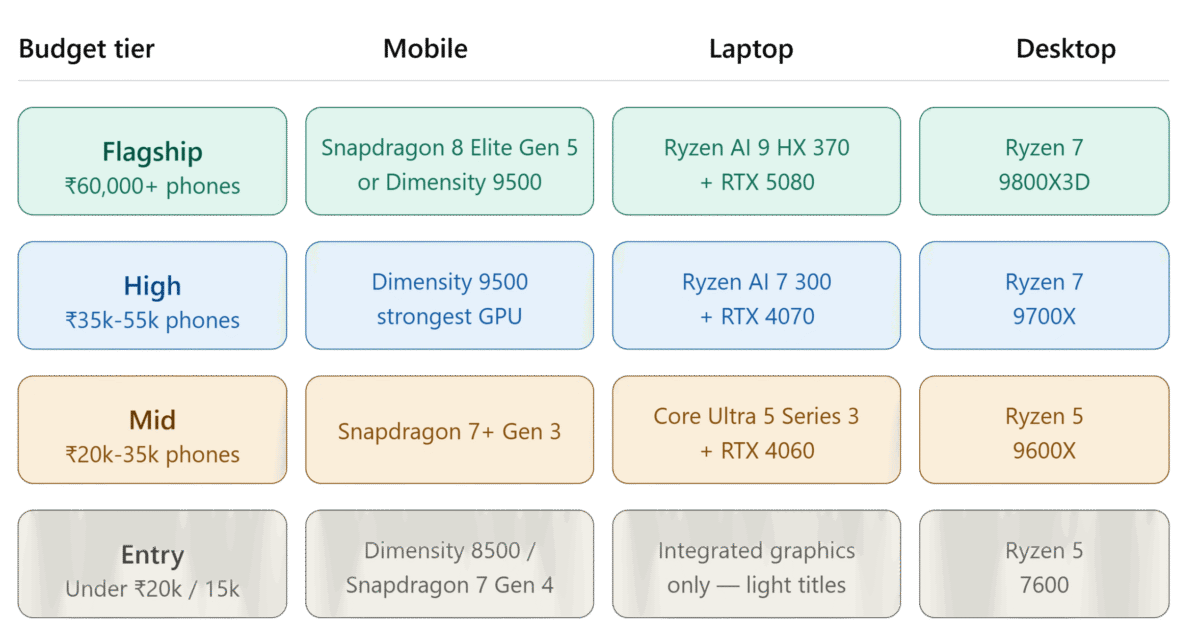
| Budget | Best Pick | Why |
|---|---|---|
| ₹60,000+ | Snapdragon 8 Elite Gen 5 or Dimensity 9500 | Snapdragon wins exclusive game-mode partnerships (BGMI, PUBG Mobile, COD Mobile unlock higher frame-rate modes specifically on Snapdragon); Dimensity 9500 wins raw GPU power and, per independent thermal testing, holds performance better over long sessions |
| ₹35,000–₹55,000 | Dimensity 9500 | Strongest GPU of the three flagships, with genuinely good sustained output — a real strength, not just a peak-benchmark number |
| ₹20,000–₹35,000 | Snapdragon 7+ Gen 3 | Best mid-range gaming chip available |
| Under ₹20,000 | Dimensity 8500 / Snapdragon 7 Gen 4 | Smooth performance in popular titles at high settings |
The honest answer here has flipped from a few months ago: for short bursts and competitive titles where peak frame rate matters, Snapdragon 8 Elite Gen 5’s exclusive game-mode support is a real advantage. But if you play long sessions of graphically demanding games (Genshin Impact, Wuthering Waves, heavy open-world titles), independent stress testing shows the Dimensity 9500 holding onto its performance noticeably better than Snapdragon, which can throttle harder under sustained load despite higher peak numbers. If long gaming sessions are your normal use case, don’t assume Snapdragon automatically wins — check phone-specific sustained-performance reviews. (Sources: 3DMark Solar Bay and thermal-stability data via multicoreperformance.com, July 2026.)
Best for Gaming Laptops
| Segment | Best Pick | Paired With |
|---|---|---|
| Budget Gaming | Intel Core Ultra 5 (Series 3) | RTX 4060 / RX 7600M |
| Mid-Range Gaming | AMD Ryzen AI 7 300 | RTX 4070 / RX 7700M |
| High-End Gaming | AMD Ryzen AI 9 HX 370 | RTX 5080 |
| Ultra-Premium | Intel Core Ultra X9 (Panther Lake HX) | RTX 5090 |
Note on Snapdragon: the X2 Elite is excellent for productivity and battery life, but GPU-heavy games still run better on x86 (Intel/AMD) platforms — not recommended for a gaming-first laptop purchase yet.
Best for Gaming Desktops
| Budget | Best Pick | Notes |
|---|---|---|
| Under ₹15,000 | Ryzen 5 7600 | Great entry-level AM5 gaming chip |
| ₹15,000–₹25,000 | Ryzen 5 9600X | Solid 6-core Zen 5 for 1080p/1440p |
| ₹25,000–₹40,000 | Ryzen 7 9700X | 8-core Zen 5, excellent for high-refresh gaming |
| ₹40,000+ | Ryzen 7 9800X3D | Best gaming CPU available — 24% faster than Core Ultra 9 285K averaged across a 45-game test suite (TechSpot) |
Bottom line for gaming: Snapdragon 8 Elite Gen 5 for phones, AMD Ryzen AI 9 HX 370 or Intel Core Ultra X9 paired with a dedicated GPU for laptops, and the Ryzen 7 9800X3D — no real competition right now — for desktop.
Which Processor Is “Enough” for Everyday Use? (Calls, Social Media, Banking, Browsing)
Not everyone needs a flagship, and honestly most people don’t. If your daily use is calls, WhatsApp, Instagram, banking apps, and YouTube — here’s what’s actually enough:
- Budget phone (under ₹15,000): Snapdragon 6 Gen 2 or Helio G99 handle this without any lag. You will not notice a difference vs. a flagship for these tasks specifically.
- Mid-range phone (₹20,000–₹35,000): Snapdragon 7+ Gen 3 or Dimensity 8500 — total overkill for calls/social/banking, but gives you headroom for light gaming and multitasking too.
- Laptop for browsing, Office, video calls: Any Core Ultra 5, Ryzen AI 5, or Apple M4/M5 — even entry-level chips from the last three years handle this comfortably. Don’t overspend on a flagship chip if this is your only use case; put the budget into RAM and a good screen instead.
Where people over-buy: banking apps and social media are lightweight software — they don’t need flagship silicon. Where people under-buy: if “banking and social media” is doing some quiet lifting for “and also I game sometimes” or “and also I do video calls with heavy filters,” size up one tier.
How to Actually Choose: Quick Recommendations
Flagship Android phone (2026): Snapdragon 8 Elite Gen 5 is the top all-round pick. Dimensity 9500 is a very close second, especially if GPU performance matters more to you than sustained gaming stability.
iPhone buyer: Apple A19 Pro remains the single-core and efficiency benchmark. Anything A17 Pro or newer is still fast in 2026 if you’re buying used or discounted.
Mid-range phone: Snapdragon 7+ Gen 3 and Dimensity 8500 are the standouts — near-flagship performance at a fraction of the price.
Windows laptop (thin & light): Snapdragon X2 Elite is now a genuine recommendation, especially for battery life. Intel’s Panther Lake (Core Ultra Series 3) is the safer pick if you need broad app compatibility.
Windows laptop (performance/creator): AMD Ryzen AI 9 HX 370 or Intel Core Ultra 9 HX for raw horsepower.
Mac: Apple M5 or M5 Pro if buying new. M4 remains excellent and often discounted.
Gaming desktop: Ryzen 7 9700X for best value. Ryzen 7 9800X3D if gaming performance is the only thing that matters to you.
Frequently Asked Questions
Which is the fastest smartphone processor in 2026?
The Snapdragon 8 Elite Gen 5 leads overall Android performance, with the Dimensity 9500 a close competitor, especially in GPU-heavy workloads. On iPhone, the Apple A19 Pro leads single-core performance and efficiency.
Is Tensor good for gaming?
No. Google’s Tensor G4 and G5 prioritize on-device AI and camera processing over raw performance. For gaming, pick the Snapdragon 8 Elite Gen 5 or Dimensity 9500 instead.
Should I buy a Snapdragon laptop in 2026?
Yes, with real confidence for the first time. App compatibility and emulated performance have improved dramatically, and battery life remains a genuine advantage. If you rely on niche or older Windows software, Intel or AMD is still the safer choice.
Which mid-range processor is best for gaming in India?
The Snapdragon 7+ Gen 3 is the strongest mid-range gaming chip available in 2026, with the Dimensity 8500 a close rival in the ₹25,000–₹35,000 range.
What’s the best processor for battery life in a laptop?
Apple M5 leads overall. On Windows, the Snapdragon X2 Elite delivers real-world battery life in the 16–20+ hour range on thin-and-light designs.
Which budget processor is good for daily use — calls, social media, browsing?
Snapdragon 6 Gen 2, Dimensity 6100+, and Helio G99 all handle everyday use smoothly in the ₹10,000–₹18,000 phone segment. For banking, browsing, and social media specifically, even these budget chips are more than enough.
What is an NPU and why does it matter in 2026?
An NPU (Neural Processing Unit) is a dedicated chip for on-device AI tasks — photo enhancement, voice processing, translation, and AI features in apps. Every major processor now ships with a capable NPU, and it’s become as relevant a spec as raw CPU speed for the features people actually use daily.
How does a flagship mobile chip’s AnTuTu score compare to a laptop or desktop CPU?
It doesn’t translate directly — AnTuTu is a mobile-specific benchmark, while laptops and desktops are measured with tools like Cinebench and Geekbench. Directionally, even a flagship phone chip will lose to most modern laptop CPUs in sustained multi-core work, but can hold its own in single-core responsiveness.
Which processor is best for gaming under ₹10,000 (budget phone)?
At this price point, don’t expect flagship-tier gaming — look for the Dimensity 6100+ or Snapdragon 4 Gen 2 for the smoothest experience in casual titles at this budget; heavy 3D games will struggle regardless of chip choice this low in the market.
For more buying guides, check out our Best Laptops Under ₹50,000 in India (2026) guide — ideal for students and professionals.

Ayush Singhal is the founder and chief editor of TechMitra.in — a tech hub dedicated to simplifying gadgets, AI tools, and smart innovations for everyday users. With over 15 years of business experience, a Bachelor of Computer Applications (BCA) degree, and 5 years of hands-on experience running an electronics retail shop, Ayush brings real-world gadget knowledge and a genuine passion for emerging technology.
At TechMitra, he covers everything from AI breakthroughs and gadget reviews to app guides, mobile tips, and digital how-tos. His goal is simple — to make tech easy, useful, and enjoyable for everyone. When he’s not testing the latest devices or exploring AI trends, Ayush spends his time crafting tutorials that help readers make smarter digital choices.
📍 Based in Lucknow, India
💡 Focus Areas: Tech News • AI Tools • Gadgets • Digital How-Tos
📧 Contact: Get in touch →
🔗 Full Bio: https://techmitra.in/about-us/