

By Ayush Singhal / Updated 14’October , 2026
Back in February, Microsoft quietly added something new to Bing Webmaster Tools: a tab that shows how often AI systems are actually using your content. Not clicks. Not rankings. Just — is AI picking your pages as a source, and how often.
I wrote about it when it first launched. Since then, Microsoft has expanded it twice, and I’ve now got about seven months of real data from TechMitra’s own dashboard to go with it. So this is a proper update, not just a patch note.
Here’s everything the tab shows today, what changed, and what I’m actually seeing on my own site.
What Is the AI Performance Report in Bing Webmaster Tools?
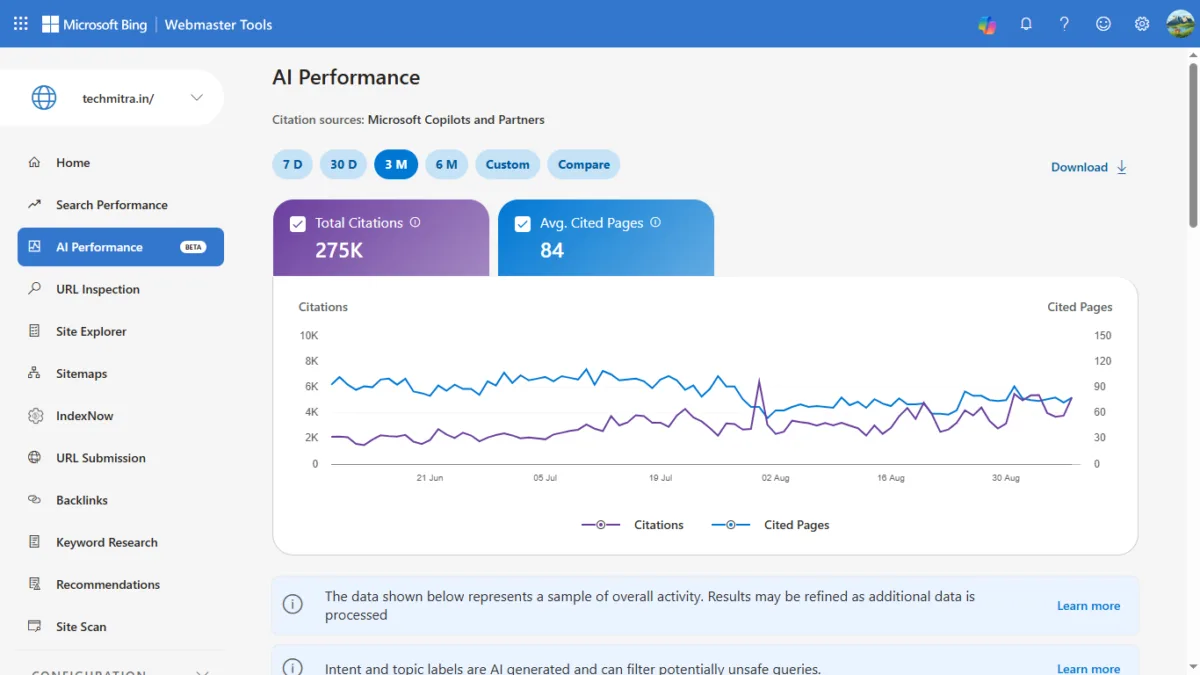
The AI Performance tab (still marked Beta) lives inside Bing Webmaster Tools and shows how your site is being cited inside Microsoft’s AI experiences — Copilot, Bing’s AI-generated summaries, and a handful of partner integrations.
It’s an AI visibility report, not a traffic report. It doesn’t tell you who clicked through. It tells you whether AI is choosing your content as a source in the first place — which, honestly, is a different and arguably earlier question than the one Search Performance answers.
Since February, Microsoft has rolled this out in three stages:
- Feb 10, 2026 — Public preview launches, showing how publisher content appears across Microsoft Copilot, AI-generated summaries in Bing, and select partner integrations — with Total Citations, Avg. Cited Pages, and a grounding queries list
- June 3, 2026 — Google responds with its own GenAI performance reporting in Search Console (UK-only test, impressions only, no citation-level detail) — so Bing isn’t the only game in town anymore, though it’s still ahead on data depth
- June 16, 2026 — Bing expands the tab with four new capabilities in preview, globally: Intents, Topics, Citation Share, and Compare
- October 2026 (approx.): The AI Performance tab is reorganised into two views, Citations & Pages and Topic Portfolio (Beta). The new tab shows a topic-level table with Topic Size, Sites Cited and Queries.
Let’s go through what’s actually in there now.
The Original Three Metrics
These haven’t changed, so if you read my first pass on this, skip ahead — but for anyone new, here’s the quick version.
Total Citations is the number of times AI referenced your site as a source. One page can be cited multiple times, and one query can trigger multiple citations, so this number climbs fast. On TechMitra it currently sits at 275K over a 3-month window.
Avg. Cited Pages is the daily average number of unique pages from your site being cited across AI experiences during the selected window — not a running total, a per-day average. It’s the clearest read you’ll get on how broadly your content participates in AI answers, without implying any authority or ranking. Mine’s at 84.
Grounding Queries shows the key phrases the AI used when retrieving content that was referenced in AI-generated answers. Worth being precise here: these aren’t necessarily the literal words a user typed into Copilot — they’re closer to the search terms the AI system generated on its own to go find supporting sources, which can be different from the original user prompt. Microsoft says this data represents a sample of overall citation activity, and it’s still being refined. It’s still the closest thing to keyword data you’ll get in the AI-search world, just not a one-to-one match with real user searches.
One thing worth repeating from my original piece, because it’s still true: Microsoft has always flagged that this data is a sample, not a full census. The dashboard now states outright that the numbers represent a sample of overall activity and may be refined as more data is processed — so treat trends as directional, not gospel.
The whole report can also be exported as CSV or Excel, which is genuinely useful — it’s how I pulled the page-level numbers you’ll see further down this article instead of eyeballing the dashboard.
What’s New: The June 2026 Update
This is the part that actually changes how useful the tool is. On June 16, Bing rolled out four new dimensions globally in preview, and they all attach to the grounding queries list. Instead of just knowing that you got cited, you now get context on why and how much of the pie you’re getting.
Citation Share
This is the standout addition. Citation Share tells you what percentage of citations for a given grounding query went to your site, out of all citations shown across all sites for that same query.
Think of it as a rough analogy to a ranking position, though Microsoft is careful to say it isn’t one. There’s no “position 1 through 10” in an AI answer — a query might get answered by pulling from five different sites at once — so Citation Share is Microsoft’s attempt to give publishers a directional, competitive number instead. Microsoft explicitly describes it as an observational metric, not a ranking system, a quality score, or a traffic metric, and it doesn’t expose which competitor domains you’re sharing the citation space with.
On my dashboard, this plays out like:
| Grounding Query | Citations | Citation Share |
|---|---|---|
| xbox cloud gaming india | 14.4K | 23.63% |
| apaar id | 10.8K | 24.38% |
| jio post paid plans | 10.2K | 22.84% |
| ckyc number | 5.8K | 14.92% |
| esim | 3.8K | 5.08% |
That range — from roughly 5% up to nearly a quarter of all citations for a query — is my own TechMitra dashboard data, and it tells me something I couldn’t see before: which topics I have strong, concentrated presence in versus which ones are more fragmented across many other cited sources.
Intent Labels
Every grounding query now gets tagged with an intent — Microsoft’s current categories include Informational, Commercial, Navigational, Learn and Solve, Research, Creation, Local, and more. These labels are AI-generated, so they won’t always be perfect, especially for niche or highly specialized topics. On TechMitra almost everything currently pulling in is tagged Informational — people (or AI systems on their behalf) asking “what is X” or “how do I do Y,” rather than comparison-shopping or hunting for a specific brand.
That’s a useful gut-check. If you’re writing commercial content hoping AI cites you during purchase decisions, but your Intent breakdown is mostly Informational, you’re getting picked for education, not for influencing a sale. Different goal, different content strategy.
Topic Groups
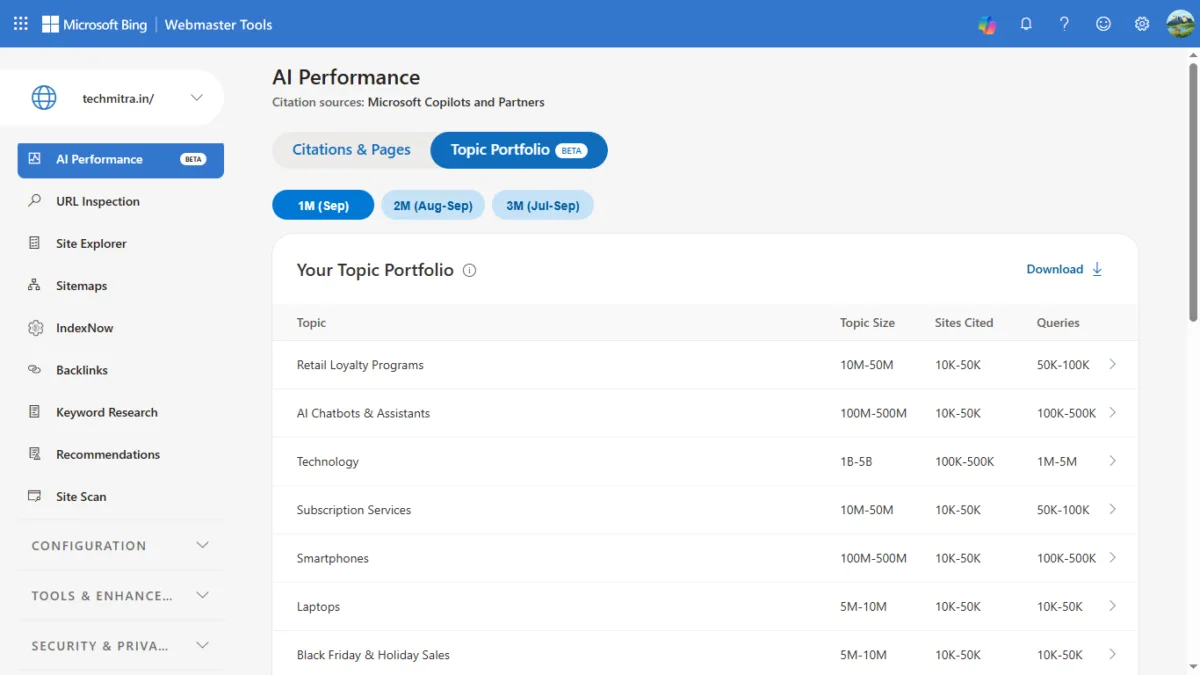
The newest change is structural. AI Performance is now split into two views: Citations & Pages, the dashboard covered above, and Topic Portfolio (Beta).
The topic list. The main table lists the topics Bing connects your content to, with three columns: Topic Size, Sites Cited and Queries. All three are bucketed ranges (like 10M–50M or 10K–50K), so they describe the size of the topic overall, not your own numbers. The tab has its own 1M, 2M and 3M filters, labelled by calendar month, and a Download button.
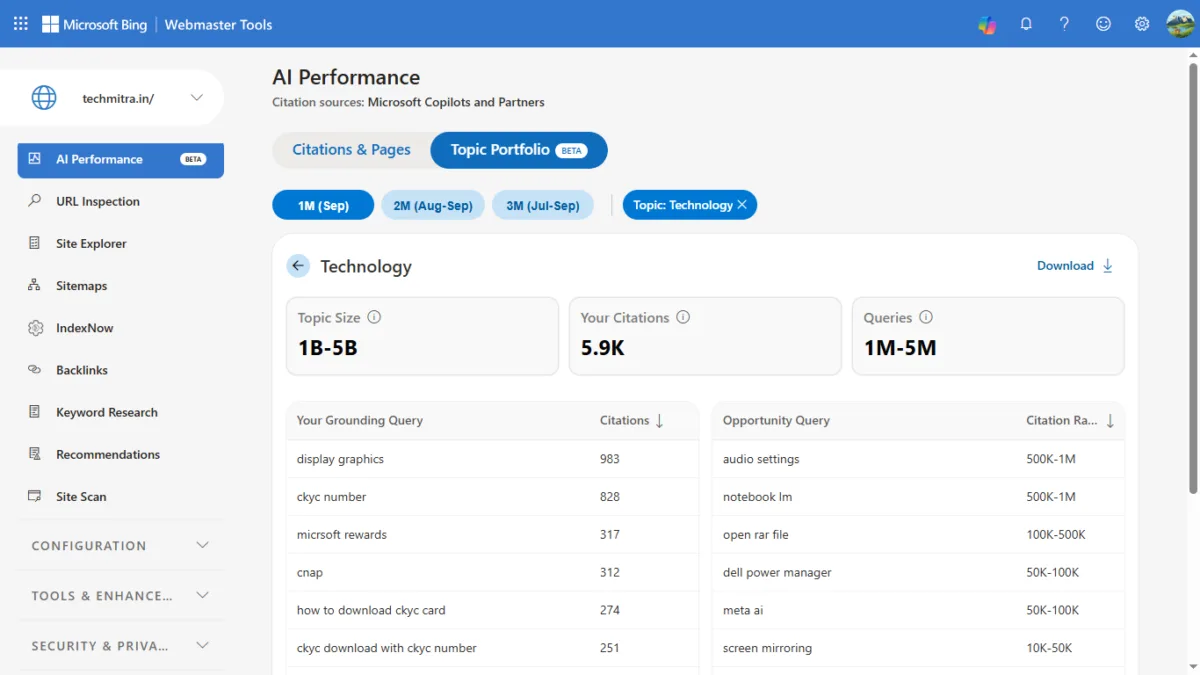
The drill-down. Click any topic and you get a detail page with three cards: Topic Size, Your Citations and Queries. Your Citations is an exact figure. For Technology on my site in September it was 5.9K, against a topic size of 1B–5B.
Below the cards are two side-by-side tables:
- Your Grounding Queries: the queries in that topic where your pages were cited, sorted by citations. Mine were led by “display graphics” (983), “ckyc number” (828), “microsoft rewards” (317) and “cnap” (312).
- Opportunity Queries: queries in the same topic, shown with a citation range rather than an exact count. Mine included “audio settings,” “notebook lm,” “open rar file,” “dell power manager,” “meta ai” and “screen mirroring,” with ranges from 10K–50K up to 500K–1M.
I read Opportunity Queries as queries the AI cites heavily in this topic that aren’t already among my top cited queries. Microsoft hasn’t explained the list on the page, so I treat it as a content-idea list, not a promise that I’d win those citations.
What I noticed. Nearly all the opportunity queries are practical, task-style topics: open a RAR file, change audio settings, mirror a screen. That matches what my own data already showed, that how-to explainers get cited far more than news. The topic labels are also loose. “ckyc number” sits under Technology, which shows the classification is AI-generated and won’t always match how you’d group things yourself.
How I’d use it: take the Opportunity Queries list for your strongest topic, pick the ones you can answer from real experience, and write practical pages for them. Then check next month whether they show up in your grounding queries.
Compare
The fourth addition is a Compare view, sitting alongside the existing date filters (7D, 30D, 3M, 6M, Custom). It lets you overlay a previous time period directly onto the current view — say, this 30 days against the prior 30 — to see how citation activity is shifting.
One important caveat straight from Microsoft: a change you spot in Compare doesn’t tell you why it happened. Citation activity can move because of evolving AI models, competing content, freshness signals, or shifts in demand — so if you see a jump right after updating an article, that’s a correlation worth noting, not proof the update caused it.
Worth noting: Microsoft’s UI also now discloses that intent and topic labels are AI-generated, and that this classification can filter out potentially unsafe queries. So a handful of grounding queries may show up with no Intent or Topic at all — I’ve got at least one like that in my own data (more on this below).
What My Own Data Actually Shows
I pulled the full page-level export for TechMitra rather than eyeballing the dashboard, and the pattern that shows up is sharper than I expected.
On my own site, out of 234 pages that have picked up at least one citation, the top 20 pages account for roughly 84% of all citations — this is specific to TechMitra’s export, not a general characteristic of AI search. Still, that’s a steep concentration on my own data. A small set of pages is doing almost all the work.
Here’s what’s actually sitting at the top, straight from my TechMitra AI Performance export:
- Microsoft Rewards Points Value in India: How to Earn & Redeem (~39.0K citations)
- How to Download CKYC Number Online – Understanding India’s Central KYC System (~36.3K)
- Jio Postpaid Plans 2026: Full List, Pricing & Why I Chose the ₹449 Family Plan & its review (~25.1K)
- Xbox Cloud Gaming in India (2026): Pricing, Setup & Is It Worth It? (~19.5K)
- What is APAAR ID? Meaning, Benefits & Complete 2026 Guide (~16.6K)
None of these are breaking-news pieces. They’re all practical, task-oriented explainers — the kind of thing someone asks an AI assistant when they’re trying to do something specific: activate a service, find a number, understand a government ID system. That lines up with the Intent data too — almost everything getting cited on my site is tagged Informational, and it’s the how-to and explainer format that’s winning, not news coverage.
On my site, the data strongly favors practical, evergreen, task-solving content over news. That’s an observation from TechMitra’s own numbers, not a proven rule about how every AI system treats every publisher — but it’s consistent enough across my top pages that it’s shaping how I plan content going forward.
For contrast — my original article on this exact topic, the one this update is rewriting, sits near the bottom of my own citation list at 18 citations. It’s a fair reminder that even directly relevant, well-optimized content on a niche subject takes time to accumulate AI visibility, especially against evergreen consumer topics with much broader search demand.
What It Still Doesn’t Show
Even with four new dimensions, some real gaps remain:
- No clicks. You can see you were cited, not whether anyone clicked through to your site from that citation.
- No CTR or sessions. Same issue — no link back to actual traffic or business outcomes.
- No rankings, in the traditional sense — there isn’t really a position to rank in AI answers the way there is in blue links.
- No surface-level filtering. You can’t isolate citations to just Copilot, or just Bing’s AI summaries, or a specific partner integration — it’s all lumped together, and Microsoft doesn’t disclose who the partners even are.
Microsoft has said it plans to keep evolving these capabilities and improve inclusion, attribution, and visibility across both search results and AI experiences — but hasn’t committed to a timeline for click data specifically. Until that lands, what you’re working with is a visibility signal: proof that AI experiences are actively using your content, not evidence of how that translates into traffic, authority, or business value. Microsoft itself is explicit that a metric like Avg. Cited Pages doesn’t indicate ranking, authority, or a page’s role within any individual answer — the same caution applies across this whole report.
So What’s the Actual Benefit of These Citations?
Fair question, and worth answering honestly instead of hyping it up: right now, a citation doesn’t put a single rupee in your pocket directly. It’s not a click, it’s not an ad impression, it’s not confirmed traffic. Someone could get their entire answer inside Copilot and never visit your site at all.
So here’s what citations actually do for you today, and what they don’t.
What you genuinely get:
- A content-strategy compass. This is the most concrete benefit right now. My own data shows a striking difference: practical how-to and explainer pages account for a disproportionate share of my site’s citations compared with my news content. That’s a real, usable signal for what to write next, separate from whether citations themselves pay anything.
- A visibility signal worth tracking. Getting cited repeatedly, and holding a strong Citation Share on a topic, means Microsoft’s systems are actively using your content as source material. That’s genuinely useful to know — but per Microsoft’s own framing, it’s an observational signal, not proof of authority, quality, or ranking in any formal sense.
- Visibility you wouldn’t otherwise know about. Even without clicks attached, you now know AI is actively using dozens of your pages as source material. A year ago there was no way to see that at all.
What you don’t get, at least not yet:
- No direct ad revenue tied to being cited.
- No guaranteed traffic — a citation and a visit are two different things.
- No SEO ranking boost you can point to — it’s a separate signal from traditional Bing/Google rankings.
The honest way to think about it: treat citations as an indicator to watch and let inform your content calendar, not a KPI to chase for its own sake. That calculation changes the day Microsoft adds click data — at that point this tab stops being a curiosity and starts being a real funnel metric.
Why This Matters for SEO in 2026
Classic SEO was rankings plus clicks. AI SEO is about being selected as a source — and now, with Citation Share, about how big a slice of that selection you’re actually getting relative to other cited sources.
The Intent and Topic data adds a second layer: it’s not enough to just get cited, you want to understand what kind of question is pulling you in, and whether that lines up with what you’re actually trying to achieve with the content.
Microsoft’s own guidance on improving AI visibility lines up with what most of this article has already pointed at: strengthen depth and expertise, improve structure and clarity (clear headings, tables, and FAQ sections specifically help AI systems reference your content accurately), support claims with evidence, keep content fresh and accurate, and stay consistent across text, images, and video. None of that is exotic — it’s the same fundamentals good SEO has rewarded for years, just now with a first-party report showing whether it’s working.
None of this replaces traditional Search Performance. But it’s the first real first-party window into a part of search that used to be a complete black box.
Final Thoughts
I’ve been tracking this report for roughly seven months now, alongside the 6-month preset the dashboard itself offers. In that time the AI Performance tab has gone from a curiosity with two basic numbers to something you can actually build a content strategy around. Citation Share in particular changes the conversation — it’s no longer just “am I visible,” it’s “how much of the visible pie is actually mine for this query.”
If there’s one thing my own numbers reinforce, it’s that on my site, AI systems seem to favor practical, evergreen, task-solving content far more than news. That’s my own data talking, not a universal law — but if you’re deciding where to put your writing time, it’s a genuinely useful signal to weigh, even without click data attached to it yet.
FAQ
What is the AI Performance tab in Bing Webmaster Tools?
A dashboard inside Bing Webmaster Tools showing how often your site is cited by Microsoft Copilot, Bing’s AI summaries, and partner AI experiences — including citation volume, page breadth, and (as of June 2026) intent, topic, and competitive share data.
What is a citation?
Every time an AI system uses your page as a source while generating an answer, that’s a citation. Think of it as an “AI impression” — it doesn’t mean a click or a visit, just that your content was selected as a reference.
What is Citation Share?
The percentage of citations for a specific grounding query that went to your site, out of all citations shown across all sites for that query. Microsoft describes it as an observational metric — a rough analogy to a ranking position, but explicitly not a ranking system, quality score, or traffic metric, and it doesn’t reveal competitor domains.
What do Intent and Topic labels mean?
Every grounding query is now automatically classified by intent (Microsoft’s categories include Informational, Commercial, Navigational, Learn and Solve, Research, Creation, Local, and more) and grouped into a topic cluster. It’s AI-generated classification, so it won’t always be perfect, and Microsoft notes it can filter out potentially unsafe queries — so a few queries may show up unlabeled.
Does AI Performance show clicks or traffic?
No. It covers citations, cited pages, grounding queries, intent, topic, and citation share — not clicks, CTR, or sessions. For traffic, you still need the regular Search Performance report.
Why does content type seem to matter so much?
On my own TechMitra data, practical how-to and explainer content — the kind that answers “what is X” or “how do I do Y” — accounts for a disproportionate share of citations compared to time-sensitive news content. It’s a pattern from my own numbers rather than a proven rule for every publisher, but if you’re deciding where to invest writing time for AI visibility, durable, task-solving pages look like the safer long-term bet based on what I’m seeing.
What does “cited” mean in this context?
Being “cited” means an AI system pulled information from your page and used it as source material while putting together an answer — whether or not it named you out loud or showed a link. It’s different from ranking (there’s no position 1 through 10) and different from being indexed (your page can be indexed by Bing without ever being cited). Think of it less like appearing in a results list, and more like being one of the sources an AI system actually drew on to write its response.
What is the Topic Portfolio tab in Bing AI Performance?
A Beta view next to Citations & Pages that lists the topics your site is associated with. Click a topic to see your citation count, the queries you were cited for, and Opportunity Queries, which are related queries you could target

Ayush Singhal is the founder and chief editor of TechMitra.in — a tech hub dedicated to simplifying gadgets, AI tools, and smart innovations for everyday users. With over 15 years of business experience, a Bachelor of Computer Applications (BCA) degree, and 5 years of hands-on experience running an electronics retail shop, Ayush brings real-world gadget knowledge and a genuine passion for emerging technology.
At TechMitra, he covers everything from AI breakthroughs and gadget reviews to app guides, mobile tips, and digital how-tos. His goal is simple — to make tech easy, useful, and enjoyable for everyone. When he’s not testing the latest devices or exploring AI trends, Ayush spends his time crafting tutorials that help readers make smarter digital choices.
📍 Based in Lucknow, India
💡 Focus Areas: Tech News • AI Tools • Gadgets • Digital How-Tos
📧 Contact: Get in touch →
🔗 Full Bio: https://techmitra.in/about-us/