
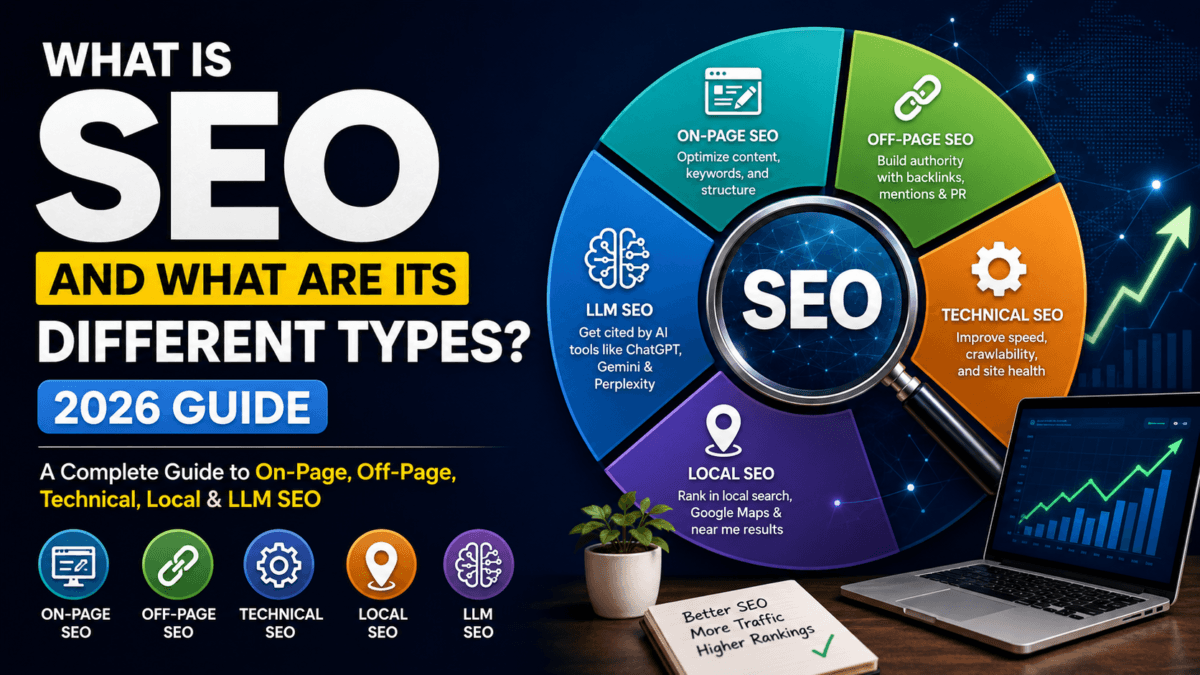
If you’ve ever asked someone how to get your website found on Google, you’ve probably heard the word SEO thrown around like it’s one single thing you either “do” or “don’t do.” It isn’t. SEO is really an umbrella term for several distinct disciplines, each handling a different part of how search engines — and now AI tools — find, understand, and trust your website.
This guide breaks down what SEO actually is and the five types you need to know in 2026: On-Page SEO, Off-Page SEO, Technical SEO, Local SEO, and the newest addition, LLM SEO.
Table of Contents
Also Read : What is Brevo, Its Pricing, and How to Authenticate Your Website (Connecting DNS)
SEO Meaning
SEO stands for Search Engine Optimization. In simple terms, it means improving a website so it appears higher in search engine results and AI-powered search experiences when people search for relevant topics.
Today, SEO goes beyond traditional search engines like Google and Bing. It also includes optimizing content so AI assistants such as ChatGPT, Google Gemini, Perplexity, and Microsoft Copilot can understand and cite your content when answering user questions.
In short: SEO means optimizing your website to improve its visibility, attract more organic traffic, and build long-term online authority.
What is SEO?
Search Engine Optimization (SEO) is the practice of improving a website so it appears more often, and higher up, when people search for things related to what that website offers. The goal is organic (unpaid) visibility — traffic you earn through relevance and trust rather than traffic you pay for through ads.
SEO isn’t a single technique. It’s a combination of disciplines that all point at the same outcome from different angles: some work happens inside your website, some happens outside it, some is purely technical, some is about physical location, and — as of the last couple of years — some of it is now about how AI tools read and cite you.
The 5 Types of SEO
1. On-Page SEO
On-Page SEO covers everything you optimize inside your own website — the parts fully under your control.
Common techniques:
- Keyword optimization in titles, headings, and content
- Meta title and meta description optimization
- Clean URL structure and internal linking
- Image optimization (ALT text and file names)
- Mobile-friendly, responsive design
- Page speed improvements
- Clear, well-structured, genuinely useful content
This is the foundation everything else builds on. If your content doesn’t answer the question clearly, nothing else compensates for that.
Successful on-page SEO starts with understanding why someone is searching. Some users want information, others want to compare products, and some are ready to buy. Matching your content to that search intent — not just the keyword itself — improves both rankings and how satisfied readers are once they land on the page.
For a deeper side-by-side comparison of on-page and off-page SEO, see our full On-Page vs Off-Page SEO guide.
For a complete walkthrough of setting up on page SEO with Rank Math’s free version — including schema, Instant Indexing, and AI/LLM optimization — check out our step-by-step Rank Math SEO guide.
2. Off-Page SEO
Off-Page SEO covers everything that happens outside your website to build its authority, trust, and reputation. Search engines use these as independent signals of how credible your site really is.
Common techniques:
- High-quality backlink building
- Social media sharing and visibility
- Brand mentions and citations, even without a link
- Guest posting on genuinely relevant sites
- Digital PR and community engagement
On-page SEO is about what you say about yourself. Off-page SEO is about what others say about you — and search engines weigh both.
3. Technical SEO
Technical SEO makes sure search engines (and AI crawlers) can actually access, crawl, and understand your site in the first place. It sits underneath both on-page and off-page work — none of that matters if your site is technically broken.
Common areas:
- Site speed and Core Web Vitals
- Mobile-friendliness
- HTTPS/SSL
- XML sitemaps and a clean robots.txt
- Structured data (schema markup)
- Fixing crawl errors, broken links, and duplicate content
- Canonical URLs, to avoid duplicate-content confusion when the same content is reachable at multiple URLs
- Crawl budget optimization, so search engines spend their limited crawl time on your important pages rather than low-value ones
- Hreflang tags, for sites serving multiple languages or regions
For the full checklist — including real indexing speed data, Cloudflare configuration, and crawl budget — see our Technical SEO Checklist guide.
Why E-E-A-T Matters
Google doesn’t rank pages simply because they contain the right keywords. It evaluates content using E-E-A-T — Experience, Expertise, Authoritativeness, and Trustworthiness. Content backed by real first-hand experience, genuine subject knowledge, credible sourcing, and clear author information tends to perform better in both traditional search results and AI-generated answers. This isn’t a separate type of SEO on its own — it’s a quality standard that runs through on-page, off-page, and LLM SEO alike. Google’s own guidance on creating helpful, people-first content is worth reading directly rather than relying on secondhand summaries.
4. Local SEO
Local SEO is about showing up when nearby customers search for what you offer — in Google Maps, the Local Pack, and “near me” searches. This matters most if you run a shop, clinic, restaurant, or any business that serves people in a specific area.
Local SEO essentials:
- Claim and verify your Google Business Profile — your single most important local ranking asset
- Keep your NAP (Name, Address, Phone number) identical across your website, Google Business Profile, and every directory
- Choose accurate business categories rather than the broadest one available
- Add real photos of your location, team, and work
- Collect and respond to customer reviews
- List on relevant Indian directories — JustDial, Sulekha, IndiaMART, or industry-specific ones like Practo for healthcare
- Keep your Google Business Profile active with regular posts and updates
Local SEO runs on a different timeline than the rest — a well-optimized Google Business Profile can show results in weeks, while content and backlink authority typically take months.
5. LLM SEO (the newest widely discussed branch of SEO)
LLM SEO — also called AI SEO, AEO (Answer Engine Optimization), or GEO (Generative Engine Optimization) — is the practice of optimizing your content so AI tools like ChatGPT, Google Gemini, Perplexity, Claude, and Microsoft Copilot can find, understand, and cite your website when generating an answer. Some SEO professionals treat it as its own discipline; others consider it part of Technical or Content SEO applied to a new audience. Either framing is reasonable — what matters is understanding what it involves.
Traditional SEO competes for a spot in a list of links. LLM SEO competes to be one of the sources an AI model actually pulls from and mentions — whether or not anyone clicks through afterward.
How it works: For many current or factual queries, AI assistants retrieve fresh information from the web before generating an answer, rather than relying only on what they learned during training. Which pages get pulled depends on the underlying index:
| AI Platform | Primary Crawling Source |
|---|---|
| ChatGPT | Bing index + GPTBot |
| Google AI Overviews | Google Search |
| Gemini | Google Search |
| Claude | ClaudeBot |
| Perplexity | PerplexityBot + web search |
| Microsoft Copilot | Bing |
What actually helps:
- Clear, direct answers placed early on the page
- Structured content — proper headings, bullet points, tables, FAQ sections
- Freshness — dated, regularly updated content
- Depth and originality — first-hand data and real numbers over reworded summaries
- Schema markup, so AI crawlers get a machine-readable confirmation of what the page is about
- Technical accessibility for the AI crawlers listed above
For the complete breakdown — including what schema markup actually does and doesn’t do for AI citations — see our dedicated LLM SEO guide.
LLM SEO isn’t a replacement for the other four types — it mostly draws from strong on-page and technical fundamentals, applied with AI retrieval in mind.
What is an llms.txt file?
llms.txt is a plain Markdown file placed at your website’s root (yoursite.com/llms.txt) that gives AI systems a short, curated summary of what your site is and which pages matter most — a clean briefing instead of the noise of a full webpage (navigation, ads, cookie banners).
Proposed by Jeremy Howard of Answer.AI in 2024, it isn’t an official W3C or IETF standard — it’s a voluntary convention. You can read the full specification at llmstxt.org. But adoption has grown quickly through 2026, with companies like Anthropic, Stripe, and Cloudflare publishing one.
A good llms.txt file has:
- A short brand summary (2–4 sentences) explaining what your site does and who it’s for
- A curated shortlist of your 10–20 best pages — not a dump of everything you’ve ever published
- Links grouped by topic, each with a one-line description
Unlike robots.txt, an llms.txt file does not control crawler access — it simply provides a curated guide for AI systems that choose to use it. It costs nothing to add and won’t fix weak content on its own, but it’s a low-effort way to help AI tools understand your site faster.
Rather than relying on a plugin’s auto-generated version, try our free llms.txt Generator to build a properly curated file in minutes.
How the Five Types Work Together
| Type | Where it happens | Main focus |
|---|---|---|
| On-Page | Inside your website | Content and structure |
| Off-Page | Outside your website | Authority and trust |
| Technical | Site infrastructure | Crawlability and access |
| Local | Google Business Profile + directories | Geographic visibility |
| LLM SEO | Content structure + technical access | AI citation |
None of these work in isolation. A technically broken site won’t rank no matter how good the content is. Great content with zero backlinks struggles against competitors with weaker content and stronger authority. And even strong on-page and off-page SEO doesn’t guarantee AI citations if the content isn’t structured for how AI models extract information.
Need a custom robots.txt file? Try our Free WordPress Robots.txt Generator to create an SEO-friendly robots.txt with built-in validation and instant download.
Which Should You Focus On First?
- Technical SEO — make sure your site is crawlable, fast, and secure before anything else matters.
- On-Page SEO — get your content clear, relevant, and well-structured.
- Local SEO, if you serve local customers — set up your Google Business Profile early; it compounds over time.
- LLM SEO structure — build this in alongside your on-page work rather than treating it as a separate project.
- Off-Page SEO — once your foundation is solid, backlinks and mentions have something worth linking to.
How Long Does SEO Take?
| SEO Activity | Typical Timeline |
|---|---|
| Technical fixes | Days to weeks |
| On-page SEO | 2–8 weeks |
| Local SEO | 1–3 months |
| Link building | 3–6 months |
| Competitive keywords | 6–12+ months |
Common SEO Mistakes
- Publishing thin content that doesn’t fully answer the question
- Ignoring search intent — optimizing for a keyword without matching what the searcher actually wants
- Buying spam backlinks
- Duplicate pages with no canonical URL set
- A slow website
- Weak or missing internal linking
- Forgetting schema markup
- Accidentally blocking important pages in robots.txt
Also Read : Google Tag and Tag Manager Just Got a Major Update — Here’s What I Found on My Own Account
Final Thoughts
SEO used to mean two things: what you controlled on your page, and what you earned off it. In 2026, that’s still true, but “getting found” now spans five different disciplines — and increasingly means being the source an AI tool trusts enough to cite, not just a link in a results page.
None of this is a one-time task. It requires ongoing updates, monitoring, and adjustment as search — and AI search — keeps evolving.
FAQs
Q1: What are the main types of SEO?
The five most commonly discussed types are On-Page SEO, Off-Page SEO, Technical SEO, Local SEO, and LLM SEO (AI search optimization) — though some professionals group LLM SEO under Technical or Content SEO rather than treating it as fully separate.
Q2: Which type of SEO is most important?
None works well alone. Technical SEO is usually the foundation, since a site that can’t be crawled or loads slowly undermines everything else.
Q3: Is Local SEO relevant if I only sell online?
Less so. Local SEO matters most for businesses with a physical location or a defined service area — shops, clinics, restaurants, local services.
Q4: Do I need a separate strategy for LLM SEO?
Not really a separate one — it builds on strong on-page and technical fundamentals (clear structure, direct answers, schema, freshness). Most of the work overlaps with good on-page SEO.
Q5: Is an llms.txt file required?
No — it’s a voluntary convention, not an enforced standard. It’s low-effort to set up and may help AI tools understand your site faster, but it won’t fix weak content on its own.
Q6: How long does SEO take to show results?
It depends on the activity — see the timeline table above. Technical fixes can show impact within days, while competitive keyword rankings typically take 6-12 months or longer.

Ayush Singhal is the founder and chief editor of TechMitra.in — a tech hub dedicated to simplifying gadgets, AI tools, and smart innovations for everyday users. With over 15 years of business experience, a Bachelor of Computer Applications (BCA) degree, and 5 years of hands-on experience running an electronics retail shop, Ayush brings real-world gadget knowledge and a genuine passion for emerging technology.
At TechMitra, he covers everything from AI breakthroughs and gadget reviews to app guides, mobile tips, and digital how-tos. His goal is simple — to make tech easy, useful, and enjoyable for everyone. When he’s not testing the latest devices or exploring AI trends, Ayush spends his time crafting tutorials that help readers make smarter digital choices.
📍 Based in Lucknow, India
💡 Focus Areas: Tech News • AI Tools • Gadgets • Digital How-Tos
📧 Contact: Get in touch →
🔗 Full Bio: https://techmitra.in/about-us/