

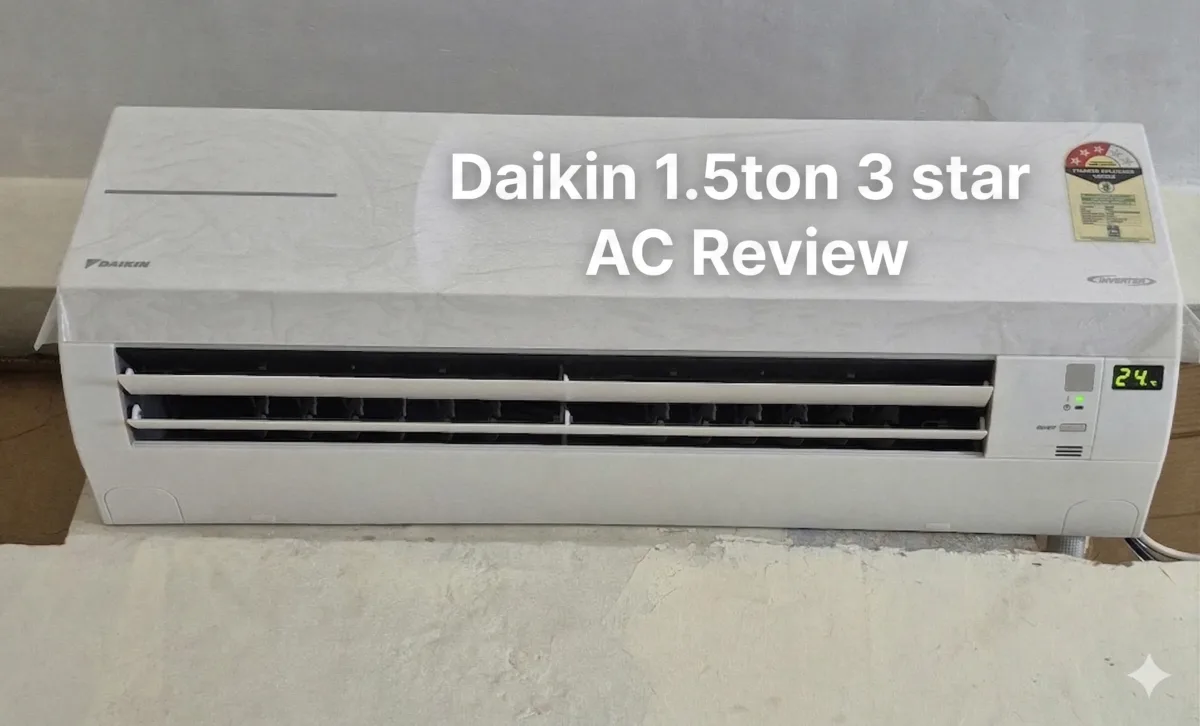
Is the Daikin 1.5 Ton 3 Star Split AC (FTKL50XV16) worth buying in 2026? My honest 10-day 1.5 ton Split AC review & experience.
Updated on 28-07-2026
Is the Daikin FTKL50XV16 worth buying in 2026? My honest review after real usage — including how it held up in peak summer heat, not just the first cool week after installation.
If you’re shopping in the ₹33,000–₹37,000 range, this review should give you a clear, no-nonsense answer. I bought the Daikin 1.5 Ton 3 Star Inverter Split AC (FTKL50XV16) this year, and everything here comes from actually owning and running it — not from a spec sheet.
I’ve used Carrier and Panasonic ACs for years before this one, so the comparisons in this Daikin ac 1.5 ton review come from real long-term experience, not guesswork.
Also Read: Inverter AC vs Non-Inverter AC — 8 Real Differences (2026 Guide) · Air Conditioner Buying Guide: How to Choose the Right AC for Your Home (2026)
Table of Contents
Why I Chose Daikin Over LG, Voltas & Carrier
My budget was around ₹35,000, and I had three non-negotiables: strong cooling, a brand I could trust long-term, and no bloated feature list I’d never use.
What tipped it toward Daikin:
- Most competitors in this price band top out around 4,800W cooling capacity. This model rates 5,000W, and that extra headroom actually matters once Lucknow summers hit 43°C+.
- I spent 2014–2019 as an electronics dealer, and in that time Daikin consistently stood out — better build quality, stronger long-term reliability, and fewer complaints coming back to the shop than most competing brands.
That background trust made choosing Daikin again an easy, low-risk call.
Why I skipped the others:
- LG / Voltas — heavy focus on WiFi and AI features I wasn’t going to use daily. Paying a premium for smart-home gimmicks didn’t make sense for a room AC.
- Carrier — my old Carrier ran reliably for 11 years, genuinely impressive. But current models in this price range offer only ~4,800W, less than this Daikin.
- Panasonic — used one for 5–6 years previously, no complaints, just didn’t make the shortlist this time.
Why not 5-star instead of 3-star? The price gap is roughly ₹10,000, and the efficiency gain is modest enough that it would take 3–4 years to recover that difference through electricity savings. For my usage pattern, 3-star made more financial sense — though if you’re running your AC 10+ hours a day, that math shifts in the 5-star’s favor. (More on this below.)
👉 Curious what your own usage would cost? Try my Electricity Consumption Calculator.
The Specs Nobody Selling You This AC Actually Explains
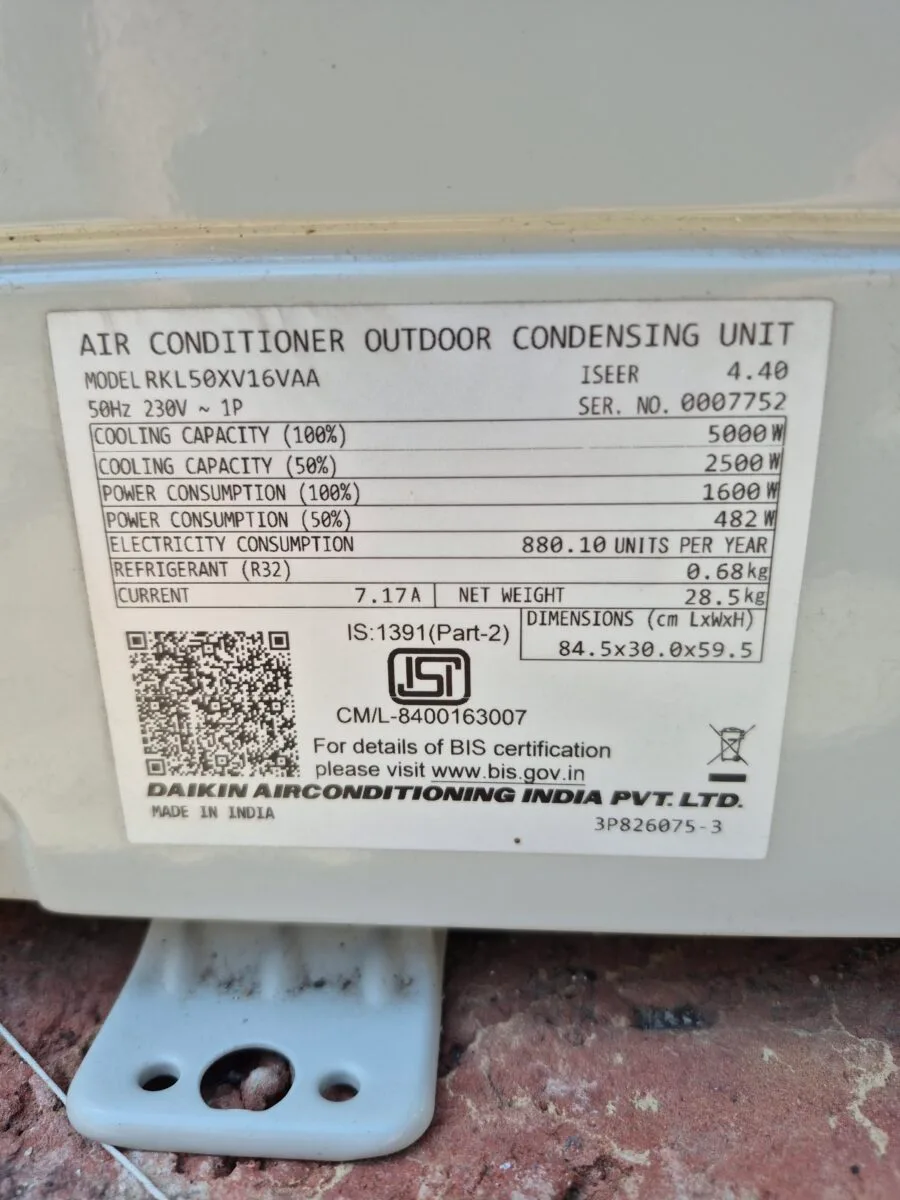
Most listings throw numbers at you without context. Here’s what they mean in practice, straight from Daikin’s own spec sheet for this exact model:
| Spec | FTKL50XV16 | What it means for you |
|---|---|---|
| Cooling capacity | 5.0 kW (5,000W), rated down to 1.4 kW | Cools fast, and scales down efficiently once the room’s already cool |
| ISEER rating | 4.4 | Solid mid-range efficiency — comfortably 3-star, closer to the upper end of that band |
| Annual power consumption (BEE rated) | 880.1 kWh | This is the standardized number to compare against other ACs — not just the wattage on the box |
| Compressor | Swing-type inverter compressor | Daikin’s proprietary design, used across their 3-star and 5-star lines alike |
| Refrigerant | R32 | The eco-friendlier refrigerant standard now used across most current-gen ACs |
| Voltage range | 130V–285V, stabilizer-free | Built to handle India’s voltage swings without a separate stabilizer, in most areas |
| Noise (indoor, across fan speeds) | 32–48 dB | Genuinely quiet at low/medium fan speed; noticeably louder at full blast |
| Air throw | Up to 16 metres | This is what makes the room-filling airflow I describe below possible |
| 100% cooling capacity up to | 43°C ambient | Matters more than it sounds — see the heatwave section below |
Buying Experience (Offline)
I bought this from a local Daikin Solution Plaza rather than online — wanted to see the unit and talk to someone directly before spending ₹35,000.
What’s included in the box:
- Indoor and outdoor unit
- Remote
- 10 ft copper pipe
- Interconnecting cable
What’s not included, and cost extra:
- Indoor power cable
- Installation (paid separately, standard practice but worth budgeting for)
Installation was handled by authorized technicians and went smoothly. One thing worth calling out specifically:
Proper vacuuming of the pipes before gas release. This is a step some installers skip or rush, and it directly affects both cooling performance and how long the compressor lasts. If you’re getting a split AC installed anywhere, this is worth watching them do, not just taking on faith.
Cooling Performance: Early Days vs. Peak Summer
I’m splitting this into two parts deliberately, because early testing and peak-heat testing told me genuinely different things.
First 10 Days (Room: 140 sq. ft.)
Cooling was strong and stable from day one. No surprises, no underperformance — it did what a 5,000W unit in a 140 sq. ft. room should do.
Real Test: 43°C Heatwave
Early usage happened to coincide with a spell of cooler, rainy weather in Lucknow, so I didn’t get a genuine stress test until temperatures climbed to around 43°C in peak afternoon heat. Here’s what that actually looked like:
- Running mostly at 26–27°C set temperature, cooling stayed impressive and consistent even at the peak of the heat.
- In peak afternoon sun, the AC takes roughly 30–40 minutes to bring the room to a comfortable level — not instant, but reasonable given the outside conditions.
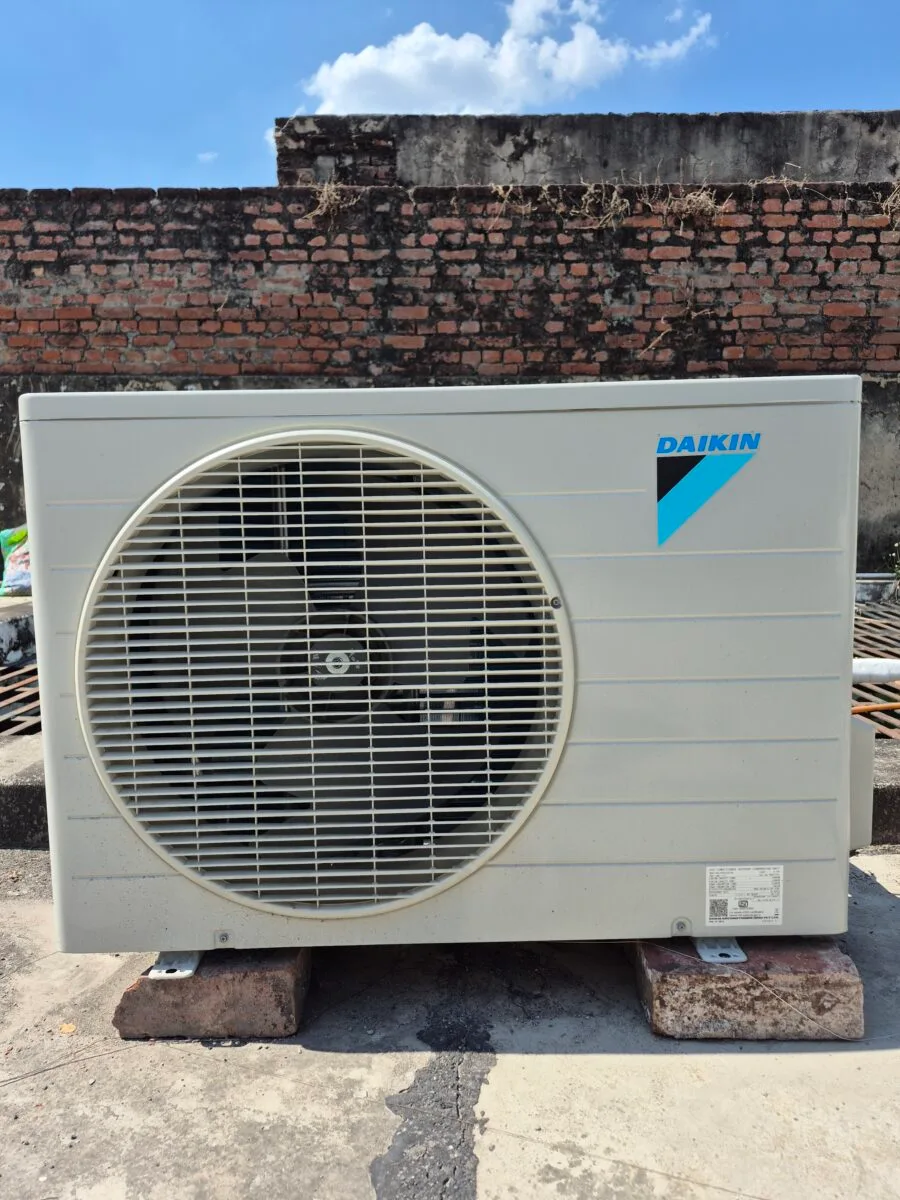
- My outdoor unit is installed on an open roof, in direct sunlight — about as harsh a placement as it gets — and the AC still held up.
- Once the room reaches target temperature, cooling stays consistent rather than yo-yoing.
On power consumption during the heatwave: the compressor runs at full load continuously for the first 1–1.5 hours in extreme heat, and consumption is noticeably higher during that window. Once the set temperature is reached, compressor load drops and power consumption stabilizes. This is completely normal behavior for any inverter AC above 40°C ambient — it’s not a flaw, it’s the compressor doing exactly what it’s designed to do (working harder to establish the setpoint, then coasting).
Given that Daikin rates this unit for 100% cooling capacity up to 43°C ambient specifically, this real-world test lines up with what the spec sheet promises — which is reassuring, because plenty of ACs quietly underperform once you’re past the “ideal lab conditions” the marketing numbers are based on.
Air Throw — The Best Part of This AC
This is genuinely where the FTKL50XV16 stands out. Airflow is strong, and cooling reaches every corner of the room quickly — it feels closer to a window AC’s direct-blast cooling than the more diffused airflow I was used to from split ACs.
Compared to my old Carrier: noticeably weaker airflow on the Carrier. The Daikin’s 16-metre rated air throw isn’t just a spec-sheet number — it’s the difference you actually feel within the first few minutes of switching it on.
Power Consumption & Features
- Max consumption: ~1600W
- Cooling capacity: 5000W
👉 Balanced performance for a 3-star inverter AC.
Useful Features (No Gimmicks)
Features That Are Actually Useful (No Gimmicks)
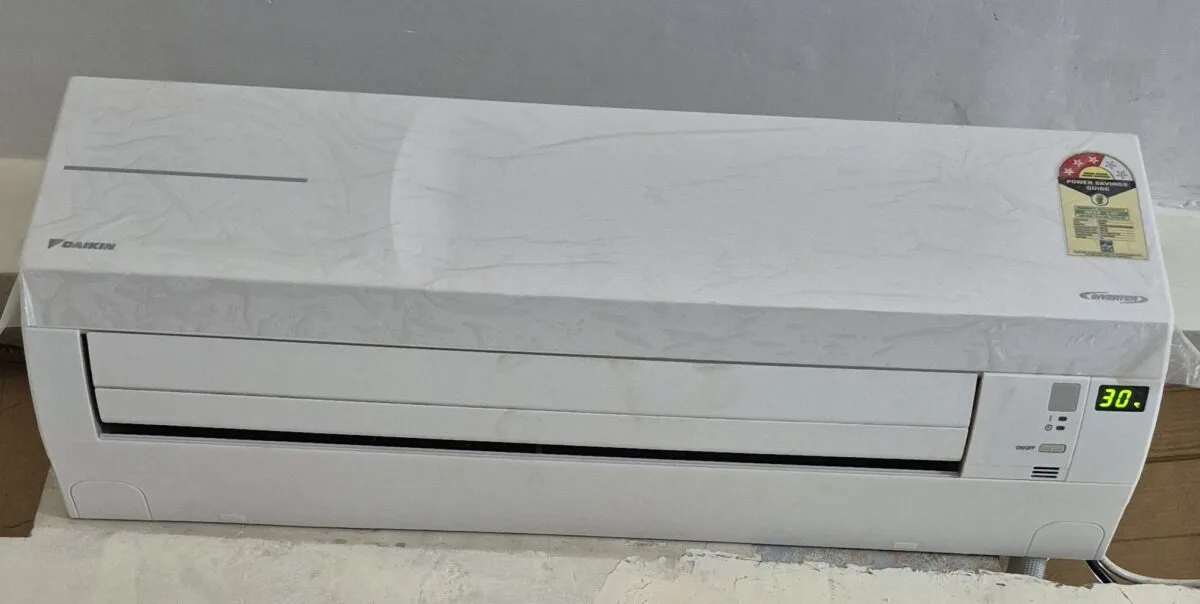
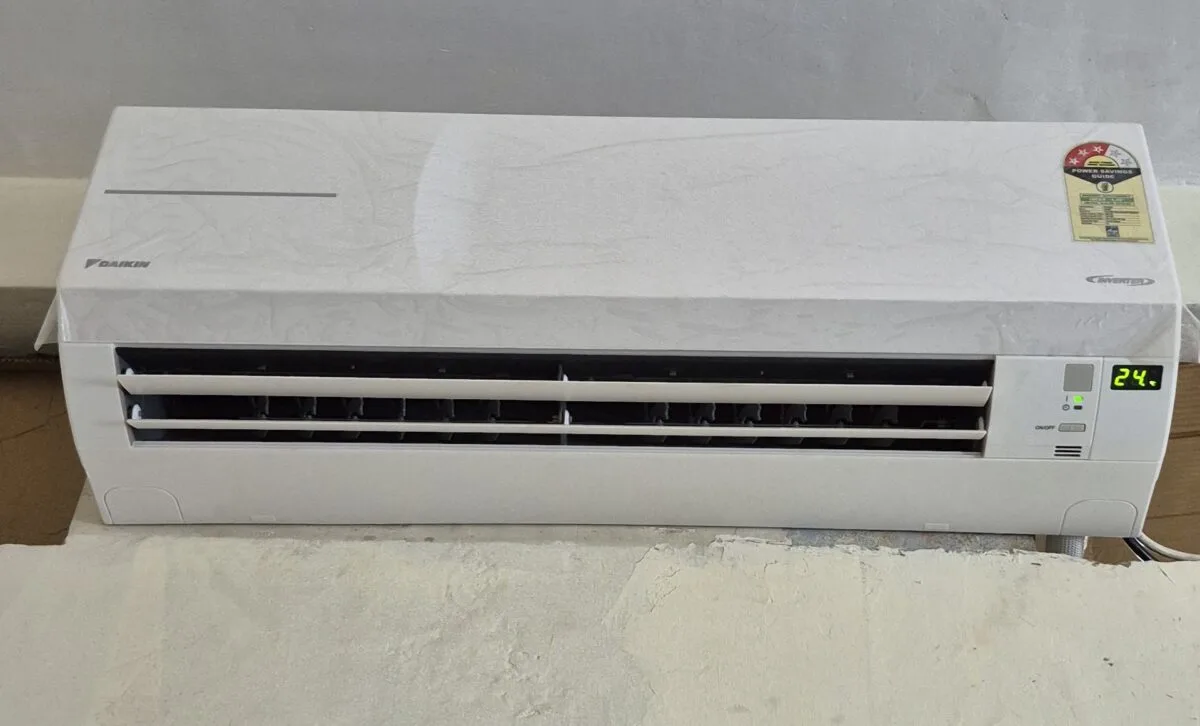
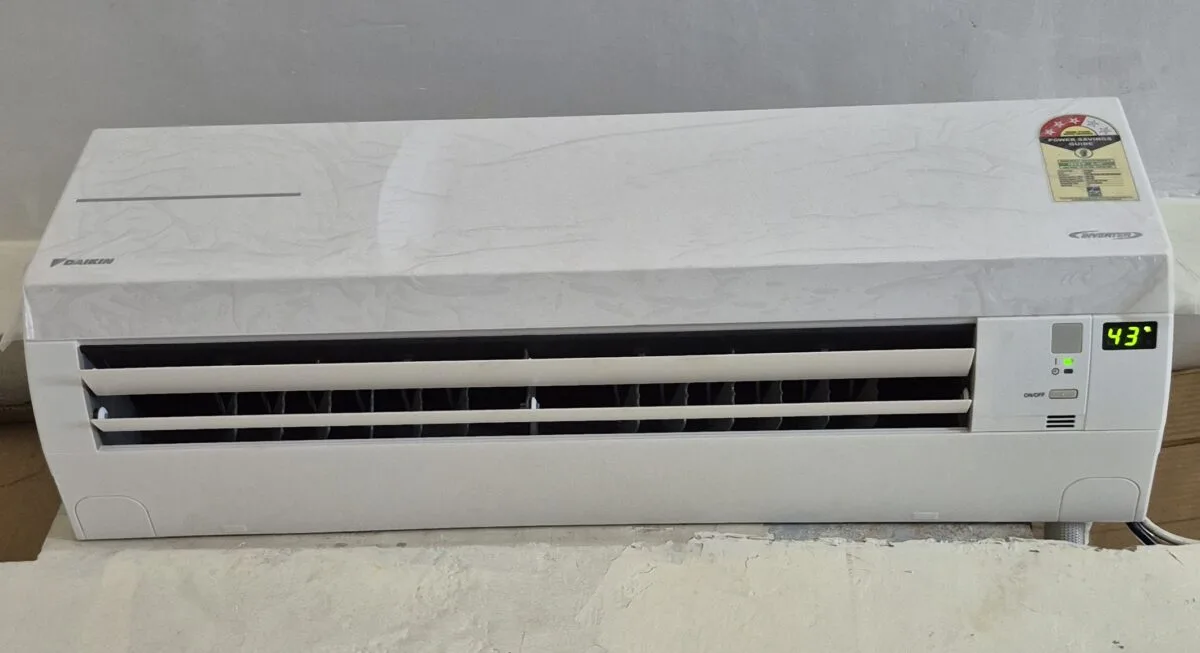
The display cycles through:
- Room temperature
- Set temperature
- Electricity consumption (as a percentage)
One feature I didn’t expect to like as much as I do: even when the AC is off but still powered on, the display keeps showing room temperature. Small thing, but genuinely useful — I can glance at it and decide whether it’s actually worth switching the AC on, instead of guessing.
Other features that are there and work, without being oversold:
- Horizontal and vertical swing
- Filter clean indicator
- Self-diagnosis for faults
- 3D airflow for more even room coverage
No WiFi, no voice control, no app. Given my priorities going in, that’s a plus, not a gap — I didn’t want to manage another app for something that just needs to cool a room reliably.
Noise Level (Honest Take)
Indoor unit: quiet at low and medium fan speed — this matches Daikin’s rated 32 dB at the lowest setting, which is genuinely unobtrusive. Noticeably louder at full speed (rated up to 48 dB at the top end), which is worth knowing if you plan to run it on turbo/Power Chill mode overnight.
Outdoor unit: slightly louder than my old Carrier’s outdoor unit. If your outdoor unit is going to be installed close to a bedroom wall, this is worth factoring in — it was noticeable enough that I’d flag it to anyone installing in a tight space.
👍 Pros & 👎 Cons
Pros
- Strong cooling (5,000W, rated to perform at full capacity up to 43°C ambient)
- Excellent air throw — best feature of this AC by a clear margin
- Reliable brand with a track record I trust from my own retail years
- R32 refrigerant, swing compressor — solid build under the hood, not just surface features
- Stabilizer-free operation across a wide voltage range (130–285V)
- Practical features only — nothing bolted on for the sake of a spec sheet
- Ideal for rooms in the 120–160 sq. ft. range
Cons
- Indoor power cable not included — budget for it separately
- Installation cost is extra, on top of the unit price
- Noticeably noisier at full fan speed
- Outdoor unit is a bit louder than expected if placed near a bedroom
- Daikin Not provide any manual with ACyou have to download it online from this link
Final Verdict — Should You Buy It?
If your budget is around ₹35,000 and your priorities are strong cooling, good airflow, and a brand you can trust for the long haul, the Daikin FTKL50XV16 is a genuinely practical choice — and having now tested it through a real 43°C heatwave rather than just a mild first week, I’m more confident in that recommendation than I was after the initial install.
Best for: medium-sized rooms (120–160 sq. ft.), buyers who prioritize performance over smart features, long-term use.
Not for: anyone who specifically wants a silent AC at full speed, or buyers who want app control and voice assistant integration.
I’ll continue updating this review with electricity bill data and durability notes as I get more months of real usage — that’s the one gap I still want to close with actual numbers instead of general impressions.
FAQs
Is the Daikin FTKL50XV16UAA good for a 140 sq. ft. room?
Yes — in my usage, it cools a 140 sq. ft. room efficiently, including through peak 43°C heat.
What is the power consumption of this AC?
Daikin rates it at 880.1 kWh annual consumption (BEE standard) with an ISEER of 4.4. In real use, expect higher draw during the initial cooling phase in extreme heat, dropping once the set temperature is reached.
Does this AC support WiFi or smart features?
No — and if you’re not planning to use app control daily, that’s arguably a plus rather than a missing feature.
Is Daikin better than LG or Voltas?
For cooling performance and brand reliability, I’d say yes, especially if you don’t need smart features. LG and Voltas lean harder into Wi
Does it make noise?
Indoor unit is quiet at low/medium speed, louder at full speed. Outdoor unit is a bit louder than older Carrier models I’ve used.
Does it show room temperature when the AC is off?
Yes — as long as it’s still powered on, the display keeps showing room temperature even with the AC switched off.
Does it need a voltage stabilizer?
No — it’s built for stabilizer-free operation across 130–285V, which covers most areas with reasonably stable supply. If your area has frequent, severe voltage drops below that range, a stabilizer is still worth considering as extra protection.

Ayush Singhal is the founder and chief editor of TechMitra.in — a tech hub dedicated to simplifying gadgets, AI tools, and smart innovations for everyday users. With over 15 years of business experience, a Bachelor of Computer Applications (BCA) degree, and 5 years of hands-on experience running an electronics retail shop, Ayush brings real-world gadget knowledge and a genuine passion for emerging technology.
At TechMitra, he covers everything from AI breakthroughs and gadget reviews to app guides, mobile tips, and digital how-tos. His goal is simple — to make tech easy, useful, and enjoyable for everyone. When he’s not testing the latest devices or exploring AI trends, Ayush spends his time crafting tutorials that help readers make smarter digital choices.
📍 Based in Lucknow, India
💡 Focus Areas: Tech News • AI Tools • Gadgets • Digital How-Tos
📧 Contact: Get in touch →
🔗 Full Bio: https://techmitra.in/about-us/