

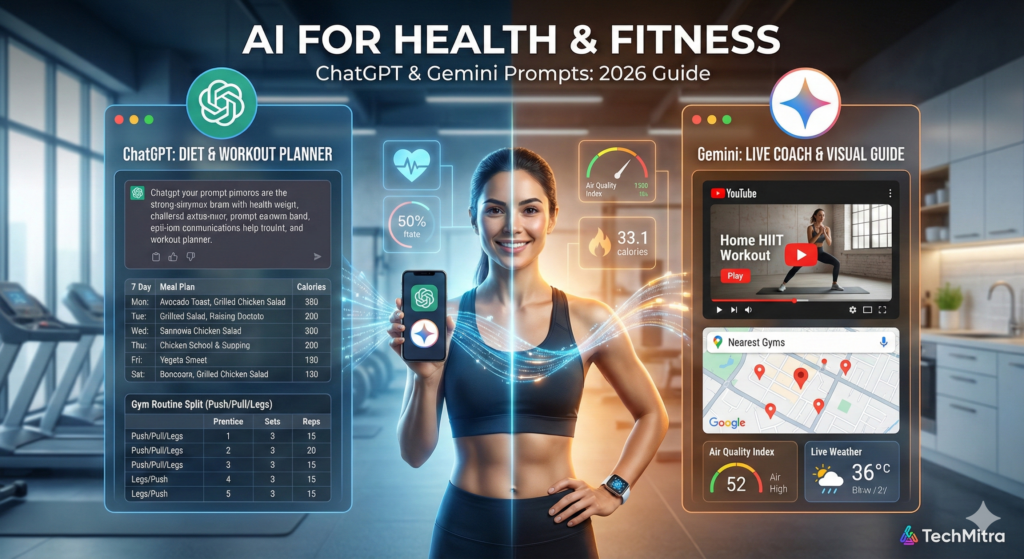
Updated August 2026
⚠️ Medical & fitness disclaimer: AI-generated fitness and nutrition information is for general educational purposes and is not a substitute for advice from a qualified healthcare or fitness professional. Do not use AI to diagnose a condition, change prescribed medication, or determine whether an exercise is medically safe for an injury or health condition. If you have a medical condition, are pregnant or postpartum, have an injury, or develop concerning symptoms, consult an appropriate healthcare professional before making significant changes to your exercise or diet.
If you’ve asked ChatGPT or Gemini something like “give me a workout plan” and gotten back a generic, forgettable routine, you’re not alone — and it’s not really the AI’s fault. A 2025 study published in Biology of Sport had sports scientists blind-rate training plans generated from vague versus detailed prompts. The detailed prompts scored significantly higher on personalization (4.2/5 vs 3.7/5), safety (4.0/5 vs 3.3/5), and overall quality (16.8/20 vs 14.8/20). Same AI model, same underlying capability — the only difference was how much real information went into the prompt.
That’s the whole game with AI fitness prompts: vague input produces a generic plan; specific input produces something closer to what you’d get from an actual coach.
To make that easier, I built a free tool below that asks you the same questions a real trainer would on an intake form, then assembles a ready-to-copy prompt in real time — no signup, nothing sent to a server, it runs entirely in your browser. And if you’d rather skip straight to copy-pasting, the 20 ready-to-use Gemini & ChatGPT prompts for health and fitness further down are written using the same structure, covering everything from meal planning to recovery to what to do on days you don’t feel like training.
Also Read : 30 Best ChatGPT Prompts for Travel Planning in 2026 (With the Ones That Actually Work)
Table of Contents
Try It: The Personalised AI Fitness Prompts Builder
AI Fitness Prompt Builder
Answer a few questions. Watch your ChatGPT / Gemini prompt build itself on the right — structured the way a published sports-science study found gets more personalized, safer AI workout and diet plans than a vague request.
⚠️ This tool helps you write a better prompt — it doesn’t give medical or training advice itself. AI-generated plans aren’t a substitute for a doctor, physiotherapist, or certified trainer, especially for injuries, chronic conditions, pregnancy, or disordered eating.
Built with TechMitra · Nothing you enter is sent anywhere — this runs entirely in your browser.
Pick your goal, equipment, schedule, and experience level, and the prompt on the right builds itself. Copy it straight into ChatGPT, Gemini, or Claude.
Why Most AI Fitness Prompts Fail
Before the prompt list, it’s worth understanding why generic prompts underperform, because it’ll help you get more out of every prompt below — including the ones you customize yourself.
AI models don’t fail because they lack fitness knowledge. They fail because a vague prompt gives them nothing to personalize. Ask “how do I build muscle?” and you’ll get a Wikipedia-style answer about progressive overload and protein intake — true, but useless as an actual plan.
The fix used by coaches and prompt engineers is a simple five-part structure:
- Role — Tell the AI who to be. “Act as an experienced strength coach” produces noticeably more specific, opinionated programming than no role at all.
- Context — Your actual situation: age, experience, equipment, schedule, injuries. This is the part most people skip, and it’s the part the study above found mattered most for safety.
- Task — One clear thing you want produced. Don’t ask for a workout plan and a diet plan and a supplement stack in one prompt — split them.
- Format — How you want it structured: a table, a checklist, a day-by-day breakdown. Vague formatting requests get vague-looking answers.
- Constraints — What to avoid. “Do not include overhead pressing — I have a shoulder issue” is far more reliable than mentioning the same injury in passing.
Every prompt in this list — and the one the tool above generates — follows this structure. Use it as a mental checklist any time you’re prompting AI for anything fitness-related on the fly.
One more thing worth knowing: even with an identical, detailed prompt, the same AI model will give you a different plan if you ask again tomorrow. That’s not a bug — it’s how these models generate text. Treat any AI fitness plan as a strong first draft, not a fixed prescription, and don’t hesitate to ask follow-up questions to refine it.
Best 20 Gemini/ChatGPT Prompts For Health And Fitness
AI Nutrition & Diet Prompts
1. The 7-Day Meal Planner
Act as a registered-dietitian-style nutrition planner. I am a [age]-year-old [gender] weighing [current weight] kg, and my goal is to [goal, e.g., lose 2kg/month, build muscle]. My dietary preference is [e.g., vegetarian, keto, Indian, Mediterranean], and I need to avoid [allergies/dislikes]. Create a 7-day meal plan as a table with columns for Breakfast, Lunch, Snack, and Dinner, including approximate calories per meal. Ask me clarifying questions first if you need more detail.
2. The Budget Grocery Planner
I have a weekly food budget of [amount] in [currency]. Create a healthy grocery list and a matching meal plan that maximizes nutrition without exceeding this budget. Focus on low-cost, high-protein foods commonly available in [your country/region]. Present it as a table with estimated cost per item.
3. The Fridge Raider
I have these ingredients available: [list ingredients]. Suggest 3 healthy recipes I can make in under 30 minutes using only what I have. For each, note the approximate calories and the main nutritional benefit.
4. The Macro Calculator
Calculate my estimated maintenance calories and a macronutrient breakdown (protein, carbs, fats) to support my goal of [goal]. I am [age] years old, [height], [weight] kg, and I work out [X] days a week at [intensity level]. Show your reasoning briefly, then give me a daily target in grams for each macro.
5. The Diabetic-Friendly Planner
Create a general educational meal-planning example for someone with Type [1/2] diabetes. My usual foods are [foods], my dietary preferences are [preferences], and my goal is [goal]. Focus on balanced meals, fiber-rich foods, and general principles that may help support steady blood-glucose levels. Do not diagnose, prescribe treatment, recommend medication changes, or suggest changing insulin or other diabetes medication. Clearly identify anything I should confirm with my doctor or diabetes educator before making changes to my diet.
6. High Blood Pressure Management (DASH-style)
Explain general DASH-style eating principles for someone who wants to support healthy blood pressure. List 10 foods that are commonly limited in a DASH-style diet and 10 practical alternatives. Explain the reasoning behind each swap in simple language. Do not diagnose, treat, or recommend changing blood-pressure medication or prescribed sodium limits. If someone has hypertension or another medical condition, clearly state what should be discussed with their healthcare professional.
Personalized AI Workout Prompts
7. The Full Custom Plan (Use the Structure)
Act as an experienced strength coach who programs using progressive overload. I am [experience level] and my goal is [goal]. I can train [equipment/location], [X] days a week, for [Y] minutes per session. My timeline is [X weeks]. Please account for: [injuries/limitations]. Create a plan with: (1) a weekly split, (2) exercises with sets, reps, and rest periods for each day, (3) a warm-up and cooldown, (4) equipment substitutions, (5) a brief safety note on when to stop or seek medical advice. Present it as a table.
(This is the same structure the tool above builds for you automatically — use it as a template for future check-ins too.)
8. The Zero-Equipment Home Program
Create a complete bodyweight workout program for home use with zero equipment. My level is [beginner/intermediate/advanced], my goal is [goal], and I have [space available] and [time] per session, [X] days a week. For each exercise, include an easier regression and a harder progression, and explain how to add difficulty over time without adding weight (tempo, range of motion, pauses, unilateral work).
9. The First-Timer’s Gym Orientation
I am starting at the gym for the first time. I am [age] and my goal is [goal]. I can go [X] times a week. Create an 8-week beginner program that introduces exercises gradually rather than all at once. For each exercise, describe correct form (what to feel, what not to feel, common mistakes) and include basic gym etiquette. Also tell me what to do in a session when I don't know how to use a machine.
10. The Split Optimizer
Help me evaluate my current training split: [describe what you do now]. My goal is [goal], and I can train [days/times available]. My recovery capacity: [sleep quality, stress level, age]. Tell me if my current split fits my goal, present 3 alternative splits with pros and cons for my situation, and recommend the best one with a weekly layout.
11. The Injury-Aware Modifier
I want to continue exercising while dealing with [injury/limitation]. My current symptoms are [describe symptoms], and the movements that seem to aggravate them are [movements]. Help me identify general, lower-risk exercise alternatives that may train [muscle group] without deliberately aggravating the affected area. Do not diagnose my injury or claim that an exercise is medically safe for me. Flag movements or symptoms that warrant stopping exercise and seeking advice from a qualified healthcare professional. Ask clarifying questions before suggesting alternatives if important information is missing.
12. The Form Check Guide
Give me a complete form guide for [exercise name]. My experience level is [beginner/intermediate]. Include: (1) setup — foot position, grip, posture, (2) the movement broken into 3 phases with cues for each, (3) what muscles I should feel working, and what it means if I feel it somewhere else, (4) the 5 most common mistakes and how to fix each, (5) an easier variation if I'm not ready for the full movement.
13. The Plateau Breaker
I've been stuck at [weight x reps] on [exercise] for [duration]. Here's what I've tried: [describe]. My current program: [brief description]. I sleep [hours] and eat [describe roughly]. Diagnose whether this is a recovery, programming, or technique issue — ask me questions if you need more information — then give me 3 specific strategies to break through, plus a modified 4-week plan for this lift.
14. The Postpartum Return-to-Fitness Plan
I am [weeks/months] postpartum and have been cleared by my healthcare professional to exercise [X days/week]. My delivery was [C-section/vaginal], and I currently have [symptoms/limitations, if any]. Help me create a general, gradual return-to-fitness framework focused on appropriate movement, breathing, core coordination, and low-impact activity. Do not diagnose postpartum conditions or prescribe treatment. Do not assume that my delivery type alone determines what exercises are appropriate. Highlight symptoms or warning signs that should be discussed with my doctor or another qualified postpartum healthcare professional before I progress.
15. The Desk-Job Mobility Fix
I sit at a desk for [X] hours a day and experience [neck/lower-back/wrist discomfort]. Suggest a gentle, general mobility routine that I could discuss with a qualified professional or try only if these movements do not worsen my symptoms. Keep it to 10 minutes and focus on comfortable movement rather than treating or diagnosing the cause of my discomfort. Do not claim that the routine will treat an injury or medical condition. Tell me which symptoms — such as worsening pain, numbness, weakness, or other concerning changes — should prompt me to stop and seek professional medical advice.
Recovery, Motivation & Mental Side
16. The Recovery Protocol Builder
Design a recovery protocol for my training. My program: [describe intensity, frequency, volume]. My current recovery habits: [sleep, stretching, etc.]. My weak points: [soreness, poor sleep, fatigue]. Create: (1) a daily recovery checklist, (2) a rest-day active recovery routine, (3) a post-workout recovery sequence for the first 60 minutes after training, (4) signs of overtraining I should watch for.
17. The Sleep Optimization Checklist
I struggle to fall asleep before [time]. Create an evening sleep hygiene checklist aimed at improving my training recovery. Keep it to 6-8 specific, actionable items I can start tonight, not general advice I've already heard.
18. The No-Motivation Day Coach
I don't feel like training today. Act as a direct, no-nonsense coach — not overly cheerful, not aggressive. Give me a short, honest reason to still show up, based on my goal of [goal] and how far I've come so far: [brief context]. Keep it under 100 words.
19. The 5-Minute Reset
Guide me through a simple 5-minute breathing exercise to lower stress after a hard training session. Write it as a step-by-step script I can follow in real time, with timing cues.
20. The Dining-Out Navigator
I'm eating at a(n) [cuisine type] restaurant tonight and trying to stay aligned with my goal of [goal]. Suggest 3 high-protein menu options to look for and 3 common dishes at this type of restaurant I should be cautious of if I'm managing calories.
Also Read : 40 Pro AI Prompts for Stock Trading: Excel, PDF Analysis & Live Market Data (2026 Guide)
A Quick Reminder Before You Prompt
AI can structure a plan faster than almost anything else available to you for free — but it has no way to see your form, feel your fatigue, or notice swelling around a joint. Treat every plan above as a strong starting draft: run it past a doctor if you have an existing condition, and if you belong to a gym, most offer a free or low-cost intro session where a real trainer can check your form before you go all-in on an AI-written program.
If you build a plan you like using the tool above or the prompts here, save the conversation — AI tools remember context within a thread, so you can return in a few weeks and ask for a progression, a travel-friendly version, or a swap for an exercise that isn’t working for you, without starting from scratch.

Ayush Singhal is the founder and chief editor of TechMitra.in — a tech hub dedicated to simplifying gadgets, AI tools, and smart innovations for everyday users. With over 15 years of business experience, a Bachelor of Computer Applications (BCA) degree, and 5 years of hands-on experience running an electronics retail shop, Ayush brings real-world gadget knowledge and a genuine passion for emerging technology.
At TechMitra, he covers everything from AI breakthroughs and gadget reviews to app guides, mobile tips, and digital how-tos. His goal is simple — to make tech easy, useful, and enjoyable for everyone. When he’s not testing the latest devices or exploring AI trends, Ayush spends his time crafting tutorials that help readers make smarter digital choices.
📍 Based in Lucknow, India
💡 Focus Areas: Tech News • AI Tools • Gadgets • Digital How-Tos
📧 Contact: Get in touch →
🔗 Full Bio: https://techmitra.in/about-us/