
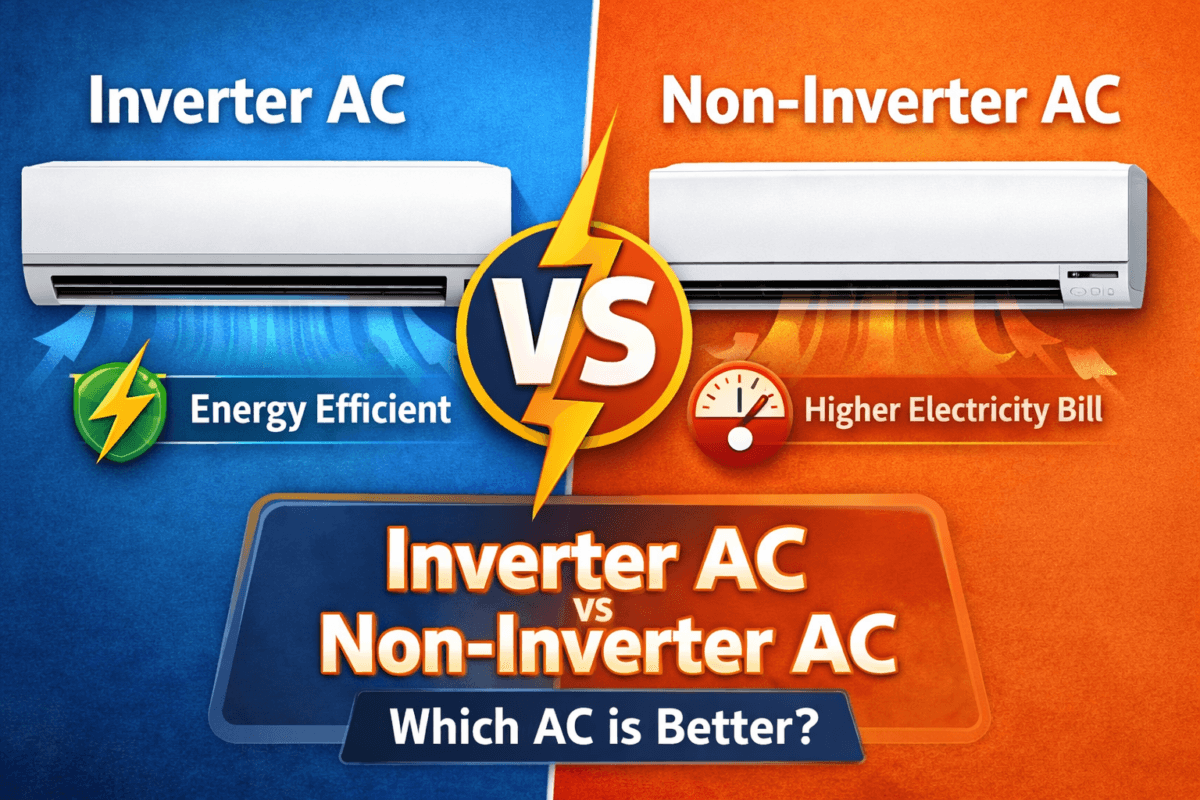
Inverter AC vs Non Inverter AC: 8 Key Differences (2026)
Originally Published on April’ 11 , 2026 – Updated On July’28, 2026
If you’re planning to buy a new AC, you’ve probably run into this question:
👉 “Inverter AC vs Non-Inverter AC — which is actually better?”
It’s one of the most searched AC-related questions in India, and the confusion is fair — both types cool your room, but the way they get there is completely different, and that difference shows up on your electricity bill every single month.
I spent years in electronics retail before starting TechMitra, and this exact question came up constantly — usually followed by something like:
👉 “Inverter AC hai toh kya yeh light ke bina bhi chalega?”
Let’s clear that up first, then get into the real comparison.
Also Read: Daikin 1.5 Ton 3 Star AC Review (2026): Real Usage, Cooling, Noise & Power Insights
What “Inverter” In AC Actually Means
It has nothing to do with running without electricity. “Inverter” refers to the technology that controls how fast the compressor runs.
- What is Inverter AC ? — the compressor runs continuously at a variable speed. Room gets hot → it speeds up. Room cools → it slows down. It never fully switches off.
- What is Non Inverter AC ? — the compressor is either fully ON or fully OFF. Room heats up → compressor kicks on. Target temperature reached → it cuts off completely. Then the cycle repeats.
That single mechanical difference is the root of everything else in this comparison — power bills, noise, cooling stability, price, and lifespan all trace back to it.
The 8 Differences Between Inverter And Non Inverter AC (Summary)
| Feature | Inverter AC | Non-Inverter AC |
|---|---|---|
| Compressor | Variable speed | Fixed speed (ON/OFF) |
| Power consumption | Lower | Higher |
| Noise level | Quiet | Noisier |
| Cooling stability | Steady, no fluctuation | Cools then drifts, repeats |
| Upfront price | ₹30,000–₹60,000 | ₹20,000–₹35,000 |
| Repair cost | Higher (PCB involved) | Lower, simpler parts |
| Lifespan | Longer | Shorter |
Why Inverter AC Is Better (The Short Answer)
If you just want the reasons without reading the full breakdown below, here they are:
- It costs less to run. A 30-50% cut in electricity use isn’t marginal — over a full summer of daily use, that’s real money back in your pocket every single month, not just a one-time saving.
- It cools more steadily. Because the compressor never fully switches off, the room holds its temperature instead of swinging between too cold and too warm — you feel this most clearly at night.
- It’s quieter. Fewer hard restarts means less compressor noise, both indoors and outdoors, over a full day of running.
- It lasts longer. A compressor that isn’t constantly stopping and restarting under full load wears more slowly — which is also part of why inverter units typically carry longer warranties.
- It pays for itself. The higher upfront price isn’t a permanent cost — for daily users, it’s recovered in about 18-24 months through electricity savings alone, and everything after that is pure benefit.
- It’s where the best efficiency ratings now live. Under the current BEE rules, the top star ratings have effectively become inverter-only — a fixed-speed compressor generally can’t reach them anymore.
The one honest exception: if you only run the AC occasionally — a couple of hours a day, a guest room, a shop with short hours — you won’t use it enough to earn back the price difference, and a non-inverter AC can be the more sensible buy. For daily use, though, the case for inverter is about as clear-cut as AC buying decisions get.
The sections below walk through each of these in detail, with the actual numbers behind them.
The 8 Differences That Actually Matter
1. Power Consumption
This is where the real gap shows up. A 1.5 ton inverter AC typically draws around 0.8–1.2 units/hour, while a comparable non-inverter model draws 1.5–2 units/hour. Run either one for 8 hours a day through a Lucknow summer and that difference adds up fast — inverter models generally save 30–50% on cooling costs over a season, with the biggest gains showing up on long runtimes (6+ hours daily), since the compressor spends most of its time cruising at low speed instead of repeatedly restarting.
👉 Want to see what that means in rupees for your actual usage? Try my Electricity Consumption Calculator.
2. Cooling Comfort
Because the compressor never fully stops, an inverter AC holds a room at a steady temperature. A non-inverter AC cools, shuts off, lets the room drift back up, then kicks in again — you’ll feel that cycle if you’re sitting still or sleeping. For bedrooms and long usage, this is the difference that’s hardest to notice on a spec sheet but easiest to notice at 2 AM.
3. Noise
Fewer hard restarts means less compressor noise, which is why inverter units are noticeably quieter — both indoors and outdoors — over a full day of running.
4. Price vs. Long-Term Cost — and the Actual Payback Period
Non-inverter wins on the sticker price. Inverter wins on the electricity bill. The question that actually matters is: how long does it take the inverter’s extra upfront cost to pay for itself?
Here’s a rough worked example for a 1.5 ton AC, running 8 hours a day through a typical summer (roughly 120–150 days of real use):
- Price difference: ₹10,000–₹12,000 more for a 5-star inverter over a comparable non-inverter unit
- Seasonal power use: non-inverter ≈ 1,800 units, inverter ≈ 1,000–1,100 units (at 8 hrs/day)
- At ₹7–₹8/unit: that’s roughly ₹5,500–₹6,500 saved in a single season
At that rate, the inverter pays back its price premium in about 18–24 months — usually within two summers — and every rupee saved after that is pure benefit for the remaining 8–10 years of the AC’s life.
The payback period stretches out if you use the AC less (2-4 hours a day, occasional use) — in that case the math genuinely favors non-inverter, since you’re not running it long enough to earn back the price difference. This is exactly why the “6+ hours daily” line matters more than any other factor in this whole comparison.
👉 Want your own numbers instead of averages? Plug in your actual usage and local tariff on my Electricity Consumption Calculator.
5. Repair Cost — the PCB Question
This is the one people worry about most, and it’s a fair concern.
The PCB (Printed Circuit Board) is what makes an inverter AC “smart” — it controls compressor speed and temperature adjustment. Because it’s electronic, it’s also the most sensitive part of the unit. A PCB repair can run ₹5,000–₹12,000 depending on the brand, and voltage fluctuations are the usual cause of failure.
The good news: most major brands sold in India today — LG, Samsung, Voltas, Daikin, Blue Star, Carrier — cover the PCB under a 5-year warranty. So the risk is real, but you’re protected for the years it’s most likely to matter.
To reduce the risk further:
- Install a voltage stabilizer if your area has fluctuating supply
- Make sure earthing is done properly
- Get the unit serviced regularly
6. Lifespan
A compressor that isn’t constantly hard-starting and stopping wears more slowly. Daikin’s own comparison makes the same point — moving away from the on/off cycle of a fixed-speed compressor is part of why inverter units are generally rated for a longer service life.
7. The Star Rating Actually Matters More Than People Realize
This is something most comparison articles skip, and it’s become more important in 2026.
The BEE (Bureau of Energy Efficiency) star rating isn’t a fixed scale — it’s based on a number called ISEER (Indian Seasonal Energy Efficiency Ratio), and BEE periodically raises the ISEER bar required for each star rating. When that happens, an AC that qualified as 5-star under the older norms can get reclassified as 4-star under the new ones — with absolutely nothing changed in the machine itself. It’s the goalposts moving, not the AC getting worse.
BEE tightened these thresholds again for the current label period, which is worth knowing for two practical reasons:
- A “5-star” sticker on an old model isn’t automatically the same as a “5-star” sticker on new stock. Check the label period printed on the sticker itself (BEE labels show a validity range, e.g. “2025–2027”) before assuming two 5-star ACs are equally efficient.
- Fixed-speed (non-inverter) compressors are running into a ceiling. Because non-inverter units can’t vary compressor speed, they generally can’t reach the ISEER levels needed for the higher star bands anymore. In practice, most non-inverter ACs available today top out around 2-star or 3-star — the 5-star band has effectively become inverter-only territory.
The practical takeaway: don’t just compare star counts — check the ISEER number and label period on the actual sticker, and treat “5-star” as meaningful only when it’s current stock. If you want to verify a specific model, BEE’s official portal (beeindia.gov.in) lists current thresholds and lets you check ratings directly.
8. Best Use Case
- Go inverter if you run the AC daily, for 6+ hours, and want lower bills with quieter, steadier cooling.
- Go non-inverter if usage is occasional, budget is tight, or it’s for a space you won’t be in long-term — a rented room or a shop with short operating hours.
Final Verdict
If you’re asking me directly: inverter AC is the better choice in most cases in 2026. It costs more to buy, but between the lower bills, steadier comfort, longer lifespan, and now the higher star ratings that only inverter models can reach — it’s not really an expense, it pays you back, usually within two summers if you’re a daily user.
Non-inverter still makes sense for short, occasional use where you’ll never run it long enough to recover the price difference — a guest room, a rented space, a shop with limited hours. It’s not outdated, it’s just built for a narrower use case than it used to cover, especially now that the top efficiency bands have effectively become inverter-only.
Read my ac buying guide 2026 to select best ac in market according to your requirements
FAQs
Which is better, inverter or non-inverter AC?
Inverter AC is better for most homes, mainly because of the electricity savings and steadier cooling over long usage.
Does inverter AC really save electricity?
Yes — typically 30–50% compared to a non-inverter unit running the same hours.
Is inverter AC expensive to repair?
Slightly, yes, because of the PCB. Most brands now cover it under a 5-year warranty, which limits the risk.
Which is better for small rooms?
Both cool a small room fine — inverter just does it more efficiently and quietly.
Is non-inverter AC outdated?
Not outdated, just less popular — it still makes sense for short, occasional use where the price difference matters more than long-term savings.
How long does it take an inverter AC to pay for itself?
For daily use of 6+ hours, usually 18–24 months through electricity savings alone. For occasional use (2–4 hours a day), the payback period stretches much longer, and a non-inverter AC may make more financial sense.
What is ISEER and why does it matter more than the star rating?
ISEER (Indian Seasonal Energy Efficiency Ratio) is the actual number BEE uses to decide star ratings — and that number gets revised periodically, so the star rating threshold isn’t fixed over time. Two ACs with the same star label can have different real-world efficiency if they were rated under different label periods. Always check the ISEER value and label validity period on the sticker itself, not just the star count.

Ayush Singhal is the founder and chief editor of TechMitra.in — a tech hub dedicated to simplifying gadgets, AI tools, and smart innovations for everyday users. With over 15 years of business experience, a Bachelor of Computer Applications (BCA) degree, and 5 years of hands-on experience running an electronics retail shop, Ayush brings real-world gadget knowledge and a genuine passion for emerging technology.
At TechMitra, he covers everything from AI breakthroughs and gadget reviews to app guides, mobile tips, and digital how-tos. His goal is simple — to make tech easy, useful, and enjoyable for everyone. When he’s not testing the latest devices or exploring AI trends, Ayush spends his time crafting tutorials that help readers make smarter digital choices.
📍 Based in Lucknow, India
💡 Focus Areas: Tech News • AI Tools • Gadgets • Digital How-Tos
📧 Contact: Get in touch →
🔗 Full Bio: https://techmitra.in/about-us/