

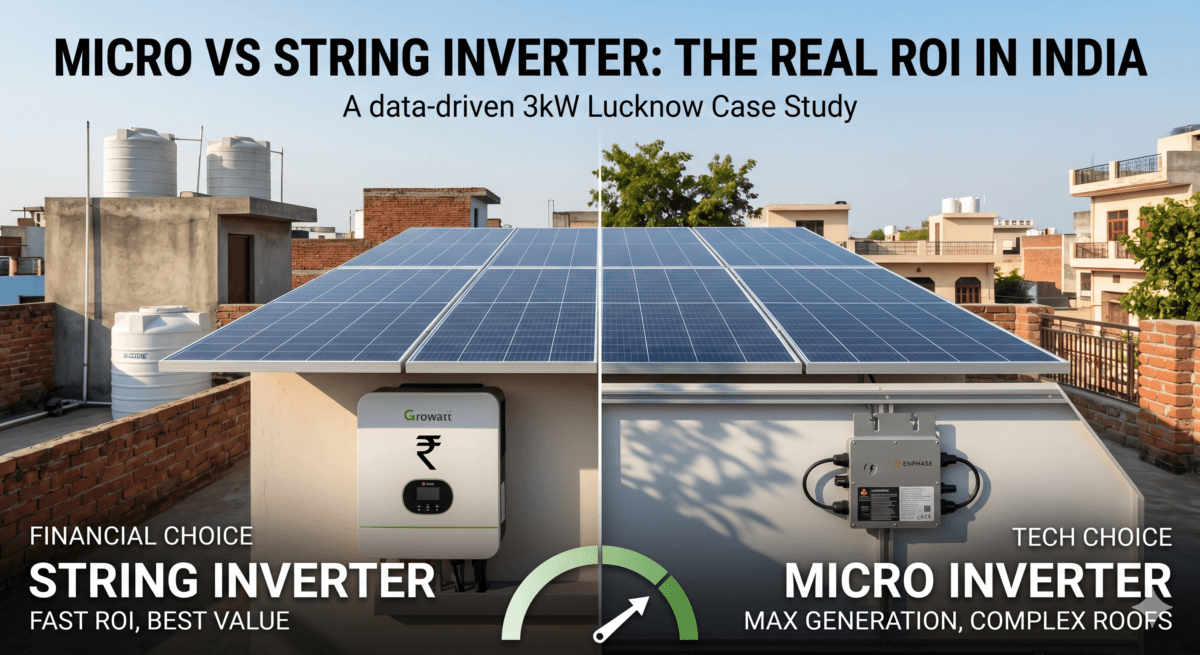
Micro Inverter vs String Inverter (2026): Cost, ROI & Which is Better
When I started researching solar systems, I noticed something strange. Every website said the same two things about on grid solar inverter: micro inverters are more efficient, and string inverters are cheaper. Fine — but almost nobody answered the question that actually matters to a homeowner spending real money: will I ever get back the extra I spend on a micro inverter?
So this isn’t going to be another generic comparison. I’m going to walk through the real ROI math, how the government subsidy actually plays into it, and what this looks like for a typical Indian rooftop — not a spec-sheet ideal.
Table of Contents
Also read my PM Surya Ghar 3kW Solar Rooftop Plant Review: Real Performance Data (2024–2026, Updated Monthly)
Quick Comparison (3kW System – India)
| Feature | String Inverter | Micro Inverter |
|---|---|---|
| Upfront Cost | Lower (₹1.5L – ₹2L) | Higher (₹2.2L – ₹3L+) |
| Subsidy Benefit | Fully applicable | Limited benefit |
| Warranty | 5–10 Years | ~25 Years |
| Shading Performance | Affected | Excellent |
| Safety | Standard | Higher (Low DC risk) |
| Best For | Budget homes | Complex roofs / premium users |
What Is a On grid Solar String Inverter?
A string inverter is a single, central inverter that all your solar panels connect to as one continuous series, or “string.” Every panel in that string feeds its DC electricity into the same inverter, which then converts the combined output into usable AC power for your home. It’s the setup most residential solar systems in India use by default — it’s simpler, cheaper to install, and it’s what most installers will quote you unless you specifically ask for something else.
The trade-off comes from how a string works electrically: because the panels are wired together in series, the whole string performs only as well as its weakest panel. If one panel gets shaded, collects dust, or develops a fault, it doesn’t just lose its own output — it drags down the output of every other panel in that string along with it.
What Is a on grid Solar Micro Inverter?
A micro inverter flips that setup on its head. Instead of one central inverter for the whole array, each individual panel gets its own small inverter mounted right behind it, converting that panel’s DC output to AC on the spot. Because every panel works independently, one underperforming panel — shaded, dusty, angled differently — has zero effect on the panels around it.
That independence is the whole selling point. It’s also why micro inverters cost significantly more per system: instead of buying and installing one inverter, you’re buying and installing one per panel.
Read My Guide On Grid Solar System Explaine And How It Actually Works
The Core Difference
So that’s the mechanical difference — one inverter for the whole array versus one inverter per panel. What actually matters is what that difference does to your generation, your upfront cost, and ultimately, whether paying more for a micro inverter is worth it for your specific roof.
The Real ROI Question
Every micro-inverter pitch leans on the efficiency gain. The number that actually matters is simpler: how many years does it take the extra generation to pay back the extra cost you spent on it? That’s the only question worth asking before you sign a quote.
The Fixed Subsidy Reality (Most People Get This Wrong)
Here’s something almost nobody explains clearly. Under the PM Surya Ghar Muft Bijli Yojana, the subsidy is fixed based on your system’s size in kW — not on what you actually spend. For a 3kW system, that subsidy is ₹78,000, flat. It doesn’t matter whether you install a ₹25,000 string inverter or a ₹1.2 lakh micro inverter setup — you still get exactly ₹78,000.
That matters more than it sounds like, because it means the subsidy doesn’t shrink the price gap between the two options. Here’s what the real numbers look like after subsidy:
| Component | String Inverter (3kW) | Micro Inverter (3kW) |
|---|---|---|
| Total System Cost | ₹1,65,000 – ₹1,85,000 | ₹2,50,000 – ₹2,80,000 |
| Govt. Subsidy | ₹78,000 | ₹78,000 |
| Your Final Cost | ₹87,000 – ₹1,07,000 | ₹1,72,000 – ₹2,02,000 |
So even after the subsidy lands, you’re looking at roughly ₹1 lakh for a string system versus ₹1.8–2 lakh for micro — a gap of ₹70,000 to a full lakh, coming entirely out of your own pocket. The subsidy doesn’t touch that premium at all, which is exactly why the ROI math below is the part that actually decides this, not the marketing.
What a 3kW System Actually Generates (North India)
As a baseline, a 3kW string system in North India typically produces 12–15 units a day, 360–450 units a month, and somewhere around 4,500–5,400 units a year. That’s your reference point for everything below.
The real question is how much more a micro inverter gets you on top of that — and the honest answer is: it depends almost entirely on shading.
| Condition | Extra Generation (Micro) |
|---|---|
| No shading | 0–5% |
| Partial shading | 5–15% |
| Heavy shading | 15–25% |
Most homes in India fall into that 0–10% range, which is a smaller gain than the marketing around micro inverters usually implies.
Real ROI Case Studies (With Subsidy Factored In)
A normal roof with no shading. Here, a micro inverter gets you maybe 20 extra units a month — about ₹1,800 a year in additional savings. Against an extra cost of ₹80,000, that works out to a payback period of over 40 years. That’s not a typo, and it’s not remotely practical for the vast majority of homes.
A roof with partial shading. Extra generation climbs to around 60 units a month, or roughly ₹5,000 a year in savings. That brings the payback down to 14–16 years — still a long horizon, and genuinely borderline. This is the case where you actually need to sit down and think it through rather than default either way.
A roof with heavy shading. Now you’re looking at around 100 extra units a month, close to ₹9,000 a year in savings, and a payback period of 8–10 years. This is the one scenario where a micro inverter genuinely makes financial sense, not just technical sense.
Check my Electricity Consumption Calculator to work out your own units and bill before deciding either way.
What About Power Optimizers?
If you’re stuck between the two, optimizers are worth knowing about — they sit in the middle. They cost less than a full micro-inverter setup but handle partial shading noticeably better than a plain string system. For homes with a bit of shade for part of the day but not the extreme case, an optimizer is often the more sensible middle ground than jumping straight to micro.
The Hidden Advantage of Micro Inverters: Warranty
This is where micro inverters actually claw back some ground that the ROI math doesn’t capture. String inverters typically carry a 5–10 year warranty, and in practice, most homeowners end up replacing theirs once over the life of the system — a future cost of roughly ₹25,000–₹40,000 that rarely gets factored into the upfront comparison. Micro inverters, by contrast, are usually warrantied for around 25 years — designed to last the full life of the system, with little to no expectation of replacement.
That doesn’t flip the financial case entirely, but it does narrow the long-term cost gap a bit more than the sticker price suggests.
For more on the technology itself, see Enphase Energy.
The Safety Angle
In a string system, high-voltage DC electricity runs across your rooftop wiring before it ever reaches the inverter. In a micro-inverter setup, the DC-to-AC conversion happens right at each panel, so there’s far less high-voltage DC exposure across the roof. Practically, that means a lower fire risk and a somewhat safer installation overall. If safety is genuinely your top priority — more than cost, more than payback period — this is the one place micro inverters win outright, no asterisks.
The Biggest Myth: “More Efficient Automatically Means Better”
This is the trap most people fall into. Yes, micro inverters generate more — but a generation gain doesn’t automatically translate into a financial win. If you’re paying 40% more for a system that only generates 5% more electricity, you’ve made a worse decision than the one you started with, no matter how good the tech sounds on paper.
When a Micro Inverter Actually Makes Sense
Go with micro if your roof genuinely has shading for several hours a day, if your panels are split across multiple directions (east and west facing, for instance), if safety is a bigger priority to you than upfront cost, or if budget simply isn’t the constraint.
When a String Inverter Is the Smarter Choice
Go with string if you’ve got a clear, unshaded rooftop, a single-direction installation, you’re budget-focused, and you want the fastest possible payback. For most Indian homes, this describes the actual situation on the ground.
Pros and Cons, Honestly
Micro inverter — the upside is real: better performance under shading, panel-level monitoring so you can see exactly which panel is underperforming, and a much longer warranty. The downside is just as real: a high upfront cost and a slow payback unless your roof genuinely has shading problems.
String inverter — the upside is affordability, a faster payback period, and a simpler system overall. The downside is that shading hits your whole system’s output at once, and you lose the flexibility of panel-level independence.
My Honest, Practical Verdict
Let me be direct about this: for 70–80% of Indian homes, a string inverter gives you the better return. The upfront cost is lower, the government subsidy covers most of the system either way, and the payback is faster.
The decision rule I’d actually use: no shading, go string — it’s the better ROI, full stop. Moderate shading, sit down and run the numbers for your specific case before deciding. Heavy shading, go micro — it’s genuinely worth the premium there.
FAQs
Is a Solar micro inverter worth it in India?
Mostly only if your roof has real shading or a complex, multi-directional layout. For a clear, unshaded roof, the extra cost rarely pays back within a reasonable time.
What’s the subsidy for a 3kW solar system?
₹78,000 under the PM Surya Ghar scheme, fixed regardless of which inverter you choose.
Does a micro inverter actually increase your savings?
Yes, but usually not by enough to justify what you paid extra for it — unless you’re dealing with meaningful shading.
Micro inverter vs string inverter — which solar inverter is better for a typical home?
For most Indian homes without significant shading, a string inverter is the smarter financial choice.
How much more does a micro inverter setup cost after subsidy?
Roughly ₹70,000 to ₹1 lakh more than a comparable string system, since the subsidy amount doesn’t change based on which inverter you pick.
Conclusion
Solar isn’t really about which technology sounds more advanced — it’s about return on investment. A micro inverter is the smarter piece of engineering. For most people, a string inverter is the smarter financial decision.
If you’re planning solar seriously, the question to keep asking at every step is simple: will this extra cost actually pay for itself? Because in the end, the best system isn’t the most advanced one — it’s the one that makes the most sense for your roof, your budget, and your electricity bill.

Ayush Singhal is the founder and chief editor of TechMitra.in — a tech hub dedicated to simplifying gadgets, AI tools, and smart innovations for everyday users. With over 15 years of business experience, a Bachelor of Computer Applications (BCA) degree, and 5 years of hands-on experience running an electronics retail shop, Ayush brings real-world gadget knowledge and a genuine passion for emerging technology.
At TechMitra, he covers everything from AI breakthroughs and gadget reviews to app guides, mobile tips, and digital how-tos. His goal is simple — to make tech easy, useful, and enjoyable for everyone. When he’s not testing the latest devices or exploring AI trends, Ayush spends his time crafting tutorials that help readers make smarter digital choices.
📍 Based in Lucknow, India
💡 Focus Areas: Tech News • AI Tools • Gadgets • Digital How-Tos
📧 Contact: Get in touch →
🔗 Full Bio: https://techmitra.in/about-us/