

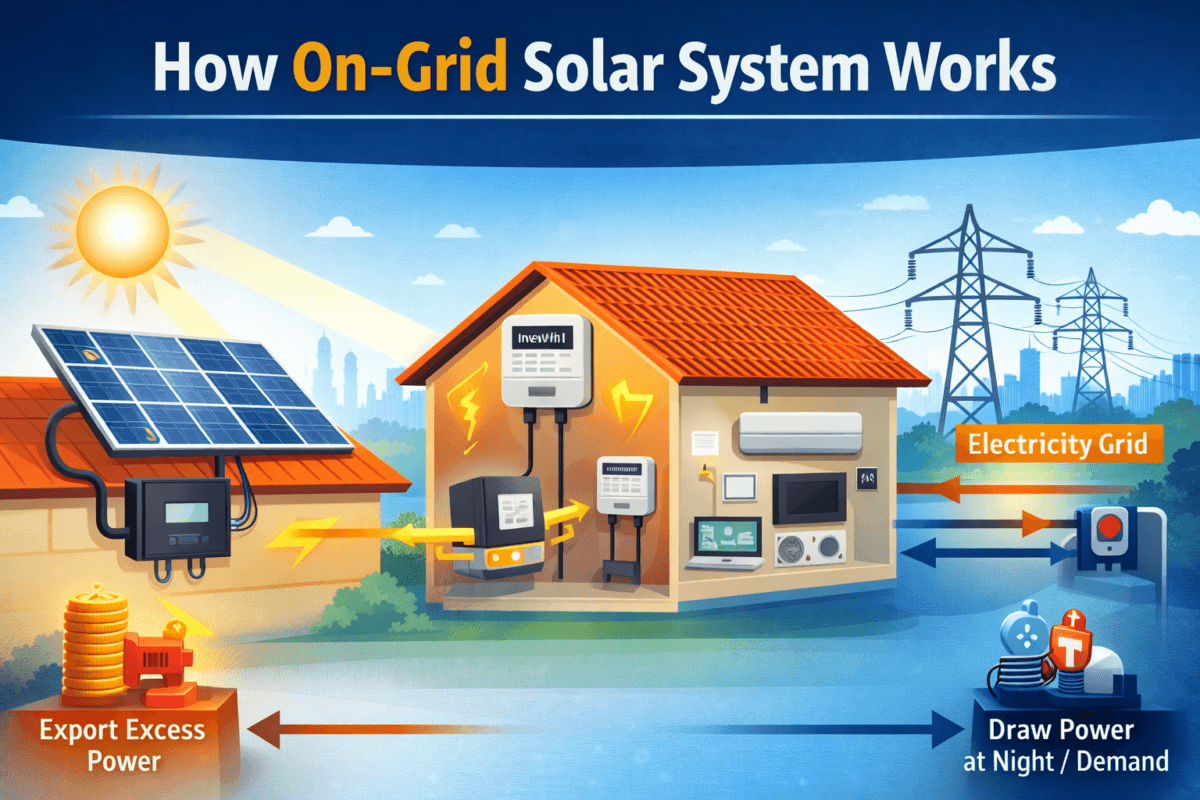
Electricity bills in India keep climbing every year, and after running my own 3.39 kW rooftop system in Lucknow for over two years now, I can say solar isn’t just an eco-friendly gesture anymore — it’s one of the most reliable financial decisions a homeowner can make. Among all the setups I get asked about, the on-grid solar system is by far the most common choice for urban homes, offices, schools, and commercial buildings, and for good reason: it hits the best balance of low cost, real savings, and simplicity.
Unlike off-grid systems that need expensive battery banks, an on-grid solar system works directly with the electricity grid. During the day, your home draws power from your panels first, and any extra you generate is automatically pushed back to the grid through net metering — the same mechanism that’s kept my own winter bills down to almost nothing but the fixed connection charge.
What’s made on-grid solar even more accessible in the last couple of years is the PM Surya Ghar Muft Bijli Yojana, the central government’s rooftop solar subsidy scheme. It’s a big part of why my own payback period came in at around 3.5 years instead of the 6–8 years solar used to take — I’ll break down exactly how the subsidy affected my numbers later in this guide.
In this guide, I’ll walk through:
- What an on-grid solar system actually is
- How it works, step by step
- The role of the panels, inverter, and net meter
- What happens during a power cut (and why)
- On-grid vs hybrid — which one you actually need
- Real costs in India for 2026
- Advantages and limitations, based on real usage
- Whether it’s still worth installing in 2026
If you’re planning rooftop solar in India, this should give you the full picture before you spend a rupee.
Table of Contents
Also Read: 11 Facts About Solar Rooftop Plants Every Indian Homeowner Must Know (Real Experience Based
What Is an On-Grid Solar System?
An on-grid solar system — also called a grid-tied system — is a solar setup connected directly to your local electricity grid. It lets your home:
- Run on solar power during the day
- Export extra electricity to the grid when you’re generating more than you’re using
- Pull electricity back from the grid when your panels aren’t producing enough
Because it skips batteries, it’s significantly cheaper to install and easier to maintain than an off-grid system. That’s exactly why most residential rooftop installs in India today — including mine — are on-grid: the payback period is faster, and net metering does the heavy lifting.
Main Components of an On-Grid Solar System
1. Solar Panels
Panels sit on your roof and convert sunlight into DC (Direct Current) electricity. How much you generate depends on:
- Sunlight intensity
- Number of panels
- Panel efficiency
- Roof direction and shading
I run 6 Adani Topcon Bifacial panels (565W each, 3.39 kW total), and even accounting for Lucknow’s fog and monsoon cloud cover, the system has produced anywhere from ~240 kWh in a foggy December to over 500 kWh in peak March–May months — real numbers I track every month from the inverter app rather than estimating.
2. On-Grid Solar Inverter
The inverter is the brain of the system. Since your appliances run on AC (Alternating Current), the inverter converts the DC electricity from your panels into usable AC power. It also:
- Syncs with the grid’s voltage and frequency
- Sends surplus power out to the grid
- Monitors system performance
- Handles safety shutdowns
My EEVO inverter is rated for 3 kW but comfortably handles 15% over that during peak generation, and I can track daily and monthly output straight from its app — which is where every number in this article comes from.
Check: Micro Inverter vs String Inverter: ROI Comparison for Indian Homes (2026 Guide)
3. Net Meter
A net meter is a two-way meter that separately records:
- Units imported from the grid
- Units exported to the grid
This is the single component that actually makes your electricity bill go down. Without it, none of the savings math below works.
4. Distribution Board (DB Box)
The DB box safely distributes power to your home’s circuits and includes breakers, safety switches, and surge protection.
5. Utility Grid
Think of the grid as your virtual battery. When you’re generating more than you use, the surplus goes out to the grid. When you’re generating less than you need, you pull it back in. No batteries required.
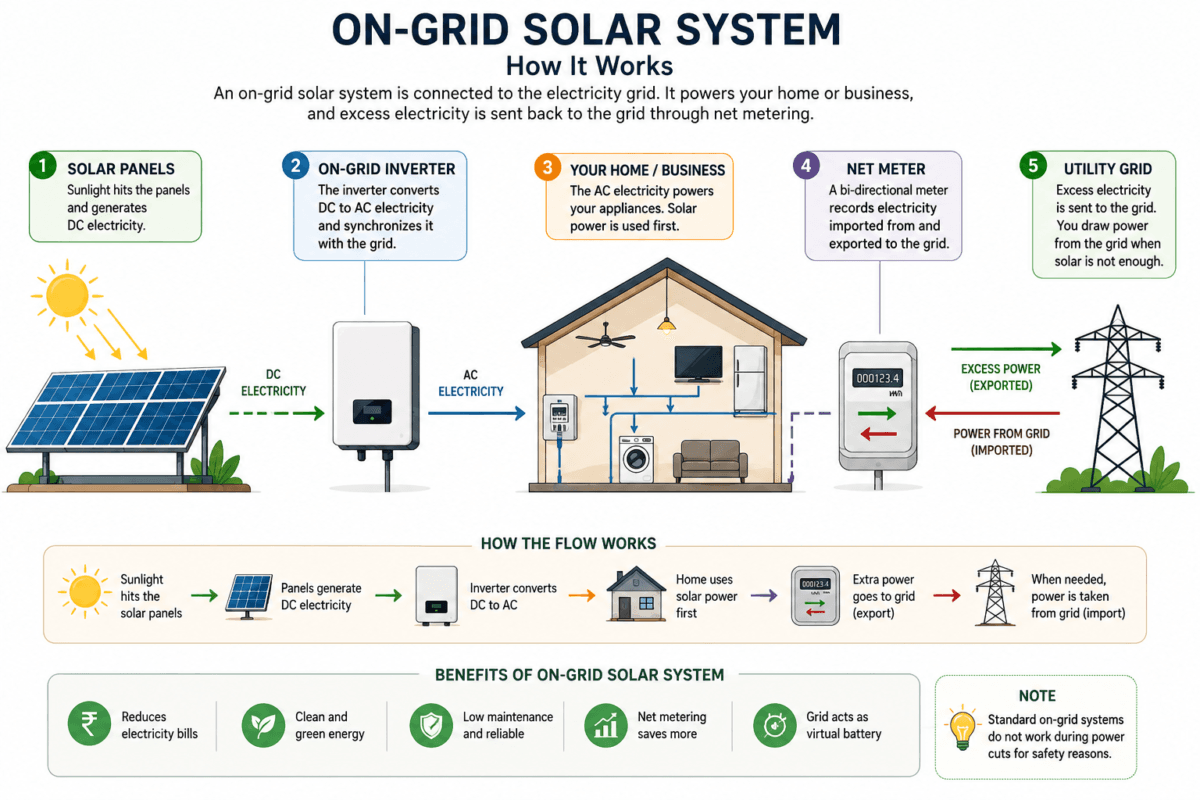
How an On Grid Solar System Works, Step by Step
Step 1: Panels Generate Electricity
Generation peaks between roughly 10 AM and 3 PM. Even in winter, a properly installed system keeps producing — my own worst month (December) still generated 242.7 kWh, not zero.
Step 2: The Inverter Converts DC into AC
Your appliances can’t run on the raw DC coming off the panels, so the inverter converts DC → AC and syncs it to match the grid’s voltage and frequency. Without that sync step, the power can’t safely flow into the grid at all.
Step 3: Your Home Uses Solar Power First
Fans, ACs, the fridge, TV, washing machine — everything in the house draws from solar generation first, automatically, before pulling anything from the grid. On my system, self-use runs close to 100% for most of the year, meaning almost everything I generate gets consumed directly rather than exported.
Step 4: Excess Electricity Goes to the Grid
This is where net metering actually kicks in, and it’s simpler than most guides make it sound.
Say your panels are generating 2 kW at a given moment, but your home is only drawing 1 kW — a couple of fans and the fridge running. That remaining 1 kW doesn’t get wasted. It flows out through your net meter into the DISCOM grid, and the meter logs it as an exported unit.
Step 5: Electricity Is Imported at Night
Once the sun goes down, panels stop producing, and your home automatically switches to importing from the grid — no manual switching, no interruption you’d even notice.
What Is Net Metering? (And How the Billing Actually Works)
Net metering is the billing mechanism that makes on-grid solar pay for itself, and once you’ve watched it play out on your own bill for a couple of years, it’s a lot more straightforward than it sounds on paper.
Here’s the mechanic again, in billing terms:
- Imported units: electricity you pull from the grid when your panels aren’t producing enough (nights, cloudy stretches)
- Exported units: the surplus your panels generate above what your home is using at that moment, sent out to the DISCOM
At the end of your billing cycle, the DISCOM nets the two against each other:
Net Units Billed = Imported Units − Exported Units
If you exported more than you imported, that difference either cuts your bill or gets banked as a credit — depending on your state’s DISCOM rules. Some states carry credits forward to future bills; others settle annually.
On my own system, this is what it actually looks like in practice: summer bills run about 40% lower than pre-solar, monsoon months around 30% lower, and winter — thanks to lower usage and steady exports — drops close to 90%, leaving little more than the fixed connection charge.
For more information, check the official PM Surya Ghar portal.
Read my full – PM Surya Ghar 3kW Solar Rooftop Plant Review: Real Performance Data (2024–2026, Updated Monthly)
Why On Grid Solar Stops Supply Elecrticity During Power Cuts ?
This is the part almost everyone gets wrong before they install that on grid solar panel. The assumption is: “I have solar panels, so my home should still have power during a blackout.” Standard on-grid systems don’t work that way — they shut down during outages.
The reason is a safety feature called anti-islanding protection. If your system kept feeding electricity into the grid during a blackout, line workers repairing the outage could be exposed to live wires they assume are dead. So the inverter automatically cuts off the moment it detects a grid failure.
Want Backup During Outages?
You’d need either:
- A hybrid solar system, or
- Added battery storage
Hybrid systems combine panels, batteries, and the grid connection. They cost more upfront, but they’ll keep your essentials running through a blackout — something a standard on-grid setup, including mine, won’t do.
On Grid vs Hybrid Solar System
| Feature | On-Grid Solar | Hybrid Solar |
|---|---|---|
| Battery Required | No | Yes |
| Cost | Lower | Higher |
| Power Backup During Outage | No | Yes |
| Maintenance | Low | Moderate |
| ROI Speed | Faster | Slower |
| Best For | Areas with reliable electricity | Areas with frequent power cuts |
For most urban Indian homes with reasonably stable power, on-grid is still the more economical call.
Real Cost of an On-Grid Solar System in India (2026)
Prices vary by panel brand, inverter quality, installation type, and state subsidy — but here’s roughly what to expect for residential systems in 2026:
| System Size | Approx Cost |
|---|---|
| 1 kW | ₹55,000 – ₹75,000 |
| 3 kW | ₹1.6 – ₹2.2 lakh |
| 5 kW | ₹2.5 – ₹3.5 lakh |
| 10 kW | ₹5 – ₹7 lakh |
For reference, my own 3.39 kW system cost ₹2,03,400 before subsidy. After the Central government subsidy (₹78,000) and the Uttar Pradesh state subsidy (₹30,000) under PM Surya Ghar Yojana, my net cost came down to ₹95,400 — bringing my actual payback period to around 3.5 years, not the vague “several years” you’ll see quoted elsewhere.
Advantages of On-Grid Solar Systems
1. Lower Electricity Bills
The biggest reason people install rooftop solar — and it delivers. My own bills are down roughly 40% in summer, 30% in monsoon, and about 90% in winter.
2. No Expensive Batteries
Skipping the battery bank is a big part of what keeps the upfront cost manageable.
3. Faster Return on Investment
Most residential systems pay for themselves in 4–7 years. Mine is tracking closer to 3.5 years thanks to the combined Central + state subsidy. After that, the electricity is essentially free for the remaining 20+ years of the panels’ rated life.
4. Environment-Friendly
Less dependence on fossil fuels, lower emissions. My system has offset an estimated 3.31 tons of CO2 in its first 18 months alone.
5. Low Maintenance
Few moving parts. My own maintenance routine is basically: clean the panels every 15 days, keep an eye on the wiring, and check inverter health through the app. Annual maintenance cost so far: ₹0.
Limitations of On-Grid Solar Systems
1. No Backup During Blackouts
Covered above — standard on-grid systems shut down during outages by design.
2. Dependent on Sunlight
Generation drops during heavy monsoon and foggy winter stretches. On my system, even the worst monsoon month hasn’t dropped below ~300 kWh, and December/January are consistently my lowest-output months across all three winters I’ve tracked so far.
3. Savings Depend on Your State’s Net Metering Policy
Export limits, billing methods, and credit carry-forward rules vary by state and DISCOM. Always check your local DISCOM’s policy before you commit — this affects your actual payback period more than almost anything else.
Precautions Before Installing Rooftop Solar
Choose a certified installer. Poor installation kills efficiency and creates real safety risks. I went with Ram Solar Waves in Lucknow — a 5-day install with a smooth net metering and approvals process bundled in.
Get the earthing right. Proper grounding protects the inverter, your appliances, and the whole system, especially during lightning or voltage spikes.
Avoid shadow areas. Even partial shading from trees, water tanks, or nearby buildings can meaningfully cut output.
Keep panels clean. Dust buildup is a real issue in most Indian cities. In my own before/after cleaning tests, dirty panels dropped my peak output to around 2.8 kW, and cleaning brought it back to roughly 3.1 kW — a difference big enough to notice on the inverter app daily. I clean mine every 15 days.
Does the Distance Between Solar Panel and Inverter Affect Generation?
This is a question I see a lot, and the honest answer is: yes, but not for the reason most people assume. It’s not the distance itself that causes a loss — it’s what that distance does to the DC cable running from your panels down to the inverter.
Every meter of cable has some electrical resistance, and current flowing through that resistance loses a bit of power as heat before it ever reaches the inverter. Engineers call this voltage drop. The longer the cable run, the more resistance it adds, and the more power gets lost along the way. A 400W panel producing 10A of current, run through 50 meters of undersized cable, can lose a noticeable chunk of voltage — sometimes enough to push the system below the inverter’s optimal operating range, especially on hot afternoons when panel voltage is already lower than usual.
The good news is that this is completely manageable with correct cable sizing. Industry practice keeps this loss under 1–2% of total output by matching cable thickness to the length of the run — for most residential Indian rooftops, a 4mm² or 6mm² copper cable is more than enough to keep losses negligible, even with the inverter mounted a reasonable distance from the panels.
Where this actually becomes a real problem is when installers cut corners — using thin, undersized cable over a long run to save a few hundred rupees. That’s a real and avoidable mistake, and it’s worth asking your installer directly what cable gauge they’re using and how far your panels will be from the inverter before installation starts.
The practical takeaway: a short, well-sized cable run barely matters. A long run with the wrong (thin) cable can genuinely cost you generation. If your inverter has to sit far from your panel array for space reasons, just make sure your installer upsizes the cable to compensate — it’s a small cost difference that protects your output for the next 20+ years.
Is On-Grid Solar Still Worth It in 2026?
For most homeowners — yes, without much hesitation.
Two years of real data on my own system backs this up: electricity tariffs keep rising, panel efficiency keeps improving, and installation costs have gotten more competitive with wider subsidy support. Comparing complete months year-over-year, my system actually produced about 2% more in the first half of 2026 than the same period in 2025 — no signs of meaningful degradation yet, which matches what manufacturer warranties (typically 0.5–1% annual degradation) would predict.
If your area has decent sunlight, reasonably reliable grid supply, and solid net metering support, an on-grid system is still one of the most cost-effective long-term investments available.
Final Thoughts
An on-grid solar system remains one of the smartest investments a homeowner can make in India right now. It lets you generate your own power, cut your grid dependence, lower your bills, and offset real carbon emissions — and having run one myself for over two years, the numbers hold up.
The system works in a simple, efficient loop:
- Panels generate electricity
- The inverter converts it to usable AC power
- Your home uses solar power first
- Surplus goes out to the grid as exported units
- The grid supplies power back when you need it
Before you install, I’d suggest:
- Compare installers and check real reviews, not just quotes
- Understand your state’s net metering rules before signing anything
- Choose quality panels and a reputable inverter brand
- Size the system to your actual usage, not a generic recommendation
With the right setup, a rooftop system can deliver reliable savings for the next 20–25 years — mine’s on track for exactly that.
Frequently Asked Questions (FAQs)
What is the difference between on-grid and off-grid solar systems?
An on-grid system connects directly to the electricity grid and doesn’t need batteries. An off-grid system runs independently and needs battery storage to supply power when the sun isn’t out.
Does an on-grid solar system work during a power cut?
No. Standard on-grid systems automatically shut down during outages because of anti-islanding protection — a safety feature that prevents your system from feeding electricity into lines that repair crews assume are dead.
Can I run an air conditioner on an on-grid solar system?
Yes, as long as the system is sized for your actual usage. My own 3.39 kW system comfortably runs ACs, the fridge, washing machine, and everything else in the house.
What happens to extra electricity generated by solar panels?
It’s exported to the grid through your net meter and logged as exported units, which offset your imported units at billing time — reducing your bill or banking as credit, depending on your state’s rules.
How much rooftop area is needed for an on-grid solar system?
Roughly: 1 kW needs 80–100 sq. ft., 3 kW needs 250–300 sq. ft., 5 kW needs 400–500 sq. ft. My own 3.39 kW system took about 300 sq. ft., including mounting structure and clearance for maintenance.
How long do on-grid solar panels last?
Most panels are rated for 25 years, with efficiency declining gradually. Mine are showing no measurable degradation after two years of same-month comparisons — production is actually running about 2% ahead of last year so far.
Is battery storage required in an on-grid solar system?
No — the grid itself acts as your backup, which is exactly what keeps the upfront cost down.
How much money can I actually save with rooftop solar?
It depends on system size, usage, local tariffs, and your state’s net metering policy. On my own system: about 40% lower bills in summer, 30% in monsoon, and around 90% in winter.
What maintenance does an on-grid solar system need?
Not much. My routine: clean the panels every 15 days, check the wiring periodically, and monitor inverter performance through its app. My annual maintenance spend so far: ₹0.
Is net metering available in all Indian states?
Most states support it, but the rules — export limits, billing method, credit carry-forward — vary by state and DISCOM. Check your local policy before you install.
Can solar panels generate electricity during cloudy or rainy weather?
My system has never fallen below roughly 300 kWh even in my heaviest monsoon months.
Is on-grid solar worth installing in 2026?
Is on-grid solar worth installing in 2026? For most homes with reasonably reliable grid power and decent sunlight, yes. Rising tariffs, better panel efficiency, and stronger subsidy support make the payback period faster than it was even a couple of years ago — mine came in around 3.5 years.
Does the distance between the solar panel and inverter affect generation? (Kya panel aur inverter ki doori se generation par effect padta hai?)
Yes, but only indirectly — through voltage drop in the DC cable, not the distance itself. With correctly sized cable (4mm² or 6mm² copper for most homes), the loss stays under 1–2% even over a reasonably long run. Problems only show up when installers use thin, undersized cable over a long distance to cut costs.
Does an on-grid solar system work during a power cut? (On-grid solar panel electricity na hone par bhi supply karega?)
No. Standard on-grid systems automatically shut down during outages because of anti-islanding protection — a safety feature that prevents your system from feeding electricity into lines that repair crews assume are dead.

Ayush Singhal is the founder and chief editor of TechMitra.in — a tech hub dedicated to simplifying gadgets, AI tools, and smart innovations for everyday users. With over 15 years of business experience, a Bachelor of Computer Applications (BCA) degree, and 5 years of hands-on experience running an electronics retail shop, Ayush brings real-world gadget knowledge and a genuine passion for emerging technology.
At TechMitra, he covers everything from AI breakthroughs and gadget reviews to app guides, mobile tips, and digital how-tos. His goal is simple — to make tech easy, useful, and enjoyable for everyone. When he’s not testing the latest devices or exploring AI trends, Ayush spends his time crafting tutorials that help readers make smarter digital choices.
📍 Based in Lucknow, India
💡 Focus Areas: Tech News • AI Tools • Gadgets • Digital How-Tos
📧 Contact: Get in touch →
🔗 Full Bio: https://techmitra.in/about-us/