

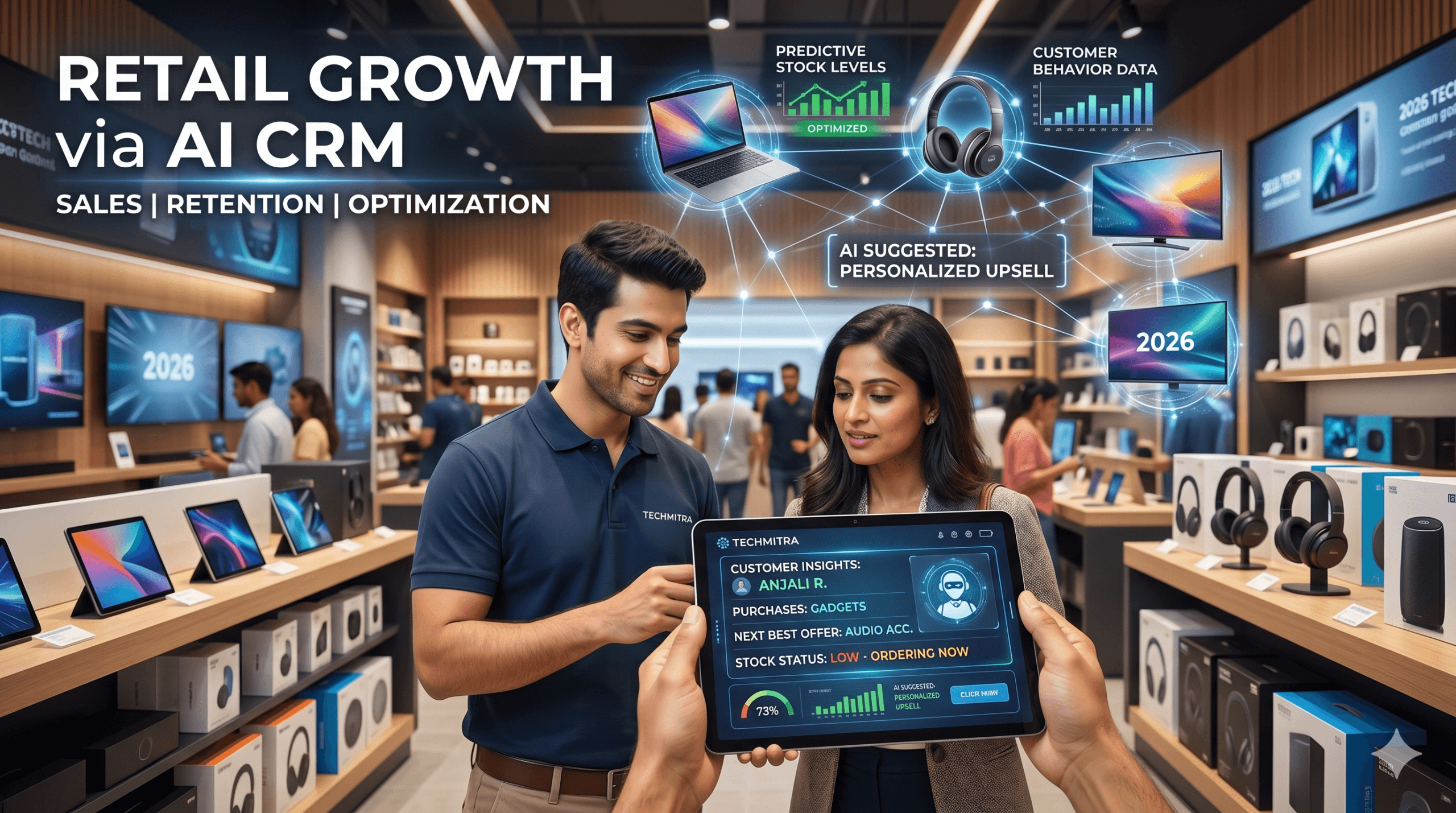
Retail in 2026 is no longer just about stocking the right products or offering competitive prices. Customers are not short of options — they are short of patience. One delayed follow-up, one generic offer, or one poor experience, and they simply move on.
This is where AI-powered CRM (Customer Relationship Management) is quietly transforming retail businesses.
Studies now show a 21–30% rise in sales revenue after adopting AI-powered CRM, and retail chains using AI CRM have reported up to 40% sales uplift through hyper-personalized recommendations. These are not projections — they are results being seen across real businesses today.
As someone who worked in electronics retail between 2014 and 2019, I’ve seen how difficult it was to track customers manually. We relied on memory, handwritten notes, or basic billing data. Once a customer walked out, reconnecting with them was mostly luck. Today, AI CRM for retail sales changes that equation completely — helping retailers understand, predict, and engage customers automatically.
This article explains what AI CRM is, how it helps retailers in real life, what’s new in mid-2026, and which AI CRM tools are worth considering — especially for Indian retailers.
Table of Contents
Also Read : Why Retail Shops in India Need E-Commerce: Lessons From 10+ Years in Retail
What Is AI CRM Software?
A traditional CRM stores customer details such as name, phone number, and purchase history. Useful — but passive.
AI CRM goes much further. It uses artificial intelligence — including machine learning, natural language processing, and predictive scoring — to analyze customer behavior, predict intent, and automate actions like follow-ups, offers, and reminders.
Rather than waiting for you to act on data, AI CRM acts for you.
Traditional CRM vs AI CRM
| Traditional CRM | AI CRM |
|---|---|
| Stores customer data | Understands customer behavior |
| Manual follow-ups | Automated, smart follow-ups |
| Generic campaigns | Personalized recommendations |
| Reactive | Predictive & proactive |
| Requires human analysis | Machine learning does the analysis |
| Fixed reports | Real-time, adaptive dashboards |
Think of AI CRM as a smart sales assistant that never forgets a customer, never misses a follow-up, and keeps learning with every interaction.
Why Retail Needs AI CRM in 2026
Retailers today face three core problems:
- Customers compare prices instantly
- Repeat purchases are hard to maintain
- Staff time is limited and expensive
AI CRM directly addresses these issues by helping retailers sell smarter, not harder.
Instead of chasing every customer equally, AI CRM focuses attention on:
- Customers most likely to buy again
- The right timing for offers
- Personalized communication that actually converts
This shift from transaction-based selling to relationship-based selling is what separates growing retailers from struggling ones.
According to Gartner, automation alone can reduce administrative sales work by nearly 20% — freeing staff to focus on serving customers rather than managing records.
Also Read : Google Universal Commerce Protocol Introduced enable AI-powered shopping directly from Search and Gemini
How AI CRM for Retail Sales Helps Retailers
1. Predicts Customer Buying Behavior
AI CRM studies:
- Past purchases
- Frequency of visits
- Time gaps between orders
- Browse and inquiry patterns
Using this data, it predicts what a customer is likely to buy next — and when.
Example: A customer buys a mixer grinder. AI CRM learns that similar customers often buy a juicer jar or extended warranty within 30–40 days. The system automatically triggers a reminder or offer — without any manual effort.
Earlier, this depended purely on staff experience. Now, it’s data-driven and consistent.
2. Increases Repeat Purchases (Where Real Profit Lies)
Every retailer knows:
It’s cheaper to sell to an existing customer than to find a new one.
AI CRM helps by:
- Sending refill reminders at the right time
- Offering loyalty discounts to high-value customers
- Suggesting relevant upgrades based on purchase history
Instead of random promotions, customers receive timely and relevant messages, increasing repeat sales naturally.
3. Automates WhatsApp, SMS, and Email Follow-Ups
In India, WhatsApp is often more powerful than email.
AI CRM can automatically:
- Send inquiry follow-ups within minutes
- Share order confirmations and delivery updates
- Deliver personalized offers based on customer history
- Collect post-purchase feedback
During my retail days, many customers said, “I’ll think and come back.” Today, AI CRM doesn’t wait — it follows up politely and consistently, turning indecision into sales.
4. Identifies High-Value and At-Risk Customers
AI CRM segments customers into:
- Loyal high-value buyers
- Occasional shoppers
- Price-sensitive customers
- Customers likely to stop buying (churn risk)
This allows retailers to:
- Reward loyal customers with exclusive offers
- Re-engage at-risk customers before they leave
- Avoid unnecessary blanket discounts
This smart segmentation directly improves margins.
5. Reduces Manual Work for Staff
Retail staff already handle billing, walk-in customers, inventory, and service queries.
AI CRM reduces workload by:
- Auto-logging customer interactions
- Updating customer records automatically
- Triggering follow-ups on its own
This allows staff to focus on selling and customer service, not paperwork. Research shows automation reduces admin sales work by nearly 20% — a significant saving for understaffed retail stores.
6. Enables Smarter Inventory Decisions
When AI CRM tracks what customers ask for — even products you don’t stock — it creates a demand signal you’d otherwise miss. Over time, this data helps retailers stock better, reduce dead inventory, and plan seasonal purchases with more confidence.
Also Read : Top 10 Free and Best Email Services Indians Should Choose From (Hands-On Review)
What’s New in AI CRM for Retail in Mid-2026
The original version of this article was published in January 2026. A lot has evolved since then. Here’s what’s changed and what Indian retailers should know now.
AI Agents Are Reshaping Retail Commerce
The biggest shift in 2026 is the rise of agentic commerce — AI agents that don’t just assist shoppers, they actively surface products, compare options, and complete purchases on behalf of customers. Retailers who expose their catalog and loyalty data via APIs are becoming “agent-friendly storefronts” and are gaining significant share.
What this means for you: If your CRM and product catalog aren’t connected in a structured way, AI agents from platforms like Google, Meta, and Amazon may not surface your products at all.
Voice-Enabled CRM Is Now a Reality
Voice-to-text notes, voice search within CRM dashboards, and voice-triggered customer lookup are now standard features in leading CRM platforms. For Indian retail staff who are often more comfortable speaking than typing, this is a meaningful productivity gain.
Proactive Refill Intelligence (Beyond “We Miss You”)
Modern AI CRM in 2026 has moved well beyond generic “we miss you” messages. The new standard is predictive refill alerts — the CRM calculates when a customer will run out of a product (based on purchase quantity and typical consumption) and sends an SMS 2–3 days before they need to reorder.
For retailers selling FMCG, stationery, consumables, or any repeat-purchase product, this is a major revenue lever.
Privacy-First Data Governance Is Now Non-Negotiable
As AI CRM systems collect more customer data, data governance has become a serious business concern. In 2026, regulatory scrutiny on customer data — even in India with the Digital Personal Data Protection Act — means retailers must use CRMs that offer:
- Consent-based data collection
- Clear opt-out options for customers
- Transparent data usage policies
When evaluating any CRM, ask: “How is customer data stored, and who can access it?”
Industry-Specific CRM Is Replacing Generic Solutions
A major 2026 trend: retailers are moving away from generic, heavily customizable CRMs toward vertical CRM solutions built specifically for retail, hospitality, fashion, or electronics. These purpose-built systems come pre-loaded with retail workflows, reducing setup time and cost significantly.
Also Read : Shopify vs WooCommerce India (2026): Real Cost, Hidden Charges & Which is Better
A Real Retail Scenario (Experience-Based Insight)
In my electronics retail days, many customers visited, compared prices on their phones, and left without buying. There was no system to track them. If they came back two weeks later, we often didn’t even remember their visit.
With AI CRM, the same situation plays out differently:
- The customer’s inquiry is logged at the point of first contact
- Interest level and product preference are recorded
- An automated WhatsApp follow-up goes out within 24 hours
- If they don’t respond, a gentle reminder follows in 3 days with a relevant offer
- If they buy, they’re moved into a loyalty follow-up sequence
Even a 10–15% improvement in conversions from inquiries can make a dramatic difference in competitive retail.
AI CRM for Small Retailers vs Large Retail Chains
AI CRM is no longer limited to big brands. Today, a single-store retailer in Tier 2 India can use the same AI capabilities that large chains pay lakhs to build.
| Feature | Small Retail Store | Large Retail Chain |
|---|---|---|
| Customer tracking | WhatsApp + AI CRM | Omni-channel CRM |
| Offers | Personalized by purchase history | AI-driven mass campaigns |
| Staff dependency | Significantly reduced | Optimized across locations |
| Decisions | Owner + AI insights | Fully data-driven |
| Setup time | Days to weeks | Weeks to months |
| Cost | ₹800–₹3,000/month | Custom enterprise pricing |
Even a single-store retailer can now use AI CRM effectively — and the entry barrier is lower than ever.
Popular AI CRM Tools for Retailers (2026)
1. Zoho CRM (with Zia AI)
Best for: Small to mid-size Indian retailers
- Predictive sales insights via Zia AI assistant
- Strong WhatsApp and SMS automation
- Deep integration with Zoho Inventory and Tally
- Affordable INR pricing with Indian support
Zoho remains the most retailer-friendly AI CRM for the Indian market, especially for businesses already using Tally or Zoho Books.
Check ZOHO CRM Official Website
2. HubSpot CRM
Best for: Retailers combining online and offline sales
- AI-assisted email and campaign drafting
- Free entry-level plan (genuinely functional)
- Excellent reporting and pipeline visibility
- Easy to set up without technical staff
Ideal for D2C brands or retailers with an active website or Instagram presence.
Check Hubspot CRM Official Website .
3. Freshworks CRM (Freddy AI)
Best for: Growing retail chains with multiple staff
- AI lead scoring and deal prioritization
- Sales forecasting with confidence scores
- WhatsApp, SMS, and email integrations
- Built-in phone and chat support tools
Strong balance between simplicity and power. Freddy AI has become noticeably smarter in 2025–26.
Check Freshworks CRM Official Website
4. Salesforce CRM (Einstein AI + Agentforce)
Best for: Large or enterprise-level retailers
- Advanced predictive analytics and AI agents via Agentforce
- Data Cloud for unified customer data across channels
- Multi-store, multi-region management
- Deep customization for complex retail workflows
Salesforce’s Agentforce — launched in late 2025 — is the most capable AI agent layer available in any CRM today. Powerful, but expensive and complex to implement.
Check Salesforce CRM Official Website
5. EngageBay CRM
Best for: Budget-conscious small retailers
- CRM + marketing automation in one platform
- Lead scoring and customer segmentation
- Email and SMS campaign tools
- Competitive pricing for startups and SMBs
A strong entry-level AI CRM that punches above its price point.
Check EngageBay CRM official Website
6. Netcore Smartech
Best for: Indian retailers with app, web, and WhatsApp channels
- Predictive segmentation built for Indian consumer behavior
- AI-driven customer journeys across channels
- Deep WhatsApp Business API integration
- Strong Indian market focus and local support
Excellent for omnichannel retailers who want a made-for-India solution.
Check Netcore Smartech Official Website
7. Pipedrive (with AI Assistant)
Best for: Retailers with active sales teams doing outbound calls
- Visual sales pipeline designed for salespeople
- AI-powered deal insights and next-step suggestions
- Easy for non-technical staff to use
- Good mobile app for field sales teams
Check Pipedrive Official Website
Choosing the Right AI CRM for Your Retail Business
For New & Small Retailers
- Zoho CRM — Best overall for Indian SMBs; Tally integration is a major plus
- HubSpot CRM (Free Tier) — Best if you’re starting from zero budget
- EngageBay — Best if you want CRM + email marketing in one
These are easy to set up, affordable, and scalable as you grow.
For Growing Retail Chains
- Freshworks CRM — Best for teams of 5–50 people
- HubSpot (Paid Automation) — Best for retailers with active marketing
- Pipedrive + Add-Ons — Best for outbound sales teams
Great balance between power and day-to-day simplicity.
For Large Retailers & Enterprise Level
- Salesforce CRM (Einstein + Agentforce) — Unmatched capability for complex, multi-store operations
Best for retailers with big data, multiple store locations, and dedicated IT teams.
Mobile CRM: A Must-Have for Indian Retailers
Most Indian retail staff work from mobile phones, not desktop computers. A CRM that’s desktop-first and mobile-second will simply not be used consistently.
In 2026, leading CRM platforms now offer:
- Real-time data sync across devices
- Offline mode — so staff can log customer info even without internet, with automatic sync when connection resumes
- Voice-to-text notes — staff can speak a customer interaction rather than type it
- GPS-based insights for field sales or delivery teams
- Push alerts for follow-up reminders
When evaluating any CRM for your retail store, test the mobile app first. If it’s clunky or incomplete on mobile, your staff won’t use it consistently — and an unused CRM helps no one.
Recommended mobile-first CRMs for Indian retailers: Zoho CRM, Freshworks CRM, HubSpot Mobile.
Bonus Tools & Integrations Retailers Can Use with AI CRM
AI CRM works best when connected to the rest of your retail tech stack:
| Tool Category | Examples |
|---|---|
| WhatsApp Automation | Twilio, Gupshup, WATI, Interakt |
| SMS Platforms | Msg91, TextLocal, Exotel |
| POS & Billing | Zoho Inventory, Tally, Shopify POS, Vyapar |
| Email Marketing | Mailchimp, SendGrid, Brevo (formerly Sendinblue) |
| E-commerce | Shopify, WooCommerce, Meesho, Amazon Seller |
| Loyalty Programs | LoyaltyXpert, Reelo (India-specific) |
These enhance your customer touchpoints and automation reach, making AI CRM significantly more powerful.
Integration Tips for Retailers
Sync All Sales Channels
Connect your POS, online store, Instagram, WhatsApp, and SMS platforms so all customer data flows to one place. Fragmented data means fragmented follow-ups — and missed sales.
Enable These Automations First
Start with workflows that deliver immediate ROI:
- New customer welcome message — sent within 1 hour of first purchase
- Abandoned inquiry follow-up — sent 24 hours after a customer enquired but didn’t buy
- Birthday or anniversary offer — personalized discount on the customer’s special day
- Refill reminder — triggered based on typical repurchase cycle
- Post-purchase review request — sent 5–7 days after delivery
Track the Right Metrics
Always monitor:
- Email/WhatsApp open rates — are messages being read?
- Conversion rate — of customers who received follow-ups, how many bought?
- Repeat purchase rate — are customers coming back more often?
- Revenue per customer — is average spend increasing?
Data tells you which campaigns work and which need adjustment.
AI CRM Pricing (Mid-2026 Estimates)
| CRM Tool | Estimated Starting Price* |
|---|---|
| HubSpot CRM (Free Tier) | ₹0 |
| EngageBay | ₹800–₹2,000/user/month |
| Zoho CRM | ₹900–₹2,500/user/month |
| Freshworks CRM | ₹1,200–₹3,000/user/month |
| Pipedrive | ₹1,200–₹2,700/user/month |
| Netcore Smartech | Custom pricing |
| Salesforce Einstein | Custom / Higher |
Prices are approximate and vary by plan, user count, and add-ons. Always check the official website for current pricing before subscribing.
Benefits of AI CRM for Retailers
- Higher customer retention through timely, relevant follow-ups
- Smarter promotions that match individual customer needs
- Better inventory planning based on real demand signals
- Reduced manual workload for staff
- Increased revenue per customer over time
- Data-driven decisions instead of gut feel
- Competitive advantage against larger chains
AI CRM converts customer data into daily decisions.
Challenges and Limitations
AI CRM is powerful — but not magic. Common challenges include:
- Initial learning curve — staff need time to adapt to new workflows
- Subscription costs — ongoing monthly spend that must be justified by ROI
- Data quality dependency — AI is only as good as the data you feed it; incomplete or outdated records reduce effectiveness
- Internet dependency — most cloud CRMs need a stable connection (though offline modes are improving)
- Data privacy responsibility — you are accountable for how customer data is stored and used
However, for growing retailers, benefits far outweigh limitations — especially once the system is set up and staff are trained.
Also Read : What is Cloud Computing? Meaning, Types, and Real Examples
Is AI CRM Worth It for Indian Retailers?
Yes, if:
- You want repeat customers and long-term loyalty
- You handle 50+ customers regularly
- You sell competitive products where follow-up makes the difference
- You run a D2C brand, electronics store, fashion boutique, or multi-store operation
Optional, if:
- You run a very small hyperlocal shop with a fixed, known set of regular buyers
Must-have, if:
- You manage multiple store locations
- You sell high-ticket items (electronics, furniture, appliances)
- You run an active WhatsApp or Instagram commerce operation
In 2026, AI CRM is no longer a luxury — it’s a competitive necessity for any retailer serious about growth.
The Future of Retail with AI CRM
The future retailer won’t ask:
“How many customers came today?”
Instead:
“How many customer relationships did we strengthen today?”
Retail is evolving toward a model where AI handles the analysis, timing, and communication — while humans focus on service quality, product knowledge, and building genuine trust.
The next phase — already beginning — involves AI agents that can interact with customers on behalf of retailers, answer product questions, process orders, and handle after-sales queries around the clock. Retailers who build structured, connected data ecosystems now will be far better positioned to take advantage of these capabilities.
AI CRM doesn’t replace humans. It amplifies human effort, reduces guesswork, and builds the kind of long-term customer loyalty that no discount can buy.
FAQs
Is AI CRM useful for small retailers in India?
Yes. Even a single-store retailer benefits immediately from automated WhatsApp follow-ups and customer segmentation. You don’t need a large team or a big budget to start.
Which AI CRM works best for WhatsApp-first Indian retailers?
Zoho CRM (with WATI or Interakt integration) and Freshworks CRM offer the strongest WhatsApp Business API support for Indian retailers. Netcore Smartech is purpose-built for this use case.
Can AI CRM integrate with Tally or billing software?
Yes. Zoho CRM integrates natively with Zoho Books and has a well-supported Tally connector. Several third-party tools also connect Tally data to other CRMs like HubSpot.
What data do I need to start using AI CRM?
Start with basic data: customer name, phone number, and purchase history. Even a simple exported list from your billing software is enough to begin. The AI learns and improves as more data accumulates.
Does AI CRM replace sales staff?
No. It enhances staff productivity by handling routine follow-ups and record-keeping, freeing people to focus on high-value conversations and customer service.
Is AI CRM expensive for a small shop?
Not necessarily. HubSpot’s free tier is genuinely functional. Zoho and EngageBay have affordable plans starting under ₹1,000/user/month. The ROI from even a small improvement in repeat purchases usually covers the cost quickly.
How soon can results be seen?
Most retailers notice improvement in follow-up consistency within the first month. Measurable sales impact typically shows within 2–3 months of consistent use.
What about data privacy for my customers?
You are responsible for informing customers that their data is stored and used for communication. Most modern CRMs offer opt-out management and DPDP-compliant data handling. Always review a CRM’s privacy policy before onboarding customer data.
Final Thoughts
AI CRM is not about chasing trends — it’s about staying relevant in modern retail.
Retailers who adopt AI CRM are not just automating tasks. They are building a systematic advantage: understanding customers better, acting at the right moment, and creating the kind of consistent experience that earns loyalty over time.
From handwritten customer registers to predictive dashboards, retail has evolved rapidly. And AI CRM is now the bridge between effort and efficiency for every retailer — from a single store in Lucknow to a chain across fifty cities.
The tools are affordable. The results are real. The time to start is now.
Disclaimer: This article is published for informational and educational purposes only. Business processes, tools, pricing, and results may vary depending on store size, location, and implementation. Prices mentioned are approximate and should be verified on official websites before purchasing. Readers are advised to evaluate solutions based on their own specific requirements.

Ayush Singhal is the founder and chief editor of TechMitra.in — a tech hub dedicated to simplifying gadgets, AI tools, and smart innovations for everyday users. With over 15 years of business experience, a Bachelor of Computer Applications (BCA) degree, and 5 years of hands-on experience running an electronics retail shop, Ayush brings real-world gadget knowledge and a genuine passion for emerging technology.
At TechMitra, he covers everything from AI breakthroughs and gadget reviews to app guides, mobile tips, and digital how-tos. His goal is simple — to make tech easy, useful, and enjoyable for everyone. When he’s not testing the latest devices or exploring AI trends, Ayush spends his time crafting tutorials that help readers make smarter digital choices.
📍 Based in Lucknow, India
💡 Focus Areas: Tech News • AI Tools • Gadgets • Digital How-Tos
📧 Contact: Get in touch →
🔗 Full Bio: https://techmitra.in/about-us/