

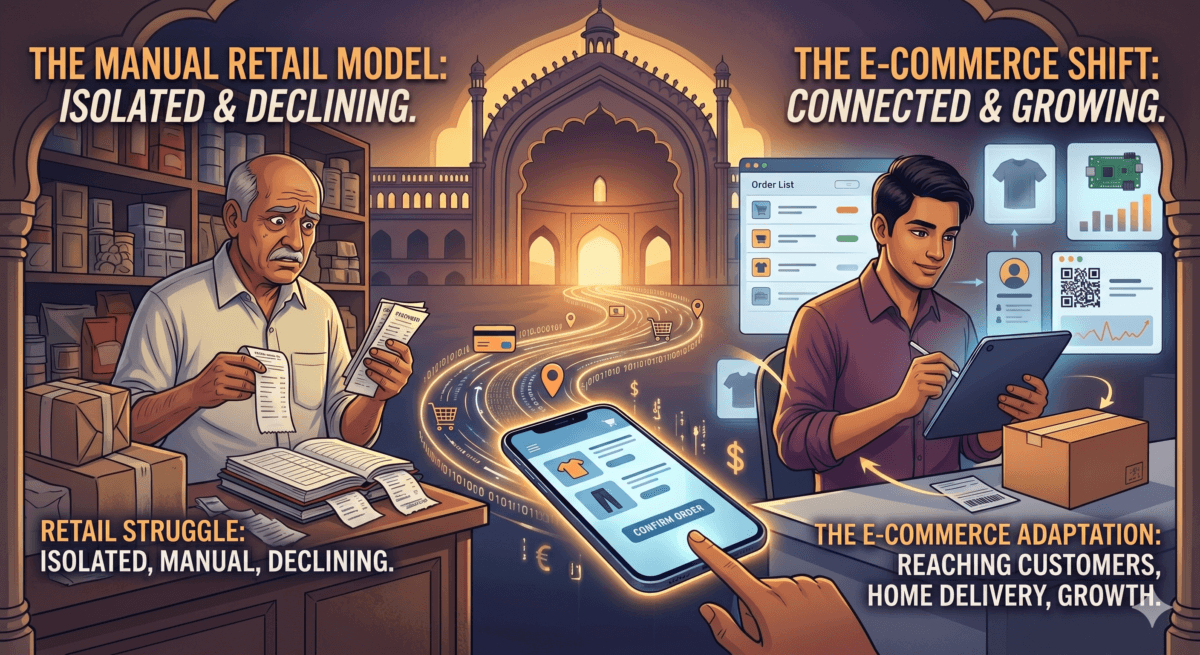
Why E Commerce for Retail Is No Longer Optional
I’ve sold products across the counter for over a decade, in two very different retail categories — and I’ve watched e commerce for retail go from “something only city customers cared about” to the single biggest reason small shops in India are struggling, or surviving.
This isn’t a textbook explanation of why e-commerce for retail matters. It’s what I actually saw happen to my own business, and what I’m watching happen again right now in a category most people assumed was immune to it.
My Background: Two Businesses, One Hard Lesson
Retail was in my blood, but in 2014, I decided to build something of my own and launched an electronics retail store. For the first couple of years, it worked the way retail had always worked. Customers walked in, compared two or three brands in person, asked questions, negotiated a little, and bought. That model had survived for decades, and I assumed it would keep working.
Then Flipkart, Amazon, and hyper-local digital trade started rewriting the rules of Indian commerce. I watched the ground shift under my own shop, year by year. While I ran that specific electronics storefront until 2019, the broader math of traditional retail kept getting tougher. After twelve years in the retail ecosystem, I made the calculated decision in December 2024 to shut down my retail operations entirely to focus 100% on digital entrepreneurship, web development, and e-commerce.
Looking back at that transition, the warning signs were there for years. The mechanics of how customers buy have fundamentally changed, and any retailer who ignores them is running on borrowed time.
Also Read : How AI CRM Helps Retailers Grow Sales, Retain Customers, and Compete Smarter in 2026
What Actually Happened on the Retail Floor (And Why the Ground Shifted)
In the early years, customers behaved predictably: they came in, handled the product, asked questions, and walked out with it. But by 2016, that pattern broke down in very specific, visible ways:
- Instant Price Anchoring: Customers stopped trusting walk-in pricing. They’d pull out their phone right there in my shop and check the same product online before deciding anything. I wasn’t competing with the shop next door anymore—I was competing with every major e-tailer in the country, instantly, from inside my own store.
- The Vanishing Footfall: A massive segment of people stopped coming to physical shops entirely. Why deal with Lucknow’s traffic, parking, and negotiation when the phone solves the same need?
- New Baseline Expectations: Two things customers wanted that a standard counter conversation genuinely couldn’t replicate were browsing on their own time and home delivery. Scrolling through photos and specs at midnight without a salesperson hovering became the preferred way to shop. Once e-commerce normalized cheap or free delivery, expecting customers to carry their own heavy purchases home started to feel like a downgrade rather than a service.
- The Margin Squeeze: Margins kept shrinking because brick-and-mortar stores often have to slash prices to match online sellers—while still carrying heavy rent, staff salaries, and electricity costs. You end up competing on price against businesses with a fundamentally different, hyper-scaled cost structure.
By the time the financial pressure becomes critical, you are usually reacting to changes that have already been building for two or three years. I realized that the future wasn’t in fighting the digital tide, but in riding it.
Why This Shift Is Happening Across Indian Retail, Not Just My Two Categories
Based on what I’ve lived through, here’s where I think the pressure is actually coming from — not as abstract market commentary, but as the mechanics I’ve watched play out at my own counter.
Price comparison has become instant and automatic
This is the single biggest shift I’ve personally experienced. Whether it was electronics in 2016 or sanitary fittings today, customers increasingly treat a physical shop as a place to confirm a decision they’ve already made online, not a place to discover and decide. If your price isn’t competitive — or isn’t visible anywhere online — you’re starting every conversation at a disadvantage you can’t see coming.
A meaningful share of customers actively prefer not to visit a shop at all
This was the part that genuinely surprised me. It isn’t only convenience-seeking younger customers — it’s people who simply don’t want to deal with traffic, parking, or travel time when their phone solves the same need. A business that exists only as a physical location is invisible to this entire group, no matter how good the in-store experience is.
Photos, specifications, and delivery aren’t optional add-ons anymore
When I had my electronics shop, I underestimated how much customers wanted to browse at their own pace and have the item delivered without a trip. I’m seeing the identical expectation form in sanitary goods now. These used to be conveniences a shop could offer as a bonus. They’re now baseline expectations a customer assumes you’ll meet.
Your competition is no longer defined by geography
A shop’s customer base used to be the neighborhood, or whoever was willing to travel a few kilometers. Once a customer can order from anywhere and have it delivered, your real competition isn’t the shop down the road anymore — it’s every seller they can find through the same search, anywhere in the country.
What Retail Businesses Can Actually Do About It
I’m not going to pretend every small retailer needs a full e-commerce platform overnight. I didn’t build one for either of my businesses, and that’s part of why my electronics shop struggled as long as it did. Based on what I’ve seen work for shops around me that adapted in time, here’s what actually matters, roughly in the order I’d tackle it.
1. Get visible online in some form, even a basic one
You don’t need a full Shopify or WooCommerce store on day one. A WhatsApp Business catalog, an Instagram page with clear photos and prices, or a simple listing on a local marketplace app is enough to capture customers who are now searching before they ever visit. The goal at this stage isn’t a polished storefront — it’s existing somewhere a phone-first customer can find you.
If and when you do want a proper website, WooCommerce (a WordPress plugin) tends to suit small Indian retailers well because it’s relatively low-cost to set up and doesn’t lock you into a monthly platform fee the way Shopify does. Shopify is easier to use out of the box but comes with recurring subscription costs that matter more when you’re a single-shop operation rather than a scaling brand.
Check my comparison of Shopify vs WooCommerce India (2026): Real Cost, Hidden Charges & Which is Better
2. Offer delivery, even informally, for your common items
This was the single biggest gap I felt in my electronics shop, and I didn’t act on it until it was too late. You don’t need a logistics partnership on day one — a local delivery boy, your own scooter for nearby orders, or a tie-up with a local courier for a small radius covers most small-retail delivery needs. Customers are often willing to pay a small delivery charge; what matters is that the option exists at all.
3. Be upfront and competitive with your pricing wherever customers can see it
If customers are already checking prices on their phone inside your shop, hiding your pricing online just pushes them toward competitors who do show it. Listing transparent prices, even on a basic WhatsApp catalog, builds the same trust that used to come from a face-to-face conversation.
4. Use photos and clear product details to replace what in-person inspection used to provide
This matters even in categories like sanitary goods, where people assume physical inspection is necessary. Clear photos from multiple angles, accurate dimensions, and honest notes about finish or quality go a long way toward replacing what a customer used to get by picking the product up in your shop.
5. Don’t wait until margins are already shrinking to act
By the time I felt the financial pressure in my electronics shop, I was reacting to changes that had already been building for two or three years. The retailers I see doing well today started adapting before the pressure became unavoidable — not after.
Check best Cloud VPS hosting plans for businesses in my article
My Honest Take
I’ve now seen this shift from both sides: as someone who lost a business partly because I didn’t adapt to it fast enough, and as someone currently watching it unfold again in a category that was supposed to be more resistant.
E-commerce isn’t replacing retail shops entirely. Sanitary goods, like many categories, still benefits from a physical presence customers can trust and visit when they genuinely need to see something in person. But the shops that survive this shift are the ones meeting customers where they now actually are — comparing prices on their phones, wanting photos and clear information before they decide, and increasingly expecting delivery as a default rather than a favor.
I didn’t make that shift in time with my electronics shop. I’m making sure I don’t repeat that mistake with the business I’m in now.

Ayush Singhal is the founder and chief editor of TechMitra.in — a tech hub dedicated to simplifying gadgets, AI tools, and smart innovations for everyday users. With over 15 years of business experience, a Bachelor of Computer Applications (BCA) degree, and 5 years of hands-on experience running an electronics retail shop, Ayush brings real-world gadget knowledge and a genuine passion for emerging technology.
At TechMitra, he covers everything from AI breakthroughs and gadget reviews to app guides, mobile tips, and digital how-tos. His goal is simple — to make tech easy, useful, and enjoyable for everyone. When he’s not testing the latest devices or exploring AI trends, Ayush spends his time crafting tutorials that help readers make smarter digital choices.
📍 Based in Lucknow, India
💡 Focus Areas: Tech News • AI Tools • Gadgets • Digital How-Tos
📧 Contact: Get in touch →
🔗 Full Bio: https://techmitra.in/about-us/