

Last Updated: 14′ August 2026
Table of Contents
Also Read : Jio AirFiber vs Airtel Xstream AirFiber: Full Plan Comparison (2026)
Introduction: A 18-Month Reality Check (Not a First Impression)
Introduction: An 18-Month Reality Check (Not a First Impression)
Most Jio AirFiber reviews you’ll find online are based on the first few days of setup, not real long-term use. This one is different. I’ve been using Jio AirFiber for 18 months in Lucknow, and this review is built on real daily usage — peak-hour slowdowns, extreme summer heat (tested at 41°C), monsoon performance, gaming and cloud gaming, and heavy OTT and multi-device use. If you’re planning to install AirFiber in 2026, this is the practical, long-term review you actually need.
Jio AirFiber Good or Bad? My Honest Take
I’ll address this directly, because it’s the question most people actually have. If you search online, most Jio AirFiber reviews and discussions — including plenty of posts on X (Twitter) — lean negative. I’ve had people comment on my own posts assuming I’m promoting AirFiber simply because my experience has been positive. To be clear: this is not a sponsored review. It’s my genuine, personal experience after 18 months of daily use.
Here’s why reviews are so mixed. Jio AirFiber’s performance depends heavily on three things: 5G signal strength in your area, tower congestion, and installation quality. In areas with weak signal or an improperly aligned outdoor unit, speeds can fall short of the plan and performance can fluctuate — and that’s genuinely where most of the negative reviews come from. I’ve also noticed a pattern where some negative feedback comes from installations that weren’t done correctly in the first place, rather than a fault with the technology itself.
In my case, I have strong 5G coverage in my area and the installation was done properly. The result has been no major issues, stable speeds, and reliable daily usage for 18 months straight. So my honest verdict is this: Jio AirFiber isn’t inherently good or bad — it’s location-dependent. In a strong-signal area, it’s an excellent experience. In a weak-signal area, expect a poor one. That’s the reality, and it’s worth knowing before you install.
Also Read : Jio AirFiber vs Airtel Xstream AirFiber: Full Plan Comparison (2026)
How Does Jio AirFiber Perform in Rainy Season?
This is one of the most-asked questions I get, and most reviews don’t address it with real data — so here’s mine.
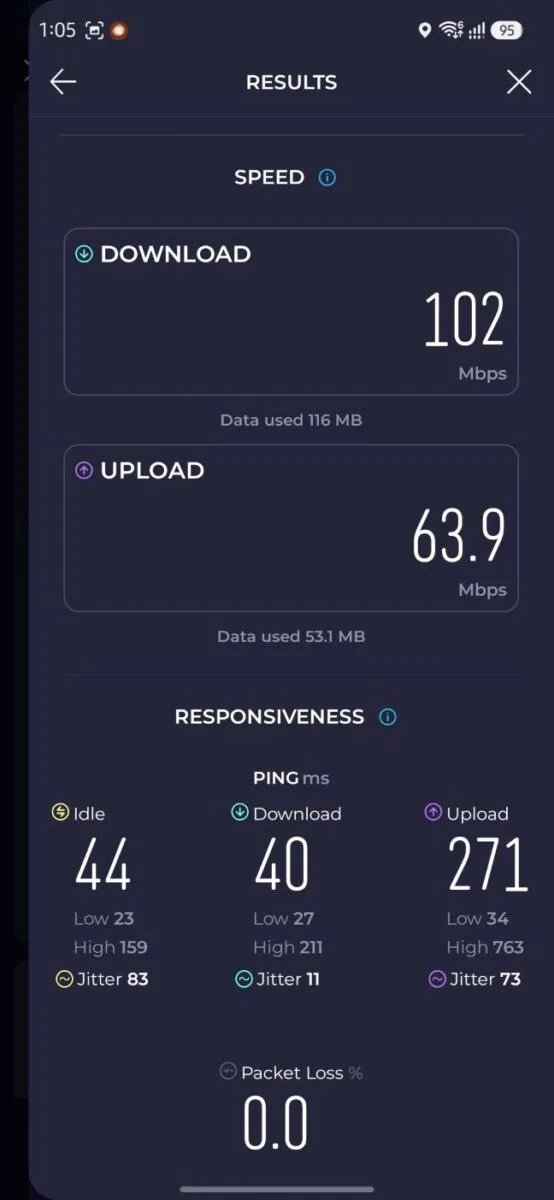
I ran a fresh speed test during light drizzle in Lucknow in July 2026, and the results were essentially identical to my dry-weather numbers: 102 Mbps download, 63.9 Mbps upload, 0.0% packet loss. Ping stayed reasonable at 44ms idle and 40ms on download. The one place I noticed a difference was upload jitter, which ran a bit higher than usual (73ms) — but this didn’t translate into any noticeable slowdown for normal browsing, streaming, or day-to-day use.
In heavier rain, I’ve noticed jitter can increase further, but I haven’t experienced any real disconnection or meaningful speed drop, even during Lucknow’s monsoon season.
Here’s a real advantage of AirFiber that most comparisons miss: wired fiber has its own rain-related failure mode. Heavy rain can cause tree falls or water damage that physically snaps fiber cables — and I dealt with exactly this kind of disruption regularly on my old JioFiber connection (in my case, from monkeys damaging the line, not weather, but the vulnerability is the same). A wireless connection like AirFiber sidesteps that entire failure mode entirely, since there’s no exposed cable to damage.
Why I Switched from JioFiber
Before AirFiber, I used JioFiber (₹999/month, 150 Mbps) for two years with no real issues on speed or service. The actual problem was physical: monkeys damaging the fiber cable roughly every 15–20 days, causing frequent disconnections and 5–6 hour repair wait times each time it happened. That’s what pushed me to switch to Jio AirFiber in January 2025 — a completely wireless solution that removes that specific failure point.
What Is Jio AirFiber? (Simple Explanation)
Jio AirFiber is a wireless broadband service that uses Jio’s 5G network to deliver high-speed internet at home without a physical fiber-optic cable. Unlike JioFiber, which needs a wired connection run into your home, AirFiber works through a 5G receiver that connects to the nearest Jio tower and delivers internet through a Wi-Fi router.
How it works: Installation includes an outdoor 5G receiver (CPE), an indoor Wi-Fi router, and access to Jio’s 5G network. The outdoor receiver captures the 5G signal and converts it into a broadband connection for your home.
Key features:
- No fiber cable installation required
- Quick, plug-and-play setup
- Speeds up to 100 Mbps and above, depending on plan
- Supports multiple devices simultaneously
- OTT and Live TV benefits included on select plans
Who should consider it: AirFiber is a strong fit for homes where fiber broadband isn’t available, users who want a fast setup without waiting for cable installation, families running multiple smartphones/TVs/laptops at once, and anyone looking for a wireless alternative to traditional broadband. In my 18 months of use in Lucknow, it’s delivered stable performance whenever the 5G signal is strong and the installation was done correctly.
JioFiber vs Jio AirFiber: The Real Difference
| Feature | JioFiber | Jio AirFiber |
|---|---|---|
| Technology | Wired Fiber | 5G Wireless |
| Stability | Very Stable | Depends on network load |
| Installation | Wiring required | Plug & Play |
| Downtime Risk | Cable damage | Tower congestion |
| Best For | Gaming, heavy usage | General home usage |
My honest take: wired fiber is still more stable on paper, but AirFiber is more practical in real-world situations — especially anywhere cable damage (from monkeys, construction, or storms) is a recurring problem.
Jio AirFiber ₹899 Plan: The Actual Cost
- Base price: ₹899
- GST: ₹161.80
- Total: ₹1,060.80/month
What you get: 100 Mbps speed, 1000 GB (1TB) monthly data, plus OTT apps and 1000+ Live TV channels. For most households, this is genuinely strong value.
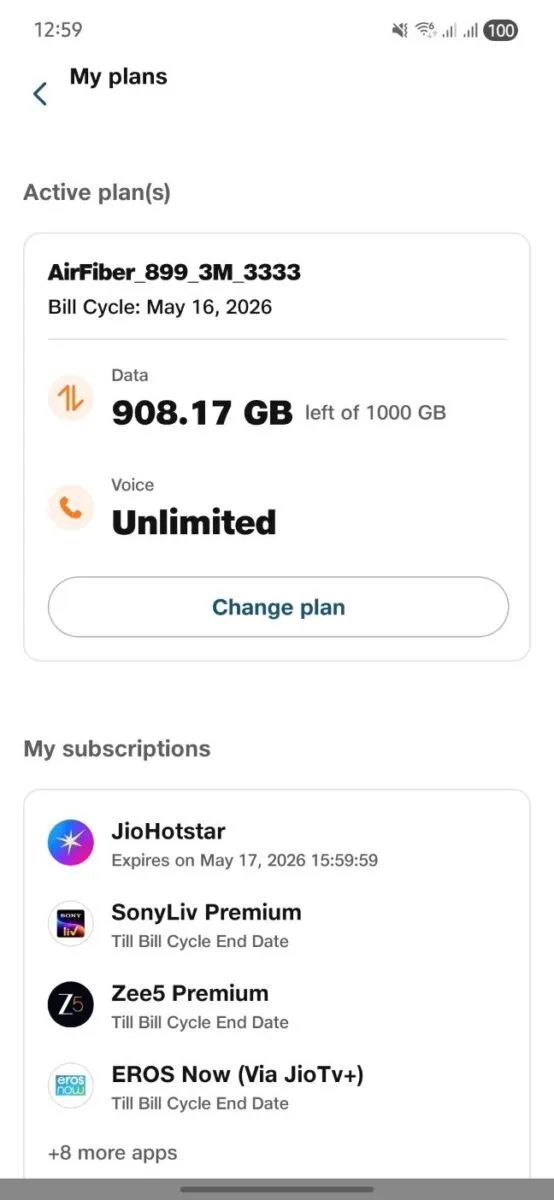
To check full Jio Airfiber plans details Click Here
Jio AirFiber Speed Test Results
April 2026 — Tested in ~41°C heat:
- Download: 101 Mbps
- Upload: 80.6 Mbps
- Idle Ping: 33 ms
- Latency (Download): 311 ms
- Latency (Upload): 188 ms
- Jitter: 11.9 ms
This is something most reviews skip entirely: how AirFiber holds up in extreme Lucknow summer heat. Across repeated testing, I saw no overheating, no shutdowns, and no meaningful speed drop — genuinely strong reliability even in harsh conditions.
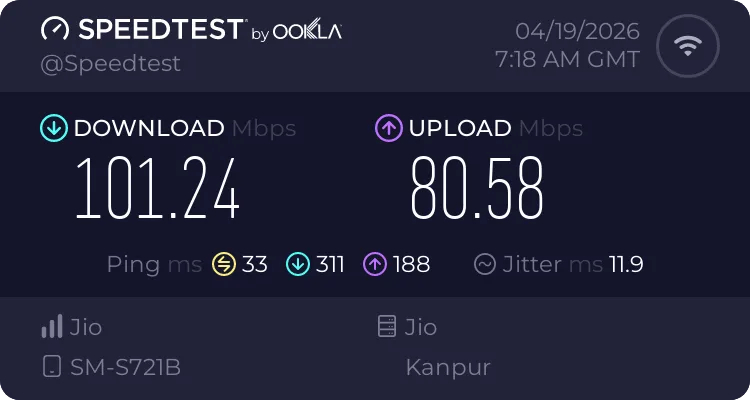
This is something most reviews skip entirely: how AirFiber holds up in extreme Lucknow summer heat. Across repeated testing, I saw no overheating, no shutdowns, and no meaningful speed drop — genuinely strong reliability even in harsh conditions.
June 2026 — Multi-device test (June 9): Download: 103.57 Mbps, Upload: 59.73 Mbps, while the connection was actively being used by 4 smartphones and 1 laptop simultaneously. I didn’t notice any significant lag during normal browsing, streaming, or work tasks — suggesting the router handles a typical household’s multi-device load comfortably.
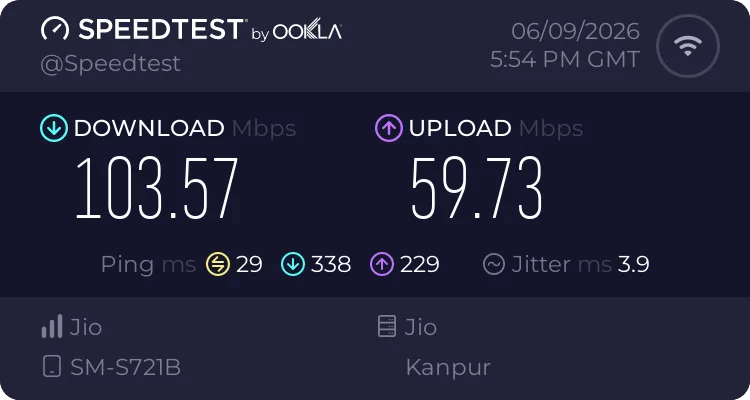
During my latest speed test in June 2026, Jio AirFiber delivered 103.57 Mbps download and 59.73 Mbps upload speed. At the time of testing, the connection was actively being used by 4 smartphones and 1 laptop, yet I did not notice any significant lag or slowdown during normal browsing, video streaming, or work-related tasks.
This suggests that the Jio AirFiber router can comfortably handle multiple connected devices in a typical household environment. In my experience, day-to-day performance has remained stable even with several devices connected simultaneously.
Real-world performance in Lucknow (Tier-2 city): during normal hours, it performs almost like fiber. During peak hours (evenings, cricket matches), there’s a slight slowdown — mostly tied to tower congestion and signal strength rather than the technology itself.
Also Read : JioPC Goes Standalone: No More JioHome Required, New Plans, and What Actually Changed
Real Usage Experience After 18 Months
What works well: speeds staying consistently in the 95–100 Mbps range, near-zero downtime, strong upload speeds, and smooth OTT streaming even in 4K.
Peak-hour reality: during high-traffic periods like cricket matches or evening hours, apps can open a little slower and YouTube may buffer at 1080p — even when a speed test at that moment shows normal numbers. It’s a real quirk worth knowing about rather than a dealbreaker.
Gaming & Cloud Gaming Performance (2026 Update)
Casual gaming runs smoothly. Competitive gaming is more dependent on latency and can be inconsistent. Cloud gaming is genuinely playable — a real improvement over earlier performance. That said, it’s still not as stable as wired fiber for serious, competitive gamers.
OTT & Live TV Experience
AirFiber includes 1000+ Live TV channels through the Jio TV+ dashboard, along with access to platforms like Hotstar, SonyLIV, and Zee5. Netflix, Amazon Prime, Jio Games and YouTube Premium aren’t bundled in, but you can log in with your own subscriptions and access everything from a single dashboard — creating a genuinely smart-TV-like experience without switching between apps.
Also Read : Jio Cloud Gaming Review: I Tested It on Mobile, TV and a 4GB RAM PC — Here’s the Honest Truth
Router Control & Settings (Important Limitation)
👉 You don’t get router admin access
Only allowed:
- Change WiFi name
- Change password
Through MyJio App.
Not Available:
- No advanced settings
- No port forwarding
- No band control
👉 Good for beginners
👉 Frustrating for advanced users
Jio Diagnostics Tool: A Genuinely Useful Feature
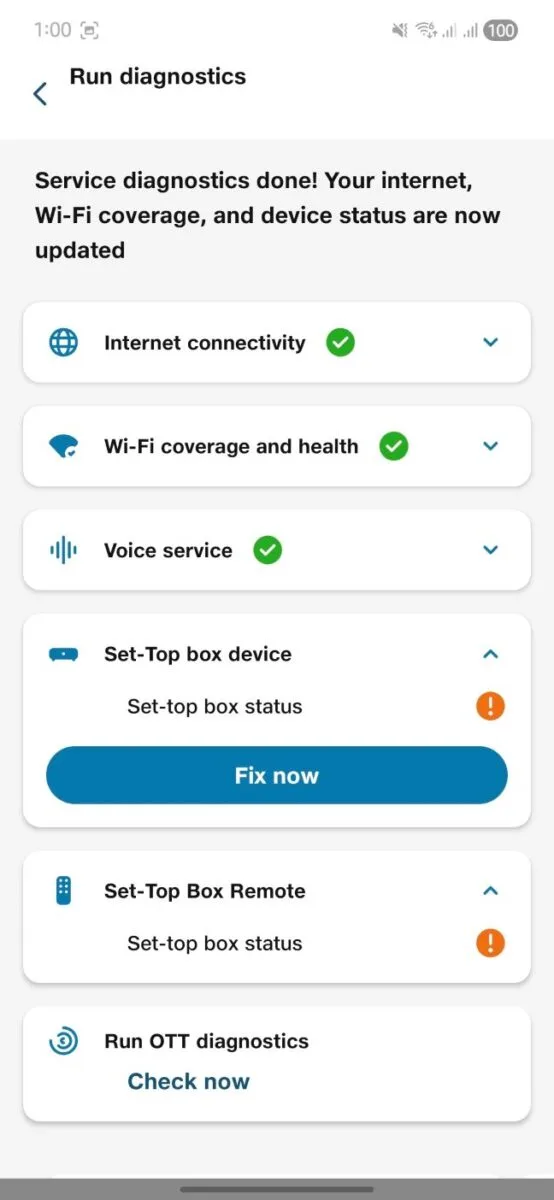
This is one of the more impressive parts of the experience. Inside the MyJio app, the diagnostics tool checks your connection instantly, detects issues automatically, and shows a clear error message. The best part: a single click registers a complaint and generates a reference number instantly — no need to call support at all.
Related: How to Protect Your Home Wi-Fi Network: The Ultimate Security Guide
Data Limit (FUP) in 2026
The current limit is 1000 GB/month — important to keep in mind if you’re doing heavy 4K streaming, running AI tools regularly, or downloading large files often.
AirFiber vs Jio 5G Hotspot (Postpaid ₹449 Plan)
| Feature | AirFiber | 5G Hotspot |
|---|---|---|
| Stability | Better | Unstable |
| Devices | 20–30 | Limited |
| Speed | Consistent | Fluctuates |
| Gaming | Medium | Poor |
AirFiber is a proper home broadband solution; the hotspot plan is better suited as a backup or for lighter, mobile use.
Also Read: My Jio Postpaid Family Plan ₹449 Review and Experience
Billing & Initial Cost
Monthly billing: ₹1,060.80/month, paid in advance.
Initial setup cost: ₹3,333 upfront, covering 3 months of usage, installation, and the device itself.
Jio AirFiber Customer Care & Support Options
- Customer Care Number: 1800 896 9999
- Email Support: [email protected]
- X (Twitter) Support: @JioCare
My experience with support: Jio pushes users toward the MyJio app’s AI-powered chat support first for troubleshooting and complaints. It handles basic issues reasonably well, but I’ve found it falls short on more complex problems. For anything detailed, I’ve had better results with email support (good for written records and follow-ups) and the @JioCare account on X, which tends to be faster for escalation. The MyJio app remains useful specifically for diagnostics and complaint tracking, and the phone line is fine for general account questions. Support quality can vary depending on the issue and your location, so it’s worth trying more than one channel if the first doesn’t resolve things.
Pros & Cons (Updated 2026)
Pros:
- Stable speeds, including in extreme heat and rain
- No cable-damage risk (unlike wired fiber)
- Cloud gaming supported
- 1000+ Live TV channels with smart OTT dashboard
- Strong upload speeds
- Excellent, fast diagnostics tool
Cons:
- Peak-hour slowdown in some areas
- Latency fluctuation, especially on upload
- No router admin access
- Not ideal for competitive gaming
- Performance depends heavily on 5G signal strength
- 1TB monthly data cap
Technical FAQs (2026)
Bridge mode? Not available. NAT type? Moderate. Can I use my own router? Limited support only.
Who Should Buy Jio AirFiber?
Best for: families, work-from-home users, heavy OTT users, and anyone in an area where wired cable connections keep failing.
Consider skipping it if: you need consistently low latency or you’re a hardcore/competitive gamer — wired fiber is still the better choice there.
Update: August 14, 2026 — Real Service Disruption & Jio’s Resolution Time (First-Hand Account)
As part of our ongoing first-hand review of JioAirFiber, we experienced our first-ever service outage today — 19 months into using the connection. Here’s the complete timeline, documented as it happened.
9:00 AM — WiFi dropped on all devices. Router showed a red light.
We checked the diagnostics section in the MyJio app, which flagged an “Inside Home Connectivity — Service fault detected” error, with a message saying restoration was taking longer than expected.
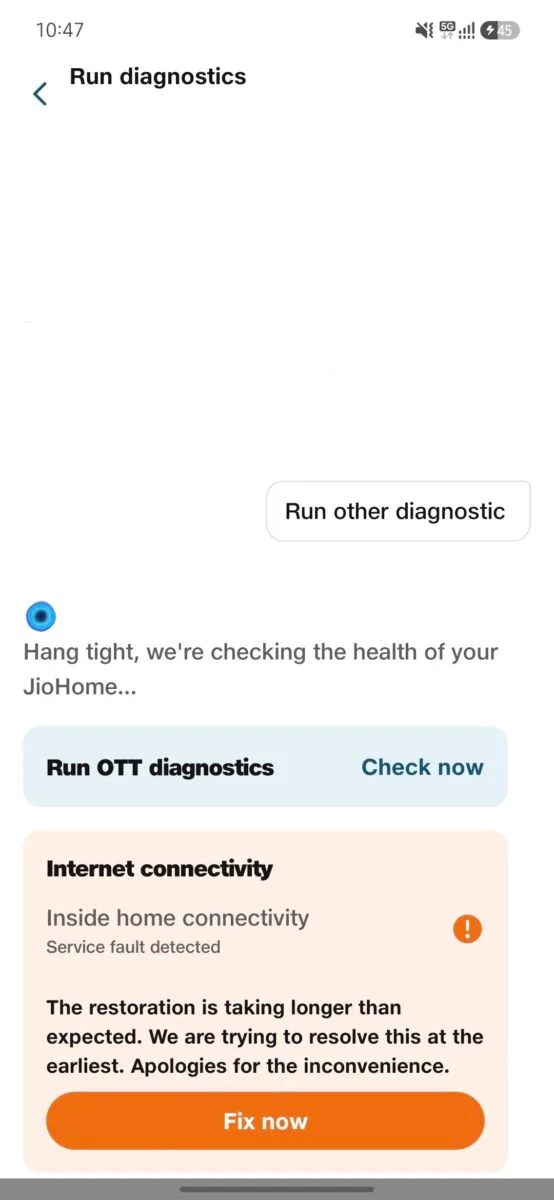
No calls, no emails needed — complaint raised directly from the app
One thing worth highlighting here: when the diagnostics couldn’t auto-resolve the issue, we didn’t have to call Jio customer care or email anyone. The same diagnostics screen had a “Fix Now” option to raise a complaint directly — one tap, and it was registered instantly, with an SMS confirmation received right away. Jio’s standard resolution commitment for such complaints is within 24 hours. In our case, it was resolved in under 5 hours — well inside that window.
This is a meaningful convenience factor: no hold music, no repeating account details to a call center agent, no waiting on email replies. The entire fault-reporting process happened inside the MyJio app itself.
Here’s the full timeline:
- Power-cycled the router (off/on) — no change.
- Waited another 30 minutes in case it was a temporary network-side issue — still down.
- Checked the outdoor unit on the roof — found it had no power at all.
- 9:59 AM — Registered a formal complaint via the app’s “Fix Now” option after confirming it wasn’t a quick fix.
- 10:55 AM — Received an SMS confirming an engineer had been assigned, with an estimated visit window of 2:00 PM – 3:00 PM.
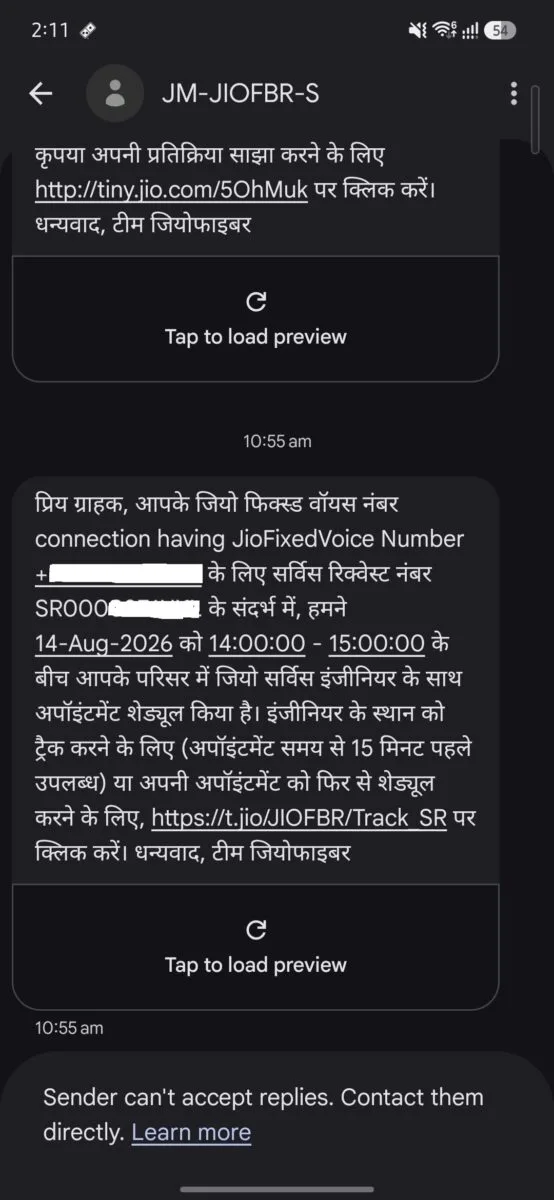
- 12:30 PM — Got a call from the Jio engineer confirming the address, saying he’d arrive by 1:15 PM — well ahead of the SMS estimate.
- Engineer arrived on time and diagnosed the issue: the socket connecting the outdoor unit had burnt out, likely due to water seepage from heavy rain the previous night.
- Socket was replaced on the spot.

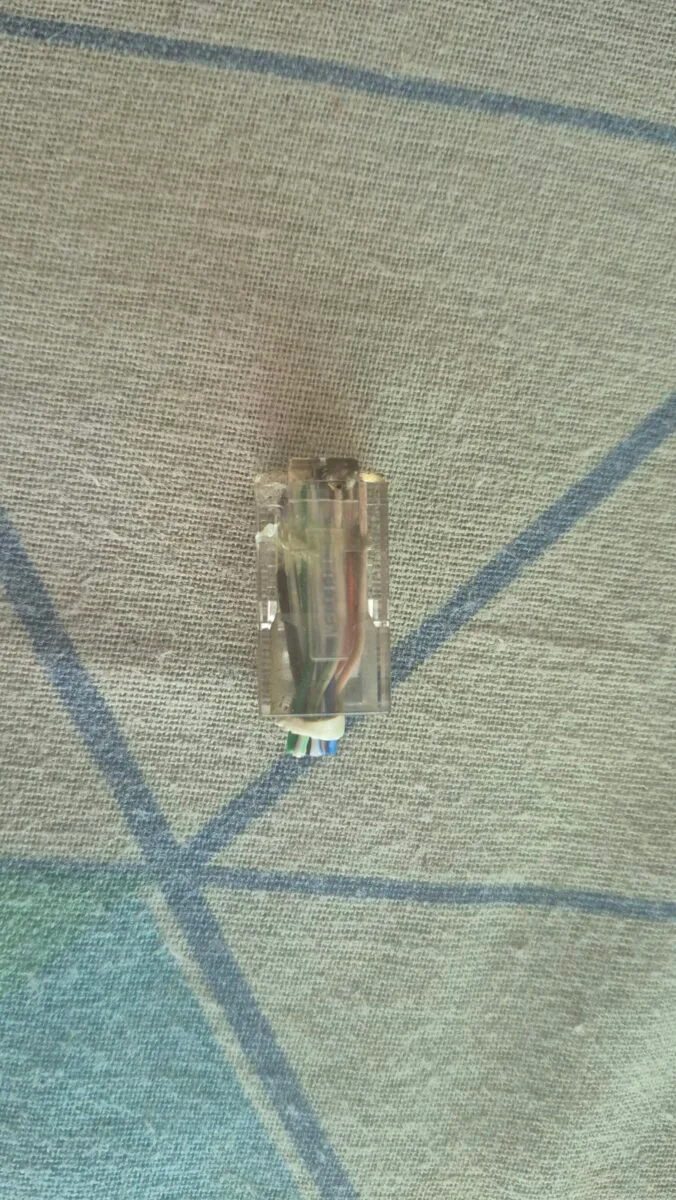
The burnt RJ45 connector/socket from the outdoor unit, replaced by the Jio engineer — damage caused by water seepage during heavy rain.
1:34 PM — Internet fully restored and working normally.
Total downtime: ~4 hours 34 minutes
Our take: This was our first fault in 19 months of continuous JioAirFiber use, so the reliability track record so far remains strong. What stood out was that the actual resolution beat Jio’s own SMS estimate by nearly an hour, and the entire process — from fault detection to complaint registration to engineer dispatch — required zero phone calls or emails on our end. The root cause (rain-related water damage to an outdoor socket) is also a useful data point for anyone in heavy-rainfall regions considering AirFiber’s outdoor unit setup.
Final Verdict After 18 Months
After 18 months of daily use, my honest take is this: Jio AirFiber is a reliable wireless broadband option with a few real limitations. Speed: excellent. Stability: good. Gaming: decent, but not fiber-level. Value: strong.
Final Rating: 8.5/10
If your area has strong 5G coverage, AirFiber is genuinely worth choosing — especially if wired fiber has been unreliable for you. But if competitive gaming is your priority, fiber still wins.

Ayush Singhal is the founder and chief editor of TechMitra.in — a tech hub dedicated to simplifying gadgets, AI tools, and smart innovations for everyday users. With over 15 years of business experience, a Bachelor of Computer Applications (BCA) degree, and 5 years of hands-on experience running an electronics retail shop, Ayush brings real-world gadget knowledge and a genuine passion for emerging technology.
At TechMitra, he covers everything from AI breakthroughs and gadget reviews to app guides, mobile tips, and digital how-tos. His goal is simple — to make tech easy, useful, and enjoyable for everyone. When he’s not testing the latest devices or exploring AI trends, Ayush spends his time crafting tutorials that help readers make smarter digital choices.
📍 Based in Lucknow, India
💡 Focus Areas: Tech News • AI Tools • Gadgets • Digital How-Tos
📧 Contact: Get in touch →
🔗 Full Bio: https://techmitra.in/about-us/
Good way of telling, and pleasant paragraph to obtain facts about my presentation subject matter, which i am going to present in university.
jio air fibre review posting – one of the best internet service provide who is going down the drain day by day with lot of internet challenges and also with pathetic customer services. Reaching their call center is big headache and they disconnect the call abruptly as well. Very much pathetic service. Hope Jio looks into this while we are looking at Swadeshi mantra, this kind of service really disgusts any customer.