

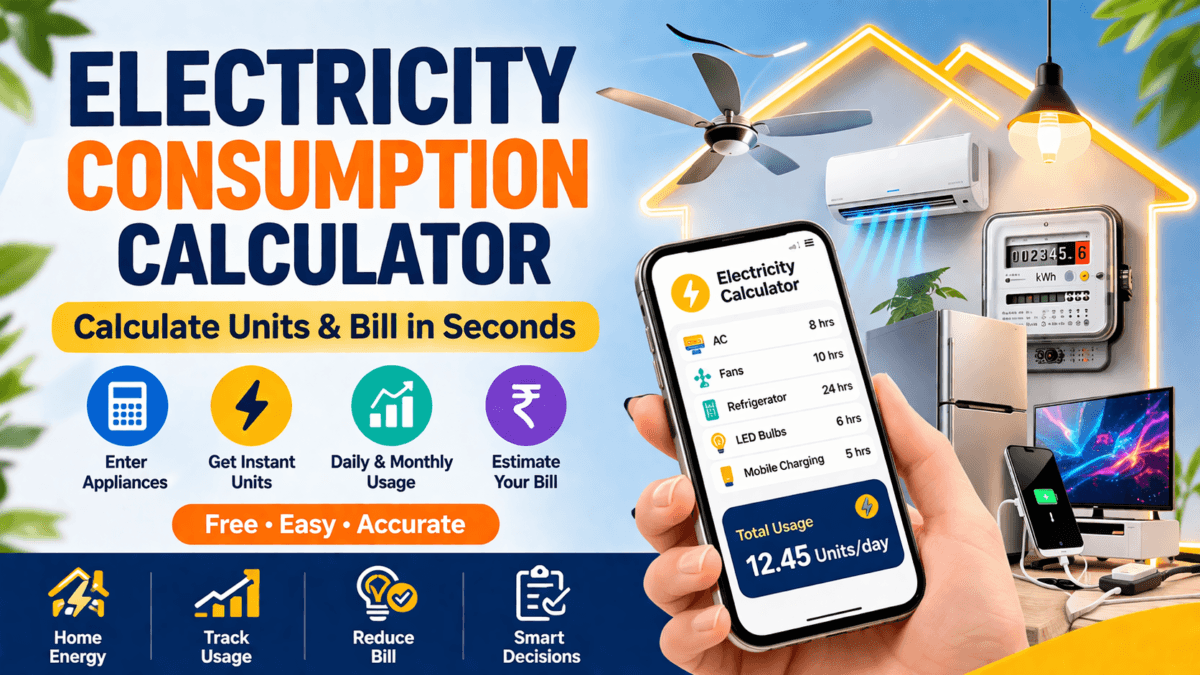
Electricity Consumption Calculator India – Calculate Home Units & Bill Easily
Ever wondered why your electricity bill suddenly spikes even when your usage feels “normal”? Most of us use appliances like AC, fans, refrigerators, and washing machines daily—but we rarely know how much electricity they actually consume.
The problem is simple:
👉 Electricity usage isn’t easy to calculate manually.
That’s exactly why we built this free Household Electricity Consumption Calculator India. Instead of guessing, you can now estimate your daily and monthly units in seconds.
Table of Contents
Calculate Your Home Electricity Usage Instantly
👉 Enter your appliance usage below to instantly calculate your electricity consumption:
Electricity usage calculator
Set quantity and daily hours for each appliance you use
Note: This is an estimated calculation based on average appliance usage. Actual electricity consumption may vary depending on appliance efficiency and usage patterns.
How This Electricity Consumption Calculator For Home Works
This tool is designed to keep things simple while still being realistic.
It calculates your electricity consumption based on:
- Number of appliances
- Daily usage hours
- Average power consumption (in watts)
- Real-world usage patterns (like inverter AC & mobile charging)
Formula Used
Units (kWh) = (Watt × Hours × Quantity) ÷ 1000
For mobile charging, we use a smarter approach:
- Instead of watt, we calculate based on energy per charge (Wh)
👉 This makes the calculator more accurate than most tools available online.
Average Power Consumption of Common Appliances
To give you a better idea, here’s how much electricity common household appliances consume:
| Appliance | Average Watt Consumption |
|---|---|
| AC 1 Ton | 700–1100W |
| AC 1.5 Ton | 900–1500W |
| Ceiling Fan | 60–80W |
| LED Bulb | 8–12W |
| LED Batten | 18–25W |
| Refrigerator | 150–300W |
| Water Heater (Geyser) | 1500–2000W |
| Water Pump (0.5 HP) | 350–400W |
| Water Pump (1 HP) | 700–800W |
| Washing Machine | 400–700W |
| TV | 80–150W |
| RO Water Purifier | 30–60W |
| Mobile Charging | ~10–20 Wh per charge |
👉 As you can see, heavy appliances like AC and geysers consume the most electricity.
⚠️ Mobile charging uses very little electricity. Actual consumption may vary based on battery size and charger type.
Inverter AC vs Non-Inverter AC – What’s the Difference?
This is one of the biggest factors affecting your electricity bill.
Non-Inverter AC
- Runs at fixed speed
- Consumes full power repeatedly
- Higher electricity usage
Inverter AC
- Adjusts power based on room temperature
- Consumes less electricity after cooling
- More energy-efficient
👉 In our calculator, we use average consumption values for inverter AC to give you realistic results.
Also Read : Inverter vs Non-Inverter AC: Which is Better in 2026?
How Mobile Charging is Calculator
Most calculators make a mistake here.
They assume:
Charger watt = electricity consumption ❌
But in reality:
- Fast charging happens only for a short time
- Power drops after 70–80% battery
👉 That’s why we calculate mobile charging based on:
Energy per charge (≈ 10–20 Wh)
So even if you use a 65W or 90W charger, actual daily consumption remains low.
Example: Daily Electricity Consumption
Let’s understand with a real example:
Suppose your home uses:
- 1 AC (1.5 Ton) for 8 hours
- 4 fans for 10 hours
- 6 LED bulbs for 6 hours
- 1 refrigerator running all day
👉 Your total daily usage can easily reach:
10–15 units per day
👉 Monthly:
300–450 units
👉 Depending on your electricity rate, your bill could be:
₹2,000 to ₹4,000+
Tariff Explanation – UPPCL
How to Reduce Your Electricity Bill (Practical Tips)
If your bill is high, don’t worry—small changes can make a big difference.
1. Switch to Inverter Appliances
Especially AC and refrigerators.
2. Replace Old Bulbs with LED
LEDs consume up to 80% less electricity.
3. Reduce AC Usage Smartly
- Set temperature to 24–26°C
- Use ceiling fans along with AC
4. Turn Off Idle Devices
Standby power consumption adds up over time.
5. Use Energy Efficient Appliances
Look for 5-star rated appliances.
6. Optimize Water Pump Usage
Avoid unnecessary long usage cycles.
According to the Bureau of Energy Efficiency, using energy-efficient appliances can significantly reduce electricity consumption.
Check Which Is Best Semi Automatic or Fully Automatic Washing Machine And Best Options To Purchase
Why This Electricity Cost Calculator Kwh is More Accurate Than Others
Most online electricity calculators have some common limitations:
- They rely on manual meter readings, which many users don’t understand
- They use fixed watt values, ignoring real-world variations
- They don’t consider modern appliances like inverter ACs
- They completely ignore usage patterns like mobile charging behavior
👉 That’s where this calculator is different.
✔️ What Makes This Tool Better
- Uses appliance-based inputs (no technical knowledge required)
- Supports inverter and non-inverter AC calculations
- Estimates real-world usage instead of fixed values
- Includes mobile charging with realistic consumption logic
- Shows appliance-wise consumption breakdown, so you know what’s increasing your bill
👉 This makes it much more practical and accurate for everyday household use.
Frequently Asked Questions (FAQs
Q1. How many units does a 1.5 ton AC consume per day?
A 1.5 ton AC typically consumes 6–12 units per day, depending on usage hours and whether it’s inverter or non-inverter.
Q2. How can I calculate my electricity bill at home?
Multiply total units consumed by your electricity rate (₹ per unit). This calculator helps you estimate units easily.
Q3. Does inverter AC really save electricity?
Yes, inverter ACs adjust power usage and consume significantly less electricity compared to non-inverter ACs.
Q4. What is 1 unit of electricity?
1 unit = 1 kilowatt-hour (kWh)
That means using 1000 watts for 1 hour.
Q5. Does fast charging increase electricity bill?
Not significantly. Even fast chargers consume very little electricity overall because charging duration is short.
Read my Daikin 1.5 Ton 3 Star Inverter Split AC FTKL50XV16 review and installation guide.
Final Thoughts
Understanding your electricity usage is the first step toward reducing your bill.
Instead of guessing, use this appliance electricity calculator India to:
- Track daily consumption
- Identify high-usage appliances
- Make smarter energy decisions
👉 Try adjusting your usage above and see how your electricity consumption changes.

Ayush Singhal is the founder and chief editor of TechMitra.in — a tech hub dedicated to simplifying gadgets, AI tools, and smart innovations for everyday users. With over 15 years of business experience, a Bachelor of Computer Applications (BCA) degree, and 5 years of hands-on experience running an electronics retail shop, Ayush brings real-world gadget knowledge and a genuine passion for emerging technology.
At TechMitra, he covers everything from AI breakthroughs and gadget reviews to app guides, mobile tips, and digital how-tos. His goal is simple — to make tech easy, useful, and enjoyable for everyone. When he’s not testing the latest devices or exploring AI trends, Ayush spends his time crafting tutorials that help readers make smarter digital choices.
📍 Based in Lucknow, India
💡 Focus Areas: Tech News • AI Tools • Gadgets • Digital How-Tos
📧 Contact: Get in touch →
🔗 Full Bio: https://techmitra.in/about-us/