

India Indigenous AI Model: The Complete 2026 Guide: AI Genereted Image
Originally published August 2, 2025. Updated July 2026 with the latest on Sarvam’s open-source models, Krutrim’s shutdown of Kruti, IndiaAI Mission funding data, and the honest answer to whether Indian LLMs can ever compete on brand recognition.
Table of Contents
Also Read : Samsung Galaxy Unpacked July 2026: Fold8, Fold8 Ultra, Flip8 and Everything Else Samsung Just Announced
1. Introduction
Artificial Intelligence is no longer a “someday” story for India — 2026 is the year the country’s indigenous AI bet started producing real, testable results. Sarvam AI open-sourced a 105-billion-parameter model trained from scratch on Indian soil. The government hosted the first global AI summit ever held by a Global South nation. And, in a less flattering twist, Ola’s Krutrim quietly pulled the plug on its flagship AI assistant less than a year after launching it.
So — a year on from when we first asked this question — can India actually compete with OpenAI, Google, and Anthropic? The technical answer is closer to “yes, in specific ways” than it was in 2025. The harder answer is about something this article didn’t cover last year: almost nobody outside the tech press has heard of any of these models. We’ll get to why.
Editor’s Note: We continuously track India’s AI ecosystem, government announcements, and major model releases. This article was updated in July 2026 to reflect the latest developments in Sarvam AI, Krutrim, and the IndiaAI Mission, based on primary sources including official government press releases, company announcements, and direct reporting from the India AI Impact Summit 2026.
2. What Is Indigenous AI?
Indigenous AI refers to artificial intelligence models developed within a country using local data, talent, languages, and infrastructure, instead of depending on foreign technologies.
For India, this means building LLMs that:
- Understand Indian languages
- Respect Indian cultural nuances
- Are stored and trained on Indian soil, on Indian compute
That last point matters more than it did a year ago — it’s no longer aspirational. It’s happened.
3. Why Is India Building Its Own AI?
Four core reasons still hold:
a) Digital Sovereignty
India wants to reduce dependency on foreign tech companies for critical AI infrastructure — and to avoid a scenario where export controls or geopolitics can cut off access to the chips or models Indian businesses depend on.
b) Language Inclusivity
Global models are still strongest in English. India has 22 official languages and hundreds of dialects that global labs have limited commercial incentive to prioritize.
c) Cost Efficiency
Accessing global AI APIs can be expensive at scale. Indian models aim to offer cheaper access to startups, educators, and citizens — and Sarvam’s “native tokenization” for Indian languages is specifically pitched as cutting API costs versus GPT-4-class pricing.
d) Data Privacy & Control
Keeping sensitive user data within Indian jurisdiction, under Indian law, on Indian servers rather than routed through US data centers.
4. Key Players in India’s AI Race — 2026 Status Check
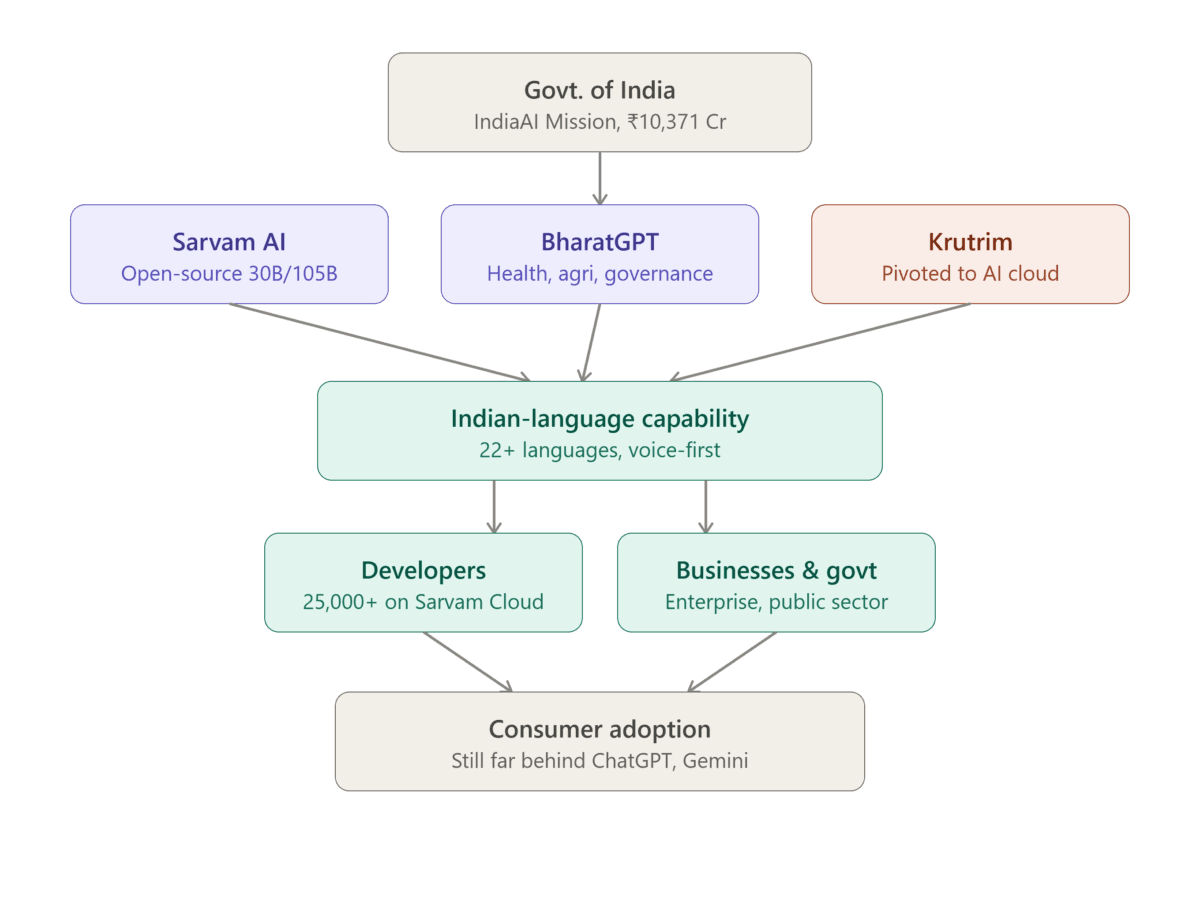
This is where the most has changed. Here’s where each player actually stands, not where they said they’d be.
Sarvam India AI — the clearest success story so far
- Founded in 2023 by former Microsoft researchers Dr. Vivek Raghavan and Pratyush Kumar, based in Bengaluru
- In March 2026, Sarvam open-sourced two foundational models — 30B and 105B parameters — under Apache 2.0, unveiled at the India AI Impact Summit and downloadable free via Hugging Face and AIKosh
- Unlike its earlier Sarvam-M model (which was fine-tuned from a French Mistral model), Sarvam-105B was trained entirely from scratch on Indian infrastructure — the government-funded distinction that actually matters for “indigenous” claims
- Benchmarks are genuinely competitive: strong scores on agentic and STEM reasoning tasks, positioned against OpenAI’s GPT-OSS-120B and Alibaba’s Qwen-3-Next-80B
- Its knowledge cutoff is June 2025, and users on forums have flagged hallucination issues — it’s not flawless
- Launched a consumer chat app, Indus, in February 2026 — voice-first, works across 22 Indian languages, handles Hindi-English code-switching natively
- Closed a $250 million Series B in March 2026 led by NVIDIA, Accel, and HCLTech, pushing its valuation to roughly $1.5 billion — India’s newest AI unicorn
- Selected by the government from 67 applicants to build India’s sovereign LLM, with access to 4,096 H100 GPUs and government compute subsidies
- Partnered with Finnish phone maker HMD to preload Indus on the Vibe 2 5G smartphone — a real distribution push, not just an app store listing
Krutrim AI (Ola, Bhavish Aggarwal) — the cautionary tale
This section needed the biggest rewrite. In April 2026, Krutrim shut down its consumer AI assistant, Kruti, less than a year after launching it, and quietly halted development of its next model, Krutrim 3. The company had already cut roughly 200 jobs in 2025, including staff on the team building out Indian-language training data, and senior executives left in the following months.
The one bright spot: Krutrim pivoted to AI cloud infrastructure instead of consumer models, and that pivot worked financially — it posted its first-ever annual profit in FY26, on revenue of around ₹300 crore, roughly triple the year before. So Krutrim survives, but the “India’s ChatGPT” ambition that this article originally described is, for now, shelved.
BharatGPT (IIT Bombay, Seetha Mahalaxmi Healthcare)
Still positioned around healthcare, agriculture, and governance applications, working with AI4Bharat and IIT partners. Progress here has been quieter and less headline-driven than Sarvam or Krutrim — worth a dedicated look in a future update once there’s a concrete public release to evaluate.
IndiaAI Mission (Govt. of India)
- ₹10,371.92 crore ($1.25 billion) sanctioned across seven pillars: compute, foundational models, datasets, applications, safety, startups, and skills
- Roughly 34,000–38,000 GPUs have been deployed and made accessible to registered startups and researchers at around ₹65 per GPU-hour
- But actual fund disbursement is well behind the headline number: only about ₹400 crore released across the first two years against the full outlay, and as of the FY2026-27 budget, nothing yet released against that year’s ₹1,000 crore allocation
- Hosted the India AI Impact Summit, February 16–20, 2026, in New Delhi — the first global AI summit held by a Global South country, reportedly drawing $250 billion in infrastructure investment pledges
At a Glance: How the Models Compare
| Model | Developer | Open Source | Language Coverage | Best Suited For |
|---|---|---|---|---|
| Sarvam 30B / 105B | Sarvam AI (India) | Yes (Apache 2.0) | 22+ Indian languages | Government deployments, developers, regional voice AI |
| Krutrim V2 | Ola (India) | No | Indian languages | Enterprise AI cloud (consumer assistant discontinued) |
| BharatGPT | IIT Bombay / SML Healthcare | No | Indian languages | Healthcare, agriculture, governance |
| Param2 (BharatGen) | Govt-backed (public infra) | Yes | 22 Indian languages | Public-sector integration, research |
| ChatGPT | OpenAI (US) | No | Global, strong in English | General-purpose chat, writing, automation |
| Gemini | Google (US) | No | Global | Search/Workspace integration, multimodal tasks |
| Claude | Anthropic (US) | No | Global | Coding, long-document reasoning, agents |
Note: “Open source” refers to whether model weights are publicly downloadable, not whether the full training pipeline or data is disclosed.
The core hurdles from 2025 are mostly still real, with one new one added.
1. Compute Power & Infrastructure
Better than it was — 34,000+ GPUs is a real number now, not a promise — but still a fraction of what OpenAI, Google, or Anthropic run at scale.
2. Skilled AI Talent
Talent migration abroad remains an issue, and Krutrim’s own layoffs of its linguistics and training-data teams show how fragile domestic teams can be when funding tightens.
3. Training Data for Indian Languages
Sarvam’s from-scratch training on Indian-language data is proof this is solvable — but it took a $1.5 billion, NVIDIA-backed company to pull off at genuine scale.
4. Funding Gaps
Sarvam’s $250M raise is a strong signal, but it’s still a rounding error next to the tens of billions flowing into OpenAI, Anthropic, and Google DeepMind.
5. Public Awareness — the gap nobody was talking about in 2025
This is the piece missing from the original article, and it may be the biggest blocker of all. More on this below.
6. A Contradiction Worth Naming: The Government Backs Global Labs Too
One thing the “digital sovereignty” framing glosses over: the Indian government isn’t actually trying to keep ChatGPT, Gemini, and Claude out in favor of homegrown tools. It’s doing the opposite in parallel — welcoming all three as partners while funding Sarvam and BharatGen at the same time.
At the February 2026 India AI Impact Summit itself, the government’s own event:
- Saw Anthropic partner with Infosys to build AI agents for telecom, with plans to expand into manufacturing. Anthropic CEO Dario Amodei had met with PM Modi in October 2025, and said Claude usage in India had risen five-fold since June 2025
- Saw Google announce a $15 billion AI infrastructure investment in Visakhapatnam, new India-US subsea cable routes, and commitments to train 20 million civil servants and support 11 million students on Google’s AI tools — plus a new Google DeepMind partnership with Indian government bodies on science and education
- Saw Tata Group partner directly with OpenAI to scale AI-ready data centers in India
So the honest picture is: India is pursuing sovereignty over infrastructure, compute, and data residency — not sovereignty over which chatbot citizens and businesses actually use. Government departments, PSUs, and enterprises are openly encouraged to use Claude, ChatGPT, and Gemini for productivity and governance work, often in the same breath as officials tout Sarvam and BharatGen as the “indigenous” answer.
This isn’t necessarily a contradiction so much as two different tracks running at once — building sovereign capability for the long term while pragmatically using whatever tools work best today. But it does mean the “India vs. Silicon Valley” framing this article leaned on is oversimplified. It’s less India instead of OpenAI/Google/Anthropic, and more India alongside them, with a long-term bet that homegrown models eventually earn a bigger share of that mix — particularly in language coverage and public-sector deployment, where sovereignty and cost genuinely matter more than raw benchmark performance.
7. Can Indian LLMs Actually Grow Like Claude, ChatGPT, or Gemini?
Technically, yes — Sarvam-105B proves an Indian lab can train and ship a model that’s benchmark-competitive with mid-tier global open models. That was a genuinely open question in 2025. It isn’t anymore.
But “can compete on capability” and “can compete for users” are different questions, and right now the second one is where Indian LLMs are losing badly — not because the models are bad, but because almost nobody knows they exist.
The numbers make this stark. Within its first three months, Sarvam’s Indus app had been downloaded just over 293,000 times in India. In the same window, ChatGPT had been downloaded 43.9 million times in India — roughly 150x more. OpenAI’s CEO has said ChatGPT now has more than 100 million weekly active users in India alone, and India accounts for the largest share of Claude’s global usage outside the US. Genuinely enormous numbers next to Indus’s few hundred thousand downloads.
So why the gap, when the underlying model is competitive?
a) Marketing spend, not just model quality, drives adoption. ChatGPT and Gemini have run aggressive, sustained promotional pricing in India — free or sub-$5 access tiers pushed hard through 2025 — backed by marketing budgets no Indian AI startup can currently match. Adoption tracked promotions almost directly: app downloads for GenAI tools in India spiked over 300% year-on-year in the months global players ran their biggest campaigns.
b) Distribution beats discovery. ChatGPT, Gemini, and Claude are pre-installed, deeply integrated, or one tap away inside products people already use — phones, Google Search, Workspace, Slack, browsers. Sarvam’s HMD smartphone partnership is a genuine attempt at the same playbook, but it’s one phone model against Android’s default Gemini integration and iOS’s ChatGPT partnership.
c) No consumer brand-building. OpenAI, Google, and Anthropic all run visible consumer marketing — ad campaigns, influencer partnerships, media presence, product launches covered by mainstream (not just tech) press. Sarvam and Krutrim’s coverage has been almost entirely inside tech and startup media. A regular smartphone user in Bhopal or Coimbatore is far more likely to have heard the word “ChatGPT” used as a verb than to know Sarvam or Indus exist at all.
d) Trust and habit are sticky. Once someone has an account, chat history, and workflow built around ChatGPT or Gemini, the switching cost — even to a genuinely good alternative — is real. Awareness has to clear that bar too, not just get someone to install an app once.
e) Enterprise vs. consumer strategy split. Interestingly, Sarvam itself seems to be leaning into this reality — its own reported growth metrics increasingly emphasize developer adoption (25,000+ developers on Sarvam Cloud) and enterprise/platform conversation volume rather than consumer app downloads. That may be the more realistic near-term path: win the B2B and government layer first, where sovereignty and language support are decisive advantages, rather than trying to out-market OpenAI for the average consumer’s home screen.
The honest verdict: Indian LLMs can absolutely reach ChatGPT/Gemini/Claude-level technical competence — Sarvam-105B is evidence that’s already partly true. But growing into that scale of usage requires marketing budgets, distribution deals, and public brand awareness that Indian AI companies, even well-funded ones like Sarvam, don’t yet have. Krutrim’s stumble shows what happens when a company tries to build consumer-scale ambition without the money or product execution to sustain it. The more likely path to “compete like Claude, Gemini, ChatGPT” isn’t a head-on consumer battle — it’s winning specific lanes (regional language voice AI, government and enterprise deployments, cost-sensitive API use cases) so thoroughly that global players can’t easily follow, then letting consumer awareness build from there.
8. Indian Language AI: Still the Real Advantage
This hasn’t changed, and if anything Sarvam’s 2026 releases sharpen it. Indus handles natural Hindi-English code-switching, responds in the same regional language a question was asked in, and works voice-first — a meaningfully different design choice than typing-first global chatbots, given how much of India’s internet growth is voice and vernacular.
Practical use cases this unlocks:
- Voice assistants for farmers in Hindi, Marathi, or Bhojpuri
- Chatbots for rural health workers who don’t type fluently in English
- AI tutors for children in Telugu or Malayalam
- Government service delivery in a citizen’s first language, not English
By solving for India first, these models may end up serving the Global South more usefully than English-first tools ever will.
9. How Far Are We From ChatGPT-Level Models? (2026 Answer)
Closer than the 2025 version of this article suggested — but with real caveats.
- Sarvam-105B’s reasoning and agentic benchmarks are competitive with mid-tier open models like GPT-OSS-120B and Qwen-3-Next-80B
- It’s not competitive with frontier closed models like GPT-4-class or Gemini’s top tier on general reasoning, multimodal capability, or coding
- Its knowledge cutoff (June 2025) and reported hallucination issues are real limitations flagged even by supportive early reviewers
Think of it less as “India built a GPT-4 rival” and more as “India built a genuinely capable, sovereign, open-source alternative that’s strong specifically where it was built to be strong: Indian languages, cost efficiency, and data residency.” That’s a real achievement — just a narrower one than “beating OpenAI.”
10. Government’s Role: The IndiaAI Mission in 2026
Sanctioned at ₹10,371.92 crore in March 2024, the Mission’s seven pillars — compute, foundational models, datasets, applications, safety, startup support, and skills — are now producing visible output, not just policy documents:
- ~34,000-38,000 GPUs deployed and accessible to startups and researchers
- Sarvam selected as the flagship foundational-model recipient from 67 applicants
- The February 2026 India AI Impact Summit put India on the global stage as the first Global South host of a major AI summit, reportedly drawing $250 billion in pledged infrastructure investment
- Fund disbursement remains the weak link — only ~₹400 crore actually released against the full five-year outlay so far, well behind the pace the headline number implies
Worth watching: the Ministry’s overall FY2026-27 budget was cut 17% year-on-year, a signal that fiscal tightening could slow the next phase of GPU and dataset expansion even as the Mission’s early wins get more visible.
11. Future of Indigenous AI in India
Realistic near-term outcomes, updated for where things actually stand:
- Indian LLMs winning specific verticals — regional-language voice AI, government service delivery, cost-sensitive enterprise API use — well before they win the consumer chatbot market
- Sarvam or a similar player exporting Indian-language AI capability to other multilingual, price-sensitive markets in Africa and Southeast Asia
- Continued consolidation: expect more companies like Krutrim to either find a sustainable enterprise/infrastructure niche or fold their consumer AI ambitions entirely
- Public awareness slowly building through hardware partnerships (like Sarvam-HMD) and government deployment rather than head-on consumer marketing against OpenAI and Google
12. Final Thoughts
A year ago, this article’s honest conclusion was that India wasn’t about rivalry, it was about relevance. That’s still true — but 2026 added a genuinely new data point: Sarvam proved an Indian lab can build a model that’s technically competitive, not just “good enough for now.” Krutrim proved that consumer AI ambition without sustained execution and funding collapses fast, even for a well-known brand backed by a unicorn.
The real gap left standing isn’t capability anymore — it’s that almost nobody outside tech circles has heard of any of this. Sarvam’s Indus has a few hundred thousand downloads against ChatGPT’s tens of millions in the same market. Closing that gap will take marketing budgets, distribution deals, and public trust-building that no Indian AI company has fully cracked yet.
The future may still be authentically Indian. It just isn’t loudly Indian yet.
Key Takeaways
- India now has a genuinely competitive indigenous AI model — Sarvam-105B is benchmark-competitive with mid-tier global open models, not just a proof of concept
- Sarvam AI leads the ecosystem on both technical capability and consumer product execution; Krutrim’s consumer ambitions have stalled, though its pivot to enterprise cloud is financially working
- Government investment is accelerating infrastructure (34,000+ GPUs deployed) but fund disbursement against the ₹10,371 crore outlay is still slow
- The government isn’t choosing indigenous AI over ChatGPT, Gemini, and Claude — it’s backing both tracks at once, through direct partnerships with Anthropic, Google, and OpenAI
- Consumer adoption remains the biggest gap: Indus has a few hundred thousand downloads against ChatGPT’s tens of millions in India
- India’s clearest near-term opportunity is multilingual, voice-first AI and public-sector deployment — not a head-on consumer battle with global chatbots
Related reading: ChatGPT vs Gemini vs Claude: Which Is Best in 2026? · What Is LLM SEO? · Best AI Tools for Indian Business Users
Frequently Asked Questions (FAQs)
Q1. What is an indigenous AI model?
An AI model developed using local data, languages, and infrastructure, tailored to a region or country’s needs — and, in India’s case, increasingly trained from scratch on domestic compute rather than fine-tuned from a foreign base model.
Q2. Who are the top players in India’s AI development in 2026?
Sarvam AI — open-source 30B/105B models, Indus consumer app, $1.5B valuation
Krutrim (Ola) — pivoted from consumer AI models to enterprise cloud services after shutting down its Kruti assistant
BharatGPT — healthcare, agriculture, and governance-focused, still developing
IndiaAI Mission — government compute and funding backbone behind most of the above
Q3. Is Krutrim’s Kruti AI assistant still available?
No. As of April 2026, Kruti was taken offline across app stores and the web, and Krutrim halted its next model, Krutrim 3, to focus on AI cloud infrastructure instead. Don’t rely on it as a working consumer AI tool right now.
Q4. Can Indian AI models really compete with ChatGPT, Gemini, and Claude?
On raw model capability, Sarvam’s 105B model is a legitimate, benchmark-competitive open-source alternative for many tasks — genuinely close in some regional-language and cost-efficiency use cases. On user adoption, not yet: Indian AI apps have a fraction of the downloads and awareness of global players, largely due to marketing spend, distribution deals, and brand trust that Indian companies haven’t built yet.
Q5. How can I try or contribute to Indian AI tools?
Sarvam AI — try the Indus app, or the open-source models via Hugging Face
Krutrim — now focused on enterprise AI cloud services
AI4Bharat — IIT Madras’s open language AI research initiative
You can contribute by creating or translating datasets, using and giving feedback on open-source Indian AI tools, or supporting Indian AI startups directly

Ayush Singhal is the founder and chief editor of TechMitra.in — a tech hub dedicated to simplifying gadgets, AI tools, and smart innovations for everyday users. With over 15 years of business experience, a Bachelor of Computer Applications (BCA) degree, and 5 years of hands-on experience running an electronics retail shop, Ayush brings real-world gadget knowledge and a genuine passion for emerging technology.
At TechMitra, he covers everything from AI breakthroughs and gadget reviews to app guides, mobile tips, and digital how-tos. His goal is simple — to make tech easy, useful, and enjoyable for everyone. When he’s not testing the latest devices or exploring AI trends, Ayush spends his time crafting tutorials that help readers make smarter digital choices.
📍 Based in Lucknow, India
💡 Focus Areas: Tech News • AI Tools • Gadgets • Digital How-Tos
📧 Contact: Get in touch →
🔗 Full Bio: https://techmitra.in/about-us/