

Last updated: 26 October 2026. Prices and ratings are as seen on Amazon India on that date and change often.
If you only want the short answer to which air purifiers (also sold as air cleaners) work best, it is the ones whose airflow actually matches your room. The number that tells you this is CADR, the Clean Air Delivery Rate, measured in cubic metres of clean air per hour (m³/h). For a room with an 8 ft ceiling, a good rule of thumb is to pick a purifier whose CADR is at least as high as the room’s floor area in square feet. A 250 sq ft bedroom needs a CADR of about 250 or more, and a 600 sq ft hall needs about 600. Most of the “covers 700 sq ft” claims on Amazon are measured at one or two air changes an hour, which is too slow to make a noticeable difference, so I ignore them and go by CADR.
The rest of this guide explains how to measure your room, how to read the specs that matter, and which models make sense for which room. Here is where each model on my list lands once you size it by CADR.
← Swipe horizontally to compare all features →
| Model | Price | CADR (m³/h) | Estimated Room Size | Filter System | Noise Level | Max Power | Replacement Filter Cost | Stated Filter Life | Warranty | App Support | Best For |
|---|---|---|---|---|---|---|---|---|---|---|---|
| Coway Airmega 50 | ₹6,999 | 120.1 | About 120 sq ft | Pre-filter, HyperCaptive HEPA, deodorisation filter | 18.4 dB (lowest); maximum not confirmed | 14 W | ₹5,818–₹6,465 | Not stated in listing | Not confirmed in Amazon listing | Not confirmed | Small study, desk or nursery |
| Qubo Q200 | ₹6,990 | 150 | About 150 sq ft | Pre-filter, antibacterial layer, activated carbon, True HEPA 13 | Up to 51 dB | 35 W | ₹1,590 (HPH01) | Up to 9,000 hours | 1 year | Not confirmed | Small bedroom; known filter cost |
| Mijia by Xiaomi 4 Compact | ₹6,990 | 230 | 230–290 sq ft | Pre-filter, HEPA, activated carbon | 20 dB (sleep mode) | About 27 W | ₹1,999 (verify compatibility) | App filter-life indicator; duration not confirmed | 1 year | Xiaomi Home app | Bedroom; strong airflow for the price |
| Philips AC0950 | ₹11,995 | 250 | 250–300 sq ft | Pre-filter, NanoProtect HEPA, activated carbon | 20.5–49 dB | 23 W | ₹1,999 (AC0951; verify compatibility) | One year recommended | 2 years per retailers; confirm | Yes | Quiet bedroom or study |
| Xiaomi Air Purifier 4 Lite | ₹10,990 | 360 | 330–360 sq ft | Pre-filter, HEPA, activated carbon | About 33–61 dB (international specs) | About 33 W | ₹2,749 (verify compatibility) | App filter-life indicator; duration not confirmed | 1 year per listing | Xiaomi Home app | Medium living room on a budget |
| Cuckoo Respure | ₹12,990 | 408 | About 400 sq ft | Pre-filter, H13 True HEPA, carbon | About 20–53 dB (listing) | Not confirmed | ₹2,990 (H13 HEPA + carbon) | Not stated on page | Up to 8 years on motor, subject to registration conditions | Not confirmed | Medium living room; affordable filters |
| Philips AC4221 | ₹24,922 | 600 | About 600 sq ft* | Pre-filter, NanoProtect HEPA, two carbon layers | About 15–51.5 dB | 54 W | ₹5,630 (FY4200/30) | Up to 9,000 hours | 2 years per retailers; confirm | Not confirmed | Large hall or open living area |
Prices are from Amazon India listings checked on 26 October 2026 and may change. Room sizes are estimates based on CADR and approximately 4–5 air changes per hour, assuming an 8 ft ceiling. The Philips AC4221 estimate falls to about 480 sq ft with a 10 ft ceiling. Verify replacement-filter compatibility, warranty terms and current prices before purchasing.
*My estimate: CADR divided by roughly 4 to 5 air changes an hour, assuming an 8 ft ceiling. If your ceilings are 10 ft, reduce each figure by about 20 percent.
How I picked these. I haven’t lab-tested these purifiers, and I won’t pretend otherwise. I shortlisted models from Amazon India listings, then checked the main figures (CADR, filter type, warranty and filter price) against the brands’ own pages wherever I could, and I say plainly where I couldn’t confirm something. The room sizes are my own calculation from CADR, not the sizes printed on the box. This page contains Amazon affiliate links, which means I may earn a small commission if you buy through them, at no extra cost to you. It did not change which models I picked or how I describe them.
I spent years selling home appliances, including water heaters and room heaters, and one lesson from that time applies here as well: the number on the box is rarely the number that matters. With air purifiers that number is the coverage area, and this guide is mostly about how to look past it.
Table of Contents
Also Read : Room Heater Buying Guide India (Winter 2026): Which Type, Which Size, What Price
How to Choose the Right Air Purifier for Your Home
Step 1: Measure your room properly
Before you look at any product, work out three things: the floor area, the ceiling height and whether the room is really a closed space.
Floor area is length times width in feet. Ceiling height matters more than most guides admit, because a purifier cleans a volume of air, not a floor. Many Indian homes have 9 or 10 ft ceilings, and a purifier rated for an 8 ft room will do noticeably less in a taller one. Then think about how closed the room is. A bedroom with the door shut and the windows closed is the best case. A living room that opens into a dining area, a kitchen or a balcony with the door open is effectively a bigger room, so size for the combined space or accept slower cleaning.
Also note where the pollution is coming from. Incense, mosquito coils and cooking smoke are major sources of indoor particles, and a purifier is a poor substitute for ventilating or removing the source. If you cook with the kitchen open to the living room, size up.
Step 2: Work out the CADR you need
The formula is floor area (sq ft) × ceiling height (ft) × 0.0283 × air changes per hour. The 0.0283 converts cubic feet to cubic metres. Most guidance aims for about 4 to 5 air changes an hour, so I use 5 as the target. That means a 200 sq ft bedroom with a 9 ft ceiling needs about 255 m³/h (200 × 9 × 0.0283 × 5).
Why do we use 0.0283?
One cubic foot equals approximately 0.0283168 cubic metres. Rounded to four decimal places, this becomes 0.0283, the conversion factor used in the CADR calculation.
If you don’t want to do the sums, this table shows the CADR needed for 5 air changes an hour (ACH).
What does ACH (Air Changes per Hour) mean?
ACH tells you how many times per hour an air purifier delivers an amount of clean air equivalent to the room’s total volume. For example, 5 ACH means the purifier delivers the equivalent of five room volumes of clean air every hour. A higher ACH generally means more frequent air cleaning. For this guide, I’ve used 5 ACH to estimate the CADR needed for each room size, helping you compare air purifiers on a consistent basis.
| Room size | 8 ft ceiling | 9 ft ceiling | 10 ft ceiling |
|---|---|---|---|
| 100 sq ft | 113 | 127 | 142 |
| 150 sq ft | 170 | 191 | 212 |
| 200 sq ft | 226 | 255 | 283 |
| 250 sq ft | 283 | 318 | 354 |
| 300 sq ft | 340 | 382 | 425 |
| 400 sq ft | 453 | 510 | 566 |
| 500 sq ft | 566 | 637 | 708 |
| 600 sq ft | 679 | 764 | 849 |
The quick rule from the start of this guide (“CADR at least equal to the floor area”) works out to about 4.4 air changes an hour in an 8 ft room, so treat it as a sensible minimum and the table as the better target. If you are sensitive to dust or pollen, or live in a heavily polluted area, aim for the table figure or a little above it.
Here are four worked examples using the models in this guide. They show how the numbers play out in real rooms.
A 12 ft by 12 ft bedroom with a 9 ft ceiling holds about 37 m³ of air, so it needs roughly 184 m³/h for 5 air changes an hour. The Qubo Q200 (150) manages about 4 air changes, which is workable, while the Mijia 4 Compact (230) gives about 6 and has headroom to run on a lower, quieter setting.
A 15 ft by 12 ft bedroom with a 10 ft ceiling holds about 51 m³ and needs roughly 255 m³/h. The Philips AC0950 (250) delivers just under 5 air changes, and the Mijia 4 Compact (230) delivers about 4.5. The Qubo Q200 would manage only about 3, which is too slow for this room.
A 20 ft by 15 ft living room with a 10 ft ceiling holds about 85 m³ and needs roughly 425 m³/h. The Cuckoo Respure (408) gives about 4.8 air changes and the Xiaomi 4 Lite (360) gives about 4.2. The Philips AC0950 would give only about 3.
A 25 ft by 24 ft hall with a 10 ft ceiling holds about 170 m³ and would need about 850 m³/h for 5 air changes. The Philips AC4221 (600) delivers about 3.5, which still helps a lot but is below the ideal. In that hall, 5 air changes an hour is only reached at roughly 480 sq ft. If your large room is taller or more open than that, expect slower cleaning, or consider running two purifiers.
Also Read : 8 Best Water Heaters in India (2026): Buying Guide for Winter
How to Read an Air Purifier’s Specifications & Features
1. CADR is the number that matters
CADR tells you how much filtered air the purifier delivers every hour. A strong fan behind a weak filter does little good, and a good filter behind a weak fan does little good in a big room. CADR combines both, which is why it beats every other headline number.
There are usually three CADR figures, for smoke, dust and pollen, which stand in for fine, medium and coarse particles. Smoke is the closest match to PM2.5. Many Indian listings quote a single “particle CADR” without saying which, so when you compare, look for the same type of number on both models.
One caution: not every CADR number is measured the same way. Philips quotes its figures under the Chinese GB/T standard, and Xiaomi’s come from Chinese testing labs. Other brands don’t say which method they use. Treat differences of 10 to 15 percent between brands as noise, but a difference between 250 and 600 is real.
Why the coverage numbers on Amazon look inflated
Brands choose the air-change rate behind their coverage claim, and the generous ones assume only one or two air changes an hour. Xiaomi’s own page says the Mijia 4 Compact covers 400 sq ft, but notes that figure is based on 2 air changes an hour. At the 4 to 5 air changes that actually keep a room’s air clean, the same 230 m³/h suits roughly 230 to 290 sq ft, and the Amazon listing itself gives 172 to 291 sq ft in its small print.
The pattern shows up even within one brand. Qubo’s own comparison table lists the Q200 and the R250 with the same 150 m³/h CADR, yet it claims 200 sq ft for one and 250 sq ft for the other. The Philips AC0950 listing says “covers 700 sq ft” in one place and 320 sq ft in another, depending on which standard is used, and the AC4221 listing gives 1,679 sq ft against 780 sq ft. When two numbers on the same page differ by more than double, trust the lower one and the CADR.
2. What is a HEPA filter? Grades, H13 vs H14 and “HEPA-type” claims
HEPA stands for high-efficiency particulate air. A HEPA filter is a dense mat of fine fibres that traps particles as air is pushed through it, and it is the part of a purifier that removes fine particles such as PM2.5. The US “True HEPA” label means at least 99.97% efficiency at 0.3 microns. Under the European scale, H13 means at least 99.95% and H14 at least 99.995% at the most penetrating particle size. So when a listing states H13 or H14, you know what you are getting. “HEPA-type” or just “HEPA filter” with no grade tells you little.
Headlines like “captures 99.97% of particles down to 0.003 microns” are the brand’s own test claims. HEPA efficiency is conventionally quoted around 0.3 microns, so compare filter grades and CADR, not the smallest particle size in the title. I’d also be careful with phrases such as “100x smaller than standard HEPA” or “2X more air than H13”, which are marketing statements I couldn’t verify independently.
3. Activated carbon and odours
Activated carbon helps with smells and some gases, but how much it helps depends on how much carbon there is. A thin carbon-coated sheet will fade quickly, while a thicker bed lasts longer and works better. Few Indian listings state the carbon weight, so if odours or cooking smells are your main concern, treat a vague “deodorising filter” as modest and look for models that mention a proper carbon layer, such as the Philips AC4221, which lists two.
4. Ionizers and ozone
Some purifiers add an ionizer. These can produce small amounts of ozone, which is a lung irritant, and they add little that a good filter doesn’t already do. I’d choose a purifier that relies on filters alone, and I’d avoid any model that advertises ozone or “negative ion” generation as a feature.
5. Noise: look at both ends of the range
Brands advertise the lowest-speed noise, which is the number you’d hear in sleep mode, but the maximum is what you’d hear when the air is bad. A rough guide is that 20 dB is a whisper, normal conversation is around 60 dB, and every extra 10 dB sounds about twice as loud. For a bedroom, a low sleep-mode figure matters most. For a living room, check the maximum, because that is where cheaper, high-airflow models get loud. I list both where I could find them.
6. Filter life, filter cost and availability
A cheap purifier with an expensive filter is a trap, so check three things. What does the replacement filter cost, how long does it last, and can you actually buy it? Check that the replacement is listed on Amazon or the brand’s own store before you buy the purifier. Filter life is always a best case. Brands test it in clean air, and in a dusty or polluted home it will be shorter. Buy filters from the brand or an authorised seller, because counterfeit filters are common and a poor-fitting filter lets air bypass it.
7. The built-in air-quality sensor
Many purifiers show a PM2.5 number or a coloured ring. The sensors in this price range are approximate, so use them to see trends and to drive Auto mode, not as precise measurements. For context, India’s 24-hour standard for PM2.5 is 60 µg/m³, while the WHO’s 2021 guideline is 15 µg/m³. A purifier that shows “good” air by its own sensor may still be above the WHO guideline.
8. Power use and running cost
Most purifiers here draw somewhere between 14 W and 54 W at maximum speed. At ₹8 a unit, a 35 W purifier running at top speed for 12 hours a day uses about 12.6 units a month, or roughly ₹100. In practice, most of the time it runs at lower speeds, so the electricity cost is small compared with filters.
9. App and smart features
An app is useful for filter-life reminders, scheduling and checking air quality while you’re away. It is not worth paying much extra for. Check that the app is actually available in India and works with your phone before you buy, and don’t rely on Wi-Fi features for the purifier to do its main job.
Best air purifiers for home by budget
Many people start with a budget, so here is how the models fall into the price bands people search for. Prices are from Amazon India on 26 October 2026.
Under ₹10,000. Three models fit: the Mijia by Xiaomi 4 Compact (₹6,990, CADR 230), the Qubo Q200 (₹6,990, CADR 150) and the Coway Airmega 50 (₹6,999, CADR 120). For most bedrooms the Mijia 4 Compact is the best buy, because it moves the most air for the money. Pick the Qubo Q200 instead if you want a stated H13 filter and a published replacement price for a small room, and the Coway only if you need something tiny and very quiet for a desk or nursery. The Xiaomi 4 Lite is just over this line at ₹10,990.
₹10,000 to ₹15,000. Here you get the Xiaomi 4 Lite (₹10,990, CADR 360), the Philips AC0950 (₹11,995, CADR 250) and the Cuckoo Respure (₹12,990, CADR 408). The Cuckoo gives the most airflow and affordable filters, the Xiaomi is the cheaper route to a living-room-sized CADR, and the Philips is the quiet, app-friendly option for a bedroom.
Under ₹20,000. Everything above qualifies, and in practice the Cuckoo Respure is the strongest of them for a living room. I haven’t verified any models between about ₹13,000 and ₹25,000 yet, so there is a gap in this guide in that range, which I’ll fill as I check more.
Above ₹20,000. The Philips AC4221 (₹24,922, CADR 600) is the only model here, and it makes sense only if you need to clean a large open space.
The best air purifiers on Amazon India, by room size
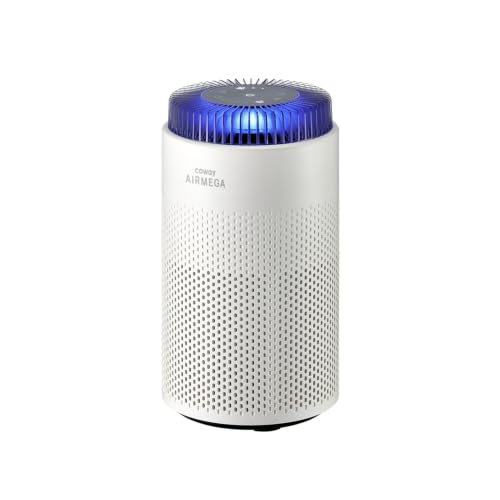
The Airmega 50 is the smallest and quietest purifier on this list. The listing gives a CADR of 120.1 m³/h, a power draw of 14 W and a sleep-mode noise level of 18.4 dB. It uses a pre-filter, Coway’s HyperCaptive HEPA filter and a deodorisation filter. The listing doesn’t state a HEPA grade, so I’d call it “HEPA” and not H13. Coway says it cleans a 25 m² room in about 30 minutes, which is generous for 120 m³/h of airflow. By CADR it suits a desk, study or nursery of around 120 sq ft.
One caution: I found the 120.1 figure on the Amazon listing and on an Indian retailer’s page that copies its wording, but not on Coway’s own site, so check it there before relying on it. The same retailer lists a 5-year motor warranty, which the Amazon text doesn’t mention. Confirm the warranty before you count on it.
Amazon price when checked: ₹6,999. Rating: 4.4.
Choose it if you want a very quiet, low-power purifier for a small space. Skip it if your room is larger than about 120 to 150 sq ft, because its airflow is the lowest on this list.
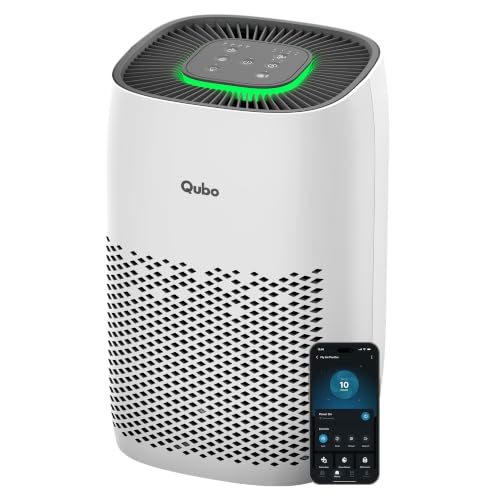
The Q200 is the cheapest way here to get a purifier whose filter cost is published. Qubo’s own page lists a CADR of 150 m³/h, True HEPA 13, activated carbon, an anti-bacterial layer and a replaceable pre-filter. It draws 35 W, tops out at 51 dB and comes with a one-year warranty. Qubo says the filter lasts up to 9,000 hours, which is about two years at 12 hours a day, and a replacement costs ₹1,590 on Qubo’s site. That is roughly ₹800 a year if the claim holds, though dusty or polluted air will shorten it.
Qubo advertises 200 sq ft of coverage, but with 150 m³/h of airflow it is really a purifier for a small bedroom of about 150 sq ft. Qubo’s specification table doesn’t list an ionizer, even though a couple of price-comparison sites do, so I haven’t treated it as one.
Amazon price when checked: ₹6,990. Rating: 4.1.
Choose it if you want a low-cost bedroom purifier with a stated H13 filter and a known replacement price. Skip it if your room is bigger than about 150 sq ft, where the Mijia 4 Compact gives far more airflow for the same price.
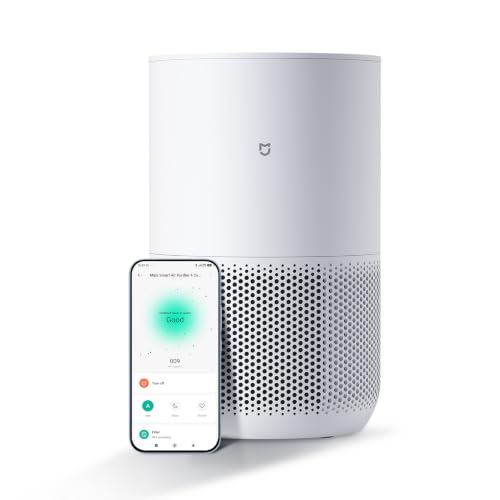
This is the best airflow for the price in a bedroom purifier. Xiaomi India’s page lists a CADR of 230 m³/h, tested by a Chinese lab, with a three-layer filter made up of a pre-filter, a HEPA filter and activated carbon. Xiaomi says the filter captures 99.97% of particles at 0.3 microns. Sleep-mode noise is 20 dB, power draw is about 27 W, and the Xiaomi Home app and voice assistants are supported. It launched in India in August 2026 at ₹7,999, so ₹6,990 on Amazon is a real discount. The Amazon listing gives a coverage of 172 to 291 sq ft, which matches my own estimate.
Two things to keep in mind. The product is new, so there is little long-term feedback on its filters or reliability, and Xiaomi doesn’t state a HEPA grade, so I’d describe it as “HEPA” and not “H13.” The warranty is one year, and I couldn’t confirm the replacement filter price.
Amazon price when checked: ₹6,990. Rating: 4.2.
Choose it if you want the most airflow per rupee for a bedroom of up to about 250 sq ft. Skip it if you want a long track record or a stated HEPA grade, because the model is new and doesn’t give one.
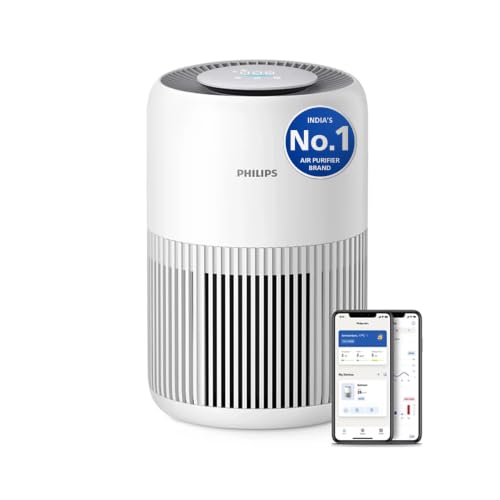
The AC0950 is the quiet one. Philips lists a CADR of 250 m³/h, a noise range of 20.5 to 49 dB and a maximum power draw of 23 W. It has a pre-filter, a HEPA filter and activated carbon, plus an app with real-time air quality readings. Philips India’s own page says it covers up to 320 sq ft, which is the realistic figure, and not the 700 sq ft that appears elsewhere on the same listing. For a bedroom or a small study of 250 to 300 sq ft, it is a sensible choice if you value low noise and an easy app.
You pay for that polish. At ₹11,995, which is Amazon’s full price, other sites list it for ₹10,000 to ₹11,900, and it costs roughly twice as much per unit of CADR as the Xiaomi Compact. Philips lists a one-year recommended filter change (filter code FY0910/30), and retailers show a two-year warranty, which is worth confirming on Philips India’s page. Philips does not state a HEPA grade, only “NanoProtect HEPA,” so I wouldn’t call it H13. I also wouldn’t repeat claims like “100x smaller than standard HEPA” as facts, because they are the brand’s own test claims. The “India’s No. 1 air purifier brand” badge is Euromonitor unit-sales data, which tells you the brand is popular, not that this model is better.
Amazon price when checked: ₹11,990. Rating: 4.4.
Choose it if you want low noise, a polished app and a well-known brand for a room up to about 300 sq ft. Skip it if you mainly care about airflow per rupee, where cheaper models do more.
Medium rooms (about 300 to 400 sq ft)

For a medium living room, the Respure has the best combination of airflow and filter cost on my list. Cuckoo India’s own page lists a CADR of 408 m³/h and a certified coverage of 570 sq ft, and the replacement filter on Cuckoo’s site is listed as H13 True HEPA plus carbon at ₹2,990. It uses a BLDC motor, is made in Korea and weighs about 6 kg. By CADR, a realistic size is around 400 sq ft. The 570 sq ft figure is Cuckoo’s own, so I would repeat it only as the brand’s claim.
The 8-year motor warranty needs a closer look. Cuckoo’s page headlines 8 years, but the fine print says the 7-year extended cover requires you to register within 15 days of delivery, and it doesn’t spell out the base period. Write it as “up to 8 years on the motor, with registration.” Cuckoo’s own price is ₹14,790, so the Amazon price is lower. The listing mentions a free replacement filter for eligible purchases made on or after 1 March 2026, subject to registration. The listing gives noise as about 20 dB in sleep mode to 53 dB at full speed, while one review site lists about 57 dB, so I’d check that before quoting a number. Make sure your Amazon page is the CAC-R1510FW, because Cuckoo also sells variants with different filters.
Amazon price when checked: ₹12,990. Rating: 4.5.
Choose it if you have a living room of around 300 to 400 sq ft and want strong airflow with affordable filters. Skip it if you are not willing to register the warranty, or if you need a compact unit, because it is large and heavy.

The 4 Lite is the cheaper alternative in this band. Xiaomi lists a CADR of 360 m³/h, from a Chinese testing institute, with a three-layer filter of pre-filter, HEPA and activated carbon. Xiaomi quotes 99.97% efficiency at 0.3 microns, and the product carries a TÜV Rheinland allergy-care certification. Xiaomi India says it covers 269 to 463 sq ft, depending on the air-change rate, which is why I put the realistic figure at 330 to 360 sq ft, near the middle of that range. It re-launched in India at ₹12,999, so ₹10,990 is a good price. It is the loudest purifier here for its size: international spec sheets list about 33 dB at night and up to roughly 61 dB at top speed, which will be audible in a living room. The app tracks filter life and air quality, and you’ll want it to remind you of filter changes.
Choose it if you want 360 m³/h for under ₹11,000 and don’t mind some noise at high speed. Skip it if you want a stated HEPA grade, or the quietest operation in a living room.
Amazon price when checked: ₹10,990. Rating: 4.2.
Large rooms (about 600 sq ft)
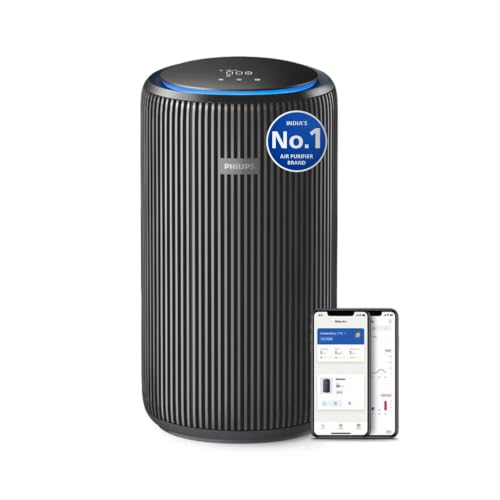
If you have a large hall or an open living and dining area, this is the one model on my list with enough airflow to handle it. Retailer specs list a CADR of 600 m³/h, and the filter stack is a pre-filter, NanoProtect HEPA and two layers of activated carbon, with a maximum draw of about 54 W. At 600 m³/h, my estimate is a realistic room size of about 600 sq ft with an 8 ft ceiling, or about 480 sq ft with a 10 ft ceiling. The title says 700, the GB/T figure is 780, and the 1,679 sq ft claim is the one to ignore.
On noise, European specs put it at about 15 dB on the lowest setting and about 51.5 dB at the top, which is quiet for 600 m³/h of airflow but not silent, so “quiet even at maximum power” is a relative claim. Philips lists filter life of up to 9,000 hours, which is about a year if you run it nonstop, and the filter code is FY4200/30.Curretly filter’s price in India is ₹5,630, also check it before you buy. Retailers list a two-year warranty, and the price varies between about ₹23,700 and ₹25,500 across sites.
It is also the most expensive purifier here by a wide margin, and I have only one large-room model on this list. I’ll update this section as I verify more.
Choose it if you have a large open space and want strong airflow with two carbon layers and low noise at the bottom of the range. Skip it if your budget is under ₹20,000, or your room is smaller than about 400 sq ft, where the Cuckoo does the job for about half the price.
Amazon price when checked: ₹24,922. Rating: 4.6.
Best air purifier for homes with pets
Pets add three problems: hair, dander and smell. A purifier helps with all three only if it has the right parts. You want a pre-filter that catches hair and is easy to clean, because pet hair clogs a pre-filter faster than ordinary dust, a HEPA filter for the finer dander, and a real carbon layer for odours. Choose a higher CADR than the room size alone suggests, since pets shed and move around all day, so I’d step up one size.
Among the models here, the Cuckoo Respure is the one whose Amazon listing speaks directly to pet hair and allergens, with a pre-filter, an H13 HEPA filter and a carbon layer, and at about 6 kg it is less likely to be tipped over. The Xiaomi 4 Lite and 4 Compact both list pet dander among the particles they capture, and the Philips AC4221’s two carbon layers make it the best of the group for smells in a large room.
These are the brands’ own descriptions, not my testing, so treat them as a starting point. Keep the unit where the pet can’t tip it or chew the cable, clean the pre-filter more often than you would without pets, and remember that carbon helps with odours but doesn’t remove the source, so urine and litter smells still need cleaning up directly.
Air purifiers for allergies, smoke and pollution
Many people search for a purifier “for allergies” or “for smoke”, and the same points apply to both. Choose a stated HEPA grade (the Qubo Q200 and the Cuckoo Respure state H13), make sure the CADR suits the room, and keep the windows closed while it runs. Smoke particles are very fine, which is why smoke CADR is the closest match to PM2.5 performance and why a higher-CADR model clears them faster.
For allergies, brands often list certifications. The Xiaomi 4 Lite lists a TÜV Rheinland allergy-care certification, and the Philips AC0950 listing mentions an ECARF allergy-friendly certification. Those are brand statements, so verify them on the certifier’s own site before you repeat them. As noted above, a purifier can reduce airborne particles in a room but isn’t medical treatment, and if you have asthma or severe allergies you should talk to your doctor.
What I left out, and why
I skipped any model whose listing doesn’t publish a CADR, because without it I can’t place it in a room size. The Dyson Hushjet Purifier Compact HJ10 is a good example. Its Amazon listing shows a price of ₹29,900, a claim of coverage up to 1,076 sq ft and a filter life of up to five years, but no CADR anywhere in the specifications, so there is nothing to check that coverage claim against. It also uses an electrostatic filter, and the listing doesn’t mention a HEPA or carbon stage, so I can’t compare it with the models above on those either. It may well be a fine purifier, but I can’t recommend it on the information provided.
What it costs to keep running
Filter prices are where cheap purifiers get expensive, so here is what I could confirm. To work out your own total, add the purchase price, the number of filter changes you expect over the years you plan to keep it times the filter price, and the electricity. As an example, a Qubo Q200 run for 12 hours a day for three years costs ₹6,990 plus about one ₹1,590 filter, or roughly ₹8,600 before electricity.
| Model | Replacement filter | Brand’s stated filter life |
|---|---|---|
| Coway Airmega 50 | ₹5,818 to ₹6,465 | Not stated in the listing |
| Qubo Q200 | ₹1,590 (HPH01) | Up to 9,000 hours |
| Mijia 4 Compact | ₹1,999, check before buying | Filter-life indicator in the app |
| Philips AC0950 | ₹1,999 (code AC0951) | One year recommended |
| Xiaomi 4 Lite | ₹2,749, check before buying | Filter-life indicator in the app |
| Cuckoo Respure | ₹2,990 (H13 HEPA + carbon) | Not stated on the page |
| Philips AC4221 | ₹5,630 (code FY4200/30) | Up to 9,000 hours |
Electricity consumption of the 7 air purifiers
Using the power ratings in your article, here’s the estimated electricity usage if each purifier runs for 12 hours daily.
| Air purifier | Maximum power | Units per 12 hours | Units per 30 days |
|---|---|---|---|
| Coway Airmega 50 | 14 W | 0.168 | 5.04 |
| Qubo Q200 | 35 W | 0.420 | 12.60 |
| Mijia 4 Compact | 27 W | 0.324 | 9.72 |
| Philips AC0950 | 23 W | 0.276 | 8.28 |
| Xiaomi Air Purifier 4 Lite | 33 W | 0.396 | 11.88 |
| Cuckoo Respure | Not confirmed | — | — |
| Philips AC4221 | 54 W | 0.648 | 19.44 |
These are calculated estimates using the maximum rated power figures in your article, not measured consumption. Actual use may be lower when a purifier operates at a reduced speed.
Estimated monthly electricity cost
Assuming an electricity rate of ₹8 per unit, the estimated costs for 12 hours of daily operation are:
| Air purifier | Estimated monthly cost |
|---|---|
| Coway Airmega 50 | ₹40 |
| Qubo Q200 | ₹101 |
| Mijia 4 Compact | ₹78 |
| Philips AC0950 | ₹66 |
| Xiaomi Air Purifier 4 Lite | ₹95 |
| Cuckoo Respure | Cannot calculate without wattage |
| Philips AC4221 | ₹156 |
The estimates assume the purifier draws its maximum rated power throughout operation. Actual consumption varies with fan speed and operating conditions.
Where to place it and how to run it
Put the purifier where air can reach it from all sides. Most manuals ask for 20 to 30 cm of clearance from walls and furniture, so avoid corners, the back of a sofa and spots behind curtains. In a bedroom, a spot a metre or two from the bed works well, with the airflow not pointed straight at you. Keep it off a closed cabinet or a carpet that blocks the intake.
Close the windows and doors while it runs. A purifier cleans the air in the room, and an open window keeps bringing particles in. Most people get the best results by running it continuously on Auto or a low to medium speed, not switching it on only when the air looks bad, and by using a higher speed for the first hour after cooking, cleaning or when outdoor pollution spikes. Sleep mode is for the night, when quiet matters more than speed.
Keep the room itself as clean as you can. Dry sweeping and dusting stir settled particles back into the air, so damp wiping is better, and the purifier will catch what remains.
Maintaining your purifier
Most purifiers have a washable or vacuum-able pre-filter that catches hair and coarse dust. Cleaning it every couple of weeks is typical, but follow the manual, because it protects the main filter and keeps airflow up. Don’t wash a HEPA filter unless the manual explicitly says so, since water can damage it. Replace the main filter when the indicator tells you to, or sooner if you live somewhere dusty, and keep the invoice and register the warranty, as Cuckoo asks you to within 15 days. Buying a spare filter before winter is also sensible, since pollution season is when demand and delivery times are at their worst.
What an air purifier can and can’t do
A purifier with a good HEPA filter reduces the fine particles, dust, pollen and pet dander in a room’s air. It doesn’t remove settled dust from surfaces, and it can’t fix a source that keeps producing smoke. Activated carbon helps with some smells and gases, but a purifier isn’t a substitute for ventilation or for a carbon monoxide alarm, and it won’t remove every gas. If you have asthma or allergies, a purifier can be one useful part of a plan, but it isn’t medical treatment, so talk to your doctor about your own situation.
Air Conditioner vs Air Purifier: Can Your AC Clean Indoor Air?
If you already have an air conditioner at home, you might wonder whether it can clean indoor air without buying a separate air purifier. The short answer is that a standard AC can trap some dust, but it is not a replacement for a dedicated air purifier.
Does an AC work as an air purifier in fan mode?
Yes, but only to a limited extent. When you switch a typical split AC to fan mode, its indoor fan circulates room air through the built-in mesh filter. This filter catches some larger dust particles, hair and lint, mainly to protect the AC’s internal components.
However, standard AC filters are not designed to remove fine PM2.5 pollution efficiently. Even when the AC runs continuously, it cannot be expected to provide the same filtration as a properly sized air purifier with a high-efficiency particulate air (HEPA) filter. Some AC models have additional air-purification filters, so check your model’s specifications before drawing conclusions.
Air conditioner vs air purifier: Key differences
| Feature | Standard AC in fan mode | Dedicated air purifier |
|---|---|---|
| Main purpose | Circulates room air | Cleans indoor air |
| Larger dust particles | Traps some | Traps particles through its filter |
| Fine PM2.5 particles | Limited filtration | Effective when appropriately filtered and sized |
| Smoke and pollen | Limited filtration | Can reduce airborne particles |
| Odours and gases | Generally limited | Can reduce some with a suitable activated carbon filter |
| Works without cooling | Yes, if fan mode is available | Yes |
Should you buy an air purifier if you already have an AC?
If your main concern is summer comfort, your AC does its job. But if you want to reduce fine dust, smoke and outdoor pollution entering your home, a dedicated air purifier is a more suitable choice.
For the best results, choose a purifier with a suitable clean air delivery rate (CADR) for your room, check the filter specifications and keep doors and windows closed while it operates during periods of high outdoor pollution. You can run it alongside your AC; the two appliances serve different purposes.
Bottom line: An AC can trap some dust, even in fan mode, but don’t rely on a standard AC filter to protect you from fine-particle pollution. A properly sized air purifier with effective filtration is the better option for that purpose.
Common mistakes to avoid
The biggest mistake is buying by the coverage area on the box and ignoring CADR. The second is buying a purifier that is too small for the room, running it on the highest speed and then finding it too loud to keep on. The third is ignoring filter cost, so that a cheap purifier ends up costing more than a better one within two years. Other common errors are putting the unit in a corner, leaving a window open, forgetting to clean the pre-filter and buying non-genuine filters. And be wary of any listing that gives a coverage number with no CADR, a filter called “HEPA-type,” or an ionizer or ozone feature.
A short checklist for reading an Amazon listing
Check that the title’s model code matches the one in the specifications, because several brands sell near-identical variants. Look for a stated CADR, and make sure it sits close to the coverage claim you’re being sold. Look for a stated HEPA grade and some mention of carbon. Check the seller and the warranty terms, and see whether registration is needed. Search for the replacement filter’s price and availability. Finally, read recent reviews for complaints about noise, filter reminders and after-sales support. Reviews are more useful when they mention a specific problem than when they just give stars.
Frequently asked questions
Which is the best air purifier for home in India?
There is no single winner, because the right one depends on your room. For a small bedroom I’d pick the Mijia 4 Compact or the Qubo Q200, for a bedroom or study up to about 300 sq ft the Philips AC0950, for a medium living room the Cuckoo Respure, and for a large hall the Philips AC4221. Match the CADR to your room first and the brand second.
Which is the best air purifier under ₹10,000?
Of the models I checked, the Mijia by Xiaomi 4 Compact at ₹6,990 gives the most airflow (CADR 230). The Qubo Q200 at ₹6,990 is the better choice if you want a stated H13 filter and a published replacement price, but its airflow is lower, so it suits a small bedroom of about 150 sq ft.
Which is the best air purifier under ₹20,000?
Among the models I verified, the Cuckoo Respure (₹12,990, CADR 408) is the strongest for a living room, the Xiaomi 4 Lite (₹10,990, CADR 360) is the cheaper alternative, and the Philips AC0950 (₹11,995, CADR 250) suits a quiet bedroom. I haven’t verified models between about ₹13,000 and ₹25,000 yet.
Which is the best air purifier for pets?
Look for a cleanable pre-filter, a stated HEPA grade and a real carbon layer, and size up the CADR. The Cuckoo Respure fits that description best among the models here, and the Philips AC4221 is the strongest on odours for a large room. See the pets section above for the caveats.
What CADR do I need for my room?
Use the table earlier in this guide. As a quick rule for an 8 ft ceiling, pick a purifier whose CADR in m³/h is at least your floor area in square feet, and aim for the table’s higher figure if you can. For taller ceilings, add about 25 percent for 10 ft.
Can one purifier clean two rooms?
Not really. A purifier works best in a closed room. If two rooms are connected by an open doorway, size for the combined volume, and expect slower cleaning in the room farther from the unit.
Should I buy one big purifier or two smaller ones?
For one large open space, one big purifier is simpler, quieter and cheaper to run. For separate rooms such as two bedrooms, two smaller units work better than one big one.
Is HEPA H13 necessary?
True HEPA, ideally H13, is what you want for fine particles. “HEPA-type” or a bare “HEPA filter” with no grade is a weaker promise. Some of the models here, including the Philips, Xiaomi and Coway ones, don’t state a grade, so I describe them only as HEPA.
Why do the room sizes in your table differ from Amazon’s?
The coverage on Amazon is the brand’s, usually calculated at one or two air changes an hour. Mine come from CADR at about 4 to 5 air changes an hour, which is closer to what keeps a room’s air clean.
How long does it take to clean a room?
At 5 air changes an hour, the air in the room is cycled through the filter about once every 12 minutes. That is why a bigger CADR matters more than leaving a small purifier on for longer.
Should I run it all day?
For most people, running it continuously on Auto or a low speed gives the most consistent results, and electricity use is small. Use sleep mode at night. If you prefer to save filters, run it for a few hours before bed with the door closed.
How often do I have to change the filter?
It depends on the model and your air. Qubo and Philips rate some filters at up to 9,000 hours, which is about a year of nonstop use, and Philips recommends changing the AC0950’s filter yearly. In a dusty or polluted area, expect it to be sooner, and watch the app’s reminders.
Do I need an app or Wi-Fi?
No. The purifier’s job is to filter air, and every model here works without the app. The app is a bonus for reminders and scheduling.
Are cheap purifiers worth buying?
They can be, as long as the CADR suits your room, the filter is a stated HEPA grade and the replacement filters are available and priced sensibly. A ₹7,000 purifier with the right CADR beats a ₹20,000 one that is too small for the room.
Does an air purifier work with windows open?
Not well. A purifier cleans the air in a closed room, so it works best with windows and doors shut while it runs.
Should I buy a purifier with an ionizer?
I’d choose one that relies on filters alone, because ionizers can produce small amounts of ozone.
Which one should you buy?
For a small bedroom on a tight budget, the Mijia 4 Compact gives the most airflow for ₹6,990, and the Qubo Q200 is the better pick if you want a published filter price and a stated H13 filter in a room of about 150 sq ft. If you want the quietest option with a good app and you’re happy to pay more, the Philips AC0950 fits a bedroom or study of up to about 300 sq ft. For a medium living room, the Cuckoo Respure is my pick for airflow and filter cost, with the Xiaomi 4 Lite as the cheaper but louder alternative. For a large hall, the Philips AC4221 is the only model here with the airflow for it.
Whichever you choose, match the CADR to your room first and the brand second. Prices and availability change often, so check the current price on Amazon before you decide.
Affiliate disclosure: links on this page are Amazon affiliate links. If you buy through them, TechMitra may earn a small commission at no extra cost to you.

Ayush Singhal is the founder and chief editor of TechMitra.in — a tech hub dedicated to simplifying gadgets, AI tools, and smart innovations for everyday users. With over 15 years of business experience, a Bachelor of Computer Applications (BCA) degree, and 5 years of hands-on experience running an electronics retail shop, Ayush brings real-world gadget knowledge and a genuine passion for emerging technology.
At TechMitra, he covers everything from AI breakthroughs and gadget reviews to app guides, mobile tips, and digital how-tos. His goal is simple — to make tech easy, useful, and enjoyable for everyone. When he’s not testing the latest devices or exploring AI trends, Ayush spends his time crafting tutorials that help readers make smarter digital choices.
📍 Based in Lucknow, India
💡 Focus Areas: Tech News • AI Tools • Gadgets • Digital How-Tos
📧 Contact: Get in touch →
🔗 Full Bio: https://techmitra.in/about-us/