

Published: August 25, 2025 | Last Updated: June 2026
Editor’s Note (June 2026): This article has been significantly updated to reflect major developments since its original publication — including the IndiaAI Mission’s expanded compute rollout, the India AI Impact Summit 2026 and New Delhi Declaration, Sarvam AI’s sovereign LLM launch, and the latest NASSCOM workforce data.
Table of Contents
Also Read : Claude AI Pricing in India: How It Compares to ChatGPT and Gemini (July 2026)
Impact of AI on Indian Economy , Jobs and Industries
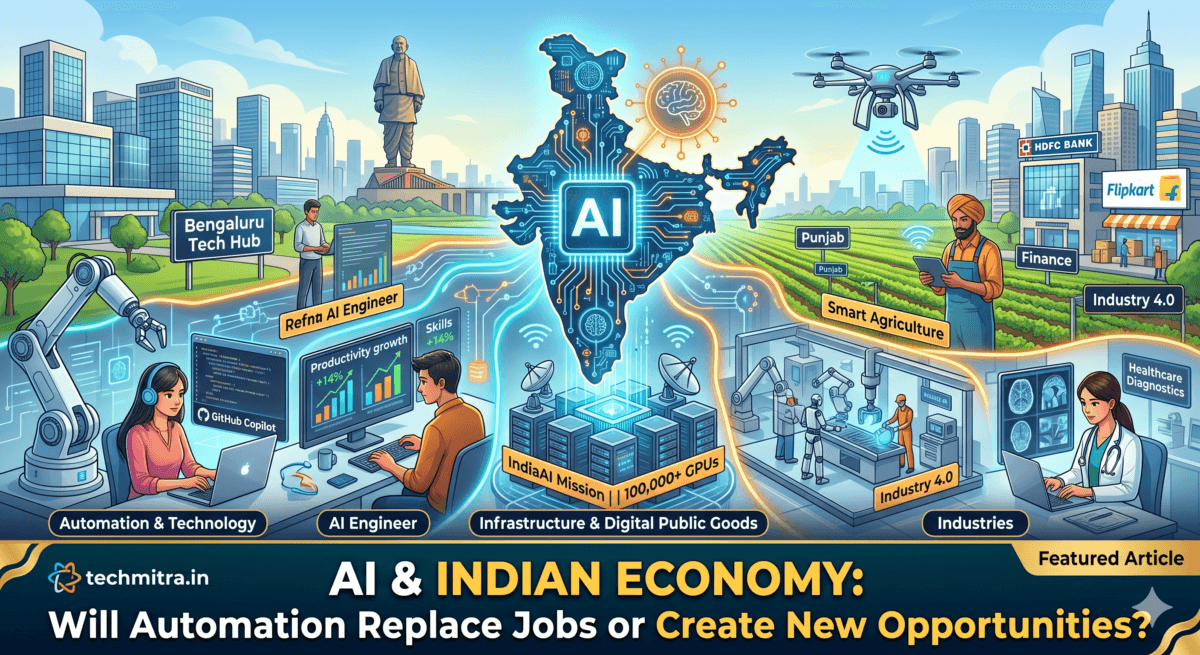
Artificial Intelligence (AI) is no longer a futuristic buzzword; it is a present-day reality shaping the core of India’s workforce and industries. From the buzzing tech hubs of Bengaluru to the vast farmlands in Punjab, AI is making its mark in ways both disruptive and transformative. For India — a country with a workforce of over 500 million — understanding how AI impacts jobs and industries is not just important, it is critical for economic survival and growth.
And the pace of change has accelerated sharply. Since 2025, India has moved from talking about AI to actively building sovereign AI infrastructure, hosting one of the largest AI summits in world history, and launching its first domestically trained large language model (LLM). This article explores how AI is revolutionizing sectors such as IT, agriculture, healthcare, and manufacturing — while also addressing the big question: will AI create more jobs than it replaces?
Introduction to AI and Its Growing Influence in India
Artificial Intelligence refers to the simulation of human intelligence in machines that can learn, reason, and make decisions. Globally, AI is at the forefront of innovation, and India is no exception. With one of the youngest workforces in the world and a booming digital economy, AI adoption in India is accelerating faster than ever.
What is Artificial Intelligence?
In simple terms, AI is the ability of a computer system to mimic tasks usually requiring human intelligence — such as problem-solving, decision-making, language understanding, and image recognition. Unlike traditional software that follows predefined instructions, AI learns and improves with experience through machine learning and deep learning.
For example, the voice assistant on your phone, the product recommendations you get on Flipkart, or fraud detection in digital banking — all of these are everyday AI applications that Indians are already using without even realising it.
Why AI Matters for India’s Economic Future
India’s economy is heavily reliant on both its IT sector and agriculture, which collectively employ hundreds of millions of workers. AI has the power to boost productivity, improve decision-making, and cut costs — but it also has the potential to displace jobs if the workforce is not prepared.
The numbers tell the story clearly. As of December 2025, the NASSCOM AI Adoption Index scores India at 2.45 out of 4, with 87% of enterprises actively using AI solutions. The Indian AI market has grown from USD 2.97 billion in 2020 to USD 7.63 billion in 2024, and is expected to reach USD 131.31 billion by 2032 at a CAGR of 42.2%. According to PwC, AI could add nearly $1 trillion to India’s economy by 2030 — but only if industries and workers embrace the transition.
India’s Big Bet: The IndiaAI Mission and Sovereign AI Push
This section covers major developments from 2025–2026 not present in the original article.
One of the most significant shifts in India’s AI journey has been the government’s move toward AI self-reliance — the idea that India should not remain dependent on foreign AI infrastructure and models built for Western markets.
The IndiaAI Mission: ₹10,371 Crore for a Sovereign AI Ecosystem
The Union Cabinet approved the IndiaAI Mission in March 2024 with a total outlay of ₹10,371.92 crore (~$1.25 billion) over five years. This is India’s most ambitious AI infrastructure initiative to date, and by 2026, it has moved well beyond the planning stage.
Key achievements as of mid-2026:
- 34,000+ GPUs deployed across data centres in India, accessible to startups, researchers, and government agencies at approximately ₹65 per GPU-hour — a fraction of what global cloud providers charge (AWS and Azure charge roughly ₹210–335 per hour for comparable access).
- 20,000 additional GPUs announced at the India AI Impact Summit in February 2026, targeting a total public capacity of 100,000 GPUs by December 2026.
- Private deployments by Reliance, Tata, and international hyperscalers could push India’s combined national GPU capacity beyond 200,000 units within two years.
- 367 datasets have already been uploaded to AI Kosh, India’s open national AI dataset platform.
- 12 startups have been selected to develop indigenous multimodal foundation models using India-specific data.
- The Mission operates across seven pillars: subsidised compute, foundation model development, startup financing, open datasets, AI in governance, international collaboration, and safe AI governance.
The Mission’s vision is captured simply: “Make AI in India, Make AI Work for India.”
Sarvam AI: India’s First Sovereign Large Language Model
A historic milestone came in February 2026 when Sarvam AI — the first startup selected under the IndiaAI Mission — launched two open-source models trained on Indian compute:
- Sarvam-30B: A mixture-of-experts architecture
- Sarvam-105B: Activates approximately 9 billion parameters per token with a 128,000-token context window, supporting 10+ Indian languages
Sarvam-105B is now the most capable open-source AI model trained specifically on Indian language data, covering Hindi, Tamil, Telugu, Kannada, Malayalam, Bangla, and more. This matters enormously for Indian users — most global AI models are primarily trained on English data and perform poorly in regional languages. Sarvam AI also launched a startup programme in March 2026, offering AI credits and developer tools to Indian companies building on its models.
Digital Personal Data Protection (DPDP) Rules 2025
India also took a major step on AI governance. The DPDP Rules were notified on November 13, 2025. For businesses and individuals using AI:
- Consent Manager registration launches November 2026
- Full compliance requirements, including breach notifications, kick in May 2027
- AI systems processing Indian user data will fall under Significant Data Fiduciary obligations above certain thresholds
This gives India a balanced regulatory framework — not as rigid as the EU AI Act, but enough to protect citizens while letting innovation continue.
Also Read : When AI Gets Technical Advice Wrong: A LiteSpeed Cache Purge All Case Study
India AI Impact Summit 2026: India Takes the Global Stage
In February 2026, India hosted one of the most significant AI events in history.
What Happened at the Summit
The India AI Impact Summit 2026, held February 16–21 at Bharat Mandapam in New Delhi, brought together:
- Over 20 Heads of Government
- Delegations from 118 countries and over 100 international organisations
- More than 100 global AI CEOs and CXOs
- Over 6 lakh in-person attendees and 9 lakh cumulative virtual views
The scale made it one of the largest AI gatherings in world history.
Key Outcomes
The New Delhi Declaration on AI Impact was adopted on February 19, 2026, and endorsed by 89 countries and international organisations. The Declaration emphasises equitable AI diffusion, trusted AI frameworks, scientific collaboration, and workforce reskilling — with India’s vision of “Vasudhaiva Kutumbakam” (the world is one family) at its core.
Investment Commitments: Over USD 200 billion in AI-related investments were committed across infrastructure, foundation models, hardware, and applications — signalling global confidence in India as an AI destination.
Workforce Commitments:
- Signing of the Voluntary Guiding Principles for Reskilling in the Age of AI, endorsed by 23 countries
- Release of the Equitable AI Transition Playbook in partnership with the International Labour Organization (ILO), aimed at preparing workers for AI-driven changes
- India achieved a Guinness World Record for the “Most pledges received for an AI responsibility campaign in 24 hours” — with over 2.5 lakh validated pledges
India also formally joined the Pax Silica Initiative — a US-led framework securing supply chains for semiconductors and advanced computing hardware. This protects India’s continued access to advanced AI chips, a critical geopolitical move given global chip export restrictions.
Transformation of the Indian IT Industry through AI
The Indian IT industry has always been the backbone of the economy, contributing significantly to exports and global outsourcing. With AI entering the scene, the IT sector is going through its biggest evolution since the rise of the internet.
The Real Numbers: Jobs Are Being Reshaped Right Now
The transformation is no longer theoretical. As of early 2026:
- 86% of Indian employers have already seen AI impact job roles and responsibilities (Indeed–NASSCOM report, May 2026)
- 35% report significant redefinition or transformation of roles
- NASSCOM reports that workforce growth in India’s tech sector slowed to 2.3% in FY26, even as the industry expanded — companies are moving from large-scale fresher hiring toward specialised roles
- Entry-level IT roles have declined by 20–25% as AI automates repetitive tasks like manual testing, data entry, and L1 customer support
- Companies like Infosys, Wipro, and TCS have announced AI-first strategies that reduce headcount in repetitive task categories by 20–30%
This does not mean a jobs apocalypse. What it means is a structural shift — the kind of shift that happened when PCs replaced typewriters, or when the internet displaced traditional retailers. The roles don’t disappear; they transform.
Automation of Repetitive IT Tasks
AI-powered bots now handle software testing, bug fixing, data entry, and basic customer support. Chatbots powered by Natural Language Processing (NLP) resolve customer issues without human intervention — saving costs for companies while raising concerns about entry-level job losses.
However, engineers today are increasingly working alongside AI systems — reviewing outputs, refining prompts, and ensuring quality rather than writing every line of code from scratch. A study by ICRIER (backed by OpenAI) confirms that while AI is not yet causing widespread job losses, it is fundamentally reshaping how work is organised and how productivity is measured.
AI in Software Development, Cybersecurity, and Cloud Services
AI is revolutionizing software development with tools like GitHub Copilot that help developers write cleaner and faster code. In cybersecurity, AI-driven systems detect unusual patterns and prevent attacks faster than human analysts.
In cloud computing, AI plays a major role in resource optimization. Indian IT companies offering cloud services are increasingly becoming global leaders in AI-enabled solutions.
Job Shifts: From Coders to AI Specialists
While traditional coding jobs are under pressure, demand is exploding in new areas:
- AI/ML engineering
- Data science and analytics
- Prompt engineering
- AI ethics and governance
- MLOps (Machine Learning Operations)
- Cybersecurity in AI systems
NASSCOM estimates that AI-related job demand in India will cross 1 million by 2026 — but only about 16% of IT professionals are currently AI-skilled, according to MeitY. This talent gap is both a challenge and an opportunity.
In early 2026, Global Capability Centres (GCCs) — which represent the highest-value AI work — leased a record 9 million square feet of office space in India, underscoring the scale and pace of growth.
Also read : Why Retail Shops in India Need E-Commerce: Lessons From 10+ Years in Retail
AI in Agriculture: Revolutionizing Indian Farming
Agriculture remains the backbone of India’s economy, employing nearly 40% of the workforce. However, Indian farming faces challenges like unpredictable weather, water scarcity, low productivity, and supply chain inefficiencies. AI is stepping in as a powerful solution.
Smart Farming with Drones and Sensors
Farmers are now using AI-powered drones to monitor crop health, spray fertilizers, and detect pest infestations with real-time data. AI-enabled sensors in soil detect moisture levels and recommend precise irrigation schedules. This “smart farming” reduces water wastage and increases crop yield, making agriculture more sustainable.
Predictive Analytics for Crop Yield and Weather Forecasts
AI models can analyze historical data and predict crop yields with impressive accuracy — forecasting monsoon patterns, alerting farmers about upcoming droughts, and helping plan sowing and harvesting schedules. Pilot projects in Andhra Pradesh and Karnataka have already demonstrated real-world benefits.
AI Tools for Market Access and Supply Chain Efficiency
AI is helping farmers connect with markets directly — platforms predict market demand and suggest the best prices, reducing the role of middlemen and ensuring farmers get fair value. Supply chain optimization using AI minimises food waste and gets fresh produce to consumers faster.
The MSME Agriculture Connection
A critical 2026 development is the convergence of AI with India’s MSME sector, which includes millions of small agri-businesses and rural traders. According to the PayNearby MSME Digital Index Report 2026, digital payments, Aadhaar-enabled banking, and AI tools are now becoming part of everyday business operations for small retailers and service providers in semi-urban and rural India. MSMEs contribute nearly one-third of India’s GDP and employ over 110 million people — making their AI adoption a national economic priority.
Impact of AI on Other Key Industries
AI in Healthcare: Diagnostics and Telemedicine
India faces a shortage of doctors, especially in rural areas. AI-powered diagnostic tools are bridging this gap by analyzing X-rays, MRIs, and blood reports with high accuracy. Telemedicine platforms use AI to recommend treatments and monitor patients remotely, making healthcare more accessible. AI is also being used for epidemic early-warning systems and drug discovery.
AI in Retail and E-Commerce: Personalized Shopping Experience
E-commerce giants like Amazon India and Flipkart use AI for personalized product recommendations, inventory management, and fraud detection. AI-powered chatbots handle customer service, while predictive analytics help businesses anticipate demand. For small retailers transitioning online, AI-driven platforms are reducing the barriers to digital commerce.
AI in Manufacturing: Robotics and Quality Control
In Indian factories, AI-powered robots handle repetitive assembly line tasks with precision. AI-driven quality control identifies defects in real time. This is pushing Indian manufacturing closer to “Industry 4.0,” where smart machines collaborate with human workers. India’s PLI (Production Linked Incentive) scheme for electronics and semiconductors further accelerates this shift.
AI in Financial Services
Banks and fintech companies are deploying AI for KYC processing, credit scoring, fraud detection, and personalized financial products. Junior analyst and clerical roles across HDFC, ICICI, and SBI are seeing AI tools handle reconciliation and basic report generation — but simultaneously, new roles in AI model oversight and financial data science are being created.
Job Displacement vs. Job Creation in the AI Era
The big question remains: will AI create more jobs or take them away?
Which Jobs Are at Risk in India?
Jobs involving repetitive tasks are most at risk:
- Data entry and document processing
- Basic customer support (L1 BPO roles)
- Manual software testing
- Routine financial analysis and reconciliation
- Telemarketing and basic sales support
NASSCOM’s 2025 report estimates that 1.5 million+ IT roles will be significantly transformed by AI within the next two years, with Bangalore, Hyderabad, and Pune tech hubs experiencing the fastest change.
New Job Roles Emerging Due to AI
At the same time, new opportunities are being created:
- AI engineers and ML specialists (highest demand)
- Data scientists and AI analysts
- Prompt engineers for GenAI tools
- Drone operators for agriculture and logistics
- AI ethics and governance specialists
- AI trainers for regional language models
- Cybersecurity professionals in AI systems
NASSCOM and Deloitte jointly estimate that India’s AI talent pool could reach around 1.25 million by 2027 — with demand likely to outpace supply significantly, creating an urgent skills gap that anyone entering the workforce now should plan around.
Human-AI Collaboration: The Real Future
NASSCOM’s current position is clear: “This is not a linear migration — it is a national workforce reinvention anchored in job evolution, not elimination.”
Doctors supported by AI diagnostics, teachers supported by AI learning platforms, farmers assisted by AI drones — these hybrid roles show how collaboration, not replacement, is the real future of AI in India. Generative AI tools have been shown to boost overall productivity by 14% — and by as much as 34% among newer or lower-skilled workers — helping close skill gaps while improving outcomes.
The Role of Upskilling and Reskilling in India
The arrival of AI is reshaping industries, but the most critical question is whether Indian workers are prepared for this change.
Government Skilling Initiatives (2024–2026)
Multiple major initiatives are now operational:
FutureSkills Prime (MeitY + NASSCOM): With over 25.3 lakh registered learners and 3,000+ course pathways, this platform focuses on AI, big data, and cloud computing, aligned with National Occupational Standards.
IndiaAI FutureSkills (launched under the IndiaAI Mission, 2024): Builds a strong ecosystem of AI-skilled professionals through fellowship programmes for UG, PG, and PhD students; AI and Data Labs; and specialised skill development curricula.
SOAR (Skilling for AI Readiness): As of December 2025, SOAR had enrolled 1.34 lakh students and teachers, delivering AI-readiness courses in partnership with Microsoft, HCL Technologies, and NASSCOM.
YUVAi (Youth for Unnati with AI) (MeitY + NeGD): Targets students from Classes 8 to 12 with foundational AI skills across eight thematic areas. Includes “YUVA AI for ALL” — a free national course targeting 1 crore (10 million) citizens with AI literacy.
The Role of NSDC in AI Training
The National Skill Development Corporation (NSDC) remains central to AI skill delivery at scale, particularly for workers outside metro cities. Through partnerships with Microsoft, Google, and IBM, NSDC delivers structured AI and machine learning courses to both urban professionals and rural learners.
Popular AI Upskilling Platforms in India
Private edtech platforms like UpGrad, Coursera, Great Learning, NPTEL, and Simplilearn offer AI and data science courses that are industry-relevant and affordable. An IT professional can enroll in a machine learning course on Coursera and transition into a data scientist role; a farmer can attend an NSDC workshop on using AI-driven soil sensors.
The combination of government skilling initiatives, NSDC outreach, and private edtech creates an ecosystem where every Indian — whether in cities or villages — has a realistic path to benefit from AI.
Government Initiatives to Promote AI Adoption
Digital India and AI for All
The Digital India mission laid the foundation for widespread AI adoption by improving internet penetration, digital literacy, and e-governance. Building on this, the government has launched the AI for All initiative, making AI learning available to students, professionals, and the general public — with free AI modules in regional languages and AI curriculum now entering schools and colleges.
NITI Aayog and the AI for Inclusive Societal Development Report (October 2025)
In October 2025, NITI Aayog published “AI for Inclusive Societal Development” — an important update to its 2018 AI strategy. The report focuses on how AI can enable 490 million informal-sector workers in India by improving access to healthcare, education, skills training, and financial services. It emphasises that technology must bridge societal gaps, not deepen them.
The IndiaAI Mission’s Seven Pillars
The IndiaAI Mission goes beyond compute. Its seven pillars are:
- AI Compute Infrastructure — subsidised GPU access for startups and academia
- AI Innovation Centre — Centers of Excellence in AI across major cities
- India Datasets Platform (AI Kosh) — open, curated datasets for Indian AI development
- AI Application Development — grants and support for solving India-specific problems
- FutureSkills — workforce reskilling at scale
- Startup Financing — capital and mentorship for Indian AI startups
- Safe and Trusted AI — ethical frameworks and governance guidelines
Public-Private Partnerships
The government’s collaboration with the private sector spans:
- Microsoft’s AI School of India — training developers in AI tools
- IBM SkillsBuild Platform — free AI and data science courses for students
- Google’s AI for Social Good Program — supporting flood forecasting, agricultural planning, and rural connectivity
- India-U.S. AI Opportunity Partnership — announced at the India AI Impact Summit 2026, securing India’s access to advanced AI chips and establishing joint R&D channels
Challenges of AI Integration in India
Skill Gaps in Rural vs. Urban Workforce
India’s workforce is split between urban professionals in IT and rural workers dependent on agriculture. While urban workers can access online AI learning platforms, rural workers often lack digital infrastructure, devices, and awareness. Bridging this digital divide is one of the biggest challenges in ensuring equitable AI adoption.
According to the Indeed–NASSCOM 2026 report, nearly all organisations expect their 2026 workforce strategy to centre around AI-related or AI-supported roles — with 40% expecting a major overhaul. This urgency has not yet reached India’s smaller cities and rural areas.
Data Privacy and Security Concerns
AI systems thrive on data, but with increasing data collection comes the risk of misuse. The new DPDP Rules (2025) are a step in the right direction, but implementation and enforcement at scale remain challenges. Concerns about privacy, cybersecurity, and ethical AI use are growing as AI enters sensitive sectors like healthcare, finance, and law enforcement.
Infrastructure: Power and Connectivity
A less-discussed but real constraint is energy infrastructure. GPU-based AI workloads demand 7–8 times higher power density than traditional server racks — and most existing Indian data centres cannot handle these requirements without major retrofits. The IndiaAI Mission’s compute targets and India’s power infrastructure are not yet fully aligned.
Economic Inequality and AI Access
There is a genuine risk that AI deepens inequality. Large corporations with AI infrastructure may thrive, while small businesses and workers without access may fall behind. Unless AI tools are made affordable and accessible — and the evidence from Sarvam AI and the IndiaAI Mission suggests India is trying — the benefits may remain concentrated in metro cities and large enterprises.
The Chip Dependency Question
A candid point worth raising: India’s 34,000+ GPUs are built on NVIDIA chips. Not a single chip in the IndiaAI compute stack is domestically designed or manufactured. This dependency creates geopolitical risk — the same US export controls that cut China off from advanced chips could, in a different political moment, affect India. The India-U.S. AI Opportunity Partnership provides some protection, but India’s long-term AI sovereignty requires progress on domestic semiconductor manufacturing.
Future Outlook: AI-Driven India
Potential Economic Impact of AI by 2030
According to PwC, AI could add nearly $1 trillion to India’s economy by 2030. The Indian AI market is projected to grow at a CAGR of 42.2%, reaching USD 131.31 billion by 2032. This impact will come from higher productivity, smarter supply chains, and more efficient industries.
India is already ranked among the first group of AI-ready nations, with progress across all five layers of AI architecture: applications, models, chips, infrastructure, and energy.
AI as a Driver for Inclusive Growth
AI’s potential in India is not just about big industries. From rural farmers using AI drones to students in small towns learning AI coding online, this technology has the power to create genuinely inclusive growth. The NITI Aayog’s focus on 490 million informal workers, combined with the IndiaAI Mission’s FutureSkills initiative, reflects a government serious about making AI work for everyone — not just Bengaluru’s tech elite.
How India Can Lead in Global AI Innovation
India has a combination of advantages no other country replicates: the world’s largest English-speaking tech workforce, the deepest pool of IT talent, a 1.4 billion-person consumer base generating enormous data, and a government now actively investing in AI sovereignty.
The India AI Impact Summit 2026’s New Delhi Declaration — endorsed by 89 countries — positions India not just as an AI consumer but as a shaper of global AI norms, particularly for the Global South. Countries across Africa, Southeast Asia, and Latin America are looking to India’s model of democratized, multilingual, inclusive AI.
India’s AI journey won’t just be about catching up with the US and China. With the right focus on AI education, affordable infrastructure, sovereign models, and ethical governance, India is positioning itself to set the standards for responsible and inclusive AI development.
Conclusion
Artificial Intelligence is reshaping Indian industries at a speed few could have imagined even two years ago. From IT automation to AI-powered farming drones, the changes are visible everywhere. Since August 2025 alone — when this article was first published — India has launched a sovereign compute mission with 34,000+ GPUs, hosted a global AI summit attended by 118 countries, adopted an international AI declaration, and released its first domestically trained large language model supporting 22 Indian languages.
Some jobs are clearly at risk, particularly repetitive, entry-level roles in IT, BPO, and data processing. But new opportunities are emerging in AI engineering, data science, prompt engineering, drone operations, and AI governance — roles that require exactly the kind of creativity and domain knowledge that India’s workforce has always excelled at.
The real challenge lies in preparing India’s vast workforce for this transition — quickly enough to benefit, and broadly enough to include workers far beyond the metro tech hubs. With strong government initiatives through the IndiaAI Mission, FutureSkills Prime, SOAR, and YUVAi — alongside private platforms like UpGrad, NSDC, and Coursera — the tools exist. The question is execution speed.
AI is not India’s threat. It is India’s opportunity — if the country moves with the urgency the moment demands.
FAQs
Will AI take away jobs in India permanently?
AI will significantly transform repetitive and low-skill jobs, particularly in IT, BPO, and data processing — but it will also create new roles in AI development, data analysis, and human-AI collaboration. Workers who upskill will find better opportunities. NASSCOM estimates demand for over 1 million AI-related roles by 2026.
Which Indian industries will benefit the most from AI?
IT, agriculture, healthcare, manufacturing, e-commerce, and financial services are seeing the fastest AI adoption. The MSME sector is also emerging as a major beneficiary as AI tools become more affordable and accessible.
What is the IndiaAI Mission?
The IndiaAI Mission is India’s ₹10,371.92 crore ($1.25 billion) national AI programme, approved in March 2024. It provides subsidised GPU compute (currently 34,000+ GPUs at ₹65/hour), open datasets, support for indigenous LLM development, startup financing, and large-scale AI skilling. Its goal: “Make AI in India, Make AI Work for India.”
What is Sarvam AI?
Sarvam AI is the first startup selected under the IndiaAI Mission to build India’s sovereign LLM. In February 2026, it launched Sarvam-30B and Sarvam-105B — open-source AI models trained on Indian data, supporting 10+ Indian languages including Hindi, Tamil, Telugu, and Bengali.
How can Indian workers prepare for AI-driven changes?
Through government programmes like FutureSkills Prime, SOAR, and YUVAi — and private platforms like NSDC, UpGrad, Coursera, and Simplilearn. The key is building AI literacy as a baseline skill and then going deeper into areas relevant to your current role.
What was the India AI Impact Summit 2026?
A landmark global AI event held in New Delhi (February 16–21, 2026), attended by delegations from 118 countries, 20+ Heads of Government, and 100+ global AI CEOs. Its key outcome was the New Delhi Declaration on AI Impact, endorsed by 89 countries, positioning India as a global leader in responsible and inclusive AI governance.
Can AI help reduce unemployment in India?
Yes, if adopted responsibly and inclusively. AI can create jobs in data science, robotics, AI-powered agriculture, and multilingual AI development, while making industries more efficient and competitive globally. The key is ensuring skilling reaches workers outside metro cities.
Disclaimer: The information in this article is for educational and informational purposes only. While every effort has been made to ensure accuracy using the latest available sources as of June 2026, readers are encouraged to verify figures with official sources including IndiaAI.gov.in, NASSCOM, NITI Aayog, and MeitY before making employment or business decisions.

Ayush Singhal is the founder and chief editor of TechMitra.in — a tech hub dedicated to simplifying gadgets, AI tools, and smart innovations for everyday users. With over 15 years of business experience, a Bachelor of Computer Applications (BCA) degree, and 5 years of hands-on experience running an electronics retail shop, Ayush brings real-world gadget knowledge and a genuine passion for emerging technology.
At TechMitra, he covers everything from AI breakthroughs and gadget reviews to app guides, mobile tips, and digital how-tos. His goal is simple — to make tech easy, useful, and enjoyable for everyone. When he’s not testing the latest devices or exploring AI trends, Ayush spends his time crafting tutorials that help readers make smarter digital choices.
📍 Based in Lucknow, India
💡 Focus Areas: Tech News • AI Tools • Gadgets • Digital How-Tos
📧 Contact: Get in touch →
🔗 Full Bio: https://techmitra.in/about-us/