

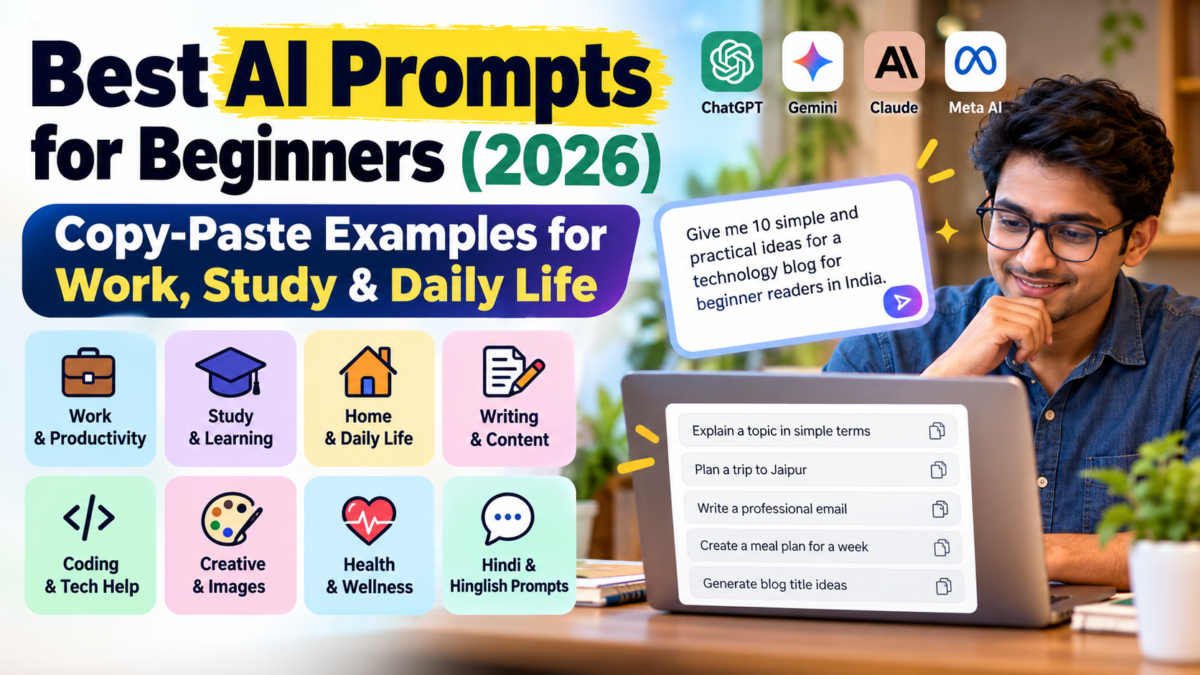
Image : Best AI Prompts for Beginners (2026): Copy-Paste Examples
Most people try an AI tool once, type something like “write email,” get a boring answer, and decide AI is overrated. The tool is rarely the problem. The prompt is.
A prompt is simply the instruction you type into an AI tool such as ChatGPT, Gemini, Claude or Meta AI. Think of the AI as a very knowledgeable friend who follows instructions literally. A vague question gets a vague answer. A clear instruction gets a useful one.
This guide gives you ready-to-use prompts you can copy, paste and edit today, grouped by what you actually do in daily life: home, work, writing, study, coding and more. There are also Hindi and Hinglish versions, because you don’t need perfect English to use AI well.
Here is the difference in one example. Say you need a leave email.
Weak prompt:
Write an email for leave.Better prompt:
Write a polite 4-sentence email to my manager asking for leave on 15 and 16 November for a family function. Mention that a colleague will cover my work. Tone: professional.The first prompt leaves the AI guessing who the email is for, which dates you need, why, and how long it should be. The second answers all of that, so the first reply is usually ready to send. The rest of this guide shows how to do the same for every kind of task.
In this guide
- The 4-part formula that improves any prompt
- Weak prompt vs good prompt (with real outputs)
- The first 10 prompts every beginner should try
- Prompts for home, work, writing, study, coding and creative tasks
- Hindi and Hinglish prompts
- Health and wellness prompts (with a safety note)
- Three habits that level up your results
- Common mistakes, privacy rules and FAQs
Table of Contents
How to Write a Good AI Prompt: The 4-Part Formula and a Real Test
The 4-Part Formula Behind Every Good Prompt
You don’t need to memorize “prompt engineering.” For everyday use, one simple formula is enough:
Task + Context + Format + Tone
- Task: What do you want the AI to do? (Write, explain, compare, summarize, plan)
- Context: Who is it for and what is the situation?
- Format: How should the answer look? (3 sentences, a table, a checklist, bullet points)
- Tone: How should it sound? (Polite, friendly, formal, simple)
Example
Write a friendly 3-sentence message to my landlord asking him to repair the bathroom tap.
Tone: polite but clear.
Task: write a message. Context: landlord, bathroom tap. Format: 3 sentences. Tone: polite but clear. Four short details made a vague request specific.
Weak Prompt vs Good Prompt: A Real Test
The fastest way to understand prompting is to see the difference side by side. Here is the same request written two ways.
Weak prompt
Plan a trip to Jaipur.Good prompt (using the 4-part formula)
Plan a 3-day budget trip to Jaipur for a couple traveling from Lucknow by train.
Budget: ₹15,000 total excluding train tickets.
Include famous food spots and historical places.
Format: day-wise plan with a rough cost for each day.
Tone: simple and practical.
Tested on ChatGPT in incognito mode on October 10, 2026, at 12:00 PM.
What the weak prompt produced
In a clean test (temporary chat, no saved context), ChatGPT guessed a 3-day, 2-night trip for two people, then ended with a six-question form asking where you are travelling from, when, for how long, who is going, your budget and what kind of trip you want. Its budget came as per-person ranges (₹2,800 to ₹5,700 for a budget trip, ₹5,800 to ₹12,300 for a comfortable one), with no cost per day and no named restaurants, only dishes to try.
What the good prompt produced
The same tool, in a temporary chat, returned a day-wise plan with a cost for each day for two people, named food stops (including Rawat Mishtan Bhandar and LMB), and a budget summary that stays inside ₹15,000 with money left over.
We also checked its arithmetic. Each day’s total matched its line items, and the category summary matched the daily tables. But the headline total (₹12,000 to ₹14,500) disagreed with the detailed summary (₹7,500 to ₹11,500) and with the closing advice (₹11,000 to ₹12,000). Entry fees and restaurant prices are estimates and changed between runs, so confirm them before you travel.
What changed? The weak prompt still gave a usable starting point, so a vague prompt is not useless. The difference is the work left over. With the weak prompt you answer six follow-up questions and convert per-person ranges into a trip budget. With the good prompt the plan already fits your budget, your route and your food interests, and you only need to verify the details.
A weak prompt gives you a plan. A good prompt gives you your plan, and it still deserves a quick check.
The First 10 Prompts Every Beginner Should Try
If you are nervous about starting, begin here. These are low-pressure, take under a minute and show instantly how useful AI can be. Replace anything in [square brackets] with your own details.
1. Make a message clearer
Rewrite this message so it sounds polite, clear and natural: [paste your text]2. Understand a confusing topic
Explain [topic] in plain language with one simple real-life example.3. Turn messy notes into a checklist
Organize these notes into a checklist, with the most important tasks first: [paste notes]4. Shorten a long text
Shorten this text to under 100 words without losing the main points: [paste text]5. Compare two options
Compare [option A] and [option B] in a table with pros, cons and who each one suits best.6. Plan the next 30 minutes
I have 30 minutes. Create a simple step-by-step plan to finish [task].7. Brainstorm ideas
Give me 10 simple and practical ideas for [goal]. Keep each idea to one line.8. Improve your own writing
Improve this paragraph so it sounds more professional. Keep my meaning and do not make it longer: [paste text]9. Summarize an article
Summarize this article in 3 bullet points for a beginner: [paste text]10. Ask for a checklist before a task
I am about to [task]. What should I check or prepare first? Give me a short checklist.Prompts for Home & Daily Life
AI is surprisingly good at everyday problem-solving, especially planning and “what should I do” questions.
The empty-fridge problem
I have 2 potatoes, some spinach and onions. Suggest 3 simple Indian vegetarian dinner recipes I can make in under 30 minutes.Weekly meal plan
Create a vegetarian meal plan for a family of 4 for one week. Use common Indian ingredients and give me a combined shopping list at the end.Stain removal
How do I remove a turmeric (haldi) stain from a white cotton shirt? Give me home remedies using things I already have in the kitchen.Balcony gardening
I want to grow tulsi and coriander on my balcony. Which natural fertilizer is best, and how often should I water each plant?Festival messages
Write 5 warm and original WhatsApp messages for Diwali. Make 2 of them funny, 2 emotional and 1 short enough for a status.Prompts for Work & Productivity
These save the most time for office workers, freelancers and small business owners.
Professional email
Write a professional email to [recipient] about [topic].
Tone: [formal / friendly].
Keep it under 120 words and end with a clear call to action.
Meeting summary
Turn these rough notes into a meeting summary with three sections: decisions made, action items with owners, and open questions.

[paste notes]
Weekly status update
Turn this list into a weekly update with: completed tasks, blockers and next steps. Keep it brief and professional.

[paste list]
Project brief
Create a one-page project brief for [project] with objective, scope, timeline, stakeholders and key risks.Polite follow-up
Write a polite follow-up message to a client who has not replied to my last email in a week. Do not sound pushy.Small business: payment reminder
Write a polite WhatsApp message reminding a customer about a pending payment of ₹[amount] for invoice [number]. Keep it respectful and under 50 words.Prompts for Writing & Content Creation
Bloggers, YouTubers and social media managers can use these as a starting point. Always edit the result so it sounds like you.
Blog title ideas
Generate 10 blog title ideas for the keyword "[keyword]". Keep each under 60 characters and make them useful, not clickbait.Article outline
Create a detailed outline for a beginner-friendly article on [topic] for [audience]. Include H2 and H3 headings and 4 FAQ questions.Hook ideas
Write 5 different opening paragraphs for an article about [topic]. Each should start with a different approach: a question, a statistic, a short story, a bold statement and a problem.Product description
Write a product description for [product] aimed at [audience]. Maximum 120 words. Mention 3 benefits and avoid exaggerated claims.Rewrite in your voice
Rewrite this paragraph so it sounds more [casual / professional / persuasive]. Keep the facts exactly the same: [paste text]Prompts for Students & Parents
Explain a concept simply
Explain [concept] to a 10-year-old using a short story and one everyday example.Practice questions
Create 5 practice word problems on "Profit and Loss" for a Class 7 student, easiest to hardest. Give the answers at the end.Quiz yourself
I am preparing for an exam on [topic]. Ask me 10 multiple-choice questions one at a time. Wait for my answer before showing the next question, and explain any mistake I make.Study timetable
Create a 7-day study timetable for a student preparing for [exam]. I can study 3 hours on weekdays and 5 hours on weekends. Include short breaks and one revision slot.Summarize for revision
Summarize this chapter into 8 key points and 5 possible exam questions: [paste text]Prompts for Coding Beginners
Understand code
Explain this code line by line as if I am a complete beginner: [paste code]Debug code
This code should [expected behavior], but it actually [what happens]. Find the likely cause, explain it in simple words and show the corrected code.

[paste code]
A real debugging example
Here is a beginner Python program that crashes:
age = input("Enter your age: ")
print("Next year you will be", age + 1)
Running it shows this error:
TypeError: can only concatenate str (not "int") to strPrompt to use:
This Python code should print the user's age next year, but it crashes with: TypeError: can only concatenate str (not "int") to str. Explain the cause in simple words and show the corrected code.

[paste the code]
A good answer will explain that input() always returns text, so Python cannot add the number 1 to it. The corrected code converts the text to a number first:
age = int(input("Enter your age: "))
print("Next year you will be", age + 1)
Notice that the prompt includes the exact error message. That one detail turns “my code doesn’t work” into something the AI can actually diagnose.
Write a simple function
Write a simple function in [language] that [task]. Add comments explaining each step.Learn a concept
Explain what [concept, e.g. an API] is using a real-life analogy, then show a very small code example in [language].Hindi & Hinglish Prompts (Yes, You Can Type the Way You Talk)
AI tools understand Hindi and Hinglish well. If English feels like a barrier, don’t let it stop you. Type exactly how you would speak to a friend.
Simple recipe
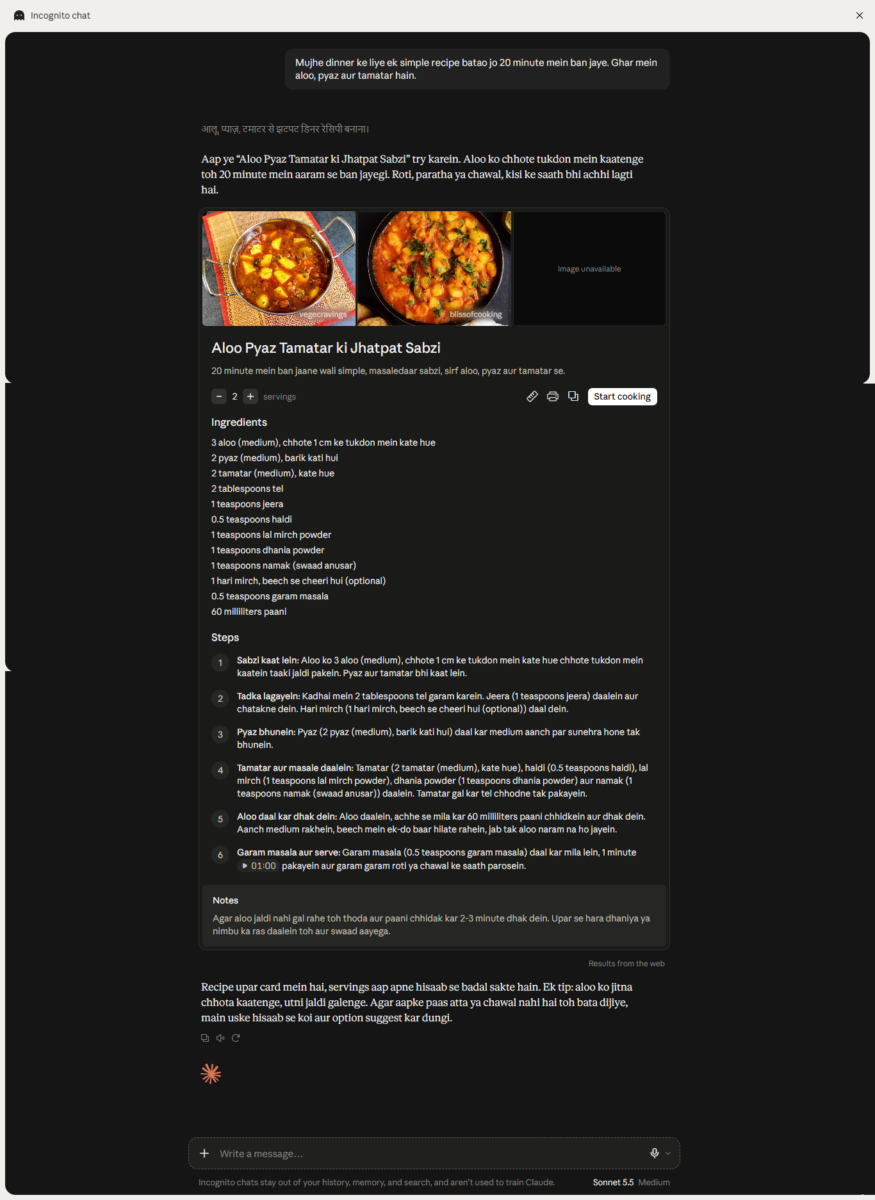
Mujhe dinner ke liye ek simple recipe batao jo 20 minute mein ban jaye. Ghar mein aloo, pyaz aur tamatar hain.Leave application
Mujhe apne boss ko 2 din ki chutti ke liye ek polite email likhna hai. Chhota aur professional rakho, English mein likho.School application
Mere bete ki tabiyat theek nahi hai. School principal ko ek chhoti si leave application likh do, Hindi mein.Explain in Hindi
Mujhe "inflation" simple Hindi mein samjhao, ek roz ki zindagi ka example dekar.Translate for family
Is English paragraph ko simple Hindi mein translate karo taaki mere mata-pita aasani se samajh sakein: [paste text]Bank application
Bank manager ko KYC details update karne ke liye ek formal application likho. Neeche jagah chhodo jahan main apna naam aur account details khud bhar sakun.Example of ” Hindi & Hinglish Prompts ” Prompt – ” Mujhe dinner ke liye ek simple recipe batao jo 20 minute mein ban jaye. Ghar mein aloo, pyaz aur tamatar hain.”
Health & Wellness Prompts (Read This First)
Important: AI can give general wellness information, but it is not a doctor. Do not use it to diagnose illness, choose medicines or change a treatment. If you have pain, a medical condition or are pregnant, talk to a qualified doctor first. If you feel very unwell or have an emergency, contact a doctor or emergency services immediately.
With that in mind, these prompts are fine for general planning and learning:
Gentle morning routine
Suggest a 15-minute beginner stretching routine I can do at home without any equipment. Keep it gentle and explain each move in one line.Food comparison
Compare 100g of paneer and 100g of chicken in a table for protein, calories and fat. Mention that values vary by brand and preparation.Breathing exercise
Give me a simple 5-minute breathing exercise I can do at my desk when I feel stressed. Use plain language and short steps.For more structured fitness prompts, see our guide on ChatGPT prompts for diet and workout.
Creative & Brainstorming Prompts
Give me 10 creative ideas for [project]. Include one unusual idea I probably have not thought of.Write 5 opening hooks for an article about [topic].I love movies like 3 Idiots and Dangal. Suggest 5 similar inspiring Indian films and explain in one line why I might like each.Five Habits That Level Up Your Results
Once the basic formula feels natural, these three habits make the biggest difference.
1. Be specific about what you want
Numbers, audience and constraints help. Compare “Write about smartphones” with “Write a 600-word guide to the best phones under ₹20,000 in India for first-time buyers, with pros, cons and a comparison table.”
2. Show an example
If you want a certain style, paste a short sample and ask the AI to match it.
Write a product review in the style of the example below. Match the tone and sentence length.

Example: "This laptop feels surprisingly premium for the price. Battery life is solid, and the performance is more than enough for students and office users."
3. Add Rules
Tell the AI what limits to follow. Compare “Write a LinkedIn post about our app” with “Write a LinkedIn post about our app. Maximum 120 words, no emojis, no buzzwords, end with a question.”
Using only the notes below, write a summary. If something is not in the notes, write “not mentioned” instead of guessing. then rewrite for beginners. This is called prompt chaining, and it usually gives cleaner results than one huge request.
4. Use your own material
If you want the answer based on your notes, paste them and say so:
Using only the notes below, write a summary. If something is not in the notes, write “not mentioned” instead of guessing.
5. Follow up, then check
(keep your existing text and bullets, then add:)
Always verify prices, dates, statistics and anything you will publish. AI can sound confident and still be wrong.
The official prompting guides: Anthropic’s prompt engineering guide, plus OpenAI’s and Google Gemini’s prompting guides
Common Beginner Mistakes
1. Asking something too broad. “Tell me about health” gets a generic essay. Narrow it down.
2. Giving no context. The AI doesn’t know your city, budget, age, audience or goal unless you say so.
3. Not saying the format. If you want a table or a checklist, ask for it.
4. Trusting everything blindly. AI can sound confident and still be wrong. Always double-check prices, dates, laws, statistics, product specs and medical information.
5. Giving up after one reply. Good prompting is a conversation.
6. Pasting private data. See the next section.
Privacy: What You Should Never Paste Into an AI Tool
Use AI for planning, writing and learning, but keep sensitive details out of your prompts. Never share:
- Passwords, PINs or OTPs
- Bank account, debit card or credit card numbers
- Aadhaar number, PAN number or other ID numbers
- Private photos or documents you wouldn’t want others to see
If you need help with a form or letter, use placeholders such as [Name] and [Account Number] and fill them in yourself.
Frequently Asked Questions
Do I have to pay to use AI tools like ChatGPT, Gemini or Claude?
No. The popular tools offer free plans that are enough for everyday tasks like emails, recipes, studying and planning. Paid plans mainly add higher usage limits and advanced features. Plans and limits change, so check each tool’s website for current details.
Can I use these prompts on my phone?
Yes. ChatGPT, Gemini and Claude all have mobile apps, and Meta AI is available inside WhatsApp and Instagram in supported regions.
Can I write prompts in Hindi or Hinglish?
Yes. Modern AI tools understand Hindi and Hinglish well. Write the way you would speak, and add “reply in Hindi” or “reply in English” if you want a specific language.
Which AI tool is best for beginners?
Any of the big three works for starting out. The best approach is to try the same prompt in two tools and keep the one whose style you prefer.
How long should a prompt be?
Long enough to include the task, context, format and tone, usually 2 to 5 lines. Longer is not automatically better. A clear short prompt beats a messy long one.
Is it safe to follow AI advice?
Use it as a starting point, not the final word. For health, legal, money or safety decisions, confirm with a qualified professional.
Free Cheatsheet
Want all the best prompts on one page? Download the free TechMitra Prompt Cheatsheet and subscribe to TechMitra Weekly for new AI guides every week.
Final Thoughts
AI is a tool, like a calculator. It doesn’t replace your thinking, but it handles the boring and repetitive parts so you can spend time on what matters.
You don’t have to try everything above. Pick one prompt from the first-10 list, replace the brackets with your own details, and run it today. Then use the follow-up habit to improve the answer. Within a week, writing good prompts will feel natural.
Try this one right now:
I want to learn about [any topic you are curious about]. Explain it in simple language with one real-life example, then ask me one question to check that I understood.Paste it, replace the brackets, and answer the question the AI asks. That is prompting in practice: one clear request, then one follow-up.
Tried one of these prompts? Share what worked in the comments, and tell us which category you’d like us to expand next.
Related reads: Best AI prompts for resume writing | AI prompts for stock trading analysis | Ready-to-use AI prompts

Ayush Singhal is the founder and chief editor of TechMitra.in — a tech hub dedicated to simplifying gadgets, AI tools, and smart innovations for everyday users. With over 15 years of business experience, a Bachelor of Computer Applications (BCA) degree, and 5 years of hands-on experience running an electronics retail shop, Ayush brings real-world gadget knowledge and a genuine passion for emerging technology.
At TechMitra, he covers everything from AI breakthroughs and gadget reviews to app guides, mobile tips, and digital how-tos. His goal is simple — to make tech easy, useful, and enjoyable for everyone. When he’s not testing the latest devices or exploring AI trends, Ayush spends his time crafting tutorials that help readers make smarter digital choices.
📍 Based in Lucknow, India
💡 Focus Areas: Tech News • AI Tools • Gadgets • Digital How-Tos
📧 Contact: Get in touch →
🔗 Full Bio: https://techmitra.in/about-us/