
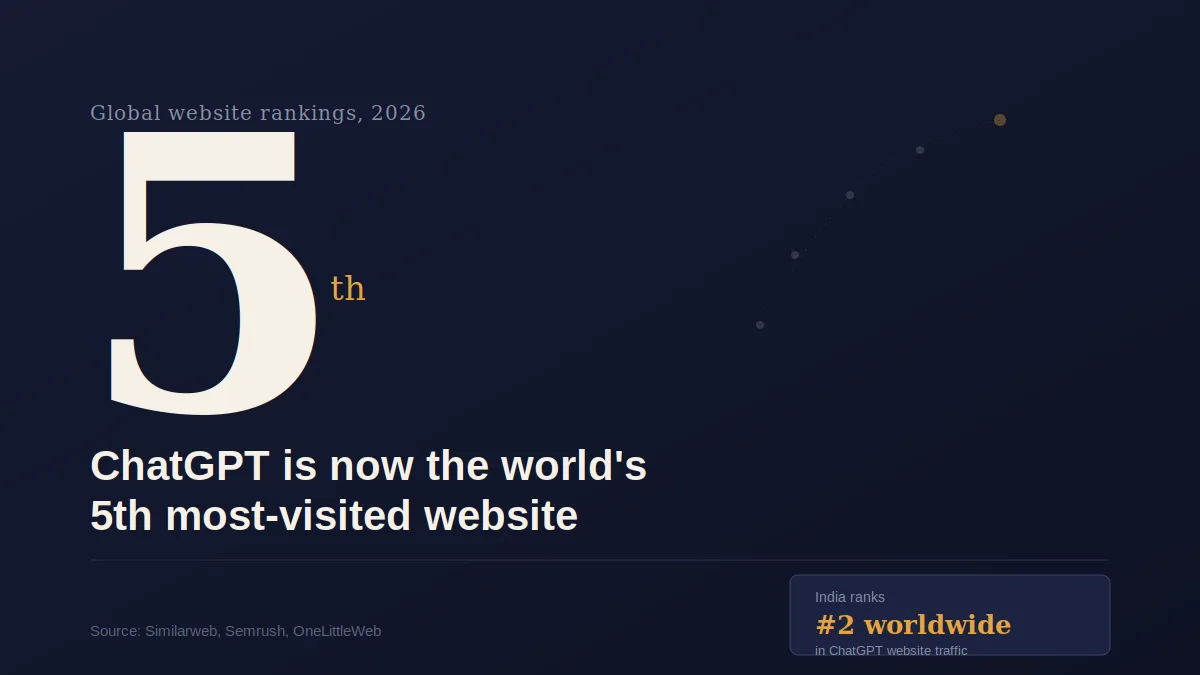
For the first time, an AI chatbot has cracked the most visited world top 5 websites — not as a curiosity or a passing trend, but as a fixture. As of mid-2026, ChatGPT sits at rank five worldwide, ahead of platforms that have anchored the internet for two decades: Reddit, Wikipedia, X, Gmail, and Amazon.
It’s a milestone worth pausing on, and for Indian readers, there’s a second story hiding inside the first: India isn’t a footnote in this shift. It’s one of the two countries driving it.
The Global Picture
According to independent traffic-analytics trackers Similarweb and Semrush — both of which compile estimates from browser and network-level data — the world’s most visited websites in 2026 run, in order: Google, YouTube, Facebook, Instagram, and then ChatGPT. Wikipedia’s own community-maintained “List of most-visited websites” page, which draws on the same two data providers, confirms the identical ranking as of August 2026.
That’s a genuinely new kind of website in the top five. Every other entry is either a search engine, a video platform, or a social network — categories that have existed, essentially unchanged, since the 2000s. ChatGPT is none of those. It’s a conversational AI product that didn’t exist as a public website until November 2022. In under four years, it has out-traffic’d platforms that took over a decade to build their audiences.
Multiple traffic trackers converge on similar figures for how large ChatGPT’s footprint has become: monthly visit estimates cluster in the 5-to-6-billion range through 2026, comfortably ahead of Reddit (around 5.1 billion) and Wikipedia (around 4-4.3 billion), and only modestly behind Instagram. Google, for context, still receives roughly 18 times more visits than ChatGPT — a reminder that “top five” doesn’t mean “close to the top.” Search remains in a different league entirely. But fifth place, sustained across multiple months and confirmed by more than one independent data provider, is no longer a blip. ChatGPT has held a top-five position consistently since late 2025.
It’s also worth being precise about what these numbers do and don’t measure. Similarweb and Semrush both count browser-based website visits — not app opens, not unique users, and not the volume of actual conversations or prompts. A single person visiting ChatGPT’s website five times in a day is counted five times. And a large and growing share of ChatGPT usage now happens through its mobile app rather than the browser, which these rankings don’t capture at all. So the real reach of the product, once you fold in app usage, is very likely larger than the website ranking alone suggests.
Where India Fits In
Here’s the part that matters more for TechMitra readers: India isn’t watching this trend from the sidelines. Semrush’s own country-level breakdown of ChatGPT’s traffic consistently places India as the second-largest source of visits to chatgpt.com worldwide, behind only the United States. Depending on the month, India accounts for somewhere between 8 and 9 percent of ChatGPT’s global website traffic — translating to several hundred million visits a month from Indian users alone, with Brazil typically rounding out the top three.
That ranking has been stable for well over a year now, through late 2025 and into 2026, which suggests this isn’t a one-off spike but a durable pattern of adoption. India’s position also lines up with what’s visible anecdotally: ChatGPT has become a default reference tool for students preparing for competitive exams, for small business owners drafting content and correspondence, for developers debugging code, and increasingly for people using it as a plain-language alternative to a Google search.
Within India’s own domestic traffic rankings, ChatGPT now sits inside the top five most-visited websites overall — behind Google, YouTube, and Instagram, but ahead of Facebook and WhatsApp on some trackers, depending on the month measured. That’s a striking position for a product that, three years ago, most Indian internet users hadn’t even heard of.
Mobile usage patterns tell part of the story too. Semrush’s device-level data shows a meaningfully higher share of ChatGPT’s India traffic comes from mobile compared to markets like the US or Germany — consistent with how the rest of India’s internet consumption skews heavily toward mobile-first behaviour rather than desktop browsing.
| Rank | Global (worldwide) | India |
|---|---|---|
| 1 | ||
| 2 | YouTube | YouTube |
| 3 | ||
| 4 | ChatGPT | |
| 5 | ChatGPT |
Approximate rankings by estimated website visits, 2026. Global ranking per Similarweb/Semrush/Wikipedia; India ranking per Semrush country-level data. Order can shift slightly month to month.
What This Means, and What It Doesn’t
It would be easy to read “ChatGPT is now a top-five website” as evidence that AI has “overtaken” search or social media. That’s not quite right, and it’s worth being careful here. OneLittleWeb’s Digital Market Intelligence dashboard, which tracks roughly 10,000 websites using Semrush and Ahrefs data, notes that AI chatbots and tools — ChatGPT, Claude, Perplexity, and Google’s own AI Mode combined — still account for a small single-digit share of total tracked web traffic.
Direct visits and traditional search still dominate how people move around the internet by a wide margin. (For a closer look at how that AI slice breaks down, see our earlier coverage of the 144.5 billion visits AI tools drew last year — and why ChatGPT alone accounts for nearly 45% of it.)
What’s actually happening is narrower, and arguably more interesting: a single AI product has become popular enough, fast enough, to compete with the internet’s most established destinations on its own numbers — without unseating the underlying architecture of the web. Search still drives discovery. Social media still drives attention. ChatGPT has carved out something adjacent: a default first stop for questions, tasks, and drafting, used by hundreds of millions of people including, disproportionately, Indians.
For a country that has historically been treated as a fast-follower market for Silicon Valley products, this is a case where Indian adoption isn’t trailing the global trend — it’s one of the two forces defining it. That’s worth tracking as ChatGPT, Gemini, and increasingly Claude compete for the same audience in the months ahead.
Traffic figures cited are estimates from Similarweb, Semrush, and OneLittleWeb’s Digital Market Intelligence dashboard, based on browser-based website visits. They do not include mobile app usage or unique visitor counts, and should be read as directional rather than exact.

Ayush Singhal is the founder and chief editor of TechMitra.in — a tech hub dedicated to simplifying gadgets, AI tools, and smart innovations for everyday users. With over 15 years of business experience, a Bachelor of Computer Applications (BCA) degree, and 5 years of hands-on experience running an electronics retail shop, Ayush brings real-world gadget knowledge and a genuine passion for emerging technology.
At TechMitra, he covers everything from AI breakthroughs and gadget reviews to app guides, mobile tips, and digital how-tos. His goal is simple — to make tech easy, useful, and enjoyable for everyone. When he’s not testing the latest devices or exploring AI trends, Ayush spends his time crafting tutorials that help readers make smarter digital choices.
📍 Based in Lucknow, India
💡 Focus Areas: Tech News • AI Tools • Gadgets • Digital How-Tos
📧 Contact: Get in touch →
🔗 Full Bio: https://techmitra.in/about-us/