

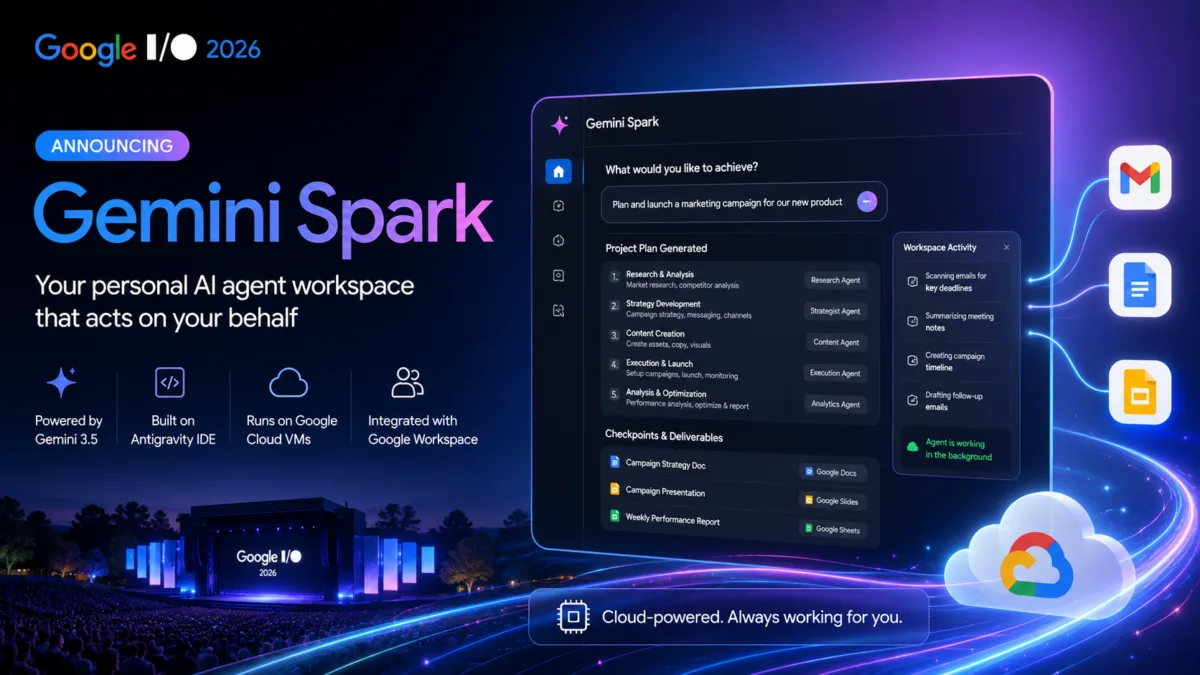
Disclaimer: This featured image is AI-generated for illustrative purposes and is inspired by Google I/O branding. Google, Gemini, Android, and related logos/trademarks belong to Google LLC.
At the annual Google I/O 2026 developer conference held at the Shoreline Amphitheatre, Google introduced one of its most ambitious AI projects yet — Gemini Spark. The company describes it as a personal AI agent workspace capable of planning, organizing, and coordinating tasks on behalf of users.
Powered by Gemini 3.5 and built on Google’s Antigravity Integrated Development Environment (IDE), Gemini Spark represents a major step toward agentic AI systems that can manage workflows with minimal human involvement.
Unlike traditional AI assistants that mainly respond to prompts in real time, Gemini Spark is designed to continue working in the background through cloud-hosted virtual machines running on Google Cloud infrastructure.
Learn what is Gemini Spark and how it works.
Also read : I Tested Google Gemini Spark AI Agent the Day It Launched in India
What Is Gemini Spark?
Gemini Spark is essentially an AI-powered workspace that helps users structure projects, automate repetitive workflows, and coordinate AI agents across different tasks.
According to Google, the platform can take a broad objective or simple instruction and automatically convert it into a fully organized workflow. This includes:
- Task breakdowns
- Assigned roles
- Deliverables
- Work phases
- Constraints
- Contextual notes
- Progress checkpoints
Instead of manually planning projects step by step, users can simply describe the goal, while Gemini Spark creates the operational framework behind the scenes.
Google says the platform is intended for both individuals and collaborative teams who want to automate routine digital work without constantly monitoring every process.
Built on Gemini 3.5 and Antigravity IDE
Gemini Spark is powered by Gemini 3.5, Google’s latest AI model family announced during the keynote session at Google I/O 2026.
The platform is also deeply connected with Google’s Antigravity IDE — an internal development environment designed for building and coordinating AI-driven workflows.
This combination allows Gemini Spark to function more like an AI operations manager instead of a simple chatbot.
One of the biggest highlights is that the system operates in the cloud. Even if users close their laptop, switch devices, or lock their phone, Gemini Spark can continue processing assigned workflows in the background using dedicated virtual machines.
Deep Integration With Google Workspace
Google confirmed that Gemini Spark is tightly integrated with several Google Workspace applications, including:
- Gmail
- Google Docs
- Google Slides
This integration enables the AI platform to analyze information across multiple apps and automate workflows based on user activity.
For example, the system can monitor incoming emails, summarize conversations, generate reports, and even prepare draft responses automatically.
Real-World Examples Demonstrated by Google
During the keynote presentation, Google showcased several practical use cases for Gemini Spark.
Subscription Monitoring
One demonstration showed the platform automatically scanning monthly credit card statements to identify newly added subscription charges. This could help users quickly spot unwanted recurring payments.
School Email Tracking
Google also demonstrated how users could train Gemini Spark to monitor school-related emails, extract important deadlines, and create concise daily summaries for parents or students.
Automated Meeting Reports
Another example involved the AI analyzing meeting notes from chats and emails, generating structured reports inside Google Docs, and drafting follow-up emails to initiate projects automatically.
These demonstrations highlighted Google’s larger vision of AI systems acting more like autonomous digital assistants instead of reactive chatbots.
Also Read : Google Introduces Docs Live at Google I/O 2026: Gemini Voice AI Comes to Gmail, Docs, and Keep
How Gemini Spark Works
Google explained that Gemini Spark itself does not directly perform every task. Instead, the platform mainly focuses on designing and organizing the operational logic behind workflows.
The process generally works like this:
- The user enters a major goal or project requirement.
- Gemini Spark analyzes the objective.
- The platform breaks the project into smaller tasks.
- It assigns roles, timelines, phases, and deliverables.
- Connected AI systems and external tools then execute the actual actions.
In simple terms, Gemini Spark acts like the “brain” coordinating the workflow, while other integrated platforms carry out the execution.
This structure could make the platform flexible enough to work across enterprise tools, automation platforms, and future AI ecosystems.
Support for Third-Party Integrations Coming Soon
Google also confirmed that Gemini Spark will soon support third-party integrations using MCP (Model Context Protocol).
This is important because it means the platform may eventually connect with external business software, automation systems, and productivity tools outside Google’s own ecosystem.
If widely adopted, MCP integration could allow Gemini Spark to become a central AI coordination layer for both personal and enterprise workflows.
Why Gemini Spark Matters
The launch of Gemini Spark signals a major shift in how AI assistants are evolving.
Most current AI tools still require users to manually guide every step of a task. Gemini Spark moves closer to “agentic AI,” where the system can independently organize workflows, monitor progress, and coordinate actions with limited human supervision.
This could eventually change how people manage:
- Office workflows
- Team collaboration
- Project management
- Research tasks
- Email handling
- Administrative work
- Productivity automation
Google’s announcement also places it in direct competition with other companies developing AI agent systems and autonomous workflow platforms.
Early Thoughts
While Gemini Spark looks highly promising, its real-world success will depend on how reliable and secure these automated workflows become over time.
Many users may appreciate the convenience of AI-managed tasks, but privacy, data access, and workflow accuracy will remain important concerns — especially for enterprise users.
Still, Google’s presentation at I/O 2026 clearly showed that the company is pushing aggressively toward a future where AI systems do much more than simply answer questions.
With Gemini Spark, Google appears to be building a platform where AI can actively organize, coordinate, and manage digital work behind the scenes.
Conclusion
Gemini Spark was one of the most futuristic announcements from Google I/O 2026. By combining Gemini 3.5, cloud infrastructure, Google Workspace integrations, and AI workflow orchestration, Google is positioning the platform as a next-generation personal AI agent workspace.
Although the platform currently focuses more on planning and workflow structuring than direct execution, upcoming third-party integrations and MCP support could significantly expand its capabilities in the near future.
As AI agents continue evolving, Gemini Spark may become an important step toward a future where intelligent systems can independently manage large portions of digital work for users and businesses alike.
Disclaimer: The information in this article is based on official announcements, company statements, and publicly available reports. We have rewritten and adapted the content for clarity, accuracy, and reader experience. All trademarks, brand names, and images belong to their respective owners.

Ayush Singhal is the founder and chief editor of TechMitra.in — a tech hub dedicated to simplifying gadgets, AI tools, and smart innovations for everyday users. With over 15 years of business experience, a Bachelor of Computer Applications (BCA) degree, and 5 years of hands-on experience running an electronics retail shop, Ayush brings real-world gadget knowledge and a genuine passion for emerging technology.
At TechMitra, he covers everything from AI breakthroughs and gadget reviews to app guides, mobile tips, and digital how-tos. His goal is simple — to make tech easy, useful, and enjoyable for everyone. When he’s not testing the latest devices or exploring AI trends, Ayush spends his time crafting tutorials that help readers make smarter digital choices.
📍 Based in Lucknow, India
💡 Focus Areas: Tech News • AI Tools • Gadgets • Digital How-Tos
📧 Contact: Get in touch →
🔗 Full Bio: https://techmitra.in/about-us/