

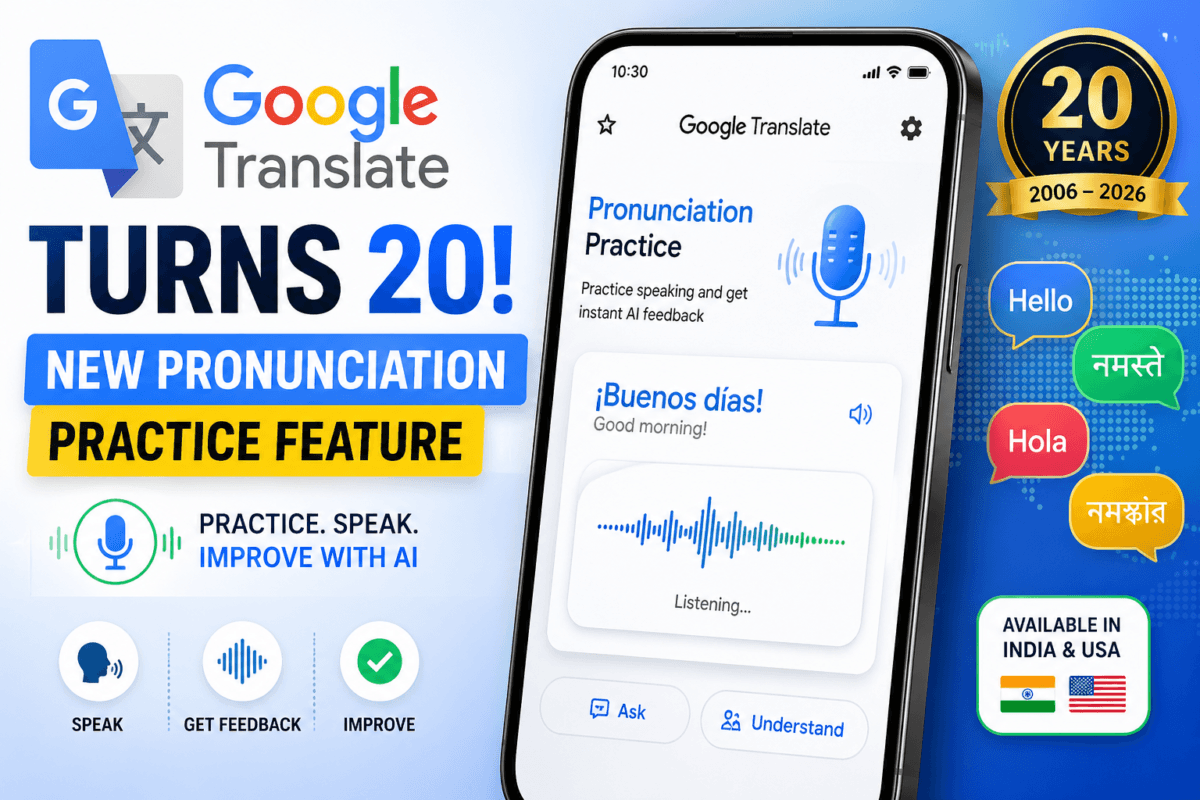
Google Translate completes 20 years and introduces AI-based Pronunciation Practice for real-time speaking improvement. ( AI Generated Image)
Google Translate has officially turned 20, and instead of just celebrating its past, it’s stepping into the future. To mark this milestone, Google has launched a brand-new “Pronunciation Practice” feature—designed to help users speak languages more confidently, not just translate them.
If you’ve ever felt awkward trying to pronounce a new language correctly, this update is actually a big deal.
Table of Contents
A 20-Year Journey: From Basic Translation to AI Understanding
When Google Translate launched on April 28, 2006, it was far from the smart assistant we know today. Back then, it relied on statistical machine translation, which basically meant translating text word-by-word using probability models.
Fast forward to 2026, and things have changed dramatically.
According to Sundar Pichai, the platform now leverages Gemini AI models, allowing it to understand context, tone, and meaning—rather than just matching patterns.
That shift is the reason why translations today feel more natural and human.
Source: Google BlogWhat Is the “Pronunciation Practice” Feature?
The new Pronunciation Practice tool is built for one purpose:
👉 Helping users speak a language correctly, not just read or understand it.
How it works:
- Available on Android devices
- Found under the “Ask” and “Understand” options
- Uses AI to analyze your speech
- Gives instant feedback on pronunciation accuracy
- Suggests improvements for specific words and phrases
Right now, it supports:
- English
- Spanish
- Hindi
And importantly for you—it’s already available in India and the US.
Why This Feature Actually Matters
Most translation tools stop at text or voice output. But real-world communication isn’t just about understanding—it’s about being understood.
This feature bridges that gap.
Think about situations like:
- Job interviews in a different language
- Talking to international clients
- Traveling abroad
- Even casual conversations with native speakers
Instead of guessing your pronunciation, you now get real-time coaching powered by AI.
Also read : Gemini Now Lets You Create & Export Files (PDF, Word, Excel) Directly from Chat
The Numbers Behind Google Translate’s Growth
Over the last two decades, Google Translate has grown into a massive global platform:
- 1+ billion users every month
- 33% of Live Translate sessions last more than 5 minutes
- Used for:
- Job interviews
- Family conversations
- Cross-cultural communication
Most translated phrases:
- “Thank you”
- “How are you?”
- “I love you”
- “Hello”
- “Please”
These aren’t just random phrases—they reflect how people actually use the app: for real human connection.
Also Read : AI Creativity Vs Human Creativity: A New Maker or a New Challenge?
Trending Use Cases: It’s Not Just Languages Anymore
One interesting trend shared by Google is how people are pushing the limits of translation.
Users are now translating:
- American Sign Language (ASL)
- Emojis
- Gen Alpha slang
This shows how translation is evolving beyond traditional language into digital and cultural communication.
Most Popular Language Pairs
Here’s what people are translating the most:
- English → Spanish (Top)
- English → Indonesian
- English → Portuguese
- English → Arabic
- English → Turkish
In India, there’s also a noticeable rise in translations from English into:
- Hindi
- Bengali
- Malayalam
This aligns with increasing digital adoption across regional audiences.
From Tool to Communication Companion
The biggest shift isn’t just technical—it’s philosophical.
Earlier, Google Translate was a utility.
Now, it’s becoming a communication companion.
With AI models like Gemini, it doesn’t just translate—it helps:
- Understand tone
- Improve speaking skills
- Enable smoother conversations
And with features like Pronunciation Practice, it’s clearly moving toward language learning + real-time communication combined.
Final Thoughts
Google Translate turning 20 isn’t just a milestone—it’s a reflection of how far AI has come in breaking language barriers.
The new Pronunciation Practice feature might seem like a small addition, but it signals a bigger shift:
👉 From translating words → to helping people communicate confidently.
If Google continues on this path, we’re likely heading toward a future where language is no longer a barrier at all—just a setting you can switch.
FAQs
Is the Pronunciation Practice feature available on iPhone?
Currently, it’s limited to Android users. iOS rollout hasn’t been confirmed yet.
Which languages are supported?
As of now: English, Spanish, and Hindi.
Is it available in India?
Yes, India is one of the first regions where the feature is live.
Does it require internet?
Yes, since it uses AI processing for real-time feedback.
Is Google Translate still free?
Yes, all core features—including this one—remain free to use.
Disclaimer
This article is for informational and educational purposes only. The details about Google Translate’s features, including “Pronunciation Practice,” are based on publicly available information and official announcements from Google. Feature availability may vary by device, region, and app version.
We do not guarantee the accuracy, completeness, or real-time updates of the information provided. Readers are advised to verify details through the official Google Translate app or Google’s official channels before relying on any feature.
This article does not represent any official partnership, endorsement, or affiliation with Google.

Ayush Singhal is the founder and chief editor of TechMitra.in — a tech hub dedicated to simplifying gadgets, AI tools, and smart innovations for everyday users. With over 15 years of business experience, a Bachelor of Computer Applications (BCA) degree, and 5 years of hands-on experience running an electronics retail shop, Ayush brings real-world gadget knowledge and a genuine passion for emerging technology.
At TechMitra, he covers everything from AI breakthroughs and gadget reviews to app guides, mobile tips, and digital how-tos. His goal is simple — to make tech easy, useful, and enjoyable for everyone. When he’s not testing the latest devices or exploring AI trends, Ayush spends his time crafting tutorials that help readers make smarter digital choices.
📍 Based in Lucknow, India
💡 Focus Areas: Tech News • AI Tools • Gadgets • Digital How-Tos
📧 Contact: Get in touch →
🔗 Full Bio: https://techmitra.in/about-us/