

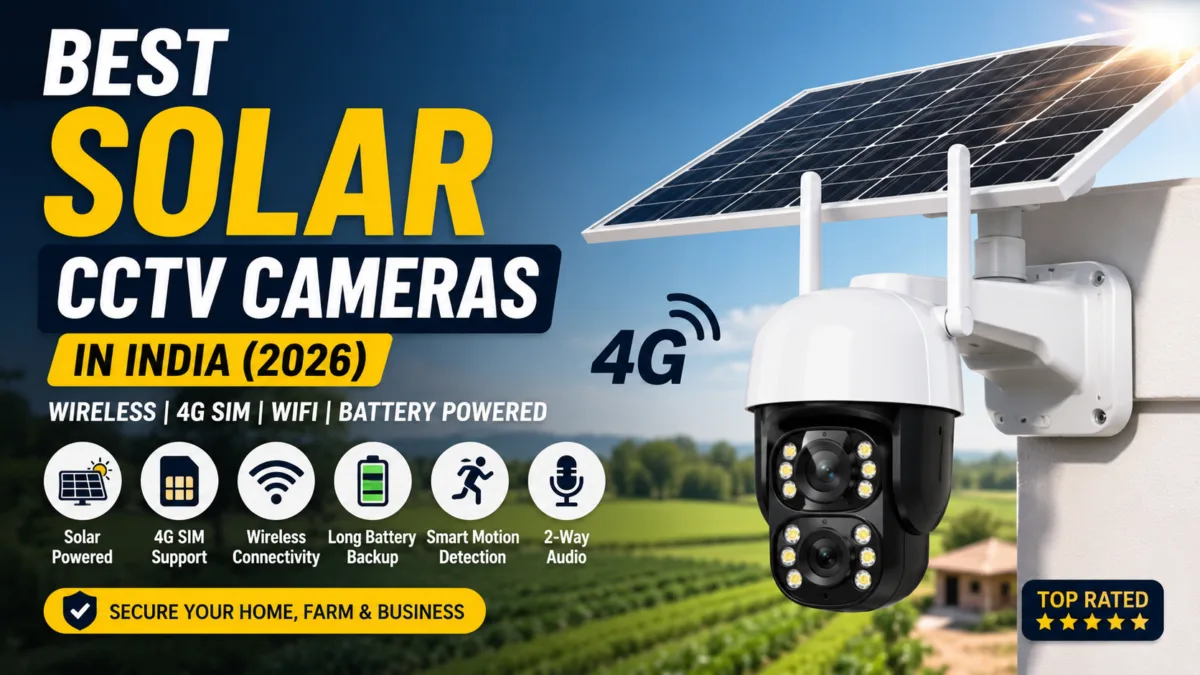
Setting up a traditional outdoor security system can be an absolute nightmare. Between drilling through thick brick walls, running meters of ugly conduit wiring, and worrying about power cuts cutting off your surveillance, it often feels like more trouble than it’s worth.
Fortunately, smart home tech has evolved rapidly. In 2026, wireless solar CCTV cameras have officially gone mainstream in India. By combining high-efficiency solar panels, large built-in batteries, and cellular connectivity, these devices offer completely off-grid, 24/7 surveillance with zero dependency on your home electricity grid.
Whether you need to secure a remote farmhouse, monitor an agricultural plot, watch over a suburban rooftop, or keep tabs on an active construction site, this guide covers the best solar powered CCTV cameras and best outside solar security cameras currently available in India, so you can pick the right one for your needs and budget. I’ve refreshed the picks below after the older models I was recommending went out of stock — everything here is currently available.
If you want to optimize your daily workflow, investing in the right tools is key. You can check out this list of cool tech gadgets for daily use to see what’s currently worth buying
Table of Contents
Why Solar CCTV Camera Are Becoming Popular in India
Traditional CCTV systems usually require continuous electricity, DVR wiring, and professional installation. Solar-powered security cameras solve many of these problems.
Here are some major reasons why Indian users are switching to solar CCTV systems:
- Works during electricity cuts
- Easy wireless installation
- Suitable for farms and remote locations
- Lower long-term electricity cost
- No complicated DVR setup in many models
- Remote monitoring through mobile apps
- Better flexibility for outdoor surveillance
These cameras are especially useful for:
- Agricultural land
- Farmhouses
- Village homes
- Construction sites
- Parking areas
- Shops and warehouses
- Rooftop monitoring
- Remote property surveillance
Outdoor Solar Powered Security Cameras Price in India (2026)
The price of a Solar CCTV Camera in India depends on factors such as camera resolution, battery capacity, solar panel size, connectivity options (WiFi or 4G SIM), and storage features. Basic models designed for home security are available at affordable prices, while advanced 4G solar cameras for farms and remote locations cost more.
| Solar CCTV Camera Type | Approximate Price Range |
|---|---|
| Basic Solar CCTV Camera | ₹2,500 – ₹5,000 |
| WiFi Solar CCTV Camera | ₹4,000 – ₹8,000 |
| 4G SIM Solar CCTV Camera | ₹6,000 – ₹12,000 |
| Dual Lens Solar CCTV Camera | ₹7,000 – ₹15,000 |
| Triple Lens Solar CCTV Camera | ₹8,000 – ₹18,000 |
Which Solar CCTV Camera Offers the Best Value?
For most homeowners, a WiFi Solar CCTV Camera priced between ₹4,000 and ₹8,000 provides a good balance of features and affordability. However, if you need surveillance for farms, warehouses, construction sites, or locations without broadband internet, a 4G SIM Solar CCTV Camera is usually the better choice despite its higher cost.
My Recommendation
Focus on battery backup, solar panel quality, app support, and connectivity — not just the sticker price. A slightly pricier camera with a good app and real weatherproofing will save you headaches down the line.
For buyers who want a no-fuss dual-lens option with a decent night vision setup, the Dr Vision Dual Lens Camera is a solid, reasonably priced pick.
For farms and locations without steady WiFi, the XUGA Cybernautt X10U gives you dual solar charging and 4G SIM support in one package.
If you want maximum coverage and don’t mind paying more, the XUGA Cybernautt X18C with its 16MP four-lens setup is currently the most capable option on this list.
Before buying any solar CCTV camera, check:
- Solar panel wattage
- Battery capacity
- App reviews and ratings
- SIM compatibility (for 4G models)
- Weatherproof rating
- Storage options (SD card or cloud)
Also Read: 10 Best Solar Innovative Products on Amazon for Daily Life (2026 Guide)
Best Solar Power Security Camera in India Available on Amazon (2026)
These are the best residential solar security cameras and 4G solar options I’ve tested or tracked closely enough to recommend right now. Each one is built for a slightly different use case, so match the camera to your property type rather than just going by price.
1. AOV Solar CCTV Triple Lens 4G Camera — Best for Continuous Recording
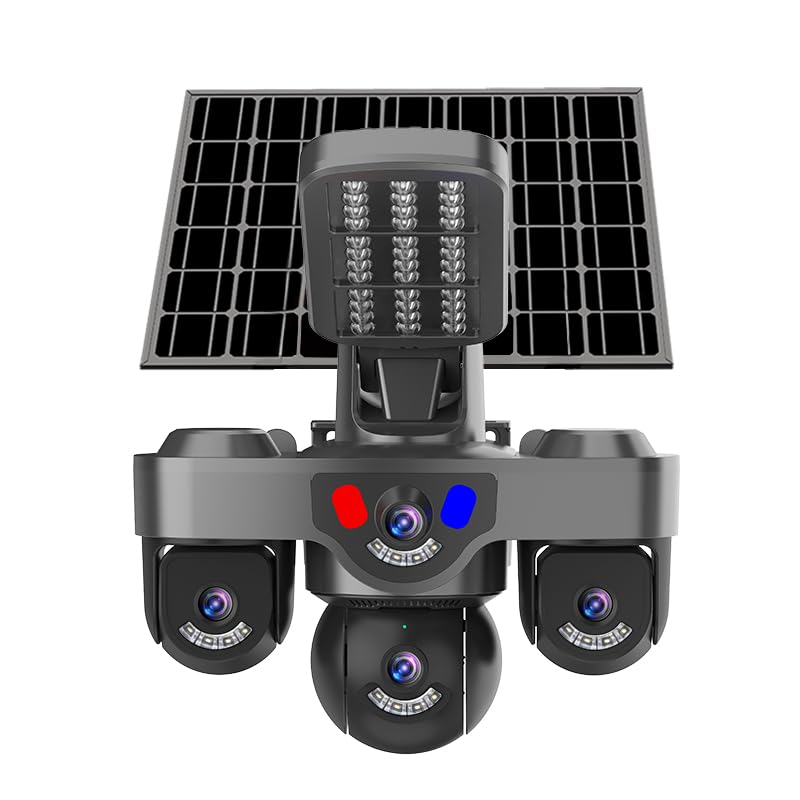
The AOV Solar CCTV camera (sold under the E bom brand) is built for people who want round-the-clock footage without gaps. It runs on a 4G SIM, so you don’t need WiFi at all, and it records continuously rather than only on motion triggers — useful if you want a complete timeline rather than just alert clips.
It uses a triple-lens setup (4MP + 4MP + 4MP) for wide 360-degree coverage, along with two-way audio and night vision. It’s aimed at construction sites, farms, and general outdoor security where you want a camera that just keeps recording no matter what.
Key Features
- 4G SIM connectivity, no WiFi needed
- 24×7 continuous recording
- Triple lens (4+4+4MP), 360° coverage
- Two-way audio
- Night vision
- PTZ (pan-tilt-zoom) control
Best For
- Construction sites
- Farms
- General outdoor security
Price: ₹7,599 | Rating: 4.4★
2. XUGA Cybernautt X10U Dual Solar 4G Camera — Best for Farms & Remote Areas
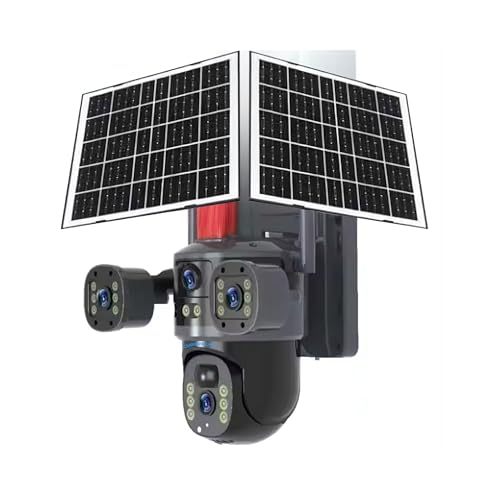
The X10U is XUGA’s dual-solar-panel model, built specifically for off-grid use. It runs on a 4G Airtel SIM (Jio isn’t recommended for this one, per the listing), which makes it a solid fit for farmland or any property where a broadband line just isn’t practical.
It’s a triple-view 12MP camera with 355° pan and 90° tilt, controlled through the V380 Pro app. The 25W solar panel is sized to keep it running continuously, and it supports up to a 128GB memory card for extended local recording alongside two-way audio.
Key Features
- Dual solar panel + rechargeable battery
- 4G LTE connectivity (Airtel SIM recommended, Jio not recommended)
- 355° pan / 90° tilt remote control via app
- 12MP, 3-lens view
- Motion detection with siren alarm
- Two-way audio, expandable storage up to 128GB
Best For
- Farms and agricultural land
- Remote properties without WiFi
- Large open-area monitoring
Price: ₹8,299 | Rating: 4.1★
3. Dr Vision Dual Lens Solar PTZ Camera — Best Budget Pick

If you want a simpler, more affordable solar camera and don’t specifically need 4G, the Dr Vision Dual Lens camera is worth a look. It runs on WiFi rather than a SIM card, and is controlled through the V380 Pro app on Android.
It’s a dual-lens PTZ camera with full 360° coverage, color night vision, and motion alerts, and it’s rated for both indoor and outdoor use — so it’s flexible enough to double up as a baby monitor or pet camera if needed, not just security. This is one of the better solar powered exterior security cameras in this price band if you want an all-rounder rather than a specialist.
Key Features
- Solar powered, wire-free setup
- 360° PTZ coverage
- Color + IR night vision
- Motion detection alerts
- Two-way audio
- Works indoors and outdoors
Best For
- Home security on a budget
- Baby or pet monitoring
- Buyers who already have stable WiFi
Price: ₹7,989 | Rating: 4.2★
4. XUGA Cybernautt X18C 16MP Quad Lens Camera — Best for Maximum Detail
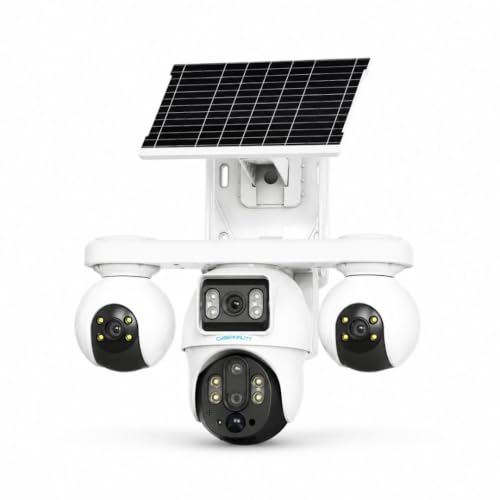
The X18C is the most powerful camera in this lineup. It uses a four-lens array (16MP total, made up of four 4MP sensors) to capture a noticeably wider field of view than single-lens cameras, at a sharper 1920×2160 resolution.
Like the X10U, it runs on a 4G Airtel SIM (Jio isn’t recommended), has a 25W solar panel, and offers 355° pan with 90° tilt through the app. If you’re covering a large property and want to avoid blind spots without installing multiple cameras, this is the one to consider — though it comes at a higher price point.
Key Features
- 16MP resolution across 4 lenses (4MP each)
- Wide field of view, 1920×2160 main resolution
- 4G LTE connectivity (Airtel SIM recommended)
- 355° pan / 90° tilt
- Two-way audio, up to 128GB storage
- Solar powered with rechargeable battery
Best For
- Large properties needing wide coverage
- Buyers who want the sharpest detail available here
- Farms, warehouses, and open compounds
Price: ₹11,999 | Rating: 4.1★
Quick Comparison Table
| Feature | AOV Solar CCTV Triple Lens | XUGA Cybernautt X10U | Dr Vision Dual Lens | XUGA Cybernautt X18C |
|---|---|---|---|---|
| Price | ₹7,599 | ₹8,299 | ₹7,989 | ₹11,999 |
| Rating | ||||
| Connectivity | 4G SIM (Cellular) | 4G LTE — Airtel recommended, Jio not recommended | WiFi | 4G LTE — Airtel recommended, Jio not recommended |
| Resolution / Lenses | Triple lens, 4+4+4MP | Triple view, 12MP | Dual lens | Quad lens, 16MP (4×4MP), 1920×2160 |
| Recording Mode | 24×7 continuous recording | Motion-triggered | Motion-triggered | Motion-triggered |
| Pan / Tilt | 360° PTZ | 355° pan / 90° tilt | 360° PTZ | 355° pan / 90° tilt |
| Night Vision | Yes | Yes | Yes (Color + IR) | Yes (Color) |
| Two-Way Audio | Yes | Yes | Yes | Yes |
| Motion Alerts | Yes | Yes, with siren alarm | Yes | Yes |
| Storage | Expandable (SD card) | Up to 128GB TF card | Expandable (SD card) | Up to 128GB TF card |
| Solar Panel | Included | Dual solar panel, 25W | Included | 25W solar panel |
| Indoor/Outdoor | Outdoor | Outdoor | Indoor & Outdoor | Outdoor |
| App Control | Mobile app | V380 Pro | V380 Pro (Android) | Mobile app |
| Best For | Construction sites, farms, continuous recording | Farms, remote areas without WiFi | Budget home security, indoor/outdoor flexibility | Large properties needing maximum coverage |
| Buy Now | Buy on Amazon | Buy on Amazon | Buy on Amazon | Buy on Amazon |
Which Wireless Solar CCTV Camera Should You Buy?
Choosing the right solar CCTV camera really comes down to your location and use case.
For Farms & Agricultural Land A 4G SIM camera like the XUGA Cybernautt X10U makes more sense here, since these locations often don’t have reliable WiFi coverage.
For Homes The Dr Vision Dual Lens camera is a good fit if you already have stable home WiFi and want an easier, lower-cost setup — one of the better best residential solar security cameras in this list for that reason.
For Maximum Coverage If you’re monitoring a large compound or want the widest field of view with the most detail, the XUGA Cybernautt X18C is the strongest option here, even at a higher price.
For 24×7 Continuous Footage The AOV Solar CCTV camera is built specifically for non-stop recording rather than only motion-triggered clips, which matters if you want a complete record rather than gaps between alerts.
Also Read: Solar String Lights: Affordable Smart Tech for Eco-Friendly Festive Lighting
How a Solar CCTV Camera Works
A solar CCTV camera uses a solar panel to charge its internal rechargeable battery during the day. That stored power then runs the camera at night or during cloudy weather.
Most modern solar cameras also use motion detection to cut down on unnecessary power draw — instead of recording nonstop, many models only start recording when they detect movement (though, as with the AOV camera above, some do offer true 24×7 continuous recording).
Depending on the model, the camera connects using:
- WiFi
- A 4G SIM card
- A mobile hotspot
You can monitor footage directly from a smartphone app either way.
Solar CCTV Camera With SIM Card: How It Works
A solar CCTV camera with a SIM card is built for locations where WiFi or broadband just isn’t available. Instead of connecting to a router, it uses a 4G SIM card to send video and alerts straight to your phone through an app.
This is especially useful for:
- Farms and agricultural land
- Construction sites
- Warehouses and storage yards
- Remote properties
- Vacant plots and outdoor locations
How Does a SIM Card Solar CCTV Camera Work?
- Insert a compatible 4G SIM card into the camera.
- Activate a data plan from your preferred operator.
- Install the manufacturer’s mobile app.
- Connect the camera to the app using the QR code or device ID.
- Start monitoring remotely from anywhere.
Do Solar CCTV Cameras Need WiFi?
No. A 4G solar CCTV camera works independently over the mobile network. As long as there’s a stable 4G signal at the location, you can view live footage, get motion alerts, and pull up recordings without any broadband connection.
Which SIM Card Is Best for Solar CCTV Cameras?
This is one area where it pays to read the fine print. Several current models — including two in this list, the XUGA Cybernautt X10U and X18C — specifically recommend an Airtel SIM and note that Jio is not recommended. Compatibility varies by camera, so always check the listing before buying a SIM.
My Recommendation
If you’re installing in a farm, field, warehouse, or anywhere without broadband, a 4G SIM solar camera is usually the better call. It means ongoing data recharges, but the flexibility is worth it for outdoor security.
4G SIM Solar CCTV Cameras vs WiFi Solar Cameras
4G SIM Cameras
Advantages
- No WiFi required
- Works well for farms and remote areas
- Flexible installation
- Works almost anywhere with mobile signal
Disadvantages
- Needs periodic data recharge
- Slightly higher upfront cost
- SIM compatibility varies by brand (check Jio vs Airtel support)
WiFi Solar Cameras
Advantages
- Lower running cost
- Often faster live streaming
- Easier setup for home use
Disadvantages
- Needs a stable broadband connection
- Less flexible placement
How to Install a Wireless Solar Powered Camera
Most solar cameras are designed for DIY installation — no electrician needed.
- Pick an outdoor spot with good sunlight exposure.
- Mount the solar panel facing direct sunlight.
- Install the camera using the mounting bracket.
- Insert an SD card if the model needs one.
- Insert the 4G SIM card for SIM-based models.
- Download the app (V380 Pro is used by several models in this list).
- Pair the camera with the app.
- Test live view and motion alerts before you walk away.
Do Solar CCTV Cameras Work During Monsoon?
This comes up a lot with Indian buyers, and in most cases, yes.
Modern solar cameras store energy during sunny periods, and the battery carries the camera through monsoon stretches. Actual backup time depends on:
- Battery capacity
- Recording frequency (continuous vs motion-triggered)
- Motion detection usage
- Sunlight availability
- Night vision usage
Cameras with bigger batteries and dual solar panels — like the X10U above — generally hold up better through extended cloudy weather.
Are Solar CCTV Cameras Worth Buying in 2026?
For most people, yes. They’re getting more practical thanks to:
- Better battery technology
- Improved mobile apps
- Affordable 4G data
- Falling solar component costs
- Easier installation
They’re particularly useful in Indian conditions, where power cuts and the need for remote monitoring are both common. If you need outdoor security without complicated wiring, a solar CCTV setup is a genuinely flexible, cost-effective option.
Important Precautions Before Buying a Solar CCTV Camera
1. Check Sunlight Availability
Solar cameras work best with several hours of direct sunlight on the panel daily. Avoid installing under dense trees, tin shades, rooftop shadows, or indoor balconies — poor sunlight badly hurts charging efficiency.
2. Verify SIM Compatibility for 4G Models
Not every 4G solar camera supports every Indian network. As seen with the XUGA models above, some explicitly recommend Airtel and advise against Jio. Always check before you buy a SIM specifically for the camera.
3. Don’t Ignore Battery Capacity
Battery backup matters a lot for cloudy weather and nighttime use. Larger battery capacities generally mean more reliable performance.
4. Use High-Quality Memory Cards
Cheap memory cards tend to fail under continuous recording. Stick to branded MicroSD cards, Class 10 or higher, and skip the fake low-cost ones — they cause footage corruption and dropped recordings.
5. Check the IP Weather Rating
Outdoor cameras should ideally carry an IP65 rating or similar, protecting against rain, dust, heat, and humidity — especially through the monsoon.
6. Secure the Camera Properly
Since these are wireless and usually mounted outdoors, use strong wall anchors, metal brackets, and elevated installation points to reduce theft risk and improve coverage.
7. Avoid Unrealistic Marketing Claims
Plenty of generic listings inflate battery backup or megapixel numbers. Focus on real customer reviews, stable app performance, reliable motion alerts, and actual weather durability instead of chasing the biggest number on the box.
Frequently Asked Questions
Which is the best solar CCTV camera in India?
It depends on your setup. For 24×7 continuous recording, the AOV Solar CCTV camera is a strong pick. For farms without WiFi, the XUGA Cybernautt X10U works well. For maximum coverage and detail, the XUGA Cybernautt X18C leads this list. If you’re specifically after the best solar powered CCTV cameras for a home rather than a farm or site, the Dr Vision Dual Lens is the easiest to live with day to day.
Can solar CCTV cameras work without WiFi?
Yes. Several current models, including three in this guide, run on a 4G SIM card and don’t need WiFi at all.
Are solar CCTV cameras waterproof?
Most outdoor solar cameras carry weather-resistant ratings like IP65, making them suitable for rain and general outdoor conditions.
Can I use a Jio SIM in solar CCTV cameras?
It depends on the model. Some of the cameras in this list specifically recommend Airtel and note that Jio isn’t recommended — always check the listing before buying.
How does a solar CCTV camera work during consecutive cloudy or rainy days?
Solar panels don’t need perfectly clear skies to generate power — they still charge, just more slowly, under cloud cover. Most current solar CCTV cameras carry large rechargeable batteries that can keep the camera running for several days without direct sunlight, which is why battery capacity matters so much when buying for Indian weather.
Can solar CCTV cameras record video even if the internet stops working?
Yes, as long as the camera has a memory card inserted. It’ll keep recording locally even if mobile data or WiFi drops, and you can pull up the footage through the app once the connection is back.
Do solar CCTV cameras require an active internet connection?
You’ll need one if you want to view live footage remotely, get phone alerts, control PTZ remotely, or use cloud features. For 4G models, that means an active data plan; for WiFi models, a working broadband connection.
What is the average solar CCTV camera price in India for a reliable model?
A reliable outdoor solar camera generally falls between ₹2,500 and ₹12,000 in India. Basic static WiFi models sit at the lower end, while multi-lens 4G PTZ cameras with bigger batteries — like the ones featured above — land between ₹7,500 and ₹12,000.
What should I look for in a solar powered outdoor security camera before buying?
Beyond price, prioritize solar panel wattage, battery capacity, SIM compatibility if you’re going 4G, and a genuine IP65 or better weatherproof rating. A camera marketed as a solar powered surveillance camera wireless setup is only as good as its battery backup during a stretch of cloudy days — that’s usually where budget models fall short first.
Final Thoughts
Solar CCTV cameras aren’t a niche gadget anymore. In 2026, they’re a practical security option for homes, farms, shops, and outdoor properties across India.
Whether you want a simple WiFi camera for home monitoring or a 4G SIM-based camera for agricultural land, there are solid options at a range of price points — and the four cameras above cover most of the common use cases I hear about from readers.
Before buying, focus on:
- Battery backup
- Solar charging quality
- SIM/WiFi compatibility
- Night vision performance
- Mobile app support
- Weather resistance
Get that combination right and you’ll get far better long-term reliability out of whichever camera you choose.
Affiliate Disclaimer
This article contains affiliate links. If you purchase a product through these links, I may earn a small commission at no extra cost to you. This helps me continue sharing honest reviews, comparisons, and guides based on my real retail experience. I only recommend products from reliable brands that I believe will offer value and long-term satisfaction to customers.

Ayush Singhal is the founder and chief editor of TechMitra.in — a tech hub dedicated to simplifying gadgets, AI tools, and smart innovations for everyday users. With over 15 years of business experience, a Bachelor of Computer Applications (BCA) degree, and 5 years of hands-on experience running an electronics retail shop, Ayush brings real-world gadget knowledge and a genuine passion for emerging technology.
At TechMitra, he covers everything from AI breakthroughs and gadget reviews to app guides, mobile tips, and digital how-tos. His goal is simple — to make tech easy, useful, and enjoyable for everyone. When he’s not testing the latest devices or exploring AI trends, Ayush spends his time crafting tutorials that help readers make smarter digital choices.
📍 Based in Lucknow, India
💡 Focus Areas: Tech News • AI Tools • Gadgets • Digital How-Tos
📧 Contact: Get in touch →
🔗 Full Bio: https://techmitra.in/about-us/