

Updated: August 2026 | By Ayush Singhal
If you ask me what the most-sold kitchen appliance was during my 5 years running an electronics retail store, the answer is simple: mixer grinders. Across hundreds of customers, different budgets, and different cooking habits, one thing stayed constant — every Indian kitchen needs one it can trust.
This guide skips the fluff and gets straight to what actually matters: which wattage you need, which motor type suits your kitchen, and specific picks in the price bands people actually search for — ₹3,000–4,000 for 750W, the best 1000W options, and food processors that double up as a mixer grinder.
Note on pricing: Amazon prices on these models shift often — more so around sale events (Independence Day, Diwali, Republic Day). The prices below reflect current listings at the time of writing. Use the Buy Now links for the live price before purchasing.
Table of Contents
Also Read : Best Fully Automatic Washing Machines in India: Buying Guide & Top 4 Picks (June 2026)
Quick Answer: Best Quality Mixer Grinder
| Category | Our Pick | Price | Why |
| Best 750W (₹3,000–4,000) | Philips HL7756 | ₹3,499 | Best balance of ventilation, warranty, and reliability |
| Best 1000W | Sujata MG03 | ₹7,990 | 90-min continuous run, coconut milk extractor |
| Best 1000W Budget | Philips HL7714/01 | ₹5,540 | 4 jars, QuickCool tech, cheaper than most 1000W rivals |
| Best BLDC (Silent) | Atomberg Zenova | ₹6,399 | 550W BLDC delivers 1000W-equivalent grinding, near-silent |
| Best Food Processor | Inalsa Inox 1000 Pro | ₹9,999 | 12-in-1 functionality, copper motor, long-lasting |
Best Mixer Grinder In India Buying Guide 2026: How to Choose
1. Motor Wattage — The Most Important Spec
Wattage decides how much load your motor can take before it strains, overheats, or trips its overload protector. It is not simply “higher is better” — it’s about matching the motor to what you actually grind.
500W is enough only for light, occasional grinding — small chutney batches, soft ingredients, dry powders for one or two people. It will struggle with dosa batter and dry turmeric, and will overheat faster under load. Fine for a bachelor or a secondary machine, not a family’s only mixer.
750W is the sweet spot for the vast majority of Indian households. It comfortably handles daily masala grinding, chutneys, ginger-garlic paste, and dosa batter in normal quantities, without straining. If you cook for a family of 3–5 and don’t grind unusually hard or bulk ingredients daily, this is almost always the right call — and it’s also the most competitively priced tier, with reliable options between ₹3,000 and ₹4,000.
1000W and above is for heavy-duty grinding — dry turmeric root, large-batch idli/dosa batter for bigger families, or near-continuous use (a home food business, a joint family kitchen). The extra torque means less strain and less risk of tripping mid-grind, but you pay more upfront and in running electricity cost, and these motors also tend to be louder.
Retailer’s tip: In my years at the counter, wattage confusion was the #1 return reason — not because the motor was weak, but because customers bought 500W for a joint family’s daily batter needs and then blamed the brand. Match the wattage to your household size and grinding frequency, not to whatever number sounds impressive on the box.
2. Motor Technology: Conventional (Copper) vs BLDC
Traditional mixer grinders use brushed AC motors — usually copper-wound, since copper handles heat and load far better than cheaper aluminium windings. These are proven, easy to service anywhere in India, and can be locally rewound if the motor ever burns out — which matters a lot outside major cities.
BLDC (Brushless DC) motors are the newer technology, led in India by Atomberg. They consume noticeably less electricity, run cooler, are significantly quieter, and tend to last longer since there are no brushes to wear down. The tradeoff is a higher upfront price and a newer, thinner service network compared to legacy brands like Philips, Bajaj, or Sujata.
As a rough rule: a 550W BLDC motor performs close to what a 1000W conventional motor delivers, because BLDC motors sustain torque more efficiently under load rather than just relying on raw wattage.
- Choose copper/conventional if: you want the widest service network, lowest repair cost, and proven longevity — especially outside metro cities.
- Choose BLDC if: noise matters (apartment living, early-morning grinding, a sleeping child), and you’re comfortable paying a premium for lower running cost and quieter operation.
3. Jar Types and Capacity
Most mixer grinders ship with three jars, and each has a job:
| Jar Type | Typical Capacity | Best For |
| Small / Chutney jar | 0.3–0.5L | Chutneys, garlic, small spice batches |
| Medium / Multipurpose jar | 0.75–1L | Masala grinding, dry spices |
| Large / Wet jar | 1.5L+ | Batter, juices, large-batch wet grinding |
Some models now add a fourth or fifth jar — a chopper jar (Atomberg), a juicer jar (Bajaj, Havells), or a coconut milk extractor attachment (Sujata). These add real utility if you’ll genuinely use them, but don’t pay a premium for a jar you won’t touch. Always check the jars are stainless steel with sturdy handles and leak-proof lids — plastic couplers and thin jar walls are where cheap mixers fail first.
4. Blade Quality
Look for stainless steel blades with anti-rust coating, and ideally separate blade designs for wet grinding, dry grinding, and chutney — a single all-purpose blade is a compromise on all three tasks. Bosch’s “PoundingBlade” is a notable design difference: it uses a blunt, thick edge that pounds rather than cuts dry spices, which some users find gives a more authentic texture for masalas.
5. Build Quality
A durable mixer grinder should have an ABS (or stainless steel, on premium models) body, a strong jar-locking mechanism, and a thick, well-insulated power cord. Cheap plastic bodies vibrate heavily during grinding — if you can, check the base for anti-skid feet or suction grips, which stop the mixer from “walking” across the counter under load.
6. Noise Levels
Most conventional mixer grinders run between 80–95 dB — comparable to a lawnmower. If low noise matters to you, BLDC models like the Atomberg Zenova are meaningfully quieter, and Bosch’s engineering also tends to run quieter than typical Indian-brand competitors at the same wattage.
7. Safety Features
Check for overload protection (OLP — usually a manual reset button that trips before the motor burns out), a jar-lock safety interlock that prevents operation with an unlocked jar, and non-slip feet. These aren’t optional extras — they’re what stands between a strained motor and a burnt-out one.
Retailer’s insider tip: During my years managing an electronics retail store, the #1 complaint on mixer grinders wasn’t power — it was a burning smell on day one (this is normal: manufacturing varnish burning off the motor windings, and it stops after a few uses) and broken jar couplers from overloading. Always prioritize nylon couplers over cheap plastic ones, and check that the OLP reset button is easy to reach at the base — some budget models bury it, making a simple reset a real hassle.
8. Service Network
This matters more in India than almost anywhere else — a mixer grinder is used 2–3 times a day, which adds up to 700+ grinding sessions a year. Even reliable machines eventually need a coupler or gasket replacement. Brands with the widest service networks include Philips, Bajaj, Sujata, and Prestige. Before buying, it’s worth checking whether the brand has a service centre near your pin code — newer entrants like Atomberg are still building this out.
9. Warranty
Standard warranty is 2 years on the product. Premium brands now offer 5-year motor warranties as a mark of confidence — Philips’ HL7756 line is a good example. A longer motor warranty is one of the more reliable signals of how long a brand expects (and stands behind) their motor lasting.
10. Price Range in India — What You Actually Get
| Budget | What You Get |
| ₹2,000–3,000 | Basic 500–750W mixers, thinner jars, standard 2-year warranty |
| ₹3,000–4,000 | Best-value 750W mixers — the sweet spot for most households |
| ₹4,000–6,000 | Premium 750W or entry 1000W models, better warranties |
| ₹6,000–9,000+ | Premium 1000W, BLDC, or food processor combo machines |
For most households, ₹3,000–4,500 delivers the best value-to-reliability ratio.
Also read : The Best 43-Inch 4K LED TVs in India (2026): A Retailer’s No-Nonsense Guide
Best 750W Mixer Grinders (₹3,000–4,000)
This is the price band where most Indian households should be shopping — enough power for daily masala, chutney, and batter grinding without paying for headroom you won’t use.
1. Philips HL7756 — Best Overall (750W)
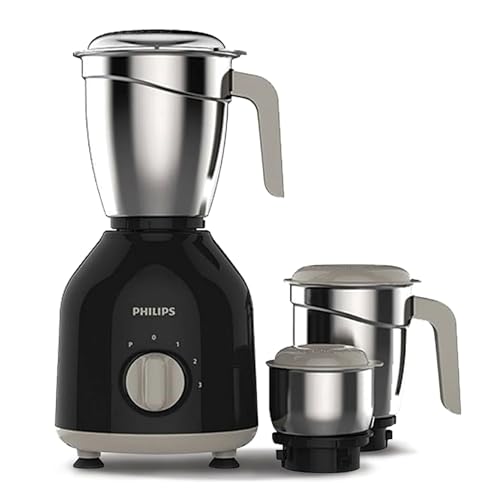
In my retail years, this was the default recommendation for almost any family walking in. Philips builds these to last, and the ventilation system genuinely holds up under repeated use.
- Motor: 750W Turbo Motor with advanced air ventilation — rated for 25 minutes of continuous grinding, even on tough ingredients like black gram dal
- Jars: 3 stainless steel — 1.5L wet jar, 1L multipurpose jar, 0.3L chutney jar — all leak-proof with a semi-transparent lid
- Warranty: 5 years on motor, 2 years on product — one of the strongest warranties at this price point
- Best for: Families who want a “fill it, forget it” mixer with minimal fuss
⭐ 4.0 rating | Buy Now / Check Price →
2. Bajaj Military Series Rex 750W — Best Value with 4 Jars
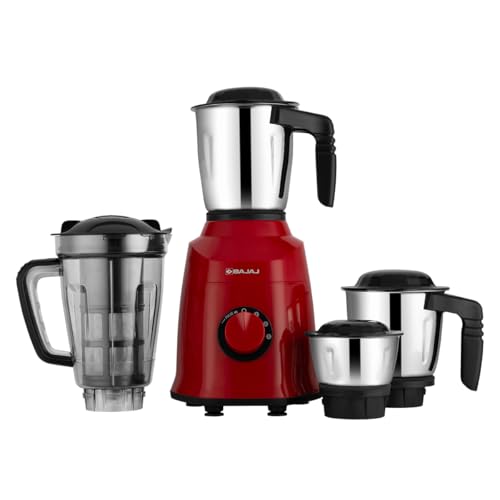
Bajaj markets this as “Military Grade” for its build durability, and it backs that up with a genuinely aggressive price for a 4-jar setup, including a bonus juicer jar most 750W competitors don’t include at this price.
- Motor: 750W Titan Motor
- Jars: 4 total, including a 1.5L juicer jar — rare inclusion at this price point
- Special feature: DuraCut blades with a lifetime warranty claim; 2-in-1 function blade in the dry jar
- Best for: Buyers who want juicing capability without paying for a separate appliance
⭐ 4.0 rating | ₹3,699 | Buy Now / Check Price →
3. Bosch TrueMixx 750W (MG4413C4GI) — Best for Authentic Masala Texture
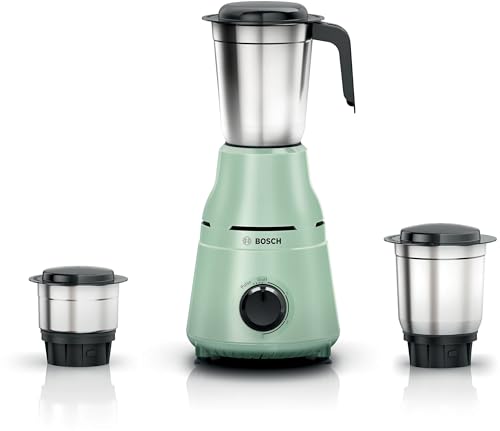
If you’re from South India or grind a lot of dry spices and masalas, Bosch’s blunt “PoundingBlade” design is worth knowing about — it pounds rather than cuts dry ingredients, which is closer to traditional sil-batta texture than a standard sharp blade.
- Motor: 750W, running at 22,000 RPM
- Jars: 3 — 400ml chutney, 800ml dry grinding, 1200ml wet grinding
- Special feature: Blunt PoundingBlade for authentic dry-spice texture; anti-skid, overheat and overload protection
- Best for: Households prioritizing dry masala texture over raw grinding speed
⭐ 4.0 rating | Buy Now / Check Price →
750W Comparison Table (₹3,000–4,000)
| Model | Price | Jars | Key Feature | Warranty | Rating |
| Philips HL7756 | ₹3,499 | 3 | Best ventilation, 25-min continuous grinding | 5Yr Motor / 2Yr Product | 4.0 |
| Bajaj Military Rex | ₹3,699 | 4 (+juicer) | DuraCut lifetime blades | 2 Years | 4.0 |
| Bosch TrueMixx | ₹3,490 | 3 | PoundingBlade for authentic texture | 2 Years | 4.0 |
Best 1000W Mixer Grinders (Heavy-Duty)
If you grind dry turmeric, run a small home food business, or cook for a large/joint family that goes through batter and masala daily, a 1000W motor gives you the torque headroom to avoid daily overload trips.
1. Sujata MG03 — Best Overall 1000W (The Workhorse)
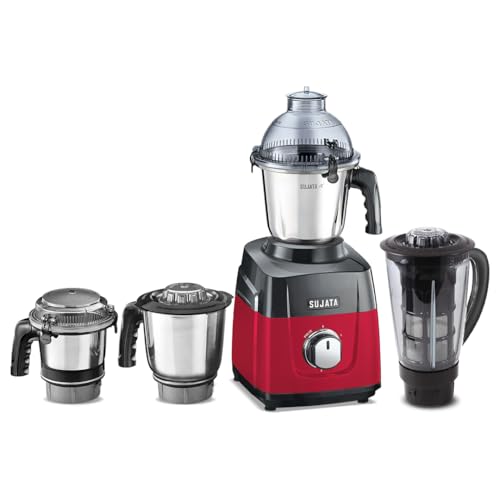
Sujata is the brand you’ll spot in nearly every juice shop and South Indian kitchen in the country, and the MG03 is their current flagship. This is the machine to buy if you want to stop thinking about your mixer grinder for the next decade.
- Motor: 1000W, 100% copper windings, double ball bearings, 24,000 RPM
- Standout feature: Rated for 90 minutes of continuous running — no other machine on this list claims that
- Jars: 4 — 1.75L unbreakable liquidizer (with coconut milk extractor mesh), 1.5L dome-shaped wet jar, 1L dry jar, 500ml chutney jar
- Best for: South Indian cooking, large families, anyone who wants a machine built to outlast the kitchen it’s in
⭐ 4.5 rating | Buy Now / Check Price →
2. Bosch Pro 1000W (MGM8842MIN) — Best Premium Build
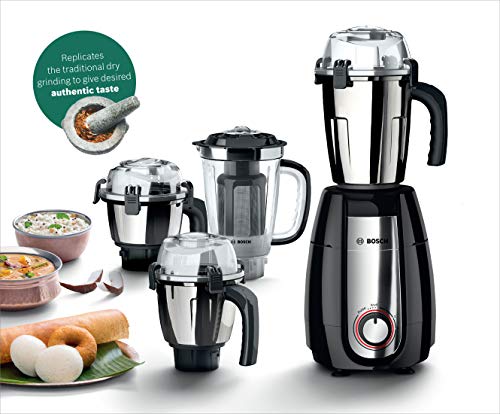
For buyers who want Sujata-level power with a more modern, compact design.
- Motor: 1000W with PoundingBlade technology for dry masalas
- Special feature: Hands-free operation with lid-locks and strong suction feet; rated for 30-minute motor cycles (5 min on, 2 min off, up to 6 cycles)
- Jars: High-grade stainless steel with ergonomic handles
- Best for: Buyers who want German engineering and a smaller footprint than the Sujata
⭐ 4.3 rating | Buy Now / Check Price →
3. Philips HL7714/01 — Best Budget 1000W
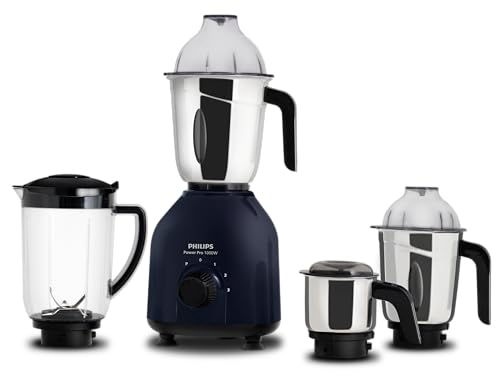
The most affordable way into 1000W power, without stepping down on jar count or build quality.
- Motor: 1000W PowerPro motor with QuickCool ventilation for extended grinding without overheating
- Jars: 4 — 0.4L, 1L, and 1.5L capacities, edgeless SS304 blades
- Best for: Buyers who want 1000W headroom without paying premium 1000W pricing
⭐ 4.0 rating | Buy Now / Check Price →
Best 1000W BLDC : Atomberg Zenova
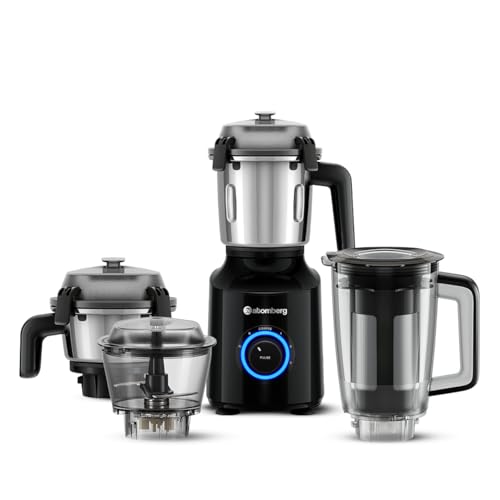
Technically a 550W BLDC motor, but Atomberg’s own claim — backed by real-world performance — is that it grinds like a 1000W conventional motor, thanks to how efficiently BLDC motors sustain torque. This is the pick if noise is your main concern and you don’t want to compromise on grinding power to get there.
- Motor: 550W Intelligent BLDC — rated to grind turmeric, garam masala, and coffee beans like a 1000W machine
- Unique features: “Coarse Mode” mimics traditional sil-batta texture; includes a dedicated 0.5L chopper jar (rare on any mixer grinder)
- Jars: 4 — 1.6L blender/juicer jar, 1L multipurpose, 0.5L chutney, 0.5L chopper
- Safety: Jar-lock detection, fault LED indication, no auto-restart after power cuts
- Warranty: 2 years standard, extendable to 3 years via registration
- Best for: Apartment living, noise-sensitive households, buyers who want the newest motor tech
⭐ 4.1 rating | Buy Now / Check Price →
1000W Comparison Table
| Model | Wattage | Price | Key Feature | Rating |
| Sujata MG03 | 1000W | ₹7,990 | 90-min continuous run, coconut milk extractor | 4.5 |
| Bosch Pro MGM8842MIN | 1000W | ₹6,896 | PoundingBlade, hands-free lid-locks | 4.3 |
| Philips HL7714/01 | 1000W | ₹5,540 | Cheapest 1000W, 4 jars, QuickCool | 4.0 |
| Atomberg Zenova | 550W BLDC | ₹6,399 | Silent, 1000W-equivalent, chopper jar | 4.1 |
Best Food Processors (Mixer Grinder + Food Processor Combo)
If chopping, slicing, kneading, and shredding are eating into your prep time alongside regular grinding, a combo food processor replaces two or three separate appliances.
1. Inalsa Inox 1000 Pro — Best Overall Food Processor

Personal note: I’ve had an Inalsa food processor in daily use for 16 years. The first unit lasted 12 years before I replaced it — the current one is already 4 years old and going strong. That’s the kind of long-term reliability that’s hard to fake in a review; it either lasts or it doesn’t, and this one has.
- Motor: 1000W, 100% copper motor
- Jars/Bowl: 2.5L main processing jar, 1.5L BPA-free blending jar, 1.2L dry/wet grinding jar, 500ml chutney jar
- Attachments: 12-in-1 — chopping, slicing, shredding, kneading, grinding, citrus juicing, whisking, blending
- Best for: Families who want one machine to fully replace a separate food processor and mixer grinder
⭐ 4.1 rating | Buy Now / Check Price →
2. Inalsa Triton FP (900W) — Best Warranty
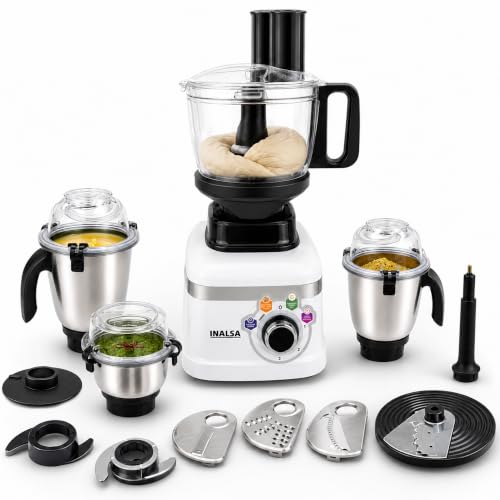
- Motor: 900W, 7-year motor warranty — the longest on this list by a wide margin
- Attachments: 13 multifunctional attachments — chopping, slicing, grating, kneading, coarse/fine grinding
- Jars: 3 stainless steel — liquidizing jar, dry grinding jar, chutney jar, plus a food processing bowl
- Best for: Buyers prioritizing long-term motor warranty above all else
⭐ 4.1 rating | Buy Now / Check Price →
3. Havells Unity 750W — Best Compact/Budget Combo
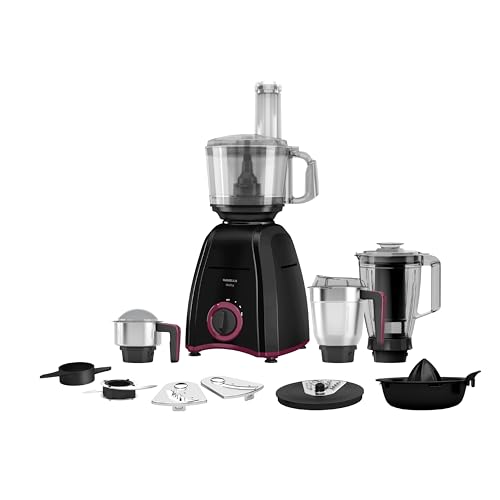
- Motor: 750W with ACS cooling technology
- Jars: 4 — juicer, mixer, grinder, and chopper functions in a compact footprint
- Warranty: 2-year doorstep warranty by Havells
- Best for: Smaller kitchens wanting combo functionality without the premium price of the Inalsa options
⭐ 4.0 rating | Buy Now / Check Price →
Food Processor Comparison Table
| Model | Wattage | Price | Attachments | Warranty | Rating |
| Inalsa Inox 1000 Pro | 1000W | ₹9,999 | 12-in-1 | Standard | 4.1 |
| Inalsa Triton FP | 900W | ₹8,495 | 13-in-1 | 7 Yr Motor | 4.1 |
| Havells Unity | 750W | ₹6,840 | 4-in-1 | 2 Yr Doorstep | 4.0 |
Mixer Grinder vs Food Processor — Which Do You Need?
A mixer grinder handles liquidizing, dry grinding, and chutneys — the core of Indian daily cooking. A food processor adds chopping, slicing, kneading (atta/dough), and shredding on top of that. If your prep work is mostly grinding and blending, a dedicated mixer grinder in the 750W–1000W range is the simpler, cheaper choice. If you’re also spending real time chopping vegetables or kneading dough by hand, a combo food processor like the Inalsa options above can genuinely replace two appliances.
Frequently Asked Questions (FAQs)
Q1. What are the most important points in a mixer grinder buying guide for 2026?
Focus on three things: Wattage (750W is ideal for daily batter and chutneys; 1000W is for heavy-duty grinding like turmeric and masalas), Motor Type (BLDC motors like Atomberg for silent operation, or copper motors like Sujata for raw durability and easy servicing), and Service Network (always pick a brand with a service centre in your city).
Q2. Which is the best mixer grinder in India for heavy usage (1000W)?
The Sujata MG03 is the top recommendation — its 24,000 RPM motor can run for 90 minutes continuously, making it ideal for grinding hard spices like turmeric. The Bosch Pro 1000W is a strong alternative if you want a quieter, more compact design at a lower price.
Q3. Which is the best mixer grinder for home use?
For most families, the Philips HL7756 (750W) offers the best balance of power, price, and durability at ₹3,499. If you have a higher budget and want near-silent operation, the Atomberg Zenova BLDC is the best modern choice.
Q4. Is a 1000W mixer grinder necessary for home use?
Not for most households. A 750W mixer comfortably handles idli batter, chutneys, and everyday spices for a family of 3–5. Upgrade to 1000W only if you have a large or joint family, grind tough ingredients like dried turmeric or coconut daily, or run a small home food business.
Q5. What’s the difference between a mixer grinder and a food processor?
A mixer grinder handles liquidizing, dry grinding, and chutneys. A food processor (like the Inalsa Inox 1000 Pro) adds chopping, slicing, kneading, and shredding on top of that. If you want an all-in-one kitchen assistant, a food processor is worth the extra cost.
Q6. Which is better for daily Indian cooking — copper motor or BLDC motor?
Copper motors are the safer default — they’re proven, widely serviceable across India (including local rewinding if the motor burns out), and typically cheaper. BLDC motors run quieter and more efficiently, but cost more upfront and have a thinner, newer service network. Choose copper for reliability and easy repairs; choose BLDC if noise and running cost matter more to you.
Q7. What is the best mixer grinder between ₹3,000 and ₹4,000?
The Philips HL7756 (₹3,499) is the strongest all-rounder in this band, thanks to its 5-year motor warranty and reliable ventilation. The Bajaj Military Series Rex (₹3,699) is the better pick if you want a bonus juicer jar included.
Q8. Is a food processor worth buying instead of a separate mixer grinder?
If your kitchen work is mostly grinding, chutneys, and batter, a dedicated 750W or 1000W mixer grinder is simpler and cheaper. If you also chop vegetables and knead dough regularly, a combo food processor like the Inalsa Triton FP can replace both appliances and simplify your kitchen counter.
This guide is based on hands-on retail experience and current Amazon India listings. Prices fluctuate frequently, especially around sale events — use the Buy Now links for the live price before purchasing.
Affiliate Disclosure
TechMitra is a participant in the Amazon Associates Program, an affiliate advertising program designed to provide a means for sites to earn advertising fees by advertising and linking to Amazon.in.
This means that if you click on one of our product links (such as “Buy Now” or “Check Price”) and make a purchase, we may earn a small commission at no additional cost to you. This helps support the running of TechMitra and allows us to continue producing detailed, independent buying guides and reviews.
All recommendations on this site are based on genuine research, specifications, and — where noted — our own hands-on retail and usage experience. Our opinions and rankings are never influenced by affiliate partnerships, and we do not accept payment in exchange for positive reviews.
Prices, ratings, and availability shown on this page are accurate as of the time of publishing but are subject to change. Please check the retailer’s website for current pricing before making a purchase decision.

Ayush Singhal is the founder and chief editor of TechMitra.in — a tech hub dedicated to simplifying gadgets, AI tools, and smart innovations for everyday users. With over 15 years of business experience, a Bachelor of Computer Applications (BCA) degree, and 5 years of hands-on experience running an electronics retail shop, Ayush brings real-world gadget knowledge and a genuine passion for emerging technology.
At TechMitra, he covers everything from AI breakthroughs and gadget reviews to app guides, mobile tips, and digital how-tos. His goal is simple — to make tech easy, useful, and enjoyable for everyone. When he’s not testing the latest devices or exploring AI trends, Ayush spends his time crafting tutorials that help readers make smarter digital choices.
📍 Based in Lucknow, India
💡 Focus Areas: Tech News • AI Tools • Gadgets • Digital How-Tos
📧 Contact: Get in touch →
🔗 Full Bio: https://techmitra.in/about-us/
Great roundup of mixer grinders for Indian kitchens. I especially liked how you covered different power ratings and use cases instead of focusing only on price. One thing many buyers overlook is the importance of choosing a reliable brand, as motor durability and after-sales service can make a huge difference in long-term performance. Thanks for sharing such a helpful guide for first-time buyers and families looking to upgrade their kitchen appliances.
Thanks for your valuable feedback, Sourabh.
I completely agree that after-sales service and motor durability are often overlooked when choosing a mixer grinder. A good service network can make a huge difference over the years, especially for households that use their mixer daily.
I’m glad you found the guide useful. Thanks for taking the time to share your insights!