

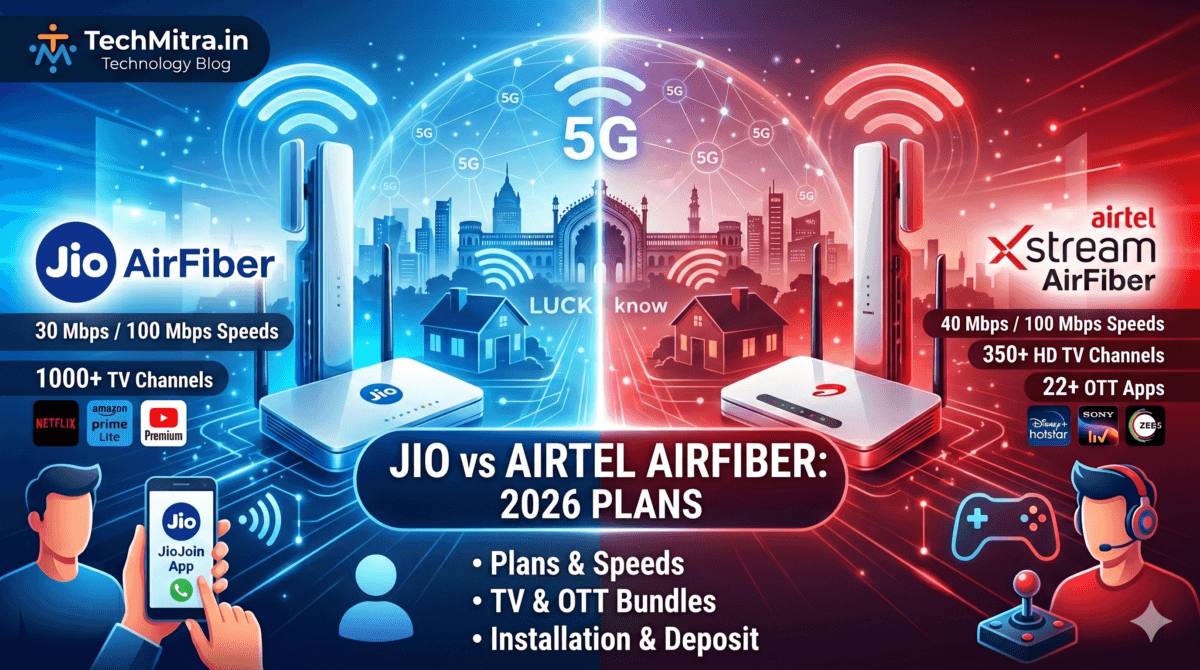
Image : Jio AirFiber vs Airtel Xstream AirFiber (2026 Plans Guide)
Both Jio AirFiber and Airtel Xstream AirFiber deliver fibre-like broadband over 5G, without the wait for a physical fibre cable to your home. They’re priced almost identically at the entry level, but the way each brand structures speed, data, and entertainment bundles is genuinely different — and that difference matters more than the headline price.
This comparison uses the current published plans from both providers, checked directly from jio.com and airtel.in. Plan prices and core benefits (speed, data, OTT/TV bundles) are stable and don’t vary by city. Installation charges and security deposits, however, do change by city and by ongoing festive-season offers — so we’ve flagged those separately rather than quoting numbers that could go stale.
Table of Contents
Also Read : Xbox Cloud Gaming in India (2026): Pricing, Setup & Is It Worth It ?
Quick verdict
- Choose Jio AirFiber if you want the lowest entry price (₹599), the widest city/town coverage, or want Netflix, Prime Video, and YouTube Premium bundled in — only Jio’s top plan includes all three.
- Choose Airtel Xstream AirFiber if you want live TV channels bundled at the entry tier, or if you’re a competitive gamer — Airtel’s network is widely reported to have lower, more consistent latency than Jio’s.
- Avoid Airtel’s ₹799 plan unless you specifically don’t want TV/OTT bundling — it’s a stripped-down, broadband-only tier sitting oddly between two bundled options.
- Both cap high-speed data around 1000GB/month, after which speeds drop sharply — heavy 4K streaming or large household usage should budget for this.
Jio AirFiber plans
Jio currently offers three AirFiber plans, all postpaid, billed monthly. The headline difference between them is speed (30 Mbps vs 100 Mbps) and which OTT apps are bundled in.
| Plan | Speed | Data | Voice | TV Channels |
| ₹599 + GST | Up to 30 Mbps | Unlimited* | Free | 1000+ channels |
| ₹899 + GST | Up to 100 Mbps | Unlimited* | Free | 1000+ channels |
| ₹1199 + GST | Up to 100 Mbps | Unlimited* | Free | 1000+ channels |
*High-speed data up to 1000GB/month; beyond that, speed drops to 64 Kbps until the next bill cycle. Commercial usage policy applies.
A voice calling quirk worth knowing: no direct landline port
The “Voice: Free” line in Jio’s plan table is technically accurate but can be misleading if you’re picturing a traditional landline experience. Unlike Jio Fiber, the Jio AirFiber router does not have a dedicated telephone port — you can’t plug a landline or cordless phone directly into it.
Instead, voice calling works through the JioJoin app, installed on a smartphone. Once set up, calls come in and go out from your AirFiber number, routed over Wi-Fi to your phone — the recipient sees your AirFiber number, so it feels like a landline call, but it’s really an app-based call riding on your home Wi-Fi rather than a physical phone line.
- This works only within range of your AirFiber Wi-Fi — unlike a SIM-based number, it won’t follow you outside the house unless your phone switches to mobile data with the app still logged in.
- If you specifically want a physical landline or cordless phone setup, Jio Fiber (wired) supports this directly; Jio AirFiber currently does not.
- Voice activation via JioJoin has, by some user accounts, rolled out unevenly across regions — if calling matters to you, it’s worth confirming the feature is fully active in your area before relying on it.
OTT apps included with each Jio AirFiber plan
All three Jio AirFiber plans include the same base set of 12 OTT apps. The ₹1199 plan adds four more, including Netflix and Prime Video — the two most-requested apps Indian buyers look for.
₹599 and ₹899 plans — 12 apps included
- JioHotstar
- Sony LIV
- ZEE5
- Sun NXT
- Hoichoi
- Discovery+
- TimesPlay
- TarangPlus
- Eros Now
- Lionsgate Play
- ShemarooMe
- ETV Win
₹1199 plan — 16 apps included
Everything in the ₹599/₹899 list above, plus:
- Netflix (Basic)
- Amazon Prime Lite (subscription valid for 2 years)
- YouTube Premium
- FanCode (via JioTV+)
Verified as a current ₹899 plan subscriber: Netflix and Amazon Prime are NOT included at ₹899, despite some third-party comparison sites listing them at this tier. They’re exclusive to the ₹1199 plan. Jio also expanded its TV channel count from 800+ to 1000+ in May 2026 — if you’re seeing older 800+ figures elsewhere, that’s outdated information predating this update.
For the full story of my 18 months with Jio AirFiber, see our complete review.
Airtel Xstream AirFiber plans
Airtel currently lists three AirFiber plans. Unlike Jio, Airtel’s middle tier deliberately strips out TV and OTT bundling — it’s positioned as a pure-broadband option for people who already have their own streaming subscriptions and don’t want to pay for bundles they won’t use.
| Plan | Wi-Fi Speed | 4K Android Box | TV Channels | OTT Apps |
| ₹699 + GST | Up to 40 Mbps | Included, no extra cost | 350+ channels (HD) | 22+ OTTs |
| ₹799 + GST | Up to 100 Mbps | Not included | Not included | Not included |
| ₹899 + GST | Up to 100 Mbps | Included, no extra cost | 350+ channels (HD) | 22+ OTTs |
Airtel’s published FAQ states AirFiber plans provide up to 1TB of high-speed data per month, after which speed is throttled to 2 Mbps.
OTT apps included with Airtel’s ₹699 and ₹899 plans
Airtel bundles the following apps with both its ₹699 and ₹899 plans (the ₹799 plan includes none):
- Disney+ Hotstar
- Sony LIV
- Lionsgate Play
- Sun NXT
- Aha
- ZEE5 (via Ultra)
- Eros Now
- Chaupal
Airtel’s site lists “22+ OTTs” with select app icons shown; the full list of all 22+ apps isn’t broken out individually on the plans page — the apps above are the ones explicitly shown.
Jio Airfiber vs Airtel Airfiber : side-by-side at similar price points
Here’s how the two brands stack up when you line up their closest-priced plans against each other.
| Jio ₹599 | Airtel ₹699 | Difference | |
| Speed | 30 Mbps | 40 Mbps | Airtel is faster for ₹100 more |
| TV channels | 1000+ channels | 350+ HD channels | Jio has more channels; Airtel guarantees HD |
| OTT apps | 12 apps | 22+ apps | Airtel bundles more apps at this tier |
| 4K set-top box | Included | Included, no extra cost | Tie |
| Jio ₹899 | Airtel ₹899 | Difference | |
| Speed | 100 Mbps | 100 Mbps | Tie |
| TV channels | 1000+ channels | 350+ HD channels | Jio has more channels; Airtel guarantees HD |
| OTT apps | 12 apps (no Netflix/Prime) | 22+ apps (no Netflix/Prime) | Airtel bundles more apps; neither has Netflix/Prime at this tier |
What’s the same data cap story on both?
Both providers use a fair usage policy (FUP) rather than truly unlimited data:
- Jio AirFiber: ~1000GB high-speed data, then throttled to 64 Kbps for the rest of the bill cycle.
- Airtel Xstream AirFiber: ~1TB high-speed data, then throttled to 2 Mbps for the rest of the bill cycle.
In practice, this means Airtel’s post-FUP experience is noticeably more usable — 2 Mbps can still handle basic browsing and SD video, while Jio’s 64 Kbps is closer to early-2000s dial-up speeds and is really only good for messaging apps. If you’re a household that regularly streams 4K video across multiple devices, this difference is worth weighing more heavily than the headline plan price.
Why good 5G speed on your phone doesn’t guarantee a good AirFiber connection
One detail that doesn’t get enough attention in most AirFiber reviews: the outdoor unit needs a clean, continuous line of sight to the nearest 5G tower — and that’s a different requirement from “my phone gets good 5G speed here.” A phone can pick up signal from multiple directions and route around minor obstructions; a fixed outdoor receiver, mounted in one position, can’t. This applies equally to Jio AirFiber and Airtel Xstream AirFiber, since both use the same fixed-wireless principle.
When this connection was installed, the installer initially tried a location that seemed reasonable — open space, and an area that already showed strong 5G speeds on a phone. A signal check on the installer’s equipment showed otherwise, and after testing from the roof, found that the outdoor unit performed properly only when mounted facing west, toward the nearest tower. That direction-specific tuning is what made the difference between a connection that works and one that doesn’t.
This matters because it’s a likely explanation for a chunk of the disconnection and instability complaints both brands receive online: a phone-based assumption (“I get good signal here”) doesn’t always translate to a good outdoor-unit mounting spot. At least one independent Airtel AirFiber user has reported exactly this gap firsthand — noting the installer’s signal alignment was done quickly and not optimally, and that manually fine-tuning the outdoor unit’s direction afterward measurably improved their signal-to-noise ratio and latency.
- Ask your installer to actively test signal strength from more than one mounting location, not just install at the first convenient spot.
- A location with strong phone signal is a reasonable starting point, but it’s not a substitute for an actual outdoor-unit signal check — the two don’t always agree.
- If you’re already facing instability after installation, ask whether the outdoor unit’s direction can be re-tested and adjusted before assuming the service itself is unreliable.
This is based on first-hand installation experience plus independently reported user accounts; it’s a reasonable explanation for some complaint patterns, not a confirmed root cause for all of them. Tower congestion, distance, and local network load also play a role and are largely outside an installer’s control.
Gaming and latency: does it actually matter which one you pick?
If you play competitive, real-time multiplayer games (BGMI, Valorant, Call of Duty Mobile), latency — not raw speed — is what you should be weighing. Multiple independent reviews and real-user reports converge on the same pattern: Airtel Xstream AirFiber tends to deliver lower and more consistent latency than Jio AirFiber, whose ping can spike more during peak usage hours.
- Casual gaming, cloud gaming (Xbox Cloud, GeForce NOW), and streaming: both services perform well on plans of 100 Mbps or higher — the difference won’t be noticeable.
- Competitive, ping-sensitive multiplayer titles: users and reviewers more consistently report Airtel as the steadier option.
Exact latency depends heavily on your specific tower distance, local network load, and time of day — we haven’t independently bench-tested both services from Lucknow ourselves, so treat this as a widely-reported pattern rather than a guaranteed result in your area. If gaming latency is a deciding factor for you, ask your installer about real-world ping figures in your specific locality before committing.
AirFiber or wired Fiber — which should you actually get?
Before choosing between Jio AirFiber and Airtel Xstream AirFiber, it’s worth asking a more basic question: should you be getting AirFiber at all, or does your address already qualify for wired Fiber (JioFiber / Airtel Xstream Fiber)?
- If wired fibre is available at your address, most reviewers — and the providers themselves — recommend it over AirFiber. Wired connections aren’t subject to wireless signal variability, tend to have more stable latency, and aren’t affected by walls, weather, or distance from a tower the way 5G FWA can be.
- AirFiber exists specifically to serve homes where running a physical fibre line isn’t feasible or hasn’t happened yet — newer constructions, areas mid-rollout, or buildings where cabling is restricted.
- If you live in a rented home or move frequently, AirFiber’s wireless setup is genuinely more practical — there’s no cable to leave behind or re-install at a new address.
- Heavy rain and other weather can cause brief signal dips on AirFiber (typically seconds, not hours) — a real but usually minor trade-off compared to wired fibre’s consistency.
In short: check fibre availability at your address first. If it’s available and pricing is comparable, wired Fiber is generally the safer long-term choice. If it isn’t available, the Jio vs Airtel AirFiber comparison above is exactly the right place to be.
Will AirFiber work in your apartment?
This is one of the most common pre-purchase questions, and neither brand answers it clearly on their own website. A few practical things to check before booking:
- The outdoor unit needs to be mounted somewhere with a clear line of sight to the nearest 5G tower — typically an exterior wall, balcony, or terrace. As covered above, this is a directional requirement, not just a “do I get signal here” check.
- Higher floors often have an advantage: in multi-storey apartments, units on higher floors tend to have fewer obstructions between the outdoor unit and the tower than ground-floor units.
- Some housing societies restrict rooftop or exterior-wall installations — check with your RWA or building management before booking, so you’re not stuck after paying a deposit.
- Thick concrete walls (common in many apartment buildings) can weaken indoor Wi-Fi coverage even after a good outdoor signal — a mesh extender may help in larger homes.
- Airtel Xstream AirFiber specifically cannot be installed above the 7th floor per its own published FAQ, due to signal quality concerns at greater heights — worth checking directly if you live higher than that.
Both providers allow you to request a signal test at your exact unit before confirming installation — it’s worth insisting on this rather than assuming availability in your building automatically means a good connection in your specific flat.
Installation and deposit charges
Both Jio and Airtel charge a refundable security deposit and may apply an installation fee, depending on your city and any ongoing promotional offers — these are frequently waived or discounted during festive seasons (Diwali, New Year, Republic Day sales are common windows for free-installation offers).
As a rough starting reference: security deposits for the outdoor unit and router commonly fall somewhere in the ₹1,500–₹2,500 range across both brands, and installation fees (when not waived on annual plans) are commonly in the ₹500–₹1,000 range. These are indicative figures pulled together from multiple public sources, not numbers we’ve verified as currently accurate for every city.
Because these charges change by location and by time of year, treat the range above as a ballpark for budgeting purposes only — not a quote. Always confirm the current installation and deposit charge for your city directly on the official booking page or with the installation executive before confirming your order.
Bottom line
For most households, the decision comes down to three questions: do you want more TV channels and a wider OTT bundle at the top tier (Jio), or HD-guaranteed channels and more OTT apps at the entry tier (Airtel)? How much does post-FUP throttle speed matter to you — if you’re a heavy data user, Airtel’s gentler 2 Mbps throttle is more forgiving? And are you a competitive gamer, in which case Airtel’s reported latency edge is worth weighing over Jio’s higher top speed.
Neither plan lineup includes Netflix or Amazon Prime at the entry price point, so if those are must-haves, you’re looking at Jio’s ₹1199 tier as the only option that bundles them in directly, rather than requiring a separate subscription.
*Plan prices, speeds, and bundled app/channel lists in this article were verified directly from jio.com and airtel.in. Installation and deposit figures are indicative ranges only, drawn from multiple public sources — confirm exact current charges directly with the provider before booking.*

Ayush Singhal is the founder and chief editor of TechMitra.in — a tech hub dedicated to simplifying gadgets, AI tools, and smart innovations for everyday users. With over 15 years of business experience, a Bachelor of Computer Applications (BCA) degree, and 5 years of hands-on experience running an electronics retail shop, Ayush brings real-world gadget knowledge and a genuine passion for emerging technology.
At TechMitra, he covers everything from AI breakthroughs and gadget reviews to app guides, mobile tips, and digital how-tos. His goal is simple — to make tech easy, useful, and enjoyable for everyone. When he’s not testing the latest devices or exploring AI trends, Ayush spends his time crafting tutorials that help readers make smarter digital choices.
📍 Based in Lucknow, India
💡 Focus Areas: Tech News • AI Tools • Gadgets • Digital How-Tos
📧 Contact: Get in touch →
🔗 Full Bio: https://techmitra.in/about-us/