
Updated on 08’June , 2026 : Let’s get one massive misconception out of the way before we dive into the deep end: the quantum internet is not going to make your Netflix streams buffer faster, nor will it lower your ping in online video games. The classical internet we use today—built on fiber-optic cables, standard routers, and silicon microchips—is exceptionally good at moving massive streams of data across the globe. It doesn’t need a physical overhaul to load web pages, host video calls, or download heavy files.
We live in a digital ecosystem where milliseconds matter. From high-frequency financial trades to global logistics, our lives run on the speed of the classical web. But the next generation of connectivity won’t just be faster—it will be fundamentally different.
Welcome to the Quantum Internet: a parallel network paradigm designed to do things that are physically impossible on our current infrastructure. It operates on the mind-bending laws of quantum mechanics to achieve absolute cryptographic security, link distributed quantum computers together, and execute complex scientific computations at scales we can barely comprehend.
For years, this technology existed purely as theoretical equations on whiteboards and fragile experiments in high-tech basements. However, real-world breakthroughs in mid-2026 have smashed through the biggest engineering bottlenecks, moving us rapidly from academic theories to actual commercial reality. This guide breaks down exactly What is Quantum Internet, how quantum internet works, why it matters, and how recent discoveries are changing the game.
⚠️ Note on Terminology: This article covers the global physics framework of quantum computing networks and atomic entanglement. If you are looking for the consumer commercial high-speed broadband provider operated by Lumen/AT&T, please visit the official Quantum Fiber residential support utilities.
Table of Contents
Also Read : Xbox Cloud Gaming in India (2026): Pricing, Setup & Is It Worth It ?
What is Quantum Internet, and how does it work?
Ans: The quantum internet is an emerging global communication network that uses the principles of quantum mechanics to transmit, store, and process completely unhackable data. Instead of using classical binary bits (1s and 0s) sent via standard fiber cables, it utilizes qubits (quantum bits), which leverage physics phenomena like superposition and entanglement to link devices instantaneously.
(Note: The quantum internet is a specialized physics infrastructure and is completely separate from “Quantum Fiber,” which is a commercial residential broadband brand name)
The Core Mechanics: Moving Away from Binary Bits
To understand the quantum internet, you first have to look at what travels through the wires right now. The classical internet lives and dies by the binary bit. Every email, image, and financial transaction is chopped up into a sequence of 1s and 0s. These bits are sent through networks as electrical pulses in copper wires or flashes of light inside fiber-optic cables. A bit is rigid: it is either a 1 or a 0 at any given moment.
The quantum internet replaces the binary bit with the quantum bit, or qubit. Typically represented by individual photons (particles of light), qubits don’t play by classical rules. They leverage three primary principles of quantum physics:
1. Superposition
While a classical bit must choose a state—either 0 or 1—a qubit can exist in a state of superposition. This means it can represent a 0, a 1, or any mathematical combination of both simultaneously. Think of a coin sitting on a table: it is either heads or tails (a classical bit). But if you spin that coin on the table, it exists in a blur of both states at once until you slap your hand down to stop it. That spinning state is superposition. This allows quantum networks to compute and process multiple computational pathways at the exact same time.
2. Quantum Entanglement
Albert Einstein famously called this “spooky action at a distance.” Quantum entanglement occurs when two or more particles become deeply interconnected in a way that their physical states remain linked, no matter how far apart they are separated—whether they are sitting on the same desk or positioned on opposite sides of a continent.
If you change the state of one entangled particle, the other particle changes its state instantaneously in response. In a quantum network, engineers use entanglement to securely link network nodes without relying on physical data streams that can be easily intercepted.
3. Quantum Teleportation
Quantum teleportation allows the state of a qubit (the underlying information, not the physical matter itself) to be transferred from one location to another using a combination of quantum entanglement and classical communication channels. Because the information does not physically travel through the intervening space in a traditional manner, it bypasses standard interception vectors entirely.
Crucial Distinction: Data vs. Entanglement
A common point of confusion is whether quantum entanglement allows for faster-than-light communication, violating the rules of physics. It does not. While the state change between two entangled photons is instantaneous, we still need a classical internet channel to send a “key” or decoding signal to interpret that quantum data. Therefore, the speed of actual usable data transmission is still limited by the speed of light.
Why Does It Matter? The Core Use Cases
If it isn’t meant to replace our daily web browsing, why are governments, tech giants, and telecom operators investing billions into building a quantum internet? The answer lies in four revolutionary applications:
1. Unhackable Security & Quantum Key Distribution (QKD)
Today’s internet security relies on complex mathematical encryption algorithms to guard our digital footprints. While we heavily depend on standard firewalls, protocols, and encryption layers—as detailed in our comprehensive guide on what online security is and its various types—the game is changing. The problem is that a large-scale quantum computer will be able to solve that traditional security math in minutes, potentially rendering modern global encryption completely useless.
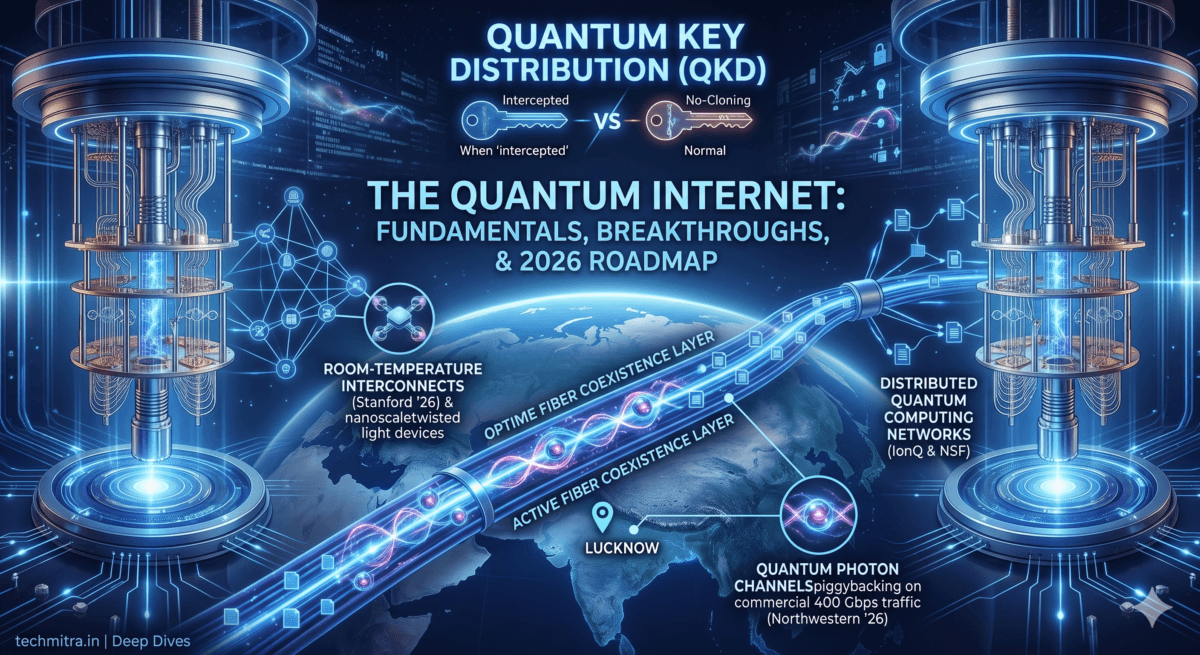
The quantum internet solves this via Quantum Key Distribution (QKD). Instead of relying on hard math, QKD relies on the unchangeable laws of physics. Because of the No-Cloning Theorem in quantum mechanics, an unmeasured qubit cannot be copied or intercepted without altering its state. If a hacker attempts to eavesdrop on a quantum key transmission, their very act of observation collapses the superposition, alters the data, and alerts the sender and receiver instantly. The compromised key is dropped, and a new one is generated. It is physically impossible to intercept a quantum key silently.
2. Distributed Cloud Quantum Computing
Individual quantum computers face immense scaling limitations. Adding more qubits to a single quantum processor requires scaling up massive, delicate environments to shield the system from external noise. The solution is modularity: building smaller quantum processors and linking them together.
The quantum internet acts as the bridge between these systems. By exchanging entangled qubits, multiple separate quantum computers can be pooled into a massive, distributed quantum cloud network. Two connected quantum computers don’t just double in power—their total solution space scales exponentially, opening the door to rapid drug discovery and advanced climate simulations. Furthermore, accessing a quantum computer over a quantum network ensures that your data remains completely encrypted even while the remote server is actively processing it.
The quantum internet acts as the bridge between these systems. By exchanging entangled qubits, multiple separate quantum computers can be pooled into a massive, distributed quantum cloud network. This completely redefines the baseline of remote data management. We already know that modern cloud storage is a savior from data loss for classical files, but accessing a quantum cloud over a quantum network takes data preservation a step further: it ensures your files remain mathematically unhackable and private even while a remote server is actively processing them
3. Ultra-Precise Quantum Sensing
Entangled sensors distributed via a quantum network can operate with unprecedented levels of synchronization. This allows for atomic clock networks that are accurate to a fraction of a second over billions of years, vastly improving GPS accuracy, deep-space navigation, defense systems, and early seismic or volcanic detection systems.
Where Things Stood: The July 2025 Landscape
When the foundational versions of this article were first evaluated in mid-2025, the quantum internet was still heavily categorized as an experimental initiative. Key milestones at that point included:
- EPB (Chattanooga, USA): Had launched America’s first commercially available quantum network—an 8-km loop utilizing 10 quantum-connected nodes.
- New York State Initiatives: Announced an initial $300 million investment to convert Long Island’s existing telecommunications fiber into a quantum testbed, centered around a new Quantum Research and Innovation Hub at Stony Brook University.
- Global Momentum: The United Nations declared 2025 the International Year of Quantum Science and Technology, celebrating a century since the formalization of quantum mechanics, while global hardware revenues hovered around $750 million.
What’s New as of June 2026? Major Technical Breakthroughs
The timeline for quantum networking has compressed dramatically over the last several months. What was once confined to highly controlled physics laboratories is now actively running on real, commercial city infrastructure. The most significant updates driving the industry forward right now include:
1. Entanglement Swapping Over NYC Fiber (April 2026)
In one of the most significant practical milestones to date, scientists successfully demonstrated polarization entanglement swapping over deployed New York City fiber lines. The system reached swapping rates of about 1.5 events per second across metropolitan distances while maintaining pristine quantum correlations. Entanglement swapping is the absolute backbone of a scalable quantum web: it allows particles that have never physically interacted to become entangled, creating the foundation for long-distance routing.
2. Active Fiber Coexistence (Northwestern University)
Historically, engineers believed that quantum networks required dedicated, completely empty “dark fiber” lines to prevent standard data traffic from scattering delicate quantum photons. In a massive infrastructure breakthrough, researchers successfully demonstrated quantum data transmission over an active, commercial fiber-optic line that was simultaneously carrying 400 Gbps of standard internet traffic. By isolating quantum channels into specific, unused light wavelengths, the quantum internet can piggyback directly on top of our existing telecommunications grid, slashing deployment costs.
3. Room-Temperature Quantum Interconnects & Diamond Memory
The physical hardware requirements for quantum systems have dropped dramatically due to two parallel breakthroughs:
- The Stanford Interface: Engineers developed a nanoscale optical interface that manipulates “twisted light” to maintain photon-to-electron entanglement at standard room temperature, reducing the need for massive, energy-hogging cryogenic cooling units.
- The Berlin Diamond Milestone: Researchers at Humboldt-Universität zu Berlin demonstrated a new method using ultrafast laser pulses to generate single photons in diamond-based quantum systems using tin vacancy (SnV) color centers, bringing scalable quantum hardware nodes closer to mass production.
- 3D-Printed Light Cages: New chip-based quantum memory components using nanoprinted “light cages” can now trap light inside atomic vapor, enabling fast and reliable storage of quantum information—an essential feature for building quantum repeaters.
4. International Partnerships & Telecom Integration
The commercial rollout is scaling globally. The University of Oxford is currently co-leading a joint UK–Japan quantum research project funded with £4.5 million (UK) and ¥1.1 billion (Japan) to build ion-trap nodes and photonic links running through 2030.
Simultaneously, Asian telecom giants have moved aggressively into the space. KT Corp (South Korea) launched a hybrid quantum-secure network combining QKD with Post-Quantum Cryptography (PQC) to protect over 15 nodes on its active 5G network, while China Mobile, China Telecom, and Singtel have announced similar large-scale security deployments.
5. The Encryption Alarm: Quantum Threat Moving Faster
The acceleration of quantum internet development is driven by a stark reality. In April 2026, research from Google and quantum startup Oratomic revealed that advanced generative AI models are being used to accelerate quantum hardware development. As a result, quantum computers capable of breaking traditional encryption algorithms may arrive much sooner than previously forecasted. In response to this compressed timeline, major network infrastructure providers like Cloudflare have moved their post-quantum migration deadlines up to 2029.
The Master Architectural Comparison
To put these structural shifts into perspective, it helps to see how the architecture of the quantum internet stacks up against the classical web framework we have relied on for decades:
| Feature / Architecture | Classical Internet | Quantum Internet |
| Fundamental Unit | Binary Bits (0 or 1) | Quantum Bits / Qubits (Superposition of 0 and 1) |
| Data Transmission | Electrical signals or standard laser pulses over fiber/copper | Entangled photons transmitted via specialized optical channels |
| Signal Regeneration | Standard amplifiers read, boost, and copy data down the line | Quantum Repeaters swap entanglement states without reading the data |
| Security Basis | Mathematical complexity (vulnerable to advanced computing power) | Laws of Physics (No-Cloning Theorem; fundamentally unhackable) |
| Deployment State (2026) | Fully ubiquitous, global infrastructure | Hybrid integration phase; utilizing active fiber coexistence networks |
Quantum Internet In India : Driving Global Research
India is positioning itself as a core player in this emerging landscape rather than sitting on the sidelines. The National Quantum Mission (NQM), backed by an official budget allocation of ₹6,003 crore, treats quantum communication as a high-priority national pillar.
Indian research institutions, premier Indian Institutes of Technology (IITs), and defense labs are actively developing localized, inter-city QKD links. As international quantum alliances scale up throughout 2026, India’s roadmap is focusing heavily on deploying secure quantum communication corridors to safeguard domestic financial and governmental data architectures against future decryption threats.
The Road Ahead: What to Expect
The transition to a quantum network will not happen as a sudden, overnight software update. Instead, the rollout is tracking across clear, progressive phases:
| Milestone Target | Expected Timeline | Current Status (2026) |
| Metropolitan Quantum Networks | Now (In Progress) | Active deployment on city fiber (e.g., New York, Chattanooga, Seoul) |
| Interstate Quantum Networks | 2028–2033 | National Quantum Virtual Laboratory testbeds expanding |
| Post-Quantum Cryptography Deployment | 2029–2035 | Accelerated by enterprise deadlines and NIST standard updates |
| Intercontinental Quantum Internet | 2035+ | Trans-oceanic satellite QKD links in early testing phases |
What This Means For You
While the quantum internet won’t change how you browse social media or send casual emails, its medium-term benefits will heavily impact your digital footprint. Your banking credentials, enterprise healthcare data, and cloud-based computations will gradually transition to quantum-safe channels, ensuring absolute privacy.
The Bottom Line
The progress made between July 2025 and mid-2026 has transformed the quantum internet from a compelling physics experiment into an active, accelerating infrastructure race. With real hardware operating on live city fiber grids, international governments pouring in billions, and AI accelerating the timeline, the question is no longer if the quantum internet will arrive. The focus has shifted entirely to how fast we can scale it, and how quickly we can transition our security frameworks to survive the change.
Frequently Asked Questions (FAQ)
Q1: What is the main difference between the classical internet and the quantum internet?
Ans: The classical internet transmits data using binary bits (represented as standard electrical or light pulses that are strictly a 0 or a 1). The quantum internet utilizes qubits (quantum bits), which leverage physics principles like superposition to exist as 0, 1, or both simultaneously, and entanglement to link network nodes instantaneously without traditional physical interception risks.
Q2: Will the quantum internet make my home gaming or streaming faster?
Ans: No. The quantum internet is not designed to replace standard web browsing, downloading, or streaming services, which our current fiber-optic infrastructure handles perfectly. Instead, it is a specialized, parallel network layer engineered for absolute cryptographic security, linking distributed quantum computers, and syncing ultra-precise scientific sensors.
Q3: Why is the quantum internet considered “unhackable”?
Ans: It relies on Quantum Key Distribution (QKD) and the No-Cloning Theorem of quantum mechanics. Unlike classical encryption, which can be broken by solving complex math equations, quantum data cannot be copied or read without altering its physical state. Any attempt by an eavesdropper to intercept a quantum key instantly collapses the signal, alerts the sender, and destroys the compromised key.
Q4: Can quantum data travel through our existing fiber-optic cables?
Ans: Yes, as of 2026, this is actively possible. Previously, it was believed quantum networks required expensive, separate “dark fiber” cables to avoid signal interference. However, 2026 engineering milestones have proven that quantum photon channels can successfully coexist on active, commercial fiber-optic lines alongside standard high-speed internet traffic by utilizing specific light wavelengths.
Q5: What is India’s strategy for the quantum internet?
Ans: India is actively building its domestic quantum infrastructure through the National Quantum Mission (NQM), which was approved with a dedicated budget of ₹6,003 crore. Spearheaded by premier research institutes, defense labs, and technology hubs, India’s roadmap is focused heavily on creating secure inter-city QKD corridors to immunize financial and governmental frameworks against future decryption threats.
Q6: When will the quantum internet be publicly available?
Ans: The rollout is happening in phases. As of 2026, we are in a localized metropolitan deployment phase, with secure quantum networks running on city fibers in tech hubs worldwide. Broader interstate grids are projected for 2028–2033, while a fully mature, global quantum backbone connecting global data centers and research universities is anticipated by the mid-2030s.

Ayush Singhal is the founder and chief editor of TechMitra.in — a tech hub dedicated to simplifying gadgets, AI tools, and smart innovations for everyday users. With over 15 years of business experience, a Bachelor of Computer Applications (BCA) degree, and 5 years of hands-on experience running an electronics retail shop, Ayush brings real-world gadget knowledge and a genuine passion for emerging technology.
At TechMitra, he covers everything from AI breakthroughs and gadget reviews to app guides, mobile tips, and digital how-tos. His goal is simple — to make tech easy, useful, and enjoyable for everyone. When he’s not testing the latest devices or exploring AI trends, Ayush spends his time crafting tutorials that help readers make smarter digital choices.
📍 Based in Lucknow, India
💡 Focus Areas: Tech News • AI Tools • Gadgets • Digital How-Tos
📧 Contact: Get in touch →
🔗 Full Bio: https://techmitra.in/about-us/