
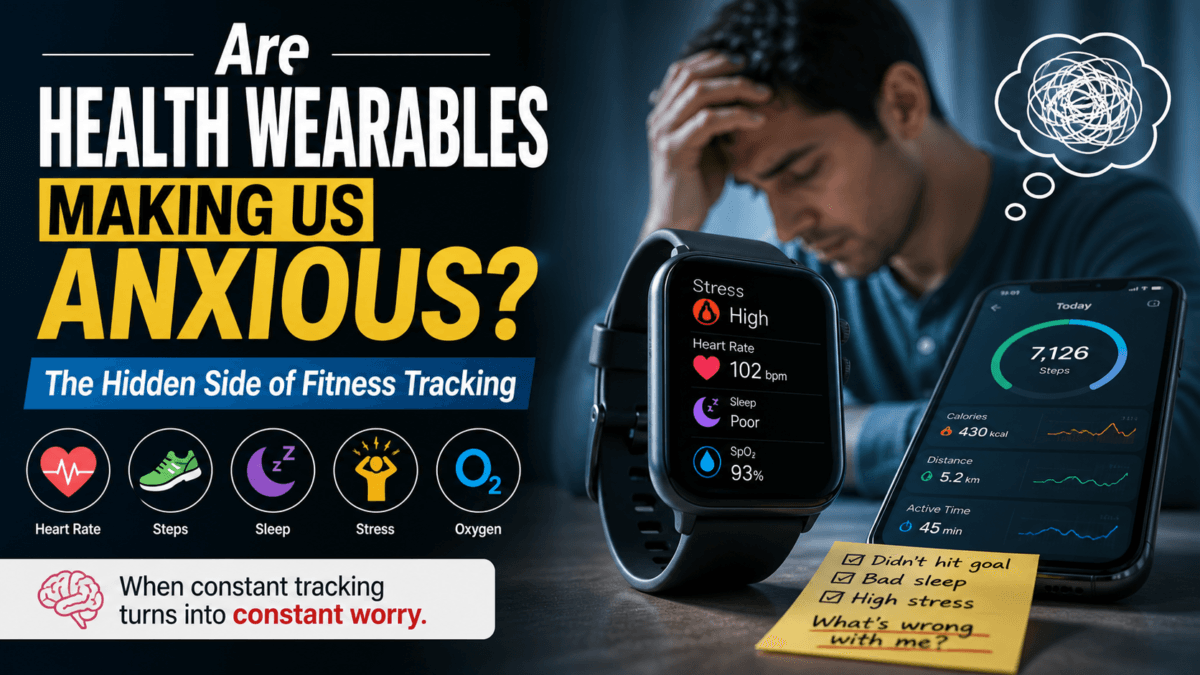
Can Health Wearables Cause Anxiety ? Growing Concern Among Wearable Users
Health wearables—like smartwatches and fitness bands—have quietly become a part of our daily routine. Whether it’s counting steps, tracking calories, or monitoring sleep, these devices promise a healthier and more informed lifestyle.
At first glance, it all sounds perfect. Who wouldn’t want a personal health assistant on their wrist 24/7?
But here’s the uncomfortable question many people are starting to ask:
Are these devices actually helping us—or are they slowly making us more anxious?
Let’s break it down in a practical, real-world way.
Table of Contents
Also Read : Beyond AI: The Rise of Wearable Technology in 2026
The Growing Popularity of Health Wearables
Over the past decade, wearable technology has evolved from a luxury gadget to an everyday essential. Today’s devices can track:
- Steps and physical activity
- Heart rate (24/7 monitoring)
- Blood oxygen (SpO2)
- Sleep quality and sleep stages
- Calories burned
- Stress levels and breathing patterns
For many users, especially fitness enthusiasts, this data becomes a powerful motivator. It encourages movement, builds discipline, and helps people stay accountable.
In fact, many people say things like:
“I started walking more just because my watch reminded me.”
And that’s true—wearables can create positive habits.
But there’s another side to this story.
When Health Tracking Becomes Mental Pressure
The problem doesn’t start with the device—it starts with how we use it.
Over time, what begins as motivation can slowly turn into pressure.
1. The Obsession With Daily Goals
Most fitness trackers come with predefined goals—like 10,000 steps per day.
Sounds simple, right?
But what happens when you hit only 8,000 steps?
Instead of feeling accomplished, many users feel:
- Guilty
- Incomplete
- Lazy
Even if they had a physically active day, the number becomes the judge.
This creates a mindset where health is reduced to a target, rather than a balanced lifestyle.
2. Constant Checking Habit
Let’s be honest—how many times do you check your smartwatch in a day?
- After a short walk
- After climbing stairs
- Before going to sleep
- Even randomly
This habit of repeatedly checking stats can lead to hyper-awareness, where you start analyzing every small change.
And that’s where anxiety begins.
3. Panic From Minor Fluctuations
Your heart rate goes slightly higher than usual.
Your sleep score drops one night.
Your oxygen level shows a small dip.
Suddenly, your mind jumps to conclusions:
“Is something wrong with me?”
The reality is—our body is dynamic. These fluctuations are normal.
But without proper understanding, wearable data can trigger unnecessary panic.
Read mental health awareness by WHO
Also Read : Best Smartwatch for Elderly in India (2026) – BP, ECG, SpO₂ & Fall Detection
Understanding “Health Anxiety” in the Digital Age
There’s a term that perfectly describes this situation:
Health Anxiety (or Cyberchondria in digital contexts)
This happens when people:
- Over-monitor their health metrics
- Google every small symptom
- Assume worst-case scenarios
- Depend more on devices than real medical advice
Wearables can unintentionally fuel this behavior.
Instead of feeling in control, users start feeling:
- Constantly alert
- Mentally exhausted
- Unsure about their own body
And ironically, this stress can negatively impact actual health.
Also Read : Should We Trust Fitness Gadgets Like Smartwatches, Smart Rings and Fitness Trackers
Are Wearables Always Accurate? Not Really.
Here’s something most people ignore:
👉 Fitness trackers are not medical devices.
They provide estimates, not clinical accuracy.
Let’s understand this with examples:
Heart Rate
Your heart rate changes based on:
- Stress
- Caffeine intake
- Movement
- Emotions
A sudden spike doesn’t always mean a problem.
Sleep Tracking
Wearables estimate sleep based on movement and heart rate—not brain activity.
So even if your watch says “poor sleep”, you might still feel well-rested.
Step Count
Even hand movements or vibrations can sometimes add extra steps.
SpO2 Monitoring
Oxygen readings from wearables can vary depending on:
- Wrist position
- Skin contact
- External factors
So, treating these numbers as absolute truth can be misleading.
Read Harvard research on health tracking devices
The Psychological Trap: When Data Controls You
The biggest risk is not incorrect data—it’s over-dependence on data.
You stop trusting your body and start trusting the screen.
For example:
- You feel fine, but your watch says poor sleep → you feel tired
- You feel energetic, but step count is low → you feel lazy
- Your stress score is high → you start feeling stressed
This is called a self-fulfilling loop, where numbers influence emotions.
And over time, this can reduce confidence in your own physical awareness.
Read Symptoms of anxiety and stress by Mayo Clinic
The Positive Side: Why Wearables Still Matter
Now, let’s be fair—health wearables are not bad.
In fact, they offer several real benefits:
Motivation Booster
Reminders to move, walk, and stay active actually work.
Awareness Builder
Many people become more conscious of their lifestyle habits.
Early Warning Signals
While not perfect, unusual trends (like consistently high heart rate) can prompt timely check-ups.
Goal Tracking
They help in building discipline and long-term consistency.
The problem is not the device—
The problem is over-reliance without understanding.
Also read : The Future is Wearable: How AI-Powered Devices Are Personalizing Healthcare for Indians. -By Nirav Hemani is the Co-Founder and Director at Aabo
Smart Ways to Use Health Wearables (Without Anxiety)
If you’re using a smartwatch or fitness band, here’s how to make it work for you—not against you.
1. Focus on Trends, Not Daily Scores
Don’t stress over one bad day. Look at weekly or monthly patterns.
2. Customize Your Goals
10,000 steps is not a universal rule. Set realistic goals based on your routine.
3. Limit Data Checking
You don’t need to check stats every hour. Once or twice a day is enough.
4. Avoid Self-Diagnosis
If something feels off, consult a doctor—not Google or your smartwatch.
5. Take “No-Tracking” Days
Give yourself a break from tracking. Let your body function naturally.
6. Listen to Your Body First
If you feel good, that matters more than any score.
Real Health = Balance, Not Numbers
Let’s not forget—health is not just about:
- Steps
- Calories
- Heart rate
True well-being includes:
- Mental peace
- Quality sleep
- Balanced diet
- Emotional stability
- Regular movement
No gadget can measure all of this perfectly.
Check details of latest smartwatches from Amazfit
When Should You Be Concerned?
Wearables should not create panic—but they can highlight patterns.
You should consult a doctor if:
- Heart rate is consistently abnormal
- Sleep issues persist for weeks
- You feel frequent fatigue or dizziness
- Data matches actual physical discomfort
The key is correlation, not assumption.
A Real-Life Perspective
Many users initially feel excited about their wearable devices. But after a few months, some experience:
- Pressure to “complete rings”
- Anxiety over missed targets
- Overthinking health data
Some even stop using these devices completely.
Why?
Because instead of simplifying life, it started complicating it.
Final Thoughts
Health wearables are one of the best examples of how technology can improve our lives—if used correctly.
They are:
✔ Helpful
✔ Insightful
✔ Motivating
But they can also become:
- Stressful
- Misleading
- Overwhelming
The difference lies in how you use them.
So next time your smartwatch shows a number, remember:
- It’s just data—not a diagnosis
- It’s a guide—not a rule
- And most importantly—you know your body better than any device
FAQs
Can fitness trackers actually cause anxiety?
Yes, especially if users become obsessed with constantly checking and interpreting data.
Are smartwatch health readings reliable?
They are useful for trends but not as accurate as medical equipment.
How often should I check my wearable data?
Once or twice a day is enough. Avoid frequent checking.
Should I stop using health wearables?
Not necessary. Use them mindfully and avoid over-dependence.
What is the negative effects of wearable technology?
Treating estimated data as absolute truth and self-diagnosing based on it.

Ayush Singhal is the founder and chief editor of TechMitra.in — a tech hub dedicated to simplifying gadgets, AI tools, and smart innovations for everyday users. With over 15 years of business experience, a Bachelor of Computer Applications (BCA) degree, and 5 years of hands-on experience running an electronics retail shop, Ayush brings real-world gadget knowledge and a genuine passion for emerging technology.
At TechMitra, he covers everything from AI breakthroughs and gadget reviews to app guides, mobile tips, and digital how-tos. His goal is simple — to make tech easy, useful, and enjoyable for everyone. When he’s not testing the latest devices or exploring AI trends, Ayush spends his time crafting tutorials that help readers make smarter digital choices.
📍 Based in Lucknow, India
💡 Focus Areas: Tech News • AI Tools • Gadgets • Digital How-Tos
📧 Contact: Get in touch →
🔗 Full Bio: https://techmitra.in/about-us/