

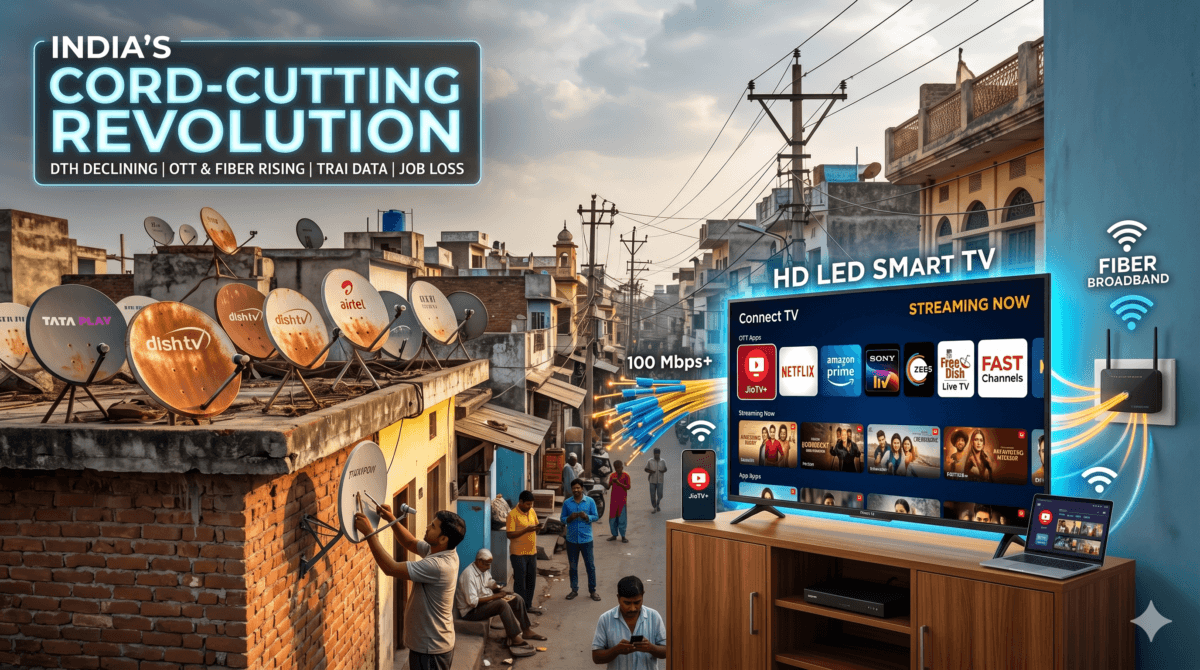
Disclaimer: This image is a creative, AI-generated conceptual graphic illustrating the transition from traditional satellite television to digital streaming in India. Logos, trademarks, and brand names shown (such as Tata Play, Dish TV, Airtel, Netflix, JioTV+, and Amazon Prime) are the property of their respective owners. Their inclusion here is for illustrative and editorial purposes only to depict market trends, and does not imply any endorsement, affiliation, or sponsorship by the respective brand holders.
Why DTH Services Are Declining in India: The Fiber & Air Fiber Boom
Look up at any urban residential complex or apartment tier across India today, and you will notice a quiet structural shift: the familiar cluster of circular, metallic mini-satellite dishes rusted out on terraces and balconies is vanishing.
For nearly two decades, Direct-to-Home (DTH) television was the unshakeable crown jewel of Indian household entertainment. It liberated millions from local cable monopolies, brought crisp digital picture quality to living rooms, and made brands like Tata Sky (now Tata Play), Dish TV, Airtel Digital TV, and Videocon d2h household names.
Yet, what seemed like an impenetrable utility business model is facing an existential freefall. It is no secret that DTH services are declining rapidly as the modern Indian consumer pulls the plug on traditional pay-TV at a rate that has left broadcast executives and satellite providers scrambling for answers.
This is not a temporary market correction; it is the death of an entire distribution architecture.
Table of Contents
The Statistical Bloodbath: Analyzing the Numbers
To understand the sheer velocity of this decline, one needs to look at the official performance metrics monitored by the Telecom Regulatory Authority of India (TRAI).
   Active Pay DTH Subscriber Base in India (TRAI Data)

   2021: █▓▒░ 69.57 Million
   2022: █▓▒░ 66.62 Million
   2024: █▓▒░ 61.97 Million
   2025: █▓▒░ 56.07 Million
The active pay DTH subscriber base in India has plummeted steadily over the last few years, crashing to 56.07 million by the end of 2025. This means the industry has wiped out millions of active paying households in a relatively compressed window. In single operational quarters alone, pay DTH operators frequently lose between 1.5 to 2 million active subscriptions sequentially.
While some of these users have migrated to the state-run, completely free DD Free Dish service, an overwhelming majority are completely cutting the cord. They are abandoning linear grid-based television entirely in favor of an omnipresent digital data pipe.
The Universal Mirror: The US and UK Blueprint
To map out where India’s media distribution landscape is headed, we must look at the structural decay of traditional pay-TV in Western markets like the United States and the United Kingdom. India is systematically following their cord-cutting blueprint, albeit with a uniquely aggressive domestic twist.
The United States: The Price-Driven Cable Exodus
In the US, pay-TV penetration has cratered from a historic high of 88% down to under 50%. The primary driver was financial exhaustion; the average American cable or satellite package routinely swelled to over $100–$150 per month, clogged with hundreds of junk channels. Streaming services emerged as a direct, lower-cost consumer rescue.
The United Kingdom: Ditching the Dish for On-Demand Apps
In the UK, the decline has manifested as a flight from satellite infrastructure. Legacy operator Sky has actively deprioritized its traditional satellite dishes, actively steering its base toward internet-reliant streaming pucks like Sky Stream. British households are discovering that they can bypass pay-TV entirely because the country’s main broadcasters provide robust, free platform environments over Wi-Fi.
The Core Difference in India
In the West, cord-cutting occurred because cable TV was pathologically expensive. In India, the dynamic is completely inverted. Indian DTH remains some of the cheapest linear television in the world, often costing households just ₹250 to ₹400 per month. Indian consumers are not abandoning the set-top box to save pocket change. They are leaving because fiber broadband infrastructure is being aggressively bundled and underpriced.
The Fiber Blitzkrieg: Breaking the Traditional Model
The single largest executioner of Indian DTH is the rapid, hyper-aggressive deployment of high-speed Fiber-to-the-Home (FTTH) networks. When telecom players upended the Indian mobile space with cheap 4G and 5G data, it permanently altered user behavior on small screens. Now, the battlefield has moved into the living room onto the largest screen in the house.
When high-speed home internet is combined with premium video catalogs for an all-inclusive price, regular DTH billing immediately morphs into an unjustifiable dual expense. The math makes direct linear TV recharge look economically irrational to a middle-class household.
The Jio Factor: Game Changer for Home Entertainment
The biggest disruptor, however, was Reliance Jio. First, it entered with the JioTV+ mobile app, which offered live TV for free to Jio users. People could now watch their favorite channels on the go without paying extra. Then came Jio Fiber, which changed the entire home entertainment game.
In plans starting from ₹599 + GST per month, Jio provides:
- High-speed 30Mbps – 150 Mbps internet
- Free Set-Top Box
- Access to JioTV+, Sony Liv, Zee5, Discovery+
- Compatibility with YouTube, Netflix, Amazon Prime
A Personal Shift: As a user, I personally stopped our previous Airtel DTH + broadband combo (₹550 for DTH + ₹799 for 30 Mbps broadband), and switched to Jio Fiber. Now, I use the Jio set-top box on a non-smart TV and connect the smart TV directly to Wi-Fi, eliminating the need for multiple monthly bills.
Even in its entry-level ₹599 + GST plan, Jio offers:
- A Jio Set-Top Box
- Over 1000+ live TV channels via JioTV+
- YouTube support
- Built-in access to apps like Sony Liv, Zee5, Discovery+, and more (with some apps requiring additional subscriptions)
- Access to popular OTT platforms like Netflix and Amazon Prime Video, if you already have their subscriptions
- Unlimited internet with 30 Mbps speed — more than enough for streaming and everyday use
By offering TV + Internet + OTT in a single package — even in its budget plan — Jio made DTH look outdated and expensive.
Check my review and experience on JIO AIRFIBER 899 PLAN
The Connected TV (CTV) Boom Beyond the Metros
The device landscape has shifted just as rapidly as the underlying network plumbing. Driven by competitive Android-powered offerings from brands like Xiaomi, TCL, realme, OnePlus, and affordable sub-₹10,000 displays, over 60 to 70 million Indian homes have entered the Connected TV (CTV) ecosystem.
Once a consumer mounts a smart television onto their wall and connects it to a home Wi-Fi network, the user experience gap between a DTH interface and an app-driven ecosystem becomes glaringly obvious. Waiting for a specific time to watch a broadcast, navigating laggy set-top box guides, and paying extra for High Definition (HD) channel packs feels completely outdated. Crucially, Tier 2, Tier 3, and rural markets are now driving the highest percentage growth in smart display sales.
Check Latest Dish Tv Plans
Regulatory Self-Sabotage: The Legacy of NTO 2.0 and 3.0
While technological disruption cracked the foundation of the DTH industry, regulatory policy inadvertently accelerated the collapse. The introduction of TRAI’s New Tariff Order (NTO) frameworks—initially designed to grant consumers choice by allowing them to pay only for channels they wanted—backfired completely.
Before the NTO eras, DTH operators curated attractive, comprehensive base packs where users received nearly all primary entertainment channels for a clean, predictable monthly fee. The NTO rules stripped away this operational freedom, implementing a fragmented architecture of Network Capacity Fees (NCF) coupled with individual, a-la-carte pay channel prices dictated by major broadcasters.
Instead of reducing monthly bills, the system made configuration confusing and the final monthly price routinely spiked higher. Realizing they could stream the exact same daily soaps, reality shows, and live events over their Wi-Fi connection without wrestling with complex DTH tariff menus, millions of consumers simply let their set-top box subscriptions expire.
The Rise of FAST and Internet-Based Linear TV
A common counter-argument from DTH executives used to be that the traditional Indian family loves “linear television”—the lean-back habit of surfing through channels. That behavioral defense has been completely neutralized by the global explosion of FAST (Free Ad-supported Streaming Television) and ALTD (Application-based Linear Television Distribution) software layers.
Platforms like JioTV+, integrated directly into connected home hubs, pull together hundreds of live television channels streamed entirely over IP networks. Concurrently, smart TV manufacturers pre-install their own proprietary FAST ecosystems—such as Xiaomi TV+, Samsung TV Plus, and LG Channels—directly into the home screen menu.
These interfaces look, feel, and operate exactly like a high-end DTH electronic program guide. Viewers can flip channels using their standard TV remote control with zero setup time. The defining difference? It requires no dedicated outdoor dish antenna, no separate set-top box hardware, and absolutely zero monthly pay-TV recharges.
Drawbacks of the Digital Shift
While the migration from traditional set-top boxes to fiber broadband offers undeniable modern convenience, the death of pay-TV is not entirely without severe friction. The structural collapse of linear television is leaving deep financial, geographic, and technical scars across the country.
A. The Ground-Level Livelihood Crisis (The LCO Strain)
The most devastating casualty of the streaming boom isn’t a drop in corporate stock values—it is the literal erasure of small-scale neighborhood micro-entrepreneurship.
According to a landmark joint study by EY and the All India Digital Cable Federation (AIDCF) titled “State of Cable TV Distribution in India”, which surveyed over 28,000 Local Cable Operators (LCOs):
- 93% of small local cable distributors reported a severe decline in their monthly take-home earnings.
- Nearly half of the operators have watched their neighborhoods abandon them completely, reporting individual subscriber losses exceeding 40%.
- National Employment Impact: When scaled across India’s estimated 85,000 localized cable networks, this digital shift has triggered an immediate livelihood crisis, causing between 114,000 to 195,000 structural job losses among neighborhood cable technicians, wiremen, and local recharge vendors.
B. The Rural Digital Divide (The DD Free Dish Migration)
While premium Tier 1 and metro apartments cruise smoothly on unlimited Wi-Fi, rural India faces a vastly different infrastructure reality. Deep geographic sectors still battle low internet broadband speeds, frequent fiber cuts, and inadequate data towers. In these regions, a physical satellite dish remains an absolute necessity for basic information access.
However, because pay-DTH has grown too expensive or cumbersome due to complex tariff rules, rural consumers aren’t moving to Netflix or JioFiber. Instead, they are fleeing pay-TV to seek asylum in the government-run DD Free Dish ecosystem. The free-to-air service has surged to over 53 million households, rapidly cannibalizing the lower-income marketplace because it requires zero monthly subscription fees after a small one-time hardware purchase.
C. Total Absolute Dependency on a Single Internet Pipe
Under the old model, a home’s entertainment utility was entirely isolated from its communication utility. If your mobile carrier network went down or your home broadband router malfunctioned, your family could still watch the evening news or a live cricket match via the independent DTH satellite link.
In an all-OTT, fiber-only ecosystem, you are running completely dependent on a single point of failure. The moment an underground fiber line is severed during local road construction, or your ISP suffers an infrastructure outage, your entire household loses everything simultaneously: work internet, smart TV entertainment, and live communication feeds.
D. App Compatibility & Regional Curation Deficits
Despite boasting catalogs containing hundreds of “live internet channels,” application-centric linear ecosystems like JioTV+ or specific TV OS platforms are still constrained by digital distribution rights.
Many niche regional languages, local community news networks, and premium English movie or infotainment packages that once occupied dedicated, reliable channel numbers on a standard DTH remote do not have stable streaming variants. Navigating between five disparate applications just to locate distinct broadcast streams fragments the unified viewing experience that senior citizens, in particular, spent decades mastering on standard numeric remotes.
The Verdict: Can DTH Survive in India?
The traditional pay DTH model in India is trapped in a classic structural decline. It is losing its high-value urban and suburban user base to high-speed fiber broadband and Connected TVs, while its lower-income rural segments are migrating toward free choices like DD Free Dish.
To survive this transition, DTH operators are being forced to evolve from satellite distribution networks into aggregate digital software platforms. This is evident in products like Tata Play Binge or Airtel Xstream Box, where legacy providers are trying to reposition their hardware boxes as smart internet streaming hubs.
However, in this new internet-first ecosystem, DTH operators no longer control the pipeline. For the modern Indian consumer, the verdict is already clear. Television has transitioned from a dedicated hardware box connected to a rooftop dish into just another app icon running on a home broadband connection.

Ayush Singhal is the founder and chief editor of TechMitra.in — a tech hub dedicated to simplifying gadgets, AI tools, and smart innovations for everyday users. With over 15 years of business experience, a Bachelor of Computer Applications (BCA) degree, and 5 years of hands-on experience running an electronics retail shop, Ayush brings real-world gadget knowledge and a genuine passion for emerging technology.
At TechMitra, he covers everything from AI breakthroughs and gadget reviews to app guides, mobile tips, and digital how-tos. His goal is simple — to make tech easy, useful, and enjoyable for everyone. When he’s not testing the latest devices or exploring AI trends, Ayush spends his time crafting tutorials that help readers make smarter digital choices.
📍 Based in Lucknow, India
💡 Focus Areas: Tech News • AI Tools • Gadgets • Digital How-Tos
📧 Contact: Get in touch →
🔗 Full Bio: https://techmitra.in/about-us/