

CNAP Caller ID Explained: Opt-Out, Rollout & vs Truecaller
Updated: August 2026
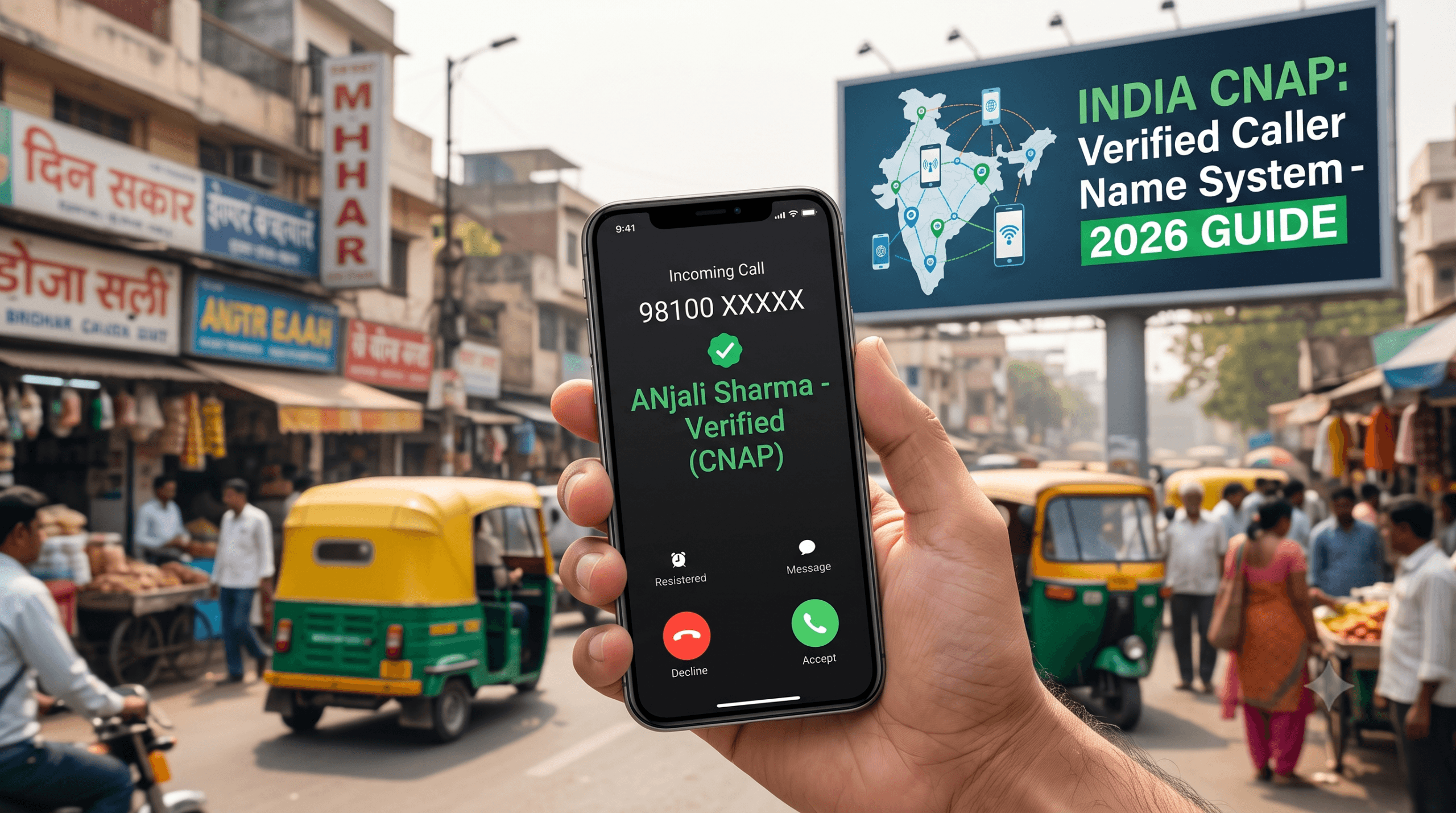
If you’ve noticed a name flashing on your screen the next time an unknown number calls you — even though you never saved that contact — you’re not imagining things, and it’s not Truecaller. It’s CNAP: Calling Name Presentation, a new network-level caller ID system that India’s telecom regulator has been rolling out since late 2025, with a nationwide target of March 31, 2026.
Here’s a complete breakdown of what CNAP is, how it actually works, how it’s different from the number-only Caller ID system you’re used to, and how it compares to third-party apps like Truecaller.
Table of Contents
What Is CNAP?
CNAP stands for Calling Name Presentation — a supplementary telecom service, first defined by the European Telecommunications Standards Institute (ETSI) in 2012, that displays the registered name of a caller alongside their phone number when you receive a call.
In India, CNAP has been introduced by the Department of Telecommunications (DoT) on the recommendation of the Telecom Regulatory Authority of India (TRAI), following a formal consultation and recommendation process that TRAI finalized in February 2024. The goal is simple: give users a reliable way to know who’s calling before they answer, without depending on a third-party app.
Unlike the caller ID you’ve had for years — which only shows a phone number — CNAP pulls a verified name directly from telecom records and displays up to 80 characters of name information on your screen at the time of the call.
Why Was CNAP Introduced?
TRAI’s own reasoning, laid out in its official recommendations, boils down to a few core problems:
- Spam and robocalls have made people stop answering unknown numbers entirely — which means genuine calls (delivery updates, bank alerts, job interviews) go unanswered too.
- Existing tools rely on crowdsourced data. Apps like Truecaller and Google’s built-in spam protection pull names from users’ saved contacts and community reports — which is often inaccurate, outdated, or simply missing for many numbers.
- A phone number alone doesn’t identify anyone. TRAI’s consultation paper points out that a string of digits gives “little or no help” in identifying who’s actually calling, especially with the rise of vishing (voice phishing) and OTP fraud.
To fix this, TRAI recommended that Calling Name (CNAM) be added as a supplementary layer to the existing Calling Line Identification (CLI) framework — which is exactly what CNAP does.
How Does CNAP Actually Work?
This is the part most explainers get vague on, so here’s the real mechanism:
- Name registration happens at SIM purchase. When you buy a SIM card, you submit KYC (Know Your Customer) documents — Aadhaar, PAN, etc. The name on those documents becomes your registered CNAP identity.
- Each telecom operator maintains a CNAP database. Jio, Airtel, and Vodafone Idea each store the verified name-to-number mapping for their own subscribers.
- At call setup, the name is looked up and passed along. When you call someone, your operator (the “originating” network) looks up your registered name and sends this CNAP data — along with a Presentation Indicator (PI) — through the signaling path to the receiver’s (“terminating”) network.
- The receiving network displays the name. Your phone shows the caller’s registered name, sourced entirely from network-level KYC data — no internet connection, no app, no permissions requested.
TRAI evaluated three possible architecture models for this — each operator maintaining its own database, a centralized third-party database, or a hybrid lookup model — and the current rollout uses a distributed model where each telecom operator manages CNAP data for its own subscribers, exchanged over the signaling network at call time.
CNAP works for voice calls only — it does not apply to SMS or messaging services.
Is CNAP Enabled by Default?
Yes. Following TRAI’s response to the Department of Telecommunications dated October 28, 2025, CNAP will be switched on by default for all subscribers — a reversal from TRAI’s original February 2024 proposal, which had recommended an opt-in model. DoT pushed for default-on instead, reasoning that an opt-in system would let scammers simply choose not to enroll, defeating the purpose of the service. TRAI agreed.
That means you don’t need to do anything to have your name shown to others. But if you’d rather not have your registered name displayed when you call people, an opt-out is guaranteed — here’s what’s actually confirmed about how it works.
How to Turn Off CNAP (Hide Your Name from Callers)
The confirmed mechanism: CLIR. TRAI’s official recommendation (Section 3.1(e), accepted by DoT) states that subscribers who have activated Calling Line Identification Restriction (CLIR) will not have their CNAP name shown to the person they’re calling. CLIR is not a new feature — it’s an existing GSM-standard privacy setting that has been available on Indian networks since well before CNAP, originally governed under DoT’s CLIR guidelines dated February 3, 2015.
You can manage CLIR two ways:
1. Via your phone’s dialer (USSD codes). These are standard GSM network codes, not CNAP-specific ones, but they control the same underlying restriction that also suppresses CNAP name display:
| Action | Code | What it does |
|---|---|---|
| Enable CLIR | *31# | Hides your number and name on all outgoing calls |
| Disable CLIR | #31# | Restores normal caller ID display |
| Check CLIR status | *#31# | Shows whether CLIR is currently active |
| Hide identity for one call only | #31# + number (e.g. #31#9876543210) | Suppresses your ID for that single call |
These codes are widely documented as working across Jio, Airtel, and Vi, though individual plans or SIM configurations can occasionally restrict USSD-based access — if a code returns a “service not allowed” type error, contact your operator’s customer care instead.
2. Via phone settings. On both Android and iPhone, there’s a native “Show My Caller ID” toggle under the Phone/Dialer app’s calling settings, which controls the same CLIR flag at the device level rather than dialing a code manually.
Important — the trade-off. Enabling CLIR shows your calls to others as “Private Number,” “Unknown Caller,” or “Presentation Restricted.” Since many people now screen or ignore unidentified calls specifically because of CNAP, hiding your identity is likely to reduce your own call answer rates. It’s a genuine privacy-vs-reachability trade-off, not a free toggle.
What’s still unclear: a name-only opt-out. Some reporting suggests operators may eventually offer a way to opt out of just the CNAP name display via their self-care apps (MyJio, Airtel Thanks, Vi App, BSNL SelfCare) while keeping your number visible — rather than the all-or-nothing privacy of full CLIR. As of this writing, this app-based, name-only opt-out flow is not confirmed to be live — TRAI’s own framework ties CNAP suppression to whether CLIR has been activated, and independent trackers of the rollout note that the exact opt-out procedure is still being finalized by individual operators. If you want to hide only your name and not your number, your safest bet right now is to contact your operator’s customer care directly and ask what’s available for your specific number and circle — don’t assume a self-care app toggle exists until you’ve confirmed it in-app.
CNAP Rollout Timeline in India
| Milestone | Detail |
|---|---|
| Feb 2024 | TRAI issues initial recommendations proposing CNAP (opt-in model) |
| Oct 2025 | Pilot launch begins |
| Late 2025 | Vodafone Idea starts CNAP pilot in Haryana; Jio follows with its own trial |
| Oct 28, 2025 | TRAI aligns with DoT, confirms CNAP will be default-on with opt-out via CLIR |
| Jan 2026 | Users nationwide begin noticing caller names appearing for the first time |
| March 31, 2026 | Target date for full nationwide rollout on 4G and 5G networks |
CNAP is currently limited to 4G and 5G networks. Older 2G-only devices — estimated at around 200 million users in India — won’t support the feature, since it depends on newer signaling infrastructure. Some smartphones may also need a software update before CNAP names start appearing correctly.
CNAP vs Truecaller: What’s the Real Difference?
This is the comparison everyone actually wants answered, so here it is side by side:
| CNAP | Truecaller | |
|---|---|---|
| Data source | Verified KYC records from SIM registration | Crowdsourced from users’ contact lists and reports |
| Requires app? | No — built into the network | Yes — separate app install required |
| Requires internet? | No — works at the network/signaling level | Yes |
| Accuracy | High — tied to official ID documents | Variable — depends on what other users have saved you as |
| Spam detection | Not currently included | Yes — AI spam scoring, community flags, colour-coded warnings |
| Works across all telecom operators? | Yes, uniformly | Yes, but dependent on database coverage |
| Business/bulk caller names | Shown as registered organisation name | Often shown as generic or user-tagged labels |
In short: CNAP tells you who a number is officially registered to. Truecaller tells you who the crowd thinks it is, plus whether it’s likely spam.
Truecaller has publicly acknowledged this shift, with a company spokesperson stating that while “CNAP provides a name, Truecaller also provides deeper context and intent… through colour-coded differentiators, AI summaries featuring spam scores, spammer statistics, and user comments.” In other words, the two systems are likely to coexist rather than replace one another — CNAP for verified identity, apps like Truecaller for spam intelligence.
Also Read : Truecaller Blocks 1,189 Crore Spam Calls in India During 2025, Saving Millions From Scams and Lost Time
Will CNAP Stop Spam and Fraud Calls?
Not directly. CNAP is an identification tool, not a blocking tool. It doesn’t filter, flag, or stop any call from reaching you — it simply shows you a verified name so you can make a more informed decision about whether to pick up.
That said, TRAI’s stated expectation is that CNAP will indirectly reduce successful scam and vishing attempts, since fraudulent callers using spoofed or unregistered numbers will be far more visible when no name — or a clearly generic/suspicious one — appears on screen.
What CNAP Means for Businesses and Bulk Callers
CNAP isn’t just a consumer-facing change — it has real implications for businesses that rely on outbound calling, virtual number services, and call centre operations.
Registered organisation names will now show up automatically. For telemarketers, toll-free numbers, and businesses making bulk calls through virtual number providers, CNAP is expected to display the registered company or organisation name instead of just a raw number. This means a call from a bank, delivery service, or SaaS company can show up as the actual business name — not an unfamiliar 10-digit number the recipient is likely to ignore.
This directly affects answer rates. One of the biggest challenges for businesses using bulk calling numbers (including 1600-series and other business number formats common in BFSI, logistics, and customer support) has been that unfamiliar numbers get ignored or ghosted by recipients wary of spam. With CNAP showing a verified, KYC-backed organisation name at the network level — rather than relying on the recipient having a spam-detection app installed — legitimate businesses have a better chance of their calls actually being picked up.
Bulk number registration may require attention. Businesses using large blocks of virtual or bulk numbers should confirm with their telecom or number-provisioning partner how organisation names get registered and mapped under CNAP, since the accuracy of the name shown depends entirely on what’s registered against each number in the operator’s KYC/CNAP database. An incorrectly registered or generic name will show up exactly as registered — CNAP won’t infer or correct it.
It reduces (but doesn’t eliminate) the “unknown number” problem for outbound sales and support teams. Businesses that previously relied on manually briefing customers to expect a call from “an unknown number” now have a network-level way to establish legitimacy — though CNAP alone doesn’t provide spam scoring or call context the way dedicated business calling platforms do.
Frequently Asked Questions
Does CNAP cost anything?
No. CNAP is a supplementary service provided by telecom operators as part of standard telephony — there’s no separate fee or subscription mentioned in TRAI’s framework.
Can I opt out of having my name shown?
Yes — CLIR is the confirmed mechanism (see the section above for USSD codes and settings). A separate name-only opt-out via operator apps is expected but not yet confirmed live everywhere.
Does CNAP work on landline phones?
Only on devices capable of displaying alphanumeric caller information. Many older landline handsets lack this display capability and won’t show CNAP names even if the network supports it.
Is my registered CNAP name the same as my Truecaller name?
Not necessarily. Your CNAP name comes from your SIM’s KYC documents (your legal/official name). Your Truecaller name is whatever other users have saved you as in their phone contacts — which can vary from person to person.
What if my registered name is wrong or outdated?
Since CNAP pulls directly from your SIM registration KYC data, correcting it would require updating your KYC details with your telecom operator.
The Bottom Line
CNAP represents one of the more meaningful telecom upgrades India has rolled out in years — a verified, app-free, network-native caller identification system built directly on official KYC data. It won’t replace apps like Truecaller outright, since spam scoring and community intelligence still add real value, but it closes a major gap: for the first time, every phone user in India — regardless of which spam-detection app they have or haven’t installed — will see a verified name, not just a number, for incoming calls.
Expect the rollout to keep expanding through 2026 as more circles and operators complete their CNAP database integration ahead of the March 31 deadline.

Ayush Singhal is the founder and chief editor of TechMitra.in — a tech hub dedicated to simplifying gadgets, AI tools, and smart innovations for everyday users. With over 15 years of business experience, a Bachelor of Computer Applications (BCA) degree, and 5 years of hands-on experience running an electronics retail shop, Ayush brings real-world gadget knowledge and a genuine passion for emerging technology.
At TechMitra, he covers everything from AI breakthroughs and gadget reviews to app guides, mobile tips, and digital how-tos. His goal is simple — to make tech easy, useful, and enjoyable for everyone. When he’s not testing the latest devices or exploring AI trends, Ayush spends his time crafting tutorials that help readers make smarter digital choices.
📍 Based in Lucknow, India
💡 Focus Areas: Tech News • AI Tools • Gadgets • Digital How-Tos
📧 Contact: Get in touch →
🔗 Full Bio: https://techmitra.in/about-us/