
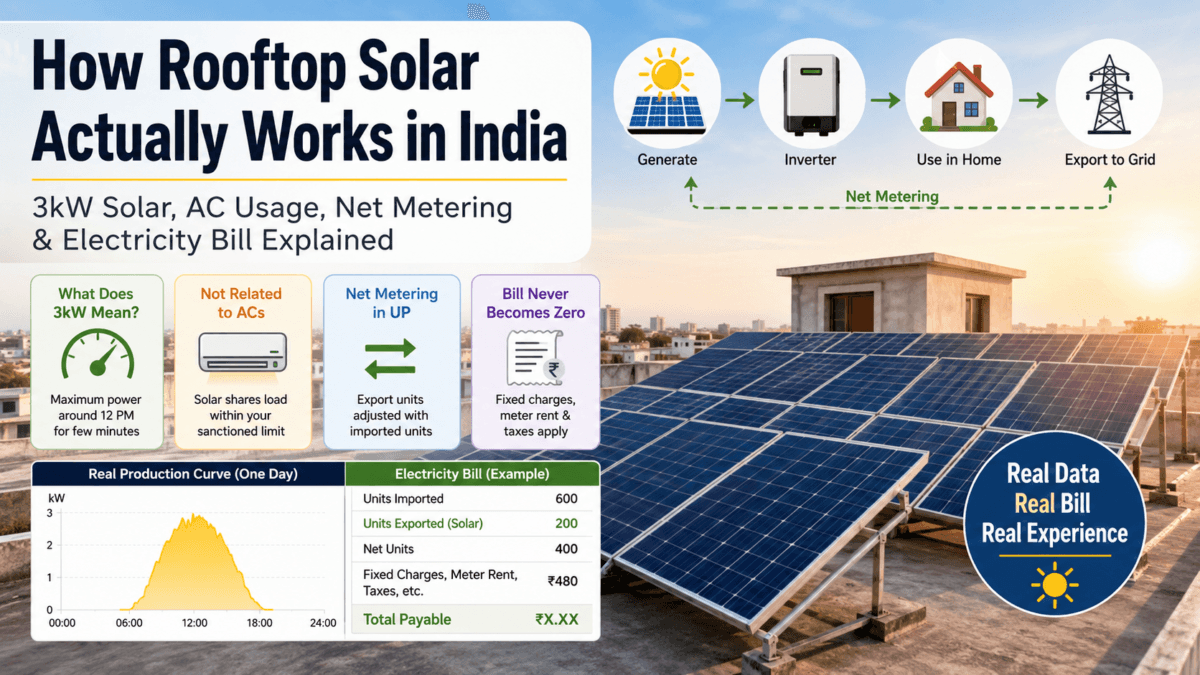
How Rooftop Solar Works in India: Net Metering & Electricity Bill Explained
Rooftop solar installations are growing rapidly in India, especially after the launch of PM Surya Ghar Yojana. But even today, many homeowners remain confused about how on-grid rooftop solar systems actually work.
People often ask questions like:
- Can a 3kW solar plant run 3 ACs?
- Does solar directly power the home?
- What does “3kW solar” actually mean?
- Why is electricity bill still coming after solar installation?
- How does net metering work?
- Why does solar generation change throughout the day?
After using a rooftop solar system personally, I realized that many YouTube videos and articles explain these things incorrectly or oversimplify them. So in this article, I’ll explain rooftop solar in simple language using real examples, real production graphs, and actual electricity bill concepts from Uttar Pradesh.
Table of Contents
Also Read : My 3 kW Solar Rooftop Plant Review – pM surya ghar yojna Cost, Performance & Savings
What Does a kW In Rooftop Solar Plant Actually Mean?
Here I take an example of 3KW plant
Many people think a 3kW rooftop solar system continuously generates:
throughout the entire day.
But that is not how rooftop solar works in real life.
A 3kW solar plant rating mainly represents the maximum instantaneous power capacity the system can produce under ideal conditions.
This peak output usually happens only around: 🕛 12 PM to 1 PM and sometimes only for a short duration.
In real-world conditions, solar generation continuously changes during the day.
Why Solar Panels Rarely Reach Full Rated Capacity
Solar production depends on many factors, including:
- Dust on panels
- High summer temperature
- Cloud cover
- Panel direction and tilt
- Inverter efficiency
- Wiring losses
- Seasonal sunlight variation
That’s why most rooftop solar systems do not continuously touch their maximum rated capacity.
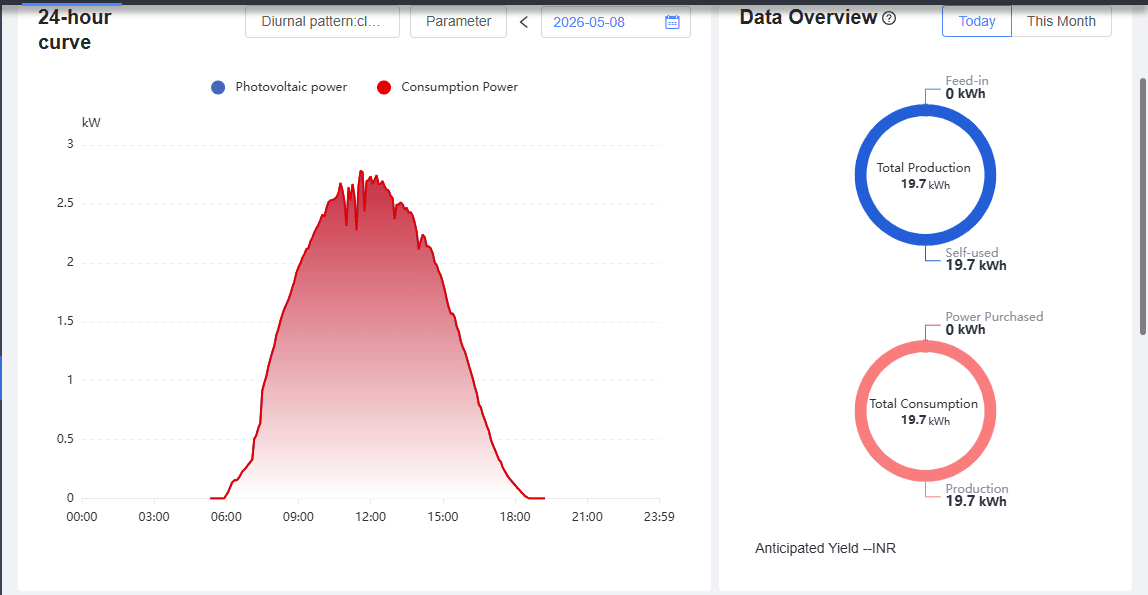
Generation usually:
- starts slowly after sunrise
- increases toward noon
- peaks briefly
- then gradually drops toward evening
This is exactly visible in my real solar production graph below.
Real production curve from my 3.39kW rooftop solar system installed in Uttar Pradesh. Peak generation occurs near noon, while production gradually rises after sunrise and falls before sunset.
Why Vendors Often Install More Than 3kW Panels for a 3kW System
Most homeowners notice that installers often use panel capacity slightly higher than the inverter rating.
For example, my rooftop setup uses:
6×565 W=3390 W≈3.39 kW
even though it is considered a 3kW category system.
This is done because real-world conditions reduce solar efficiency. Slightly oversizing panels helps compensate for:
- Heat losses
- Dust
- Seasonal performance reduction
- Morning/evening lower sunlight
This improves overall daytime generation.
Also Read : 11 Facts About Solar Rooftop Plants Every Indian Homeowner Must Know (Real Experience Based)
Does Rooftop Solar Decide How Many ACs You Can Run?
This is one of the biggest misconceptions.
A rooftop solar plant does not directly decide how many ACs or appliances you can run.
The number of appliances you can operate mainly depends on your home’s:
Sanctioned Electrical Load
provided by the electricity department.
Many people wrongly think:
“If I install 3kW solar, I can run unlimited 3kW appliances.”
But in on-grid rooftop solar systems, solar generation and sanctioned load are two different things.
How Power Sharing Actually Works
Suppose:
- Your rooftop solar is currently generating:
- But your home appliances are consuming:
Then:
- Solar supplies 2kW
- Remaining 1kW automatically comes from the electricity grid
This balancing is automatically handled by the solar inverter.
Similarly, if your home consumes less power than solar generation, extra electricity gets exported to the electricity department through net metering.
Why Do Some Users Get Load Penalty?
Even after installing rooftop solar, your house still cannot regularly exceed the sanctioned load limit.
For example:
- Your sanctioned load:
If you simultaneously run:
- multiple ACs
- geyser
- microwave
- water pump
- other heavy appliances
then total demand may exceed the sanctioned limit.
In such cases, the electricity department may apply:
- extra load charges
- penalty
- recommendation to upgrade sanctioned load
This penalty is related to the sanctioned load — and usage is dependent on your load not related to the rooftop solar system.
Solar Rooftop Plant just share the sanctioned load.
What Does the “90% Load Rule” Mean?
Under many rooftop solar policies and subsidy programs like PM Surya Ghar Yojana, the allowed solar capacity is linked to the sanctioned load.
For example:
- If your sanctioned load is:
Then permitted rooftop solar capacity may be around:
This is why many homeowners first upgrade their sanctioned load before installing bigger solar systems.
For More Information on PM Surya Ghar Yojana Scheme Guidelines Check Here
How Solar Rooftop plant Bill is Calculated in Uttar Pradesh
In Uttar Pradesh, most on-grid rooftop solar systems work using:
Net Metering
This means:
- Your home first uses available solar power
- Extra electricity gets exported to the grid
- Exported units are later adjusted against imported units
Simple Net Metering Example
Suppose your rooftop solar generated:
Out of this:
- Home directly consumed:
- Exported to grid:
Now suppose your total imported electricity from the power corporation during the month was: 600 Units
Then exported units are adjusted like this:
So the electricity bill is generated only on: 400 Units
For More information on UP solar policy Check Here
What Happens if Export Units Become Higher?
Suppose:
- Imported units:
150 units - Exported units:
200 units
Then surplus solar balance becomes:
200−150=50 units
These extra units are carried forward to the next month.
The carried-forward balance gets added to the next month’s solar adjustment.
About Solar Units in Electricity Bill
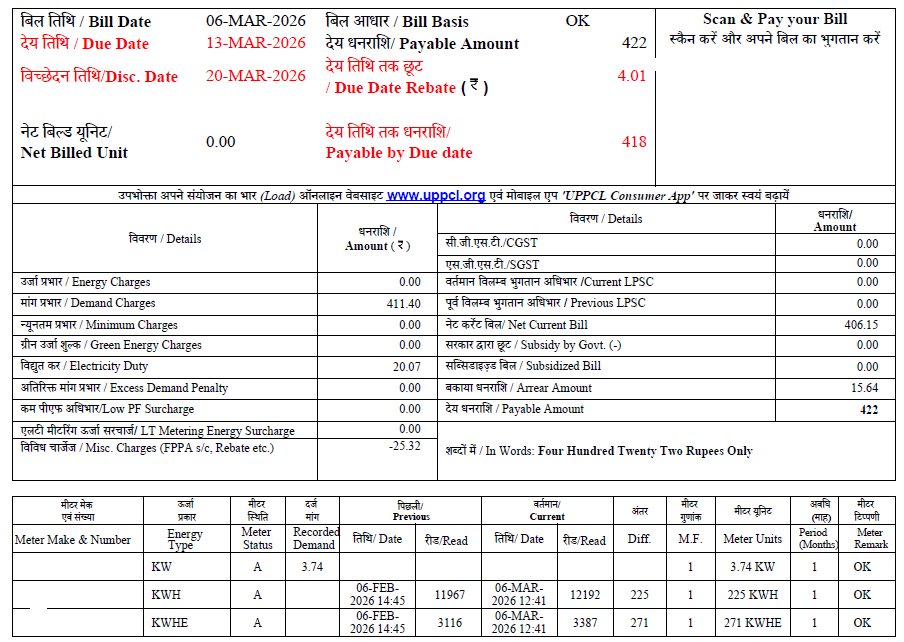
One important thing many rooftop solar users do not understand is that the electricity bill usually shows only the:
- exported solar units
and not the total solar electricity generated by the system.
For example, if your rooftop solar system generates electricity during the day and your home consumes all of it instantly, then nothing gets exported to the grid.
In such cases, the:
- KWH Export
- KWHE
- Exported Units
Section in the electricity bill may show:
Even though the solar system actually generated electricity throughout the day.
This happens because the generated solar power was directly consumed by home appliances before reaching the electricity grid.
That is why:
- Solar inverter apps
- Monitoring portals
- Inverter display data
Often show much higher total generation than the exported units visible in the electricity bill.
This does not mean the solar-generated electricity is ignored or not counted.
In an on-grid rooftop solar system, solar power first gets consumed directly by home appliances in real time.
For example, suppose a house normally consumes:
from the electricity grid.
After installing rooftop solar:
- Home may consume:
- directly from solar during daytime
- And only:
from the electricity grid.
In this case, the electricity bill mainly records only the imported grid consumption, which becomes:
because the remaining daytime electricity was already supplied directly by solar panels.
This is why many rooftop solar users notice that their imported units reduce significantly even when exported units are low.
Financial Year Rule in Uttar Pradesh
In Uttar Pradesh, surplus solar units are generally adjusted within the same billing cycle year.
The adjustment period resets after:
📅 31 March
This means:
- Surplus units are not stored forever
- A new adjustment cycle starts from:
📅 1 April
That’s why many users try to size their solar system according to yearly electricity consumption instead of excessively oversizing it.
Also Read : Solar Rooftop Plant Maintenance Guide: Cleaning Tips to Maximize Solar Output
Can Electricity Bill Become Completely Zero After Solar?
Not exactly.
Even if your rooftop solar exports more electricity than you import, the electricity bill usually does not become fully zero.
The electricity department still charges some fixed amounts such as:
- Fixed connection charges
- Meter rent
- Electricity duty
- Regulatory charges
- Taxes
For example, in many 4kW domestic sanctioned load connections in Uttar Pradesh, minimum monthly charges can be around:
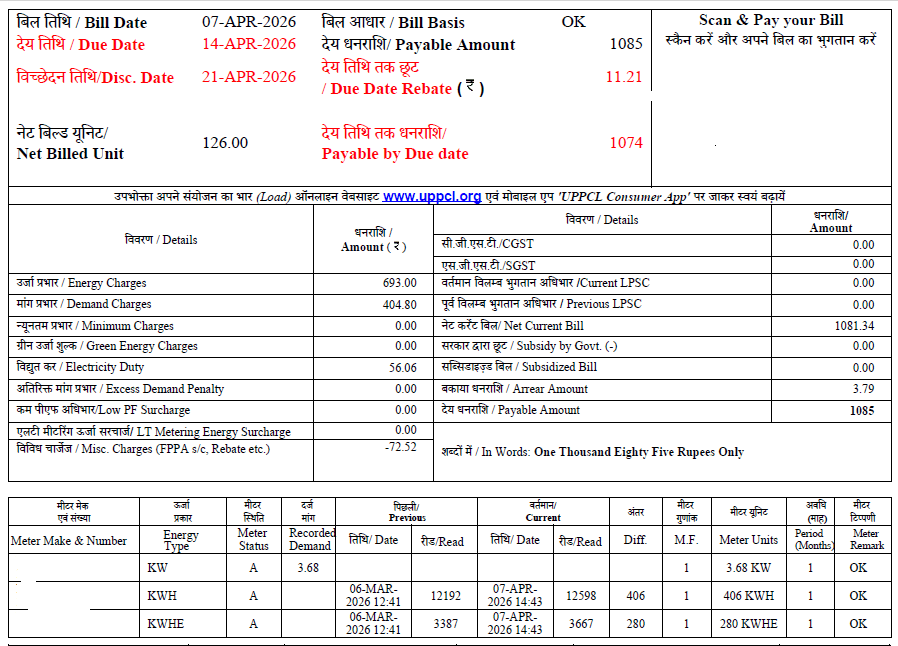
₹422/month – Check above image of Feb bill which shows Net billed units Zero but Bill amount is ₹422 to pay
So even if solar adjustment significantly reduces your bill, some minimum payable amount may still remain every month.
Charges may vary depending on:
- DISCOM category
- tariff revisions
- sanctioned load
- electricity department rules
Does Rooftop Solar Work at Night?
No.
A normal on-grid rooftop solar system generates electricity only when sunlight is available.
At night:
- Solar panels stop generating electricity
- Your home automatically starts using grid electricity
This transition happens automatically through the solar inverter.
Unless you install batteries or a hybrid system, rooftop solar does not provide solar power during nighttime.
Also Read : Micro Inverter vs String Inverter: ROI Comparison for Indian Homes (2026 Guide)
Final Thoughts
Rooftop solar is one of the best long-term investments for reducing electricity bills in India, but many homeowners misunderstand how these systems actually work.
The most important thing to understand is:
- Solar generation and sanctioned load are different
- A 3kW system does not continuously produce 3kW all day
- Net metering adjusts exported and imported units
- Bills usually never become fully zero because fixed charges still apply
- Real solar generation changes throughout the day depending on sunlight and weather
Once these concepts become clear, rooftop solar becomes much easier to understand and plan correctly.
For most homeowners, the biggest benefit of rooftop solar is not “free unlimited electricity,” but a significant long-term reduction in electricity costs while using cleaner energy.

Ayush Singhal is the founder and chief editor of TechMitra.in — a tech hub dedicated to simplifying gadgets, AI tools, and smart innovations for everyday users. With over 15 years of business experience, a Bachelor of Computer Applications (BCA) degree, and 5 years of hands-on experience running an electronics retail shop, Ayush brings real-world gadget knowledge and a genuine passion for emerging technology.
At TechMitra, he covers everything from AI breakthroughs and gadget reviews to app guides, mobile tips, and digital how-tos. His goal is simple — to make tech easy, useful, and enjoyable for everyone. When he’s not testing the latest devices or exploring AI trends, Ayush spends his time crafting tutorials that help readers make smarter digital choices.
📍 Based in Lucknow, India
💡 Focus Areas: Tech News • AI Tools • Gadgets • Digital How-Tos
📧 Contact: Get in touch →
🔗 Full Bio: https://techmitra.in/about-us/