

AI for Money Management: The New Way to Prep Before Your CA
In India, personal finance has always been deeply human-led. Even today, the vast majority of people rely on Chartered Accountants (CAs) and tax professionals for filing, compliance, and critical investment pathways.
However, a modern shift is happening. With growing concerns around data privacy, aggressive paid subscriptions, and mandatory bank-account linking in finance apps, users are looking for a safer, more controlled way to understand their financial health.
This is where Artificial Intelligence is quietly stepping in—not to replace your CA or automate your bank account, but to act as a thinking and understanding assistant. Instead of tracking you in the background, AI helps you make sense of your budgets, unpacks tax logic, and prepares you to ask the right questions while leaving you in absolute control of your data.
Table of Contents
Also read : 40 Pro AI Prompts for Stock Trading: Excel, PDF Analysis & Live Market Data (2026 Guide)
Why Many People Avoid Traditional Finance Apps
While modern fintech apps offer automated convenience, consumer hesitation in India remains widespread. The ground reality is that users are increasingly uncomfortable with:
- Intrusive Data Access: Being forced to upload full bank statements or grant continuous SMS/email tracking permissions.
- Paywalls: Essential tracking or optimization features locked behind expensive premium subscriptions.
- App Fatigue: Having multiple apps on a phone that essentially do the same thing.
- Overwhelming Layouts: Complex dashboards that confuse non-technical users rather than offer clarity.
For the average household, clarity, data control, and trust will always triumph over pure automation.
How AI Changes the Game: Total Data Control
The foundational difference between a standard finance app and an AI model comes down to who holds the keys to your data.
| Feature | Traditional Finance Apps | AI Assistants (ChatGPT, Claude, Gemini) |
| Data Demand | “Give me permanent access to everything; I’ll analyze it.” | “Share only what you want; I’ll help you understand it.” |
| Tracking | Continuous background tracking and data harvesting. | Zero background tracking; session-based interaction. |
| Data Scope | Requires exact figures, live tokens, and full histories. | Works perfectly with rounded numbers and specific date ranges. |
| Input Flexibility | Rigid bank feeds or specific CSV templates only. | Accepts raw text, copied paragraphs, Excel sheets, or images. |
Budgeting Without the Surveillance
An AI doesn’t need your live internet banking password to construct a flawless budget. By simply providing basic, approximate coordinates, you get tailored guidance without the feeling of being watched.
If you provide an AI with your approximate monthly income, major expense buckets, and a savings goal, it can instantly evaluate your layout. Rather than just spitting out a cold chart showing your expenses rose, an AI explains the behavioral trend:
Traditional App: “Your discretionary spending increased by 10% this month.”
AI Assistant: “Your discretionary spending is currently rising faster than your baseline income. This mismatch is exactly why your savings feel inconsistent month-to-month.”
This shift from raw observation to actual explanation helps users fundamentally learn and fix their habits.
AI for Tax Understanding (Not Tax Filing)
Most people do not want to execute their own tax returns—they simply want to understand where their money is going. AI excels as a pre-filing preparatory tool by translating complex fiscal rules into plain language.
- Simplifying the Code: Explaining complex income tax sections, deductions, and the core structural logic between the Old vs. New Tax Regimes.
- Strategic Preparation: Helping you organize your questions and identify potential exemptions before you sit down for a meeting with your professional.
The Financial Workflow Pipeline
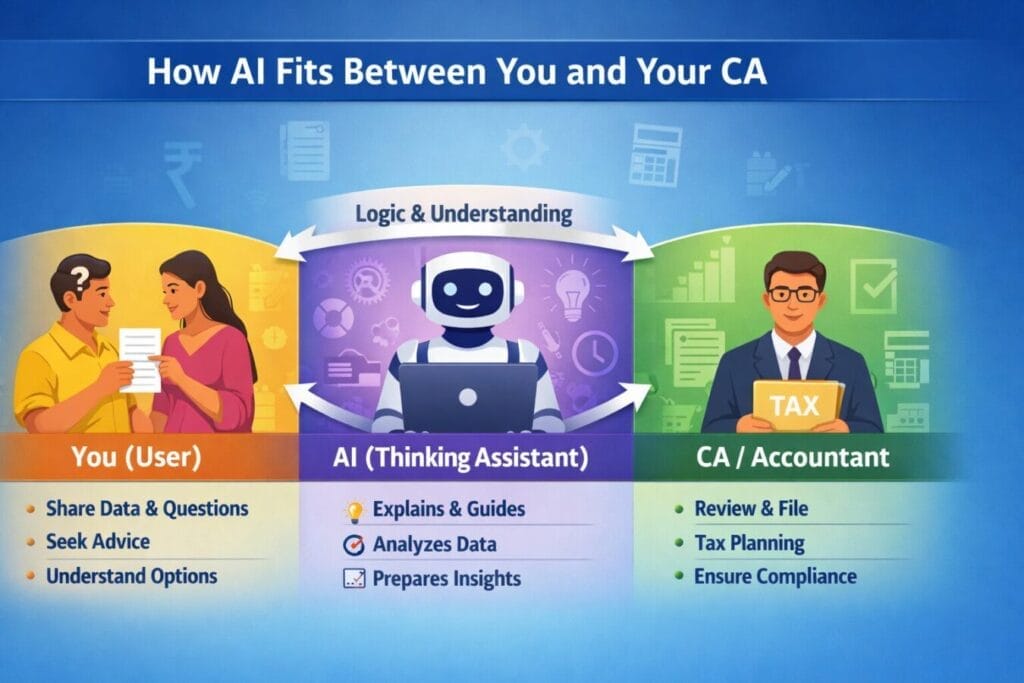
1. You (The Owner): Share limited, safe context ➔ Ask directional questions ➔ Retain total data authority.
2. AI (The Assistant): Explains tax and budget concepts ➔ Identifies trade-offs ➔ Prepares you with the right questions.
3. CA (The Expert Authority): Reviews official paperwork ➔ Applies precise tax laws ➔ Files the compliant return.
Note: AI bridges the gap between confusion and clarity, but it does not replace professional execution. Official filings must always align with the direct guidelines of the Income Tax Department of India.
Privacy Pro-Tip: Scrub Your Data First
Government cybersecurity agencies like CERT-In consistently advise citizens to limit unnecessary personal identifier data sharing online. When pasting financial details into an AI, practice structured data scrubbing.
Before hitting submit, completely delete:
- Real names and business entities.
- Account numbers, UPI IDs, and phone numbers.
- Exact transaction reference hashes or merchant locations.
Only keep the raw numerical logic: Keep the general dates, amounts, and category labels (e.g., rent, groceries, EMI).
- Instead of: “₹4,500 spent via HDFC Account 1234 at XYZ Store on 12 June”
- Use: “₹4,500 spent on shopping on 12 June”
Also read : How to Download CKYC Number Online – Understanding India’s Central KYC System
Best AI Prompts for Financial Analysis You Can Use Today
Copy and paste these safe and practical prompts directly into your AI assistant to start organizing your finances safely:
1. The Baseline Budget Planner
“My monthly income is around ₹55,000. Fixed expenses are rent ₹15,000, EMI ₹8,000, and groceries ₹7,000. I want to save ₹8,000 monthly. Create a realistic budget breakdown for the remaining amount.”
2. Behavioral Expense Auditing
“Here are my anonymous expenses for the last 7 days: [Paste scrubbed list here]. Can you identify potential unnecessary spending patterns and suggest practical improvements?”
3. Pre-CA Meeting Prep (Tax Optimization)
“I am a salaried employee earning around ₹9 lakh per year in India. Explain which key tax deductions I should understand thoroughly so I can discuss them intelligently before meeting my CA.”
4. Regime Comparison Strategy
“Explain the core structural differences between the old and new Indian tax regimes for an income of around ₹10 lakh, focusing on the pros and cons of each without giving definitive filing advice.”
5. Investment Basics: SIP vs. RD (No Recommendations)
“I have an extra ₹5,000 every month after expenses and want to build a safety net for the next 5 years. Explain the core differences between a Systematic Investment Plan (SIP) in mutual funds and a Bank Recurring Deposit (RD). Do not give me specific fund recommendations; just explain the mechanics, taxation, and historical risk profiles of both.”
6. Loan Prepayment Strategy (Math & Logic)
“I have a home loan with an outstanding principal of ₹30 lakh at an 8.5% interest rate. I have managed to save an extra ₹50,000 this year. Explain the mathematical difference between using this money to reduce my monthly EMI versus reducing my overall loan tenure. Which option generally saves more money on interest in the long run?”
7. The Emergency Fund Calculator
“My total essential monthly expenses (rent, groceries, utilities, EMIs) equal ₹35,000. I work in the private sector. Help me calculate a logical range for an emergency fund. Also, explain the types of liquid assets or accounts where people typically park this money so it is easily accessible without taking stock market risks.”
8. Organizing Freelance or Side-Business Income
“I run a small digital business on the side, making about ₹80,000 a month in revenue. Currently, my business income and personal expenses are mixed in one savings account. Suggest a step-by-step system to cleanly separate my business money from my personal money so that my CA can easily file my taxes next year without confusion.”
9. Understanding EPF vs. PPF for Retirement
“Explain the fundamental differences between the Employee Provident Fund (EPF) and the Public Provident Fund (PPF) in India. I am in my mid-30s. Outline the lock-in periods, basic withdrawal rules, and how they fit into Section 80C tax deductions. Keep the explanation simple and bulleted.”
10. Inflation and Future Goal Setting
“I want to save ₹10 lakh for a family goal in exactly 10 years. Assuming an average inflation rate of 6% in India, explain how much the ‘purchasing power’ of that ₹10 lakh will actually cost in the future. Then, explain roughly how much I need to invest monthly at an assumed 10% return to hit that adjusted target.”
Avoid These Common AI Money Pitfalls
To get the most out of an AI financial assistant, keep these guardrails in mind:
- Confusing Preparation with Execution: Treat AI as your textbook; your CA remains the final executing authority.
- Over-sharing Identity Metrics: AI requires zero personal identity markers to recognize math or spending patterns.
- Expecting Absolute Precision: AI works exceptionally well for analyzing logic, options, and directional trends—not for delivering guaranteed, localized micro-calculations.
- Blind Implementation: Always run AI-generated suggestions through a quick common-sense check or discuss them directly with your accountant.
Also Read : Best AI Prompts for Resume Writing in 2026: Land Your Dream Job with ChatGPT, Gemini, & Claude
The Path Forward: AI + Human Expertise
The future of Indian personal finance isn’t a race to replace human professionals with cold algorithms. The ultimate ecosystem relies on a hybrid approach : AI for rapid personal understanding, paired with trusted human experts for flawless, compliant execution.
If you are tired of app overload, expensive paywalls, and letting apps track your every move, using AI as an on-demand, private sounding board is the smartest way to step up your financial literacy.
Also Read : 20 Best ChatGPT Prompts for Travel Planning (2026 Guide)
Frequently Asked Questions (FAQs)
Is it safe to share my financial information with AI tools like Gemini or ChatGPT?
Yes, provided you practice “data scrubbing.” AI does not need your identity to understand financial logic. You should never share your name, bank account numbers, UPI IDs, or exact transaction references. By sharing only approximate amounts, categories (like ‘rent’ or ‘groceries’), and general date ranges, you keep your data completely safe and anonymous.
Can AI file my Income Tax Return (ITR) in India?
No. AI cannot and should not file your taxes. AI is a “thinking assistant” designed to help you understand tax regimes, explain complex deductions, and organize your finances. The actual execution, legal compliance, and official filing should always be handled by a qualified Chartered Accountant (CA) or tax professional.
Will AI give me specific stock or mutual fund recommendations?
No. AI tools are excellent for explaining the mechanics of different investments (like the difference between an SIP and an RD, or how EPF lock-ins work). However, they are not licensed financial planners. You should use AI to learn the concepts, but rely on human professionals for specific portfolio recommendations.
Why should I use AI for budgeting instead of a dedicated finance app?
Traditional finance apps often require you to link your bank accounts for continuous, background data tracking, and many lock their best features behind paywalls. AI offers a privacy-first alternative. You control exactly what data goes in (even using rounded numbers), there is no background tracking, and the AI explains why your spending habits are changing rather than just showing you a chart.
Do I need a paid AI subscription to manage my money this way?
Not at all. The free versions of major AI models are more than capable of analyzing budgets, explaining tax laws, and helping you organize your side-hustle income. You only need basic prompts and a clear understanding of what you want to achieve.
⚠️ Disclaimer
AI tools are designed strictly for informational and educational purposes. They do not constitute formal financial, investment, or legal tax advice. Always consult a qualified Chartered Accountant or certified financial planner before making final monetary decisions.

Ayush Singhal is the founder and chief editor of TechMitra.in — a tech hub dedicated to simplifying gadgets, AI tools, and smart innovations for everyday users. With over 15 years of business experience, a Bachelor of Computer Applications (BCA) degree, and 5 years of hands-on experience running an electronics retail shop, Ayush brings real-world gadget knowledge and a genuine passion for emerging technology.
At TechMitra, he covers everything from AI breakthroughs and gadget reviews to app guides, mobile tips, and digital how-tos. His goal is simple — to make tech easy, useful, and enjoyable for everyone. When he’s not testing the latest devices or exploring AI trends, Ayush spends his time crafting tutorials that help readers make smarter digital choices.
📍 Based in Lucknow, India
💡 Focus Areas: Tech News • AI Tools • Gadgets • Digital How-Tos
📧 Contact: Get in touch →
🔗 Full Bio: https://techmitra.in/about-us/