
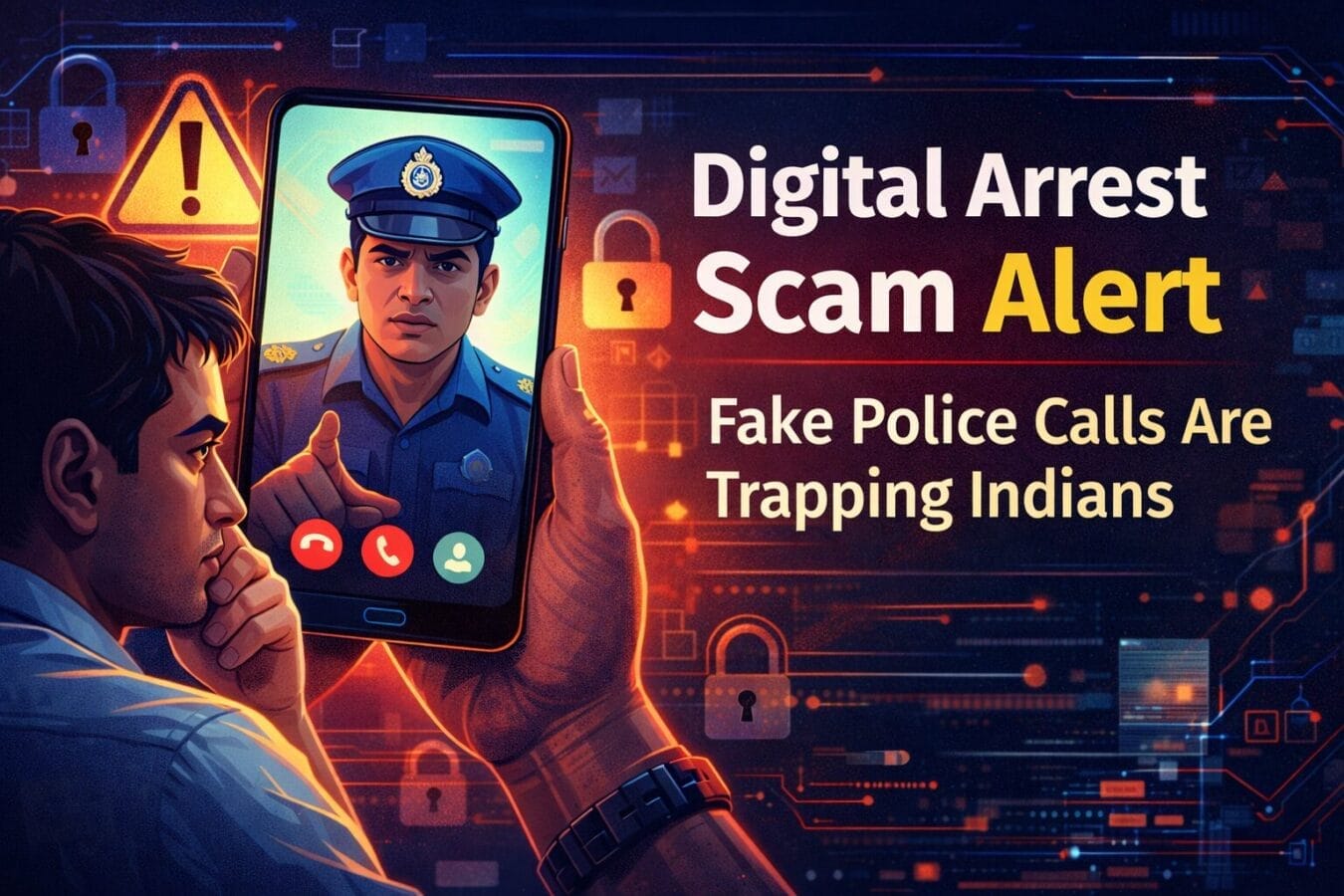
This article is written to spread public awareness about what is digital arrest scam in India is ?
The digital revolution has made life faster, easier, and more connected than ever before. From banking and healthcare to education and governance, almost everything now operates online. But alongside convenience, a darker reality has emerged — cybercrime that no longer targets systems alone, but directly attacks the human mind.
One of the most dangerous and fast-growing cyber frauds today is something known as “Digital Arrest.” It is not a legal term, not a police procedure, and not recognized by any court of law. Yet, it has already trapped thousands of people across the country, draining their life savings and leaving behind deep psychological scars.
If you prefer reading in Hindi, you can read this article ” Digital Arrest Kya Hota Hai” for a detailed explanation of the digital arrest scam.
Table of Contents
What Is Digital Arrest Exactly?
A digital arrest is a fake legal threat created by cybercriminals to psychologically trap victims. In this scam, criminals pose as police officers, cybercrime officials, customs authorities, CBI agents, or even judges. They contact the victim through phone calls or video calls and accuse them of being involved in serious crimes.
The victim is told that they are under “digital arrest” and must strictly follow instructions until the case is “resolved.”
In reality, no such concept exists. Arrests are physical legal actions carried out following due process — not something that happens through WhatsApp calls or video conferencing apps.
But scammers rely on one powerful truth:
Fear disables logic.
Check Here ” Digital Arrest: Understanding Modus Operandi, Current Trends, And Safety Tips” By Union Bank Of India
Who Are the Victims?
Unlike traditional scams that often target the elderly or digitally illiterate, digital arrest fraud affects educated, professional, and socially aware individuals.
Victims include:
Doctors
Engineers
Business owners
Chartered accountants
Teachers
Government employees
Senior corporate professionals
Ironically, the very people who believe they are “too smart to be scammed” are often more vulnerable — because scammers carefully tailor their approach using official language, legal terminology, and professional demeanor.
How the Digital Arrest Scam Unfolds
The scam is not random. It follows a well-rehearsed psychological script designed to break resistance step by step.
Step 1: The First Call — Creating Suspicion
The victim receives a call claiming:
Their Aadhaar number is linked to illegal activities
Their bank account was used for money laundering
A parcel in their name was intercepted with illegal items
A SIM card registered in their name was used for fraud
The goal is not to scare immediately, but to plant doubt.
Step 2: Authority Takes Control
The call is transferred to a “senior officer.” Sometimes, this happens on a video call where the scammer:
Wears a police uniform
Sits in front of a fake official background
Uses legal jargon fluently
The victim is told that the case is serious and non-cooperation will lead to immediate arrest.
Step 3: Fear and Isolation
Victims are warned:
Do not inform family members
Do not consult a lawyer
Do not disconnect the call
They are told the matter is “highly confidential.”
This isolation is critical. Once the victim is alone with their fear, rational thinking collapses.
Step 4: The “Solution” Appears
After hours of intimidation, the scammer offers a way out:
Money verification
Security deposit
Temporary holding of funds
“Court clearance” charges
Victims are instructed to transfer money immediately to specific accounts.
Step 5: Disappearance
Once the money is transferred:
Calls stop
Numbers become unreachable
Video profiles vanish
The victim realizes the truth — but often too late.
Why Digital Arrest Is So Dangerous
This scam is deadly not because of technology, but because of psychological manipulation.
1. It Uses Fear as a Weapon
Fear activates the brain’s survival mode. When that happens:
Logical thinking shuts down
People obey authority blindly
Urgency overrides caution
2. It Mimics Real Systems
Scammers replicate:
Police ranks
Court language
Legal procedures
To an untrained mind, everything appears authentic.
3. It Breaks Social Support
By forcing victims into secrecy, scammers eliminate:
Advice
Emotional reassurance
Reality checks
Isolation ensures control.
4. It Causes Long-Term Trauma
Even after financial loss, victims suffer:
Anxiety
Sleeplessness
Loss of self-confidence
Shame and guilt
Some victims hesitate to report the crime due to embarrassment, allowing criminals to continue targeting others.
The Alarming Scale of the Problem
Cybercrime data shows a massive rise in digital fraud cases, with digital arrest scams becoming increasingly common.
Thousands of complaints are registered every month
Financial losses run into thousands of crores of rupees
Many cases go unreported
This makes digital arrest not just a personal tragedy, but a national cyber security concern.
The Hard Truth: Digital Arrest Is Illegal and Fake
It is critical to understand the following facts:
No police officer arrests people over phone or video call
Courts do not conduct trials via WhatsApp
Government agencies never ask for money to “clear” a case
Legitimate investigations never demand secrecy from family
If any call violates these principles, it is a scam — without exception.
How to Protect Yourself and Your Family
1. Pause Before You Panic
Scammers rely on urgency. Take a breath. No real legal action happens within minutes.
2. Never Share Sensitive Information
Do not share:
OTPs
Aadhaar or PAN details
Bank account numbers
Login credentials
3. Disconnect and Verify
Hang up the call. Contact:
Your local police station
Official government helplines
Verified cybercrime websites
4. Speak to Someone You Trust
A simple conversation with a family member or friend can instantly expose the scam.
5. Report Immediately
If you receive such a call:
Report it on the national Cybercrime Portal
Call the cybercrime helpline 1930
Quick reporting increases the chance of fund recovery.
The Role of Awareness and Society
Law enforcement agencies are taking action, but technology alone cannot defeat psychological scams. Public awareness is the strongest shield.
Offices should conduct cyber safety sessions
Schools should teach digital literacy
Families should openly discuss scams
Media should highlight real cases
Silence benefits criminals. Awareness saves lives.
Why Even Smart People Get Trapped
Many victims blame themselves afterward, asking:
“How could I fall for this?”
The truth is:
Intelligence does not protect against fear
Education does not prevent panic
Confidence does not eliminate manipulation
Digital arrest scams are designed to bypass intelligence and target emotions.
Final Thoughts: The Real Arrest Happens in the Mind
Digital arrest does not involve handcuffs, police vans, or jail cells.
It begins when fear arrests logic, and panic takes control.
The only way to defeat this crime is through:
Awareness
Calm thinking
Open communication
Remember this always:
No legitimate authority will ever threaten you into silence or demand money over a call.
Stay alert. Stay informed. And talk about it — because one informed person can prevent dozens of others from becoming victims.
FAQs: Digital Arrest Scam in India
What is digital arrest scam ?
A digital arrest scam is a cyber fraud where criminals impersonate police, cybercrime officials, or government authorities and falsely claim that a person is under arrest. Victims are threatened over phone or video calls and pressured into transferring money to avoid legal action. There is no legal concept called “digital arrest” in India.
Can police arrest someone over a phone or video call?
No. Police cannot arrest anyone over a phone call, WhatsApp call, or video conference. Arrests are physical legal procedures carried out following due process and proper documentation. Any claim of arrest through digital communication is fraudulent.
Why do scammers ask victims not to talk to family members?
Scammers isolate victims to prevent them from verifying the information or seeking help. Isolation increases fear and panic, making victims more likely to comply with demands without questioning their authenticity.
Do government agencies ask for money to clear a case?
No legitimate government agency, police department, or court asks for money to “close,” “verify,” or “settle” a case over phone calls or online transfers. Any such demand is a clear sign of a scam.
What should I do if I receive a digital arrest call?
If you receive such a call:
Stay calm and do not panic
Do not share personal or banking details
Disconnect the call immediately
Talk to a trusted family member or friend
Report the incident on the cybercrime helpline 1930 or the official cybercrime portal
Early reporting improves the chances of preventing financial loss.
Who are the common targets of digital arrest scams?
Digital arrest scams often target educated professionals such as doctors, engineers, business owners, and government employees. Scammers rely on fear, authority pressure, and legal-sounding language rather than technical hacking.
Is digital arrest a real legal term?
No. “Digital arrest” is not recognized under Indian law. It is a fabricated term created by cybercriminals to intimidate victims and extract money.
Are video calls with police uniforms always fake?
While police may use video calls for communication in some cases, arrest threats, financial demands, or legal proceedings over video calls are fake. Real authorities never conduct arrests or demand payments via video calls or messaging apps.
Trending

Ayush Singhal is the founder and chief editor of TechMitra.in — a tech hub dedicated to simplifying gadgets, AI tools, and smart innovations for everyday users. With over 15 years of business experience, a Bachelor of Computer Applications (BCA) degree, and 5 years of hands-on experience running an electronics retail shop, Ayush brings real-world gadget knowledge and a genuine passion for emerging technology.
At TechMitra, he covers everything from AI breakthroughs and gadget reviews to app guides, mobile tips, and digital how-tos. His goal is simple — to make tech easy, useful, and enjoyable for everyone. When he’s not testing the latest devices or exploring AI trends, Ayush spends his time crafting tutorials that help readers make smarter digital choices.
📍 Based in Lucknow, India
💡 Focus Areas: Tech News • AI Tools • Gadgets • Digital How-Tos
📧 Email: contact@techmitra.in
🔗 Full Bio: https://techmitra.in/about-us/