
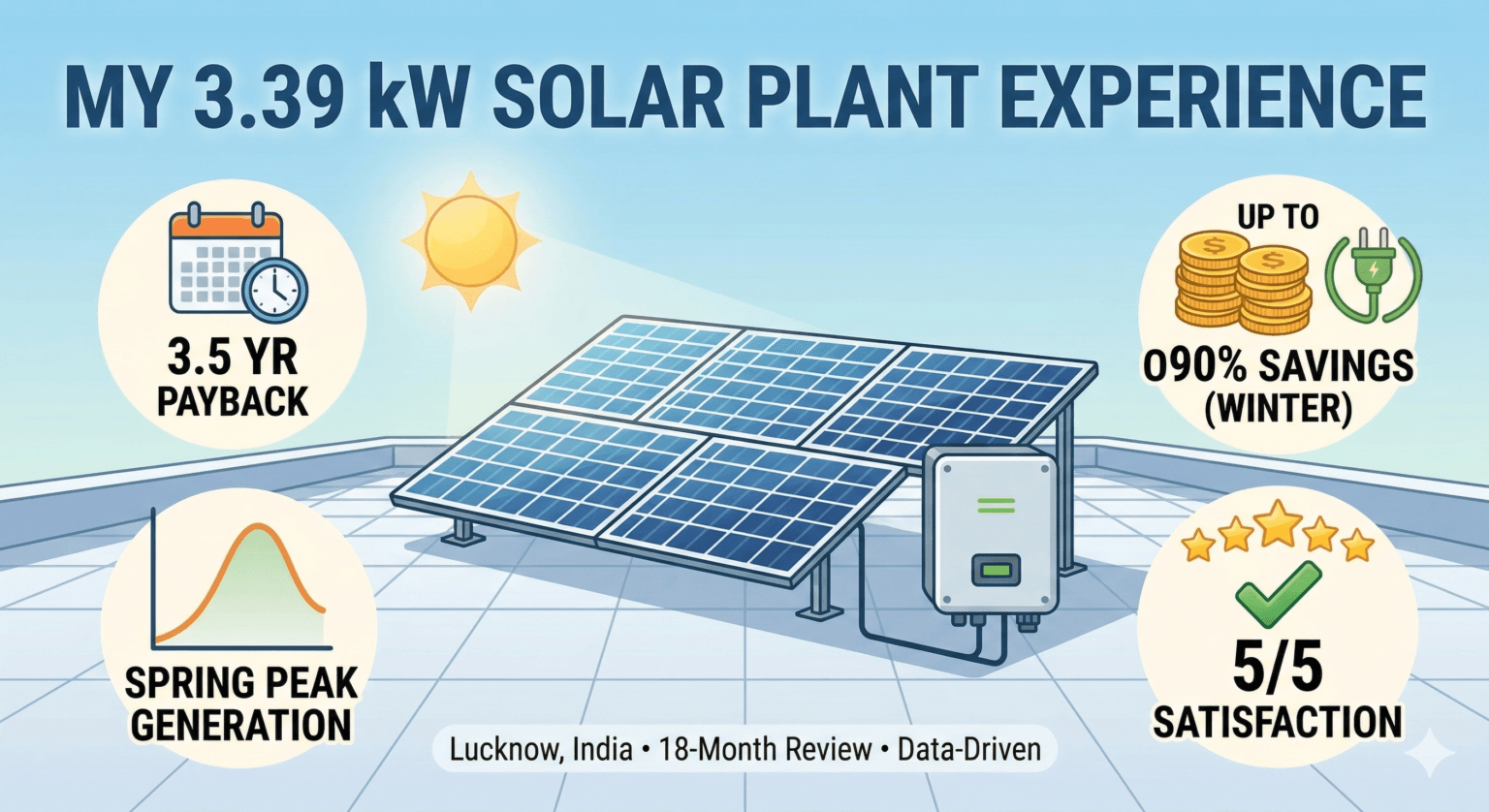
Table of Contents
Why I Chose to Install a Solar Rooftop Plant
With rising electricity bills year after year, switching to renewable energy was a practical and necessary decision for our household. After researching various energy-saving options and hearing success stories from friends and family, we decided to explore solar rooftop plant installation.
The turning point came in February 2024, when the Indian government launched the PM Surya Ghar Yojana, offering attractive solar panel subsidies for residential users. This scheme made the investment more affordable and motivated us to act quickly. The financial incentives, coupled with the opportunity to reduce our carbon footprint and become more energy-independent, made it a win-win situation.
We chose a 3.39 kW solar rooftop system using high-efficiency Adani solar panels and installed it with the help of a professional local installer. This review details our entire journey—from the planning and installation process to real-world performance, seasonal variations, cost savings, and overall satisfaction with the system.
If you’re looking for a real user’s solar rooftop plant review in India, including insights on government subsidies, savings, and performance, you’re in the right place.
Solar Rooftop Plant Details
Brand & Equipment:
Solar Panels: Adani Solar Panels 565W (6 Panels)
Inverter: EEVO Brand up to 3 KW ( Can Perform 15% Extra)
Capacity Installed: 3.39 kW
Panel Type: Topcon Bifacial (Monocrystalline)
Inverter Type: String Inverter
Installation Experience
Installer: XYZ Company In Lucknow
Installation Date: 17th May 2024
Duration: 5 Days
Net Metering & Approvals: Smooth process included in the package
Installation Quality: (5/5)
Long-Term Performance Update (2024 – 2025)
Last Updated: December 10, 2025
It has now been over 18 months since the installation of the solar plant, and we have gathered comprehensive data covering the full cycle of Indian seasons. Below is a detailed breakdown of how the system performed from mid-2024 through the end of 2025.
Key Observations
Peak Generation Season: The system hit its highest production numbers in March, April, and May 2025, with March topping the charts at 566.50 kWh. This aligns perfectly with the clear, sunny days before the peak monsoon clouds arrive.
Monsoon Impact: We saw a dip in generation during August 2025 (313.30 kWh) due to cloud cover, which is expected. However, the system maintained a healthy output of over 300 units even during the rainy season.
Winter Drop: December and January continue to be the lowest generation months due to shorter days and fog, though the efficiency remains high.
Detailed Generation Data (Month-wise)
Here is the raw data from the plant’s monitoring system.
2025 Performance (January – December) Note: December 2025 data is current as of Dec 10th.
2025 Solar Generation Report (Jan - Dec)
| Month | Production (kWh) | Savings (₹) | Status |
|---|---|---|---|
| Jan '25 | 279.10 | ₹1,814 | Winter Low |
| Feb '25 | 412.60 | ₹2,681 | Rising |
| Mar '25 | 566.50 | ₹3,682 | Peak High |
| Apr '25 | 511.80 | ₹3,326 | Excellent |
| May '25 | 504.40 | ₹3,278 | Excellent |
| Jun '25 | 400.40 | ₹2,602 | Good |
| Jul '25 | 358.00 | ₹2,327 | Monsoon |
| Aug '25 | 313.30 | ₹2,036 | Cloudy |
| Sep '25 | 366.70 | ₹2,383 | Recovering |
| Oct '25 | 381.40 | ₹2,479 | Clear Sky |
| Nov '25 | 356.90 | ₹2,319 | Steady |
| Dec '25* | 242.70 | ₹1,570 | Foggy Days |
| TOTAL | 4,591.70 | ~₹30,509 | YTD |
*Scroll table right to see more columns if on mobile.
2024 Performance (June – December)
| Month | Production (kWh) | Est. Savings (INR) |
| Mid Jun 2024 | 198.20 | ₹1,288 |
| Jul 2024 | 357.10 | ₹2,321 |
| Aug 2024 | 359.90 | ₹2,339 |
| Sep 2024 | 368.30 | ₹2,393 |
| Oct 2024 | 437.50 | ₹2,843 |
| Nov 2024 | 336.30 | ₹2,185 |
| Dec 2024 | 287.80 | ₹1,870 |
Financial Savings Analysis
Based on the “Anticipated Yield” data logged by the inverter:
In 2025 alone, the system has generated approximately ₹29,600 in value.
Since June 2024, the total cumulative savings are approximately ₹45,200.
Note: Savings are calculated based on the local utility tariff rates (6/unit) configured in the inverter.
Conclusion
The system is performing at 100% self-use ratio for most of the year, ensuring that almost every unit generated is consumed directly, maximizing the return on investment (ROI). The consistency between 2024 and 2025 (comparing similar months like July/August) shows no significant degradation in panel efficiency.
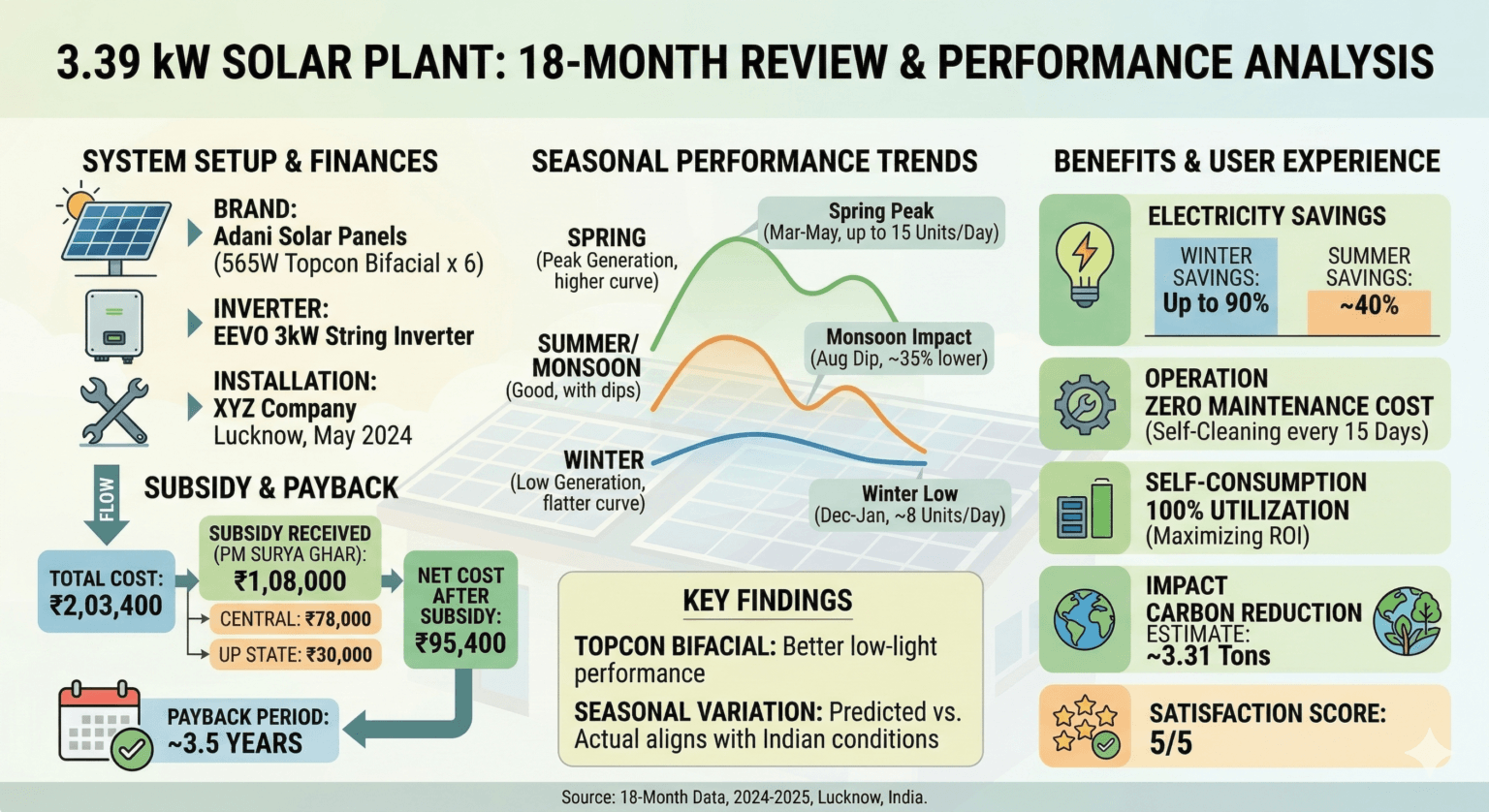
Best Season: Spring
Worst Season: Winter (fog, pollution)
Downtime: None reported
Cost Breakdown & Subsidy Details
Total Cost: ₹2,03,400
Subsidies Received:
Central: ₹78,000
Uttar Pradesh State: ₹30,000
Total Subsidy: ₹1,08,000
Net Cost After Subsidy: ₹95,400
Estimated Payback Period: 3.5 years
Annual Maintenance Cost: ₹0
Monthly Electricity Savings
Summer: 40% lower bills than last year
Monsoon: ~30% lower ( Due To Air Conditioners Working in a Day)
Winter: 90% savings (only connection rental paid)
Maintenance and Support
Cleaning Frequency: Every 15 days
Service Rating: (5/5)
Warranty:
Panels: 25 years
Inverter: 8 years
Installation: 5 years
Challenges Faced
During Installation: Portal issues from PM Surya Ghar Yojana delayed processing slightly
Post-Installation: None
Weather Impact: Dust & fog reduce sunlight quality seasonally
Environmental & Personal Impact
Carbon Reduction Estimate: 3.31 T According to the Inverter Mobile Application
Personal Satisfaction: (5/5)
Solar Rooftop Plant Advantages: A Real-World Perspective
While the environmental impact is a significant motivator, the practical and financial solar rooftop plant advantages are what truly make this a game-changing investment for Indian households. Based on my long-term performance data from Lucknow, here is why switching to solar is a strategic move:
1. Massive Reduction in Monthly Expenses
The most immediate benefit is the drastic drop in electricity bills. In my experience, a 3.39 kW system can reduce summer bills by approximately 40%, while during the winter months, the savings can soar up to 90%, leaving you with only the base connection charges to pay.
2. Attractive Government Subsidies (PM Surya Ghar)
One of the biggest advantages currently is the financial support from the government. Under the PM Surya Ghar Muft Bijli Yojana, residential users can receive substantial subsidies. For a 3kW system, the combined Central and State (UP) subsidy can reach up to ₹1,08,000, significantly lowering the barrier to entry.
3. Rapid Return on Investment (ROI)
Unlike many home improvements, a solar rooftop plant pays for itself. With the current subsidy structure and rising electricity tariffs, the payback period is remarkably short—typically between 3 to 3.5 years. After this point, your rooftop essentially becomes a “mini-power plant” generating free electricity for the next two decades.
4. Low Maintenance & High Durability
Solar systems are incredibly resilient. With no moving parts, the maintenance is minimal. Apart from a simple water cleaning every 15 days to remove dust and bird droppings, there are virtually no recurring costs. Most high-quality panels, like the Topcon Bifacial ones used in my setup, come with a 25-year performance warranty.
5. Energy Independence & Grid Stability
By installing a solar plant with net metering, you become less reliant on the traditional power grid. You consume what you generate during the day and “bank” the excess with the DISCOM, ensuring your household remains protected against future hikes in electricity prices.
6. Positive Environmental Footprint
Beyond the numbers, the carbon reduction is substantial. My 3.39 kW plant has already offset an estimated 3.31 tons of CO2 in just 18 months. This is the equivalent of planting dozens of trees, making it a powerful way to contribute to a greener future.
FAQ
1. How many units (kWh) does a 3 kW solar rooftop plant generate daily in India? Based on my 18 months of data in Lucknow, a 3.39 kW system generates an average of 12–15 units per day during sunny months (March–May). In peak winter or heavy monsoon months, this can drop to 8–10 units, though Topcon Bifacial panels perform slightly better in low-light conditions.
2. Is the PM Surya Ghar Yojana subsidy actually credited to the bank account? Yes. In my experience, the process was smooth but required patience. After the net meter installation and inspection by the DISCOM, the central subsidy of ₹78,000 and the UP state subsidy of ₹30,000 were credited within a few weeks. Ensure your bank details on the national portal match your electricity bill exactly.
3. What is the real-world payback period for a 3kW solar system? With a net investment of approximately ₹95,400 (after ₹1.08 Lakh subsidy) and annual savings of roughly ₹29,600 on electricity bills, the payback period is approximately 3.2 to 3.5 years. After this, the electricity generated is effectively free for the remaining 20+ years of the panel’s life.
4. Do solar panels work during the monsoon or on cloudy days? Yes, but at reduced efficiency. My records show that in August 2025, generation was about 35% lower than in March. However, because we used the AC more during the humid monsoon days, the “self-consumption” ratio remained high, still providing significant savings.
5. How often do I need to clean my solar panels for maximum performance? In dusty regions like North India, I recommend cleaning the panels every 15 days. Dust and bird droppings can reduce generation by 10-15%. A simple water wash in the early morning or late evening (to avoid thermal shock to the glass) is sufficient.
Final Verdict – Would I Recommend It ?
Absolutely YES!
Installing a solar rooftop plant has been one of the most rewarding decisions we’ve made for both our finances and the environment. Our electricity bills have dropped significantly, especially during the summer and spring months, and the return on investment looks promising with a payback period of just around 3.5 years.
Beyond the numbers, the satisfaction of using clean, renewable energy and reducing our dependence on the traditional power grid is unmatched. The process, from installation to activation, was smooth and hassle-free thanks to the support provided under the PM Surya Ghar Yojana. With zero maintenance costs so far and excellent performance across seasons, the system has exceeded our expectations.
My Advice to New Buyers:
Choose a reputed installer with a good track record.
Make sure your rooftop gets sufficient sunlight throughout the day, without shadow obstruction.
Prioritize ease of cleaning – dust and pollution can reduce panel efficiency if not cleaned regularly.
Stay informed about state and central subsidies to maximize your savings.
If you’re considering solar energy, now is the best time to invest. The combination of government support, falling panel prices, and increasing electricity costs makes it a highly worthwhile decision.
Are you thinking about going solar?
Explore our detailed solar rooftop calculator
For any questions or to share your own solar story, feel free to contact us at contact@techmitra.in

Trending

Ayush Singhal is the founder and chief editor of TechMitra.in — a tech hub dedicated to simplifying gadgets, AI tools, and smart innovations for everyday users. With over 15 years of business experience, a Bachelor of Computer Applications (BCA) degree, and 5 years of hands-on experience running an electronics retail shop, Ayush brings real-world gadget knowledge and a genuine passion for emerging technology.
At TechMitra, he covers everything from AI breakthroughs and gadget reviews to app guides, mobile tips, and digital how-tos. His goal is simple — to make tech easy, useful, and enjoyable for everyone. When he’s not testing the latest devices or exploring AI trends, Ayush spends his time crafting tutorials that help readers make smarter digital choices.
📍 Based in Lucknow, India
💡 Focus Areas: Tech News • AI Tools • Gadgets • Digital How-Tos
📧 Email: contact@techmitra.in
🔗 Full Bio: https://techmitra.in/about-us/
It is in reality a great and useful piece of info.
I am glad that you simply shared this useful info with us.
Please keep us up to date like this. Thank you for sharing.