
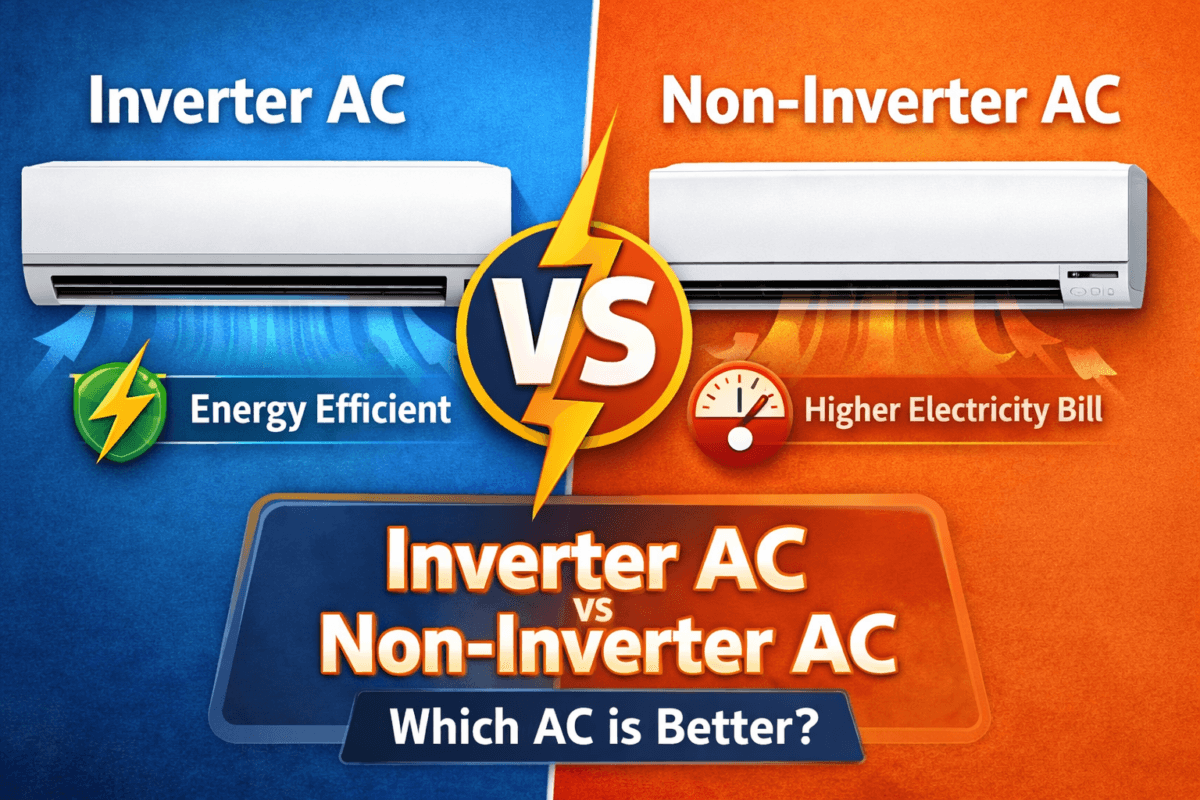
Inverter vs Non Inverter AC
If you’re planning to buy a new air conditioner, you’ve probably come across this confusing question:
👉 “Inverter AC vs Non Inverter AC which is better ?”
Honestly, this is one of the most searched AC-related queries in India right now. And the confusion is real — because both types cool your room, but they work very differently.
In this guide, I’ll break everything down in simple language — no technical jargon — so you can decide what’s actually worth your money.
Also Read : Daikin 1.5 Ton 3 Star AC Review (2026): Real Usage, Cooling, Noise & Power Insights
Table of Contents
What is an Inverter AC ?
During my years in electronic sales, one question came up again and again:
👉 “Inverter AC hai toh kya yeh light ke bina bhi chalega?”
Let’s clear this confusion once and for all 👇
In an inverter AC, the term ‘inverter’ does not mean it can run without electricity. It simply refers to a digital technology used to control the compressor speed efficiently
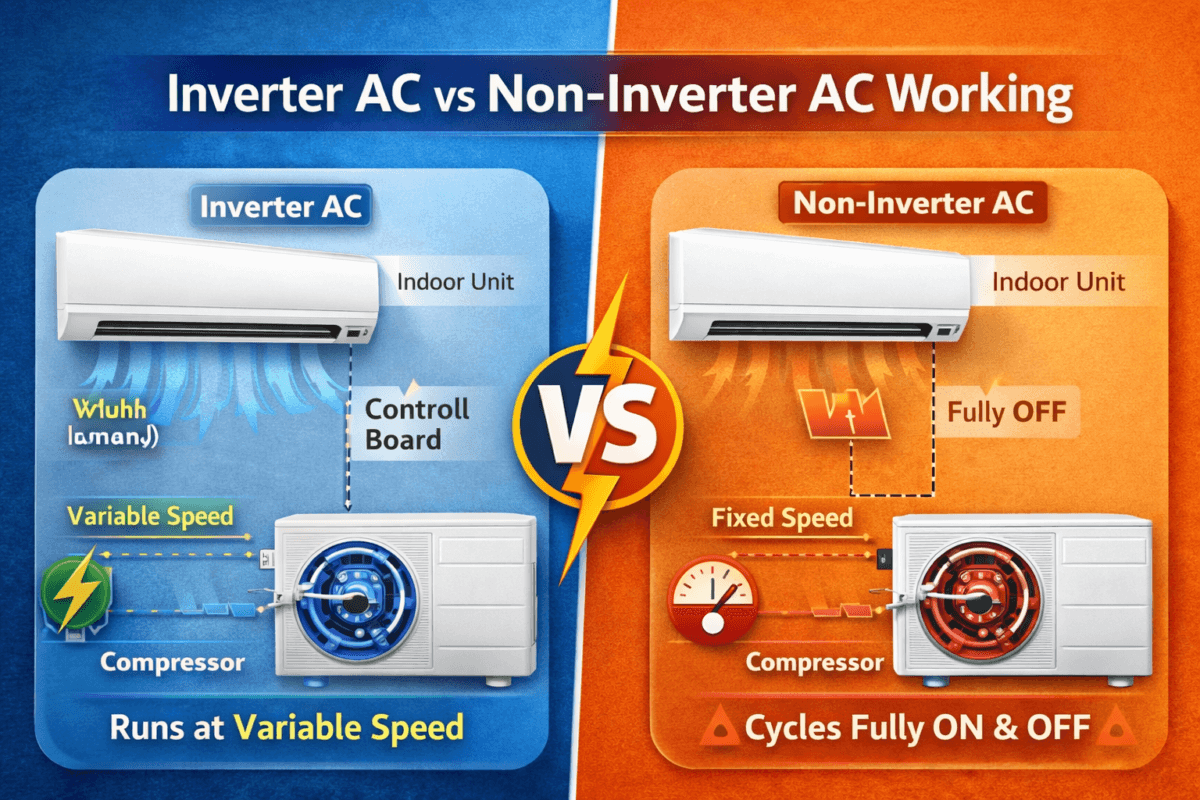
An Inverter AC is a smart air conditioner that adjusts its compressor speed based on the room temperature.
👉 Instead of turning ON and OFF repeatedly, it runs continuously at variable speeds.
Simple Example:
- Room gets hot → compressor runs faster
- Room cools → compressor slows down
This results in:
✔ Stable temperature
✔ Lower electricity bills
✔ Less noise
What is a Non-Inverter AC?
A Non-Inverter AC works on a basic mechanism:
👉 The compressor is either fully ON or fully OFF
Simple Example:
- Room heats up → compressor turns ON
- Desired temp reached → compressor turns OFF
This cycle repeats continuously.
Inverter AC vs Non-Inverter AC (Quick Comparison)
| Feature | Inverter AC | Non-Inverter AC |
|---|---|---|
| Compressor | Variable speed | Fixed speed |
| Energy Consumption | Low | High |
| Noise Level | Quiet | Noisy |
| Cooling Speed | Fast & stable | Slower & fluctuating |
| Price | Expensive | Budget-friendly |
| Lifespan | Longer | Shorter |
| Electricity Bill | Lower | Higher |
Inverter vs Non Inverter Ac Power Consumption Comparison
This is where the real difference shows up.
🟢 Inverter AC
- Saves 30%–50% electricity
- Ideal for long usage (6–12 hours daily)
🔴 Non-Inverter AC
- Consumes more power due to ON/OFF cycles
- Suitable for short usage (2–4 hours)
👉 Example:
- 1.5 Ton Inverter AC → ~0.8–1.2 units/hour
- 1.5 Ton Non-Inverter AC → ~1.5–2 units/hour
Cooling Performance
Inverter AC
✔ Maintains consistent temperature
✔ No sudden hot/cold fluctuations
✔ Better for sleep & comfort
Non-Inverter AC
❌ Temperature keeps fluctuating
❌ Less comfortable in long run
Price & Maintenance
💸 Inverter AC
- Higher initial cost (₹30K–₹60K)
- Maintenance slightly expensive (PCB involved)
💸 Non-Inverter AC
- Cheaper (₹20K–₹35K)
- Simple and low-cost repairs
👉 So if budget is tight → Non-Inverter wins upfront
👉 But long-term savings → Inverter wins
Pros & Cons
✅ Inverter AC Pros
- Energy efficient
- Quiet operation
- Long lifespan
- Better cooling control
❌ Inverter AC Cons
- Higher price
- Costly repairs
Warranty & PCB Reliability
One common concern people have with inverter ACs is:
👉 “What if the PCB fails?”
And honestly, this is a valid question.
What is PCB in Inverter AC?
PCB (Printed Circuit Board) is the brain of an inverter AC. It controls:
- Compressor speed
- Temperature adjustments
- Energy efficiency
Because inverter ACs rely on electronics, PCB is the most sensitive component.
⚠️ The Real Concern
- PCB repair can be expensive (₹5,000 – ₹12,000 depending on brand)
- Voltage fluctuations can sometimes damage it
The Good News (Very Important)
👉 Today, almost all major AC brands in India offer 5-year warranty on PCB
This includes brands like:
- LG
- Samsung
- Voltas
- Daikin
- Blue Star
- Carrier
👉 So even though PCB is a weak point, you’re protected for the initial years.
Also Read : Air Conditioner Buying Guide : How to Choose the Right AC for Your Home (2026)
Pro Tip
To avoid PCB issues:
- Always install a voltage stabilizer (if voltage fluctuates in your area)
- Ensure proper earthing
- Get regular servicing
✅ Non-Inverter AC Pros
- Affordable
- Easy to repair
- Good for occasional use
❌ Non-Inverter AC Cons
- High electricity bill
- Noisy
- Less efficient
Inverter vs Non Inverter Which Is Better?
Here’s a simple decision guide 👇
👉 Go for Inverter AC if:
- You use AC daily
- Usage is 6+ hours
- You want lower electricity bills
- You prefer silent cooling
👉 Go for Non-Inverter AC if:
- Usage is very limited
- Budget is tight
- You need AC for temporary use (rent house, shop)
According to Daikin, inverter ACs are designed to optimize energy efficiency by adjusting compressor speed.
Final Verdict
If you ask me honestly:
👉 Inverter AC is better in 90% of cases in 2026
Yes, it costs more initially — but:
- You save money every month
- You get better comfort
- And it lasts longer
So it’s not an expense — it’s an investment.
FAQs
1. inverter or non inverter ac which is best?
👉 Inverter AC is best for most homes due to energy savings and comfort.
2. Does inverter AC really save electricity?
👉 Yes, it can save up to 50% electricity compared to non-inverter models.
3. Is inverter AC costly to repair?
👉 Slightly yes, because it has advanced electronics (PCB).
4. Which AC is better for small rooms?
👉 Both work, but inverter AC gives better efficiency.
5. Is non-inverter AC outdated?
👉 Not completely — but it’s becoming less popular due to high power consumption.

Ayush Singhal is the founder and chief editor of TechMitra.in — a tech hub dedicated to simplifying gadgets, AI tools, and smart innovations for everyday users. With over 15 years of business experience, a Bachelor of Computer Applications (BCA) degree, and 5 years of hands-on experience running an electronics retail shop, Ayush brings real-world gadget knowledge and a genuine passion for emerging technology.
At TechMitra, he covers everything from AI breakthroughs and gadget reviews to app guides, mobile tips, and digital how-tos. His goal is simple — to make tech easy, useful, and enjoyable for everyone. When he’s not testing the latest devices or exploring AI trends, Ayush spends his time crafting tutorials that help readers make smarter digital choices.
📍 Based in Lucknow, India
💡 Focus Areas: Tech News • AI Tools • Gadgets • Digital How-Tos
📧 Email: contact@techmitra.in
🔗 Full Bio: https://techmitra.in/about-us/