
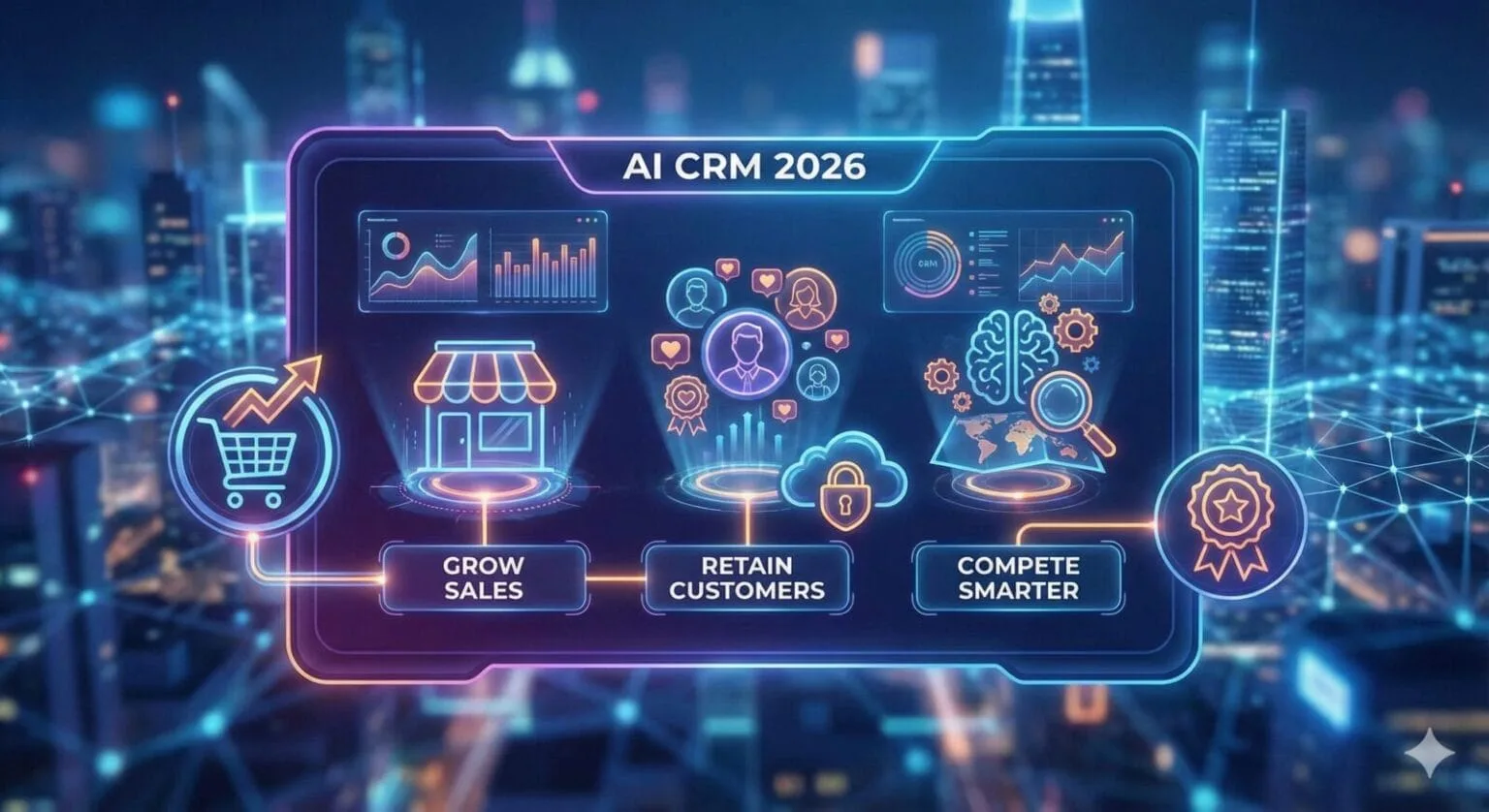
Retail in 2026 is no longer just about stocking the right products or offering competitive prices. Customers are not short of options—they are short of patience. One delayed follow-up, one generic offer, or one poor experience, and they simply move on.
This is where AI-powered CRM (Customer Relationship Management) is quietly transforming retail businesses.
As someone who worked in electronics retail between 2014 and 2019, I’ve seen how difficult it was to track customers manually. We relied on memory, handwritten notes, or basic billing data. Once a customer walked out, reconnecting with them was mostly luck. Today, AI CRM for retail sales changes that equation completely by helping retailers understand, predict, and engage customers automatically.
This article explains what AI CRM is, how it helps retailers in real life, and which AI CRM tools are worth considering—especially for Indian retailers.
Table of Contents
You May Also Like


What Is AI CRM Software?
A traditional CRM stores customer details such as name, phone number, and purchase history. Useful—but passive.
AI CRM goes much further. It uses artificial intelligence to analyze customer behavior, predict intent, predictive retail analytics and automate actions like follow-ups, offers, and reminders.
Traditional CRM vs AI CRM
| Traditional CRM | AI CRM |
|---|---|
| Stores customer data | Understands customer behavior |
| Manual follow-ups | Automated, smart follow-ups |
| Generic campaigns | Personalized recommendations |
| Reactive | Predictive & proactive |
Think of AI CRM as a smart sales assistant that never forgets a customer, never misses a follow-up, and keeps learning with every interaction.
Benefits Of AI CRM In Retail In2026
Retailers today face three core problems:
Customers compare prices instantly
Repeat purchases are hard to maintain
Staff time is limited and expensive
AI CRM directly addresses these issues by helping retailers sell smarter, not harder.
Instead of chasing every customer equally, AI CRM focuses on:
Customers most likely to buy again
Right timing for offers
Personalized communication
This shift from transaction-based selling to relationship-based selling is what separates growing retailers from struggling ones.
How AI CRM For Retail Sales Helps Retailers
1. Predicts Customer Buying Behavior
AI CRM studies:
Past purchases
Frequency of visits
Time gaps between orders
Using this data, it predicts what a customer is likely to buy next and when.
Example:
A customer buys a mixer grinder. AI CRM learns that similar customers often buy a juicer jar or extended warranty within 30–40 days. The system automatically triggers a reminder or offer—without any manual effort.
Earlier, this depended purely on experience. Now, it’s data-driven.
2. Increases Repeat Purchases (Where Real Profit Lies)
Every retailer knows:
It’s cheaper to sell to an existing customer than to find a new one.
AI CRM helps by:
Sending refill reminders
Offering loyalty discounts
Suggesting relevant upgrades
Instead of random promotions, customers receive timely and relevant messages, increasing repeat sales naturally.
3. Automates WhatsApp, SMS, and Email Follow-Ups
In India, WhatsApp is often more powerful than email.
AI CRM can automatically:
Send inquiry follow-ups
Share order confirmations
Deliver personalized offers
Collect post-purchase feedback
During my retail days, many customers said, “I’ll think and come back.”
Today, AI CRM doesn’t wait—it follows up politely and consistently.
4. Identifies High-Value and At-Risk Customers
AI CRM segments customers into:
Loyal high-value buyers
Occasional shoppers
Price-sensitive customers
Customers likely to stop buying
This allows retailers to:
Reward loyal customers
Retain slipping customers
Avoid unnecessary discounts
This smart segmentation directly improves margins.
5. Reduces Manual Work for Staff
Retail staff already handle billing, customers, inventory, and service queries.
AI CRM reduces workload by:
Auto-logging interactions
Updating customer records automatically
Triggering follow-ups on its own
This allows staff to focus on selling and customer service, not paperwork.
A Real Retail Scenario (Experience-Based Insight)
In my electronics retail days, many customers visited, compared prices, and left without buying. There was no system to track them.
With AI CRM:
The inquiry is logged
Interest level is predicted
Automated follow-ups are sent
Offers are personalized
Even a 10–15% improvement in conversions can make a huge difference in competitive retail.
AI CRM for Small Retailers vs Large Retail Chains
AI CRM is no longer limited to big brands.
| Feature | Small Retail Store | Large Retail Chain |
|---|---|---|
| Customer tracking | WhatsApp + AI CRM | Omni-channel CRM |
| Offers | Personalized | AI-driven campaigns |
| Staff dependency | Reduced | Optimized |
| Decisions | Owner + AI insights | Data-driven |
Even a single-store retailer can now use AI CRM effectively.
Popular AI CRM Tools for Retailers (2026)
1. Zoho CRM (with Zia AI)
Best for: Small to mid-size retailers
Predictive sales insights
Workflow automation
Strong Indian ecosystem integration
Affordable, scalable, and retail-friendly.
2. HubSpot CRM
Best for: Retailers combining sales + marketing
AI-assisted emails
Free entry-level plan
Excellent reporting
Ideal for online + offline retailers.
3. Freshworks CRM (Freddy AI)
Best for: Growing retail chains
AI lead scoring
Sales forecasting
WhatsApp & SMS integrations
Strong balance between simplicity and power.
4. Salesforce CRM (Einstein AI)
Best for: Large or enterprise retailers
Advanced predictive analytics
Multi-channel engagement
Deep customization
Powerful but expensive and complex.
5. EngageBay CRM
Best for: Budget-conscious retailers
CRM + marketing automation
Lead scoring
Email & SMS campaigns
Good entry-level AI CRM option.
6. Netcore Smartech
Best for: Indian retailers with app, web, and WhatsApp sales
Predictive segmentation
AI-driven customer journeys
Strong Indian market focus
Excellent for omnichannel engagement.
Choosing the Right AI CRM for Your Retail Business
Here’s a quick decision guide:
For New & Small Retailers
HubSpot CRM (Free Tier)
These are easy to set up, affordable, and scalable.
For Growing Retail Chains
HubSpot (Paid Automation)
Great balance between power and simplicity.
For Large Retailers & Enterprise Level
Salesforce CRM (Einstein)
Best for retailers with big data, multiple stores, and complex processes.
Bonus Tools & Integrations Retailers Can Use With AI CRM
AI CRM works best when it connects with other tools:
| Tool Category | Examples |
|---|---|
| WhatsApp Automation | Twilio, Gupshup, WATI |
| SMS Platforms | Msg91, TextLocal |
| POS & Billing | Zoho Inventory, Tally, Shopify POS |
| Email Marketing | Mailchimp, SendGrid |
These enhance your customer touchpoints and automation reach, making AI CRM even more powerful.
Integration Tips for Retailers
To get the most out of your AI CRM:
Sync Sales Channels
Connect your POS, online store, Instagram, WhatsApp, and SMS platforms so data flows to one place.
Enable Automation
Set up workflows like:
New customer welcome messages
Abandoned cart reminders
Birthday offers
Refill reminders
Track Results
Always monitor:
Open rates
Conversion %
Repeat purchase rate
Revenue per customer
Data tells you which campaigns succeed and which need improvement.
AI CRM Pricing
| CRM Tool | Estimated Starting Price* |
|---|---|
| HubSpot CRM (Free Tier) | ₹0 |
| Zoho CRM | ₹900–₹2,500/user/month |
| Freshworks CRM | ₹1,200–₹3,000/user/month |
| Pipedrive | ₹1,200–₹2,700/user/month |
| Salesforce Einstein | Custom / Higher |
| EngageBay | ₹800–₹2,000/user/month |
| Netcore Smartech | Custom |
*Actual prices vary by plan and add-ons.
Benefits of AI CRM for Retailers
Higher customer retention
Smarter promotions
Better inventory planning
Reduced manual workload
Increased revenue per customer
AI CRM converts customer data into daily decisions.
Challenges and Limitations
AI CRM is powerful—but not magic.
Common challenges include:
Initial learning curve
Subscription costs
Data privacy responsibility
Internet dependency
However, for growing retailers, benefits far outweigh limitations.
Is AI CRM Worth It for Indian Retailers?
Yes, if:
You want repeat customers
You handle 50+ customers regularly
You sell competitive products
Optional, if:
You run a very small shop with fixed local buyers
Must-have, if:
You are a D2C brand
You manage multiple stores
You sell electronics, fashion, or high-ticket items
In 2026, AI CRM is no longer a luxury—it’s a competitive necessity.
The Future of Retail with AI CRM
The future retailer won’t ask:
“How many customers came today?”
Instead:
“How many relationships did we strengthen today?”
AI CRM doesn’t replace humans—it supports smarter decisions, reduces guesswork, and builds long-term customer loyalty.
From handwritten customer registers to predictive dashboards, retail has evolved rapidly. And AI CRM is the bridge between effort and efficiency.
FAQs
Is AI CRM useful for small retailers?
Yes. Even small retailers benefit from automated follow-ups and insights.
Can AI CRM work with WhatsApp?
Most modern AI CRMs support WhatsApp integration.
Is AI CRM expensive?
There are affordable plans suitable for small businesses.
Does AI CRM replace sales staff?
No. It enhances staff productivity, not replaces it.
How soon can results be seen?
Most retailers notice improvement within 2–3 months.
Final Thoughts
AI CRM is not about chasing trends—it’s about staying relevant in modern retail.
Retailers who adopt AI CRM early:
Understand customers better
Sell more efficiently
Compete confidently
From my own retail experience to today’s AI-driven tools, one thing is clear: AI CRM is becoming the backbone of smart retail growth in 2026.
Disclaimer:
This article is published for informational and educational purposes only. Business processes, tools, and results may vary depending on store size, location, and implementation. Readers are advised to evaluate solutions based on their own requirements.
Trending

Ayush Singhal is the founder and chief editor of TechMitra.in — a tech hub dedicated to simplifying gadgets, AI tools, and smart innovations for everyday users. With over 15 years of business experience, a Bachelor of Computer Applications (BCA) degree, and 5 years of hands-on experience running an electronics retail shop, Ayush brings real-world gadget knowledge and a genuine passion for emerging technology.
At TechMitra, he covers everything from AI breakthroughs and gadget reviews to app guides, mobile tips, and digital how-tos. His goal is simple — to make tech easy, useful, and enjoyable for everyone. When he’s not testing the latest devices or exploring AI trends, Ayush spends his time crafting tutorials that help readers make smarter digital choices.
📍 Based in Lucknow, India
💡 Focus Areas: Tech News • AI Tools • Gadgets • Digital How-Tos
📧 Email: contact@techmitra.in
🔗 Full Bio: https://techmitra.in/about-us/