
Ever typed a question into ChatGPT, Claude, or Gemini and got back an answer that felt like you were chatting with a real person? That’s generative AI at work — with an LLM handling the language part behind the scenes.
If terms like “AI,” “generative AI,” and “LLM” all sound like the same thing to you, don’t worry — you’re not alone. This guide breaks it all down in plain language, using ChatGPT, Claude, and Gemini as real examples throughout, with no coding or tech background needed.
Table of Contents
Also Read : Tech Abbreviations and Acronyms: 200+ Full Forms Explained (2026)
What Is Generative AI?
Generative AI means it is a category of artificial intelligence that creates new content — text, images, audio, video, or code — instead of just analysing or sorting existing information.
That’s the key difference from older, more familiar AI. Your email spam filter is AI, but it doesn’t create anything — it just sorts your emails into “spam” or “not spam.” A face-unlock feature on your phone is AI, but it’s just recognising a pattern, not generating something new. Generative AI is different: ask it a question, and it writes you a fresh, original answer. Ask it to make a picture, and it creates one from scratch that didn’t exist before.
ChatGPT, Claude, and Gemini are all generative AI products focused mainly on text and conversation. Generative AI also covers tools built for other formats — image generators like DALL-E and Midjourney, or voice generators like ElevenLabs — which create pictures or audio from a text prompt the same way ChatGPT creates a written answer.
Where Do LLMs Fit In?
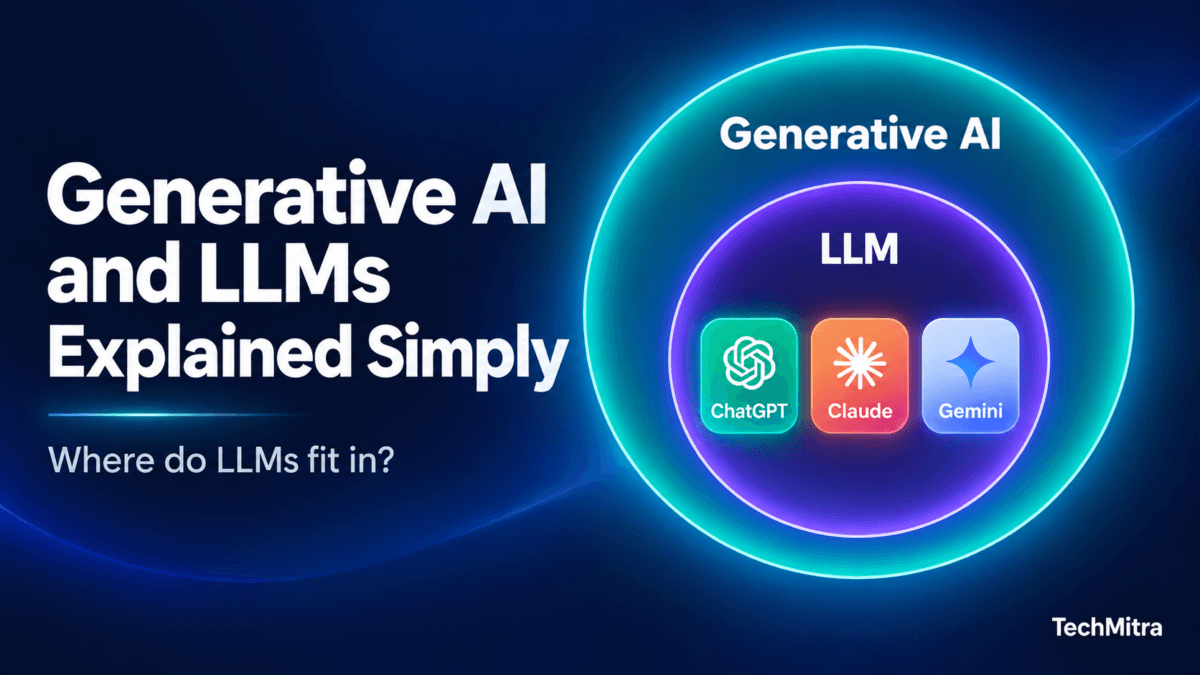
Generative AI is a broad category — it also includes tools that generate images (like Midjourney) or voices (like ElevenLabs), which work on different underlying technology. The part of generative AI that focuses specifically on language — understanding what you type and writing a natural-sounding reply — is powered by something called an LLM, or Large Language Model.
LLM stands for Large Language Model. In simple words, it’s an AI system trained on an enormous amount of text — books, websites, articles, conversations — so it can recognise patterns in how human language works: which words tend to follow others, how sentences are built, how ideas connect.
It’s worth being clear about one common misunderstanding: an LLM doesn’t store all that text like a giant searchable database. It doesn’t “remember” the specific articles it was trained on. Instead, it learns statistical patterns from that text, and uses those patterns to generate new sentences that weren’t copied from anywhere — similar to how a person who has read thousands of books doesn’t memorise every page, but develops a strong sense of how language and ideas flow together.
So, putting the two pieces together: AI is the broadest umbrella term. Generative AI is the part of AI that creates new content. LLM is the specific technology inside generative AI that handles language — and it’s what makes tools like ChatGPT, Claude, and Gemini able to hold a natural conversation with you.
One small note: “LLM” is still the most common term you’ll see, but it’s becoming a bit loose. Many modern models — Gemini included — no longer handle only text; they process images, audio, and video too. You may see these newer, broader models referred to as “multimodal models” elsewhere, or by the acronym MLLM (Multimodal Large Language Model). For everyday purposes, though, “LLM” is still the term you’ll encounter most often, and it’s fine to use it as shorthand for these chat-based AI tools.
What Is the LLM Inside ChatGPT (or Claude, or Gemini)?
This trips up a lot of beginners, so it’s worth being precise.
- An LLM is the underlying model — the “engine” that understands and generates language. This is what actually gets upgraded when you read about a new model launch.
- ChatGPT, Claude, and Gemini are chatbot applications — the interface you actually interact with, built around one or more LLMs, along with extra features like chat history, file uploads, voice input, or web search.
You don’t typically use an LLM directly. You use an app that gives you access to one, wrapped in a friendly chat window. In fact, a single chatbot product can use more than one underlying model depending on the task:
- ChatGPT is a product built on OpenAI’s GPT model family — it can use different models from that family depending on what you’re asking it to do. As of late 2026, that family includes models like GPT-5.6 Luna and GPT-6.
- Claude is a product built on Anthropic’s Claude model family, usually with a model picker letting you choose between faster or more capable versions — such as Claude Sonnet 5 or Claude Opus 5.5.
- Gemini is a product built on Google’s Gemini model family, which is also natively multimodal — designed from the ground up to handle text, images, and other formats together. The current family includes Gemini 3.8 and its variants.
So to put it plainly: ChatGPT, Claude, and Gemini are all generative AI products, powered by LLMs — but none of them is a single LLM. Each is the application layer sitting on top of a family of models from that company.
This is also useful the next time you see a tech headline like “OpenAI launches GPT-6” or “Google releases Gemini 3.8.” That’s not a new app — it’s a new LLM, released as an upgrade inside a product (ChatGPT or Gemini) you may already use. The app’s name usually stays the same; what changes underneath it is the model. Model names like these move fast — new versions ship every few months — so treat any specific version mentioned here as a snapshot in time rather than the final word.
How Does an LLM Work? (No Tech Degree Needed)
You know how your phone’s keyboard suggests the next word when you’re typing a message? An LLM works on a similar idea — just far more powerful, trained on a massive amount of text rather than just your own messages.
Here’s what roughly happens when you ask ChatGPT, Claude, or Gemini a question:
- Your question gets broken into small pieces (called tokens — think of these as word-fragments) that the model can process.
- The model looks at the full context of your question — and, in a longer conversation, everything said before it.
- It calculates probabilities for what the next token is likely to be, then generates one, then the next, then the next — building a complete response piece by piece, based on the patterns it learned during training. It doesn’t always pick the single most probable option every time, which is part of why answers can vary slightly even for the same question.
- This happens fast enough that the final answer reads like a natural, complete sentence or paragraph.
Example: If you type “The capital of India is,” the model has seen this pattern so often during training that it confidently predicts “New Delhi” as the most likely next word.
It’s not thinking the way a human does — it’s making very well-informed, pattern-based predictions, one piece at a time.
Are LLMs Replacing Search Engines?
This is a question a lot of people are genuinely wondering about — and the honest answer is: partially, but it’s not a clean swap.
For questions where you want a direct, explained answer — “what does this term mean,” “draft this for me,” “summarise this” — many people now go straight to ChatGPT or Gemini instead of Google. It saves the step of clicking through multiple links and piecing an answer together yourself.
But search engines remain particularly useful when you want current information, multiple sources to compare, a specific website or local business, or a way to verify information yourself. A plain LLM, without a search tool attached, is also working from training data that isn’t perfectly current.
Here’s the more interesting part, though: what’s really happening isn’t “LLMs replacing search” so much as search engines building LLMs directly into themselves. Google’s AI Overviews, for example, uses a Gemini model to read several search results and write a direct answer right on the results page — the same basic approach an LLM chatbot uses when it searches the web for you. Bing did something similar earlier with its Copilot integration built into search.
So the line between “a search engine” and “an LLM-powered answer” is blurring mainly because search engines are becoming more LLM-like — not because LLMs are quietly becoming search engines. Expect this convergence to continue rather than one side simply winning.
If you run a website and want to know how AI tools pick which pages to cite, see our guide on what LLM SEO is and how AI tools choose sources.
Popular Generative AI Tools and the LLMs Behind Them
Several companies have built their own LLM families, which power the generative AI products you’ve likely already heard of or used:
- ChatGPT, made by OpenAI, is built on the GPT model family — one of the most widely used AI chatbots. Depending on your plan, ChatGPT currently runs on different models from this family (for example, GPT-5.6 Luna on the free plan, and GPT-6 on paid plans), and its built-in image generation is built natively into these models rather than being a separate, disconnected tool.
- Gemini, made by Google, is built on Google’s Gemini model family (currently on version 3.8), and is woven into the Gemini app, Search, and Android. It’s natively multimodal, meaning it’s designed to handle text, images, and other formats together, not just text. Gemini’s image generation is often referred to by its popular nickname, “Nano Banana.”
- Claude, made by Anthropic, is built on the Claude model family — currently including Sonnet, Opus, and Haiku versions at different speed/capability levels (see Anthropic’s model overview for the current lineup) — known for careful, detailed responses; powers the Claude app and API. Unlike ChatGPT and Gemini, Claude does not generate new images from a text prompt — it can read and analyse images you upload, but image creation isn’t part of what it currently offers.
- Meta AI is built on Meta’s Llama model family — a family of openly available models that developers can download and build applications on, subject to Meta’s license terms. “Open” here refers to the model weights being publicly released, which is different from traditional open-source software licensing.
- DeepSeek is a Chinese model family that made global headlines for offering strong performance at a much lower cost to run.
There are more emerging regularly, but these are the ones you’re most likely to run into.
What Can You Actually Do With Generative AI Tools Like These?
This is where it gets genuinely useful in everyday life:
Writing Help
Draft an email to your landlord, a formal resignation letter, a WhatsApp reply to a customer, or even a birthday wish that doesn’t sound generic. You can also ask it to make something you’ve already written sound more polite, more formal, or more concise — genuinely useful if English isn’t your first language or you just want a second opinion before hitting send.
Learning and Homework
Ask it to explain a concept in simple terms — photosynthesis, compound interest, how GST works — in English, Hindi, or a mix of both. You can also ask it to explain the same thing three different ways until one finally clicks, something a textbook or a single YouTube video can’t easily do.
Planning
Give it a rough idea and let it structure the details — a 4-day trip itinerary for Manali, a weekly meal plan that fits a budget, or a study timetable for exams. It won’t book anything for you, but it’s genuinely good at organising options and trade-offs so you’re not starting from a blank page.
Summarising
Paste in a long news article, research paper, or PDF and ask for a short summary — or ask specific questions about it instead of reading the whole thing. This is especially useful for long government notices, terms and conditions, or lengthy WhatsApp forwards you want the gist of quickly.
Reading Images and Documents
Upload a photo, scanned document, or PDF and ask questions about it. Modern chatbots can read the text inside an image — a bill, a notice, a handwritten note, a screenshot of an error message — and then explain, summarise, or answer questions about it. For example, you could photograph an electricity bill and ask “how much did I use this month compared to last month,” and it will read the numbers directly off the image.
Translation
Translate text between languages, including casual Hindi-English mixes people actually type day to day — not just formal, textbook-style translation. Handy for replying to a customer message, understanding a contract clause, or translating a notice for a family member.
Coding Help
Write, explain, or fix small pieces of code, even if you’ve never programmed before. You can describe what you want in plain English (“make this Excel formula calculate GST at 18%”) and get a working answer, or paste in an error message and ask what went wrong.
Everyday Questions
Explain a government scheme in simple terms, define a confusing tech term you saw in the news, or walk you through how something works — from how UPI transactions settle to how a car’s mileage is calculated. Think of it as a knowledgeable friend you can ask anything without feeling embarrassed about the question.
What These Tools Can’t Do Well (Important to Know)
Generative AI tools are impressive, but they’re not perfect. A few honest limitations:
- They can get facts wrong. Sometimes an LLM states something confidently that simply isn’t true. This is called a “hallucination” in AI terms. Always double-check important facts, dates, or numbers elsewhere.
- Their built-in knowledge has a limit. A model’s core training data only goes up to a certain point in time. Many modern chatbots work around this by connecting the model to live web search or other tools to pull in current information — but the model’s own underlying “knowledge” is still only as fresh as its training.
- They’re not professionals. Don’t treat an answer from ChatGPT, Claude, or Gemini as a substitute for real medical, legal, or financial advice — use it to understand a topic better, then consult an actual expert for anything serious.
- There are genuine ethical questions around them. Generative AI has raised real concerns about misinformation, deepfakes (realistic fake images, audio, or video of real people), and copyright — since these tools learn from existing text and images, questions about how that training data was used are still being debated and tested in courts worldwide. It’s worth being aware of this context, especially when sharing or trusting AI-generated content you come across online.
Frequently Asked Questions
Is ChatGPT an LLM?
Not exactly — it’s a chatbot app built on OpenAI’s GPT model family. See “Is ChatGPT (or Claude, or Gemini) Itself an LLM?” above for the full explanation.
Is Gemini an LLM?
Same idea — the Gemini app is the product, powered by Google’s Gemini model family underneath.
Is Claude an LLM?
Same pattern — the Claude app is built on Anthropic’s Claude model family.
Is Google Search an LLM?
No. Google Search discovers, indexes, and ranks information from across the web. Google has also added AI features such as AI Overviews, which do use language models to generate direct answers — but the core search engine itself isn’t an LLM.
Can an LLM access the internet?
Not by default. On its own, a model only knows what it learned during training — it doesn’t browse or scan the internet in real time to answer a question. Many chatbots add web search as a separate tool: when it’s turned on (or triggered automatically), the app runs a search, opens a small number of relevant pages, and feeds that content to the model as extra context before it writes a reply. This is a live lookup added on top of the model, not the model itself constantly crawling websites. You may see this process called “grounding” or “retrieval” elsewhere — different words for the same basic idea.
If you run a website and want to know how AI tools pick which pages to cite, see our guide on what LLM SEO is and how AI tools choose sources.Does an LLM actually understand language the way a person does?
This is genuinely debated even among AI researchers. What’s clear is that it can recognise and reproduce language patterns extremely well — whether that counts as “understanding” is more of a philosophical question than a settled fact.
Can generative AI tools make mistakes?
Yes, regularly. Wrong facts, outdated information, and confidently-stated errors (“hallucinations”) are all known limitations — always verify anything important.
What are LLMs used for?
Mainly writing, answering questions, summarising, translating, and coding help — see the “What Can You Actually Do” section above for everyday examples.
Is It Safe to Use These Tools?
Generally, yes — for everyday tasks like writing help, learning, and planning, ChatGPT, Claude, Gemini, and similar tools are safe and genuinely useful. A couple of simple habits to follow:
- Avoid sharing sensitive personal information (like your Aadhaar number, bank details, or passwords) in a chat
- Cross-check anything factual, especially numbers, dates, or health/legal information
- Remember it’s a tool, not a person — helpful, but not infallible
In Short
Generative AI is the broad category of AI that creates new content — text, images, audio, and more — instead of just sorting or analysing it. LLMs are the specific technology inside generative AI that handles language, and they’re what power the natural, human-like conversations you have with ChatGPT, Claude, and Gemini. None of these three tools is a single LLM — each is a chatbot application built around a family of models from its company. Used sensibly, they can genuinely save you time on everyday writing, learning, and planning tasks.

Ayush Singhal is the founder and chief editor of TechMitra.in — a tech hub dedicated to simplifying gadgets, AI tools, and smart innovations for everyday users. With over 15 years of business experience, a Bachelor of Computer Applications (BCA) degree, and 5 years of hands-on experience running an electronics retail shop, Ayush brings real-world gadget knowledge and a genuine passion for emerging technology.
At TechMitra, he covers everything from AI breakthroughs and gadget reviews to app guides, mobile tips, and digital how-tos. His goal is simple — to make tech easy, useful, and enjoyable for everyone. When he’s not testing the latest devices or exploring AI trends, Ayush spends his time crafting tutorials that help readers make smarter digital choices.
📍 Based in Lucknow, India
💡 Focus Areas: Tech News • AI Tools • Gadgets • Digital How-Tos
📧 Contact: Get in touch →
🔗 Full Bio: https://techmitra.in/about-us/