

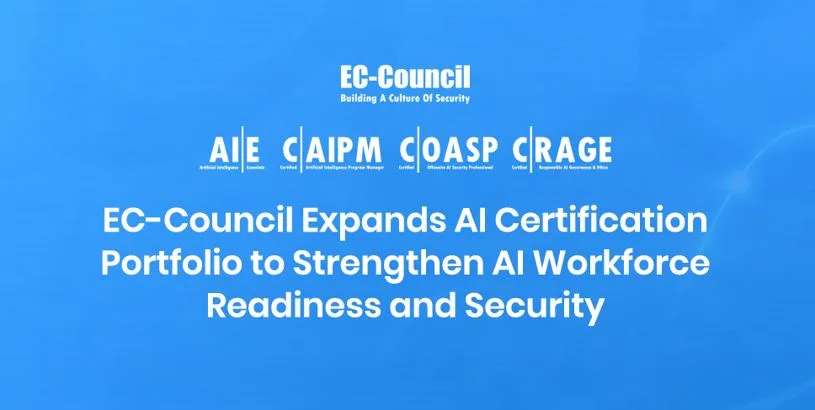
EC-Council, the organization behind the globally recognized Certified Ethical Hacker (CEH) credential, launched its Enterprise AI Credential Suite on February 11, 2026, in Hyderabad — introducing four new role-based AI certifications alongside a revamped Certified CISO (C|CISO) v4 program. EC-Council has called it the largest single expansion of its certification portfolio in the company’s 25-year history.
Seven months on, the suite is still active and increasingly relevant — especially for Indian professionals navigating a job market where AI skills are in short supply and cybersecurity hiring keeps climbing.
Also Read : India – AI Impact Summit 2026: From AI Hype to Hard Outcomes
About EC-Council
EC-Council — formally the International Council of E-Commerce Consultants — was founded in 2001 by Jay Bavisi, established in direct response to the security gaps exposed by the 9/11 attacks. The founding question was straightforward: if a similar attack were carried out on digital infrastructure instead of physical, would the information security community have been ready? At the time, it wasn’t — and EC-Council was built to close that gap.
In 2003, the organization launched its flagship program, the Certified Ethical Hacker (CEH) certification, which remains its most recognized credential today and is widely regarded as an industry benchmark for penetration testing and offensive security skills. Since then, EC-Council has expanded into a broad portfolio of over 600 training programs, certifications, and degrees, including CHFI (Computer Hacking Forensic Investigator), CPENT (Certified Penetration Testing Professional), and C|CISO (Certified Chief Information Security Officer).
EC-Council now describes itself as the world’s largest cybersecurity technical certification body, having certified over 350,000 professionals across more than 140 countries. Its certifications carry recognition from bodies including the U.S. Department of Defense (DoD Directive 8140), NSA/CNSS, ISO/IEC 17024, and GCHQ in the UK, and are used by organizations ranging from Fortune 100 companies to national intelligence agencies. EC-Council also maintains a physical presence in India, alongside offices in the US, UK, Malaysia, Singapore, and Indonesia — relevant context given how directly this AI credential launch was pitched at the Indian market.
Why This Launch Matters for India Specifically
The timing wasn’t incidental. EC-Council tied the launch directly to India’s AI push, referencing government and industry initiatives like BharatGen, Bhashini, and AIKosh, and pointing to the CyberGuard AI Hackathon as evidence of growing applied-AI momentum in the country.
The numbers back up the urgency:
- India is projected to see 2.3 million AI-related job openings, alongside a reskilling gap exceeding 1 million professionals
- 33% of Indian companies are actively hiring for AI roles right now
- 62% of professionals already use generative AI tools in their day-to-day work, often without formal training on how to do so securely
Separately, India’s broader cybersecurity workforce gap remains stark: the country needs an estimated one million cybersecurity professionals but currently has only around 80,000 qualified experts — and industry reports peg the AI-specific talent gap at roughly 53%.
In short: demand for people who can use, manage, secure, and govern AI systems is outpacing the number of professionals who can credibly claim those skills. That’s the gap this credential suite is built to address.
The Four New Certifications
EC-Council’s suite follows what it calls the ADG model — Assess, Defend, Govern — plus a foundational entry point, forming a full lifecycle from basic AI literacy to enterprise-level governance.
1. AI Essentials (AI|E)
A non-technical, foundational certification aimed at establishing a baseline of AI literacy. It’s designed for professionals across roles and industries — not just security teams — who need to understand core AI concepts, use AI tools responsibly, and apply them safely in day-to-day work. This is the recommended entry point before moving to the more specialized certifications below.
2. Certified AI Program Manager (C|AIPM)
Targeted at program managers and executives leading enterprise-scale AI initiatives. It focuses on building AI Centers of Excellence (CoE), aligning AI projects with measurable KPIs, and managing accountability and risk as AI programs scale — essentially the “Bridge” between AI strategy and business value.
3. Certified Offensive AI Security Professional (C|OASP)
A hands-on, advanced program for security professionals who need to think like attackers. It covers AI red-teaming, exploiting model vulnerabilities (prompt injection, data poisoning, model exploitation, and AI supply-chain compromise), and building countermeasures to harden AI systems against these threats.
4. Certified Responsible AI Governance & Ethics (C|RAGE)
Aimed at leaders who need to design and manage responsible AI frameworks. It covers ethical risk management, bias mitigation, explainability (XAI), and governance — aligned with established frameworks like NIST AI RMF and ISO/IEC 42001.
Why This Could Matter for Your Career
If you’re an Indian IT or cybersecurity professional weighing whether this is worth pursuing, a few practical points:
- These certifications are role-specific, not one-size-fits-all. A SOC analyst or penetration tester looking to specialize in AI security is a better fit for C|OASP, while someone moving into a leadership or compliance-adjacent role would get more value from C|AIPM or C|RAGE.
- EC-Council’s certifications carry ANSI and DoD 8140 compliance, which matters if you’re targeting government, defense, or regulated-industry roles — sectors where formal accreditation is often a hard requirement, not just a preference.
- This lands squarely in a widening skills gap. With AI cited as the single biggest skills gap by organizations globally — ahead of even cloud security — being able to demonstrate structured, credentialed AI security or governance knowledge is a genuine differentiator right now, not just resume padding.
- It complements, rather than replaces, foundational certifications. If you don’t already hold something like CEH or a cloud security credential, it’s worth sequencing your learning — foundational security knowledge first, then layering in AI-specific certifications as this suite is designed to do via the AI|E entry point.
The Bigger Picture
This launch reflects something we’ve been tracking across the broader cybersecurity certification space: the industry consensus has shifted from AI as a technology to master toward AI as a system that itself needs to be secured, governed, and managed — no different from how the network security and cloud security certification tracks evolved a decade earlier.
For Indian professionals, the combination of aggressive AI hiring plans, a widening reskilling gap, and a still-thin pool of qualified candidates means certifications like this one carry more weight right now than they might in a saturated market. Whether it’s worth the investment for you specifically depends on your current role and where you want to specialize — but the structural gap in the Indian job market is real, and it isn’t closing on its own.
This article was updated in September 2026 to reflect the current status of EC-Council’s Enterprise AI Credential Suite, seven months after its February 2026 launch.
Source & Disclaimer
Source: Press Release by NewsVoir
Disclaimer: This article is based on a syndicated press release from NewsVoir. TechMitra has edited and optimized the content for clarity, readability, and SEO. All facts, claims, and data are the responsibility of the source organization.

Ayush Singhal is the founder and chief editor of TechMitra.in — a tech hub dedicated to simplifying gadgets, AI tools, and smart innovations for everyday users. With over 15 years of business experience, a Bachelor of Computer Applications (BCA) degree, and 5 years of hands-on experience running an electronics retail shop, Ayush brings real-world gadget knowledge and a genuine passion for emerging technology.
At TechMitra, he covers everything from AI breakthroughs and gadget reviews to app guides, mobile tips, and digital how-tos. His goal is simple — to make tech easy, useful, and enjoyable for everyone. When he’s not testing the latest devices or exploring AI trends, Ayush spends his time crafting tutorials that help readers make smarter digital choices.
📍 Based in Lucknow, India
💡 Focus Areas: Tech News • AI Tools • Gadgets • Digital How-Tos
📧 Contact: Get in touch →
🔗 Full Bio: https://techmitra.in/about-us/