

Introduction
Search Engine Optimization (SEO) is no longer about keyword stuffing or backlink chasing — it’s about creating high-quality, structured, and understandable content that both Google and AI systems can interpret.
For me, on-page SEO has always been the most powerful and controllable part of digital visibility. With the help of the Rank Math SEO plugin, I’ve consistently achieved fast and stable rankings — often appearing on Google’s first page within hours of publishing.
But SEO is evolving. Today, your content doesn’t just need to rank on Google — it also needs to be optimized for AI tools and LLMs (Large Language Models) that power modern search assistants.
And Rank Math is already equipped for this future.
Also Read : On-Page SEO vs Off-Page SEO: What’s the Difference and Why Both Matter?
Table of Contents
What Makes On-Page SEO So Important
On-page SEO ensures your content is optimized for both search engines and readers. It helps Google understand your topic, structure, and purpose.
Key on-page elements include:
Keyword placement in titles, headings, and paragraphs
Meta tags and descriptions
Internal links and structured schema
Image optimization and alt text
Readable content and mobile responsiveness
Without strong on-page SEO, even great content can remain invisible.
That’s why Rank Math acts as your real-time SEO assistant — guiding you to optimize every detail that matters.
Why I Use Rank Math Plugin Over Other SEO Plugins
Before switching to Rank Math SEO Plugin, I tried other tools like Yoast and AIOSEO — but Rank Math felt like the perfect balance of simplicity and depth.
| Feature | Why Rank Math Wins |
|---|---|
| Ease of Use | Clean, visual indicators (red → green) for instant feedback. |
| Built-in Tools | Includes schema, redirections, analytics, and instant indexing — all in one. |
| Performance | Lightweight plugin that keeps your site fast and Core Web Vitals healthy. |
It’s powerful yet beginner-friendly — which is why it’s trusted by professionals, bloggers, and agencies alike.
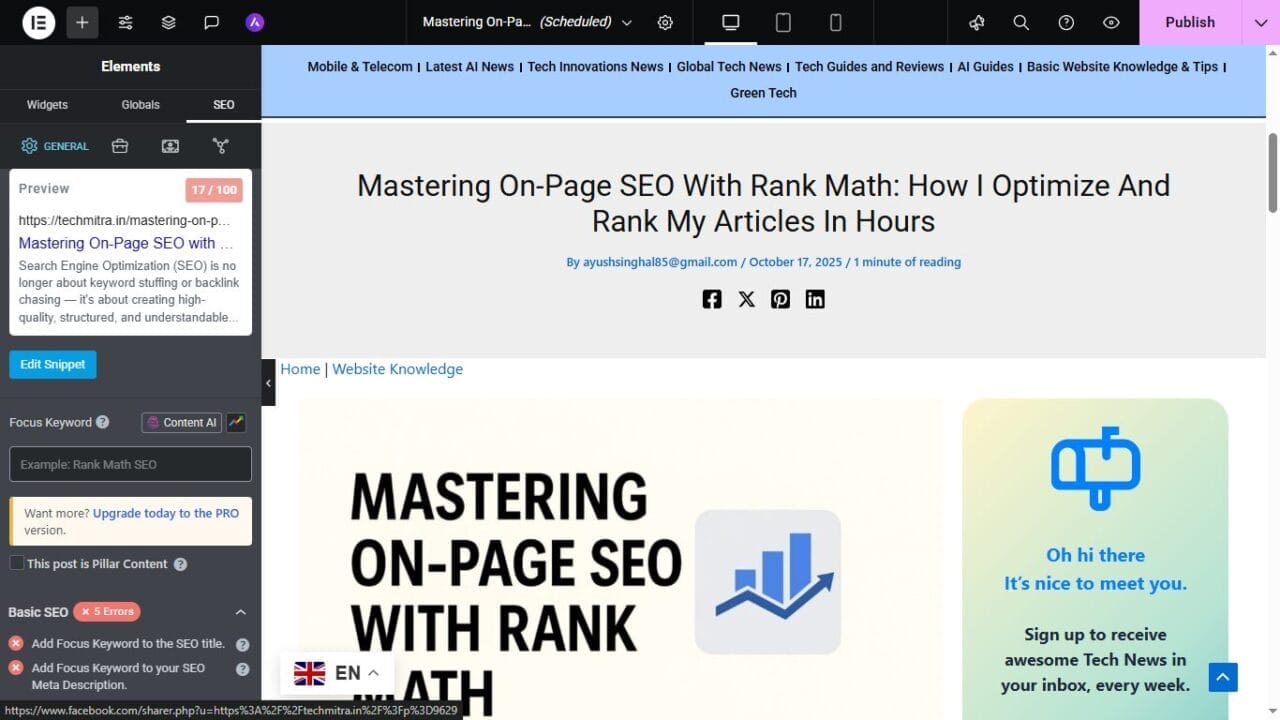
Below Screenshot : Rank Math dashboard showing SEO score + keyword field.
A Note on the Version I Use
I’ve achieved all these results using the free version of Rank Math.
It already includes powerful features like schema generator, multiple focus keywords, SEO analysis, and redirection tools.For anyone starting out, the free version is more than enough to perform complete on-page SEO and even prepare your content for AI-driven visibility (LLMO).
Step-by-Step: How Rank Math Helps Optimize a Page
Step 1: Set the Focus Keyword
Rank Math lets you add multiple focus keywords per article. Once added, it automatically scans your content for:
Keyword placement in title, URL, and meta description
Keyword usage in headings and body text
Keyword density and distribution
This keeps your content natural and keyword-rich without triggering over-optimization penalties.
Step 2: Optimize Title & Meta Description
Rank Math’s snippet editor shows how your content appears in Google results.
You can adjust:
SEO title and meta description
Mobile vs desktop previews
Character length and keyword inclusion
These small tweaks can significantly increase CTR (Click-Through Rate).
Step 3: On-Page SEO Checklist
- Rank Math SEO WordPress Plugin provides a color-coded checklist for 100+ on-page factors:
- Internal/external links
- Image ALT text
- Keyword in intro paragraph
- Content length
- Readability score
Every green light means your content is one step closer to ranking better — and faster.
Step 4: Schema & Rich Results
Structured data (schema) helps Google and AI understand your content contextually.
Rank Math’s Schema Generator lets you easily add:
Article schema
Product schema
FAQ or How-To schema
Review schema
Schema is the secret behind those “rich results” — like star ratings, FAQs, and price snippets — that increase visibility and CTR.
Step 5: Technical Maintenance
Rank Math includes tools that most plugins charge extra for:
404 Monitor (find broken links)
Redirection Manager (fix them instantly)
Analytics Dashboard (view keyword performance via Search Console)
Together, they keep your site technically healthy and optimized.
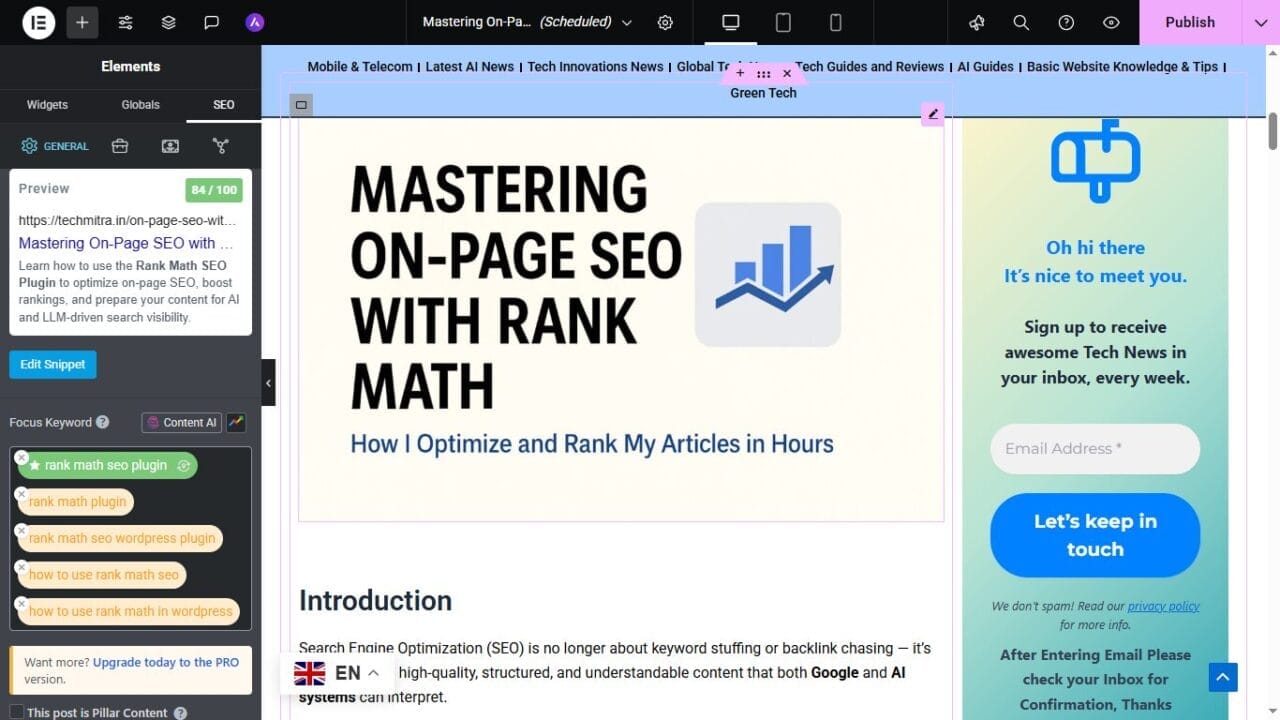
This article achieved an 84/100 SEO score in Rank Math — proving how effective its on-page optimization techniques truly are.
How Rank Math’s SEO Score Improves Writing Quality
Rank Math doesn’t just measure optimization — it teaches good writing habits.
When your score rises from 70 to 90, it means your content:
Became more structured
Uses keywords naturally
Flows better for readers and search engines
It’s like having an SEO mentor inside WordPress — one that pushes you to deliver quality and clarity.
Optimizing for AI and LLMs: The Future of SEO
What Is an LLM?
LLM stands for Large Language Model — the AI engines behind tools like ChatGPT, Claude, Gemini, and Perplexity.
These models scan web pages to extract useful, trustworthy, and structured information to answer user queries.
But here’s the twist:
AI tools don’t crawl like Google. They only read and use specific parts of your page — mainly clear, structured content sections like FAQs, headings, and summaries.
That’s why the new era of SEO involves LLMO — Large Language Model Optimization.
What Is LLMO?
LLMO (Large Language Model Optimization) means making your content easy for AI models to read, understand, and reuse in answers.
It’s like SEO — but instead of optimizing for Google bots, you’re optimizing for AI crawlers and semantic engines.
The goal is simple:
Write in a clear, structured way
Use schema and FAQs to guide AI
Provide concise answers that AIs can quote or summarize
How Rank Math Helps in LLMO
Rank Math already includes powerful tools that naturally support AI-readability and LLM optimization:
| Feature | LLMO Benefit |
|---|---|
| FAQ & TOC Blocks | Help AI pick direct, structured answers easily. |
| Schema Generator | Adds rich data (FAQ, Article, Product) for AI parsing. |
| LLM.txt File Support | Guides AI crawlers on how to interpret your site content. |
| Voice Search Optimization | Helps content rank for conversational AI queries. |
| Canonical URLs | Ensures AI models and search engines avoid duplicates. |
Together, these features help AI tools trust and recommend your content more often in their answers — even in zero-click search results.
Why LLMO Matters for Your Business
When AI systems like ChatGPT or Perplexity mention your website, product, or blog in their answers, you gain:
Brand visibility without needing backlinks
Traffic from “AI citations”
Reputation as an authority in your niche
LLMO is the next evolution of SEO — and Rank Math is already leading the way by helping you create AI-friendly, human-readable, structured content.
Real Results: Proof from My Own Articles
Using Rank Math’s features, I’ve achieved consistent real-world results:
My “Jio AirFiber Review” article has ranked #4 on Google’s first page for over 3 months.
My “Google One Diwali Offer” article reached #4, after Huge media websites verified in incognito search.
Both results were achieved without backlinks, purely through on-page SEO + Rank Math optimization.
That’s the power of clear structure, keyword alignment, and schema-backed content — exactly what Rank Math makes effortless.
Key Takeaways
| Aspect | Rank Math Advantage |
|---|---|
| Keyword Optimization | Real-time keyword tracking and density check |
| Meta & Snippets | Mobile-friendly live preview for perfect CTR |
| Schema | Structured data generator for AI + Google |
| Internal Linking | Improves crawl depth and engagement |
| Analytics | Connects to GSC for keyword insights |
| LLM Optimization | Structured data, LLM.txt, and FAQ support |
Conclusion
Rank Math isn’t just an SEO plugin — it’s your on-page optimization partner for both Google and AI search.
With its intelligent features, you can:
Write better, structured content
Optimize pages effortlessly
Prepare your website for the future of AI-driven search
“SEO helped us rank on Google.
LLMO will help us rank inside AI answers.”
If you’re serious about visibility, traffic, and authority — start using Rank Math not just for SEO, but for LLMO (Large Language Model Optimization) too.
Because the future of search isn’t just about keywords — it’s about clarity, structure, and intelligence.

Ayush Singhal is the founder and chief editor of TechMitra.in — a tech hub dedicated to simplifying gadgets, AI tools, and smart innovations for everyday users. With over 15 years of business experience, a Bachelor of Computer Applications (BCA) degree, and 5 years of hands-on experience running an electronics retail shop, Ayush brings real-world gadget knowledge and a genuine passion for emerging technology.
At TechMitra, he covers everything from AI breakthroughs and gadget reviews to app guides, mobile tips, and digital how-tos. His goal is simple — to make tech easy, useful, and enjoyable for everyone. When he’s not testing the latest devices or exploring AI trends, Ayush spends his time crafting tutorials that help readers make smarter digital choices.
📍 Based in Lucknow, India
💡 Focus Areas: Tech News • AI Tools • Gadgets • Digital How-Tos
📧 Email: contact@techmitra.in
🔗 Full Bio: https://techmitra.in/about-us/