
Google has started rolling out the December 2025 Core Update, triggering noticeable ranking and traffic changes worldwide. Here’s what webmasters should expect and why Google advises patience during the rollout.
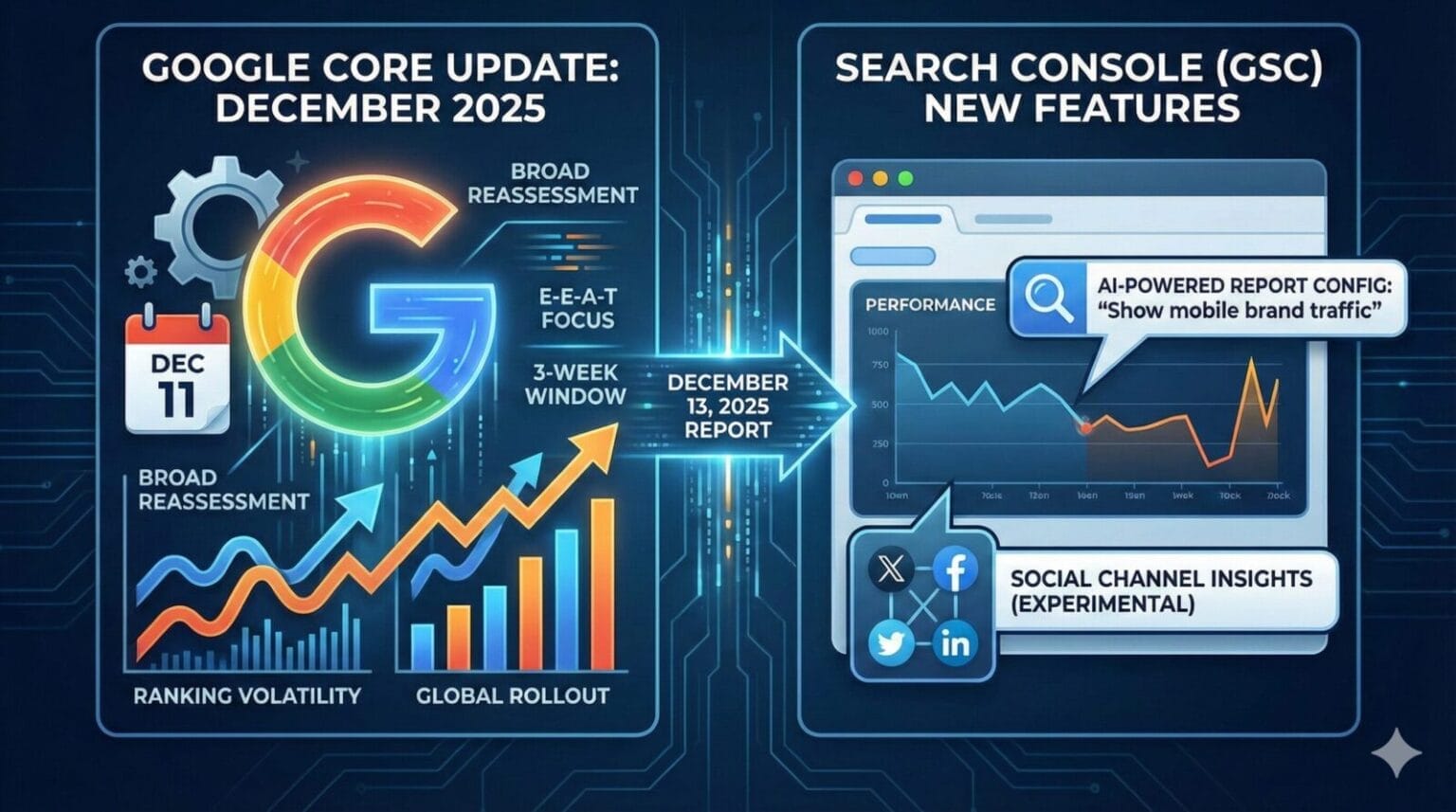
Google search core update 2025 rolled out this December, marking the third and likely final broad core algorithm update of the year. The update went live on December 11, 2025, at 09:25 AM PST, and within hours, SEO tools and webmasters across the world started noticing sharp movement in rankings, impressions, and clicks.
At the same time, Google quietly introduced new features inside Google Search Console (GSC), making December a double-impact month for site owners. Many people are referring to this period as both a core update and a GSC update—and for good reason.
Below is a clear, practical breakdown of what changed, why it matters, and how webmasters should respond.
Table of Contents
The December Google Search Core Update 2025
What Exactly Happened?
Google confirmed the rollout via its Search Status Dashboard, stating that the update began on December 11 and may take up to three weeks to fully deploy across all data centers.
Like all broad core updates, this one is:
Global (all countries and languages)
Not niche-specific
Not a penalty-based update
If your rankings moved, it does not automatically mean something is wrong with your website.
The Real Goal of the Update
Throughout 2025, Google has been steadily refining how it evaluates “helpful content.” The December update continues this direction but with a stronger emphasis on content depth and authenticity.
Instead of targeting spam or specific tactics, this update works as a large scale reassessment of:
Which pages best satisfy user intent
Which sources feel genuinely trustworthy
Which content adds new value rather than repeating what already exists
Reward, Not Punish
Google has repeated this message over the years, and it applies here too:
A ranking drop does not mean your site was penalized. It often means other pages are now seen as more helpful.
This distinction is critical. Panic edits during rollout often cause more harm than good.
Stronger Weight on E-E-A-T
Early observations suggest that E-E-A-T (Experience, Expertise, Authoritativeness, Trustworthiness) is playing a bigger role than before.
Sites seeing volatility often share one or more of these traits:
Thin or generic content
Mass-produced articles with little originality
AI-generated content published without human review or real-world insight
Missing author context or credibility signals
On the other hand, pages that:
Demonstrate first-hand experience
Clearly explain why something works
Are written or reviewed by real subject experts
appear to be holding steady—or improving.
What You’ll Notice in Google Search Console
During the rollout window, it’s normal to see unusual patterns in your Performance report, such as:
Sudden spikes or dips in impressions and clicks
Average position fluctuations, sometimes changing daily
Temporary drops followed by partial or full recovery
Important advisory:
Most SEO professionals recommend waiting until the rollout is fully complete (likely late December or early January 2026) before making major changes. Rankings often stabilize—or reverse—once the update finishes.

New Features Added to Google Search Console (Tool Updates)
Alongside the algorithm update, Google also released functional improvements to Search Console, which has added to the confusion around “December updates.”
These changes do not affect rankings directly, but they do change how you analyze performance.
A. Social Channel Insights (Experimental)
Google has started testing a new Social Channel Insights section within Search Console Insights.
What it does
Combines search performance data with signals from connected social platforms
Shows how content traction on social media aligns with search interest
Why it matters
For creators and publishers, this helps answer an important question:
Is social visibility helping—or predicting—search demand?
This feature is still experimental and may not appear for all properties yet.
B. AI-Powered Report Configuration
Another experimental addition is natural language report setup inside GSC.
How it works
Instead of manually applying filters, you can type queries like:
“Show me mobile traffic for my brand keywords”
Google then automatically builds the report for you.
Availability
Rolling out gradually
Currently visible only on select accounts
This feature doesn’t change data—but it dramatically reduces analysis time.
Summary & Action Plan
| Update / Feature | Current Status | What You Should Do |
|---|---|---|
| December 2025 Core Update | Rolling out (started Dec 11) | Monitor trends, avoid panic edits |
| Social Channel Insights | Experimental | Check GSC Insights for availability |
| AI Report Configuration | Gradual rollout | Test natural-language queries |
Smart Next Steps for Webmasters
1. Annotate Your Analytics
Mark December 11, 2025 in:
Google Analytics
Search Console exports
SEO tracking tools
This helps you accurately link future changes to this update.
2. Review Content — Don’t Rewrite Blindly
If traffic drops after the rollout completes, evaluate affected pages using Google’s own quality questions:
Does this content offer something new?
Is real experience visible?
Would you trust this page if you landed on it for the first time?
Focus on improving clarity, depth, and usefulness, not just keywords.
3. Keep an Eye on the Status Dashboard
Google will officially announce when the rollout is complete. That is the right moment to decide whether action is needed.
Final Thoughts
The December 2025 Core Update reinforces a message Google has been sending all year:
Helpful, experience-driven content wins in the long run.
At the same time, new Search Console features show Google’s push toward smarter, AI-assisted analysis for creators and webmasters.
If you stay calm, track data correctly, and focus on genuine value rather than quick fixes, this update can be an opportunity—not a setback.
As always in SEO, patience and quality beat panic and shortcuts.
Disclaimer
This article is based on officially available information, early industry observations, and ongoing monitoring of the December 2025 Google Core Update. Search performance may fluctuate during the rollout period, and outcomes can vary by website. The information provided here is for informational purposes only and should not be considered guaranteed SEO advice or a prediction of ranking results.
Trending

Ayush Singhal is the founder and chief editor of TechMitra.in — a tech hub dedicated to simplifying gadgets, AI tools, and smart innovations for everyday users. With over 15 years of business experience, a Bachelor of Computer Applications (BCA) degree, and 5 years of hands-on experience running an electronics retail shop, Ayush brings real-world gadget knowledge and a genuine passion for emerging technology.
At TechMitra, he covers everything from AI breakthroughs and gadget reviews to app guides, mobile tips, and digital how-tos. His goal is simple — to make tech easy, useful, and enjoyable for everyone. When he’s not testing the latest devices or exploring AI trends, Ayush spends his time crafting tutorials that help readers make smarter digital choices.
📍 Based in Lucknow, India
💡 Focus Areas: Tech News • AI Tools • Gadgets • Digital How-Tos
📧 Email: contact@techmitra.in
🔗 Full Bio: https://techmitra.in/about-us/