
Get the latest TechMitra news, AI trends, and gadget updates instantly on WhatsApp.
👉 Join our WhatsApp Channel
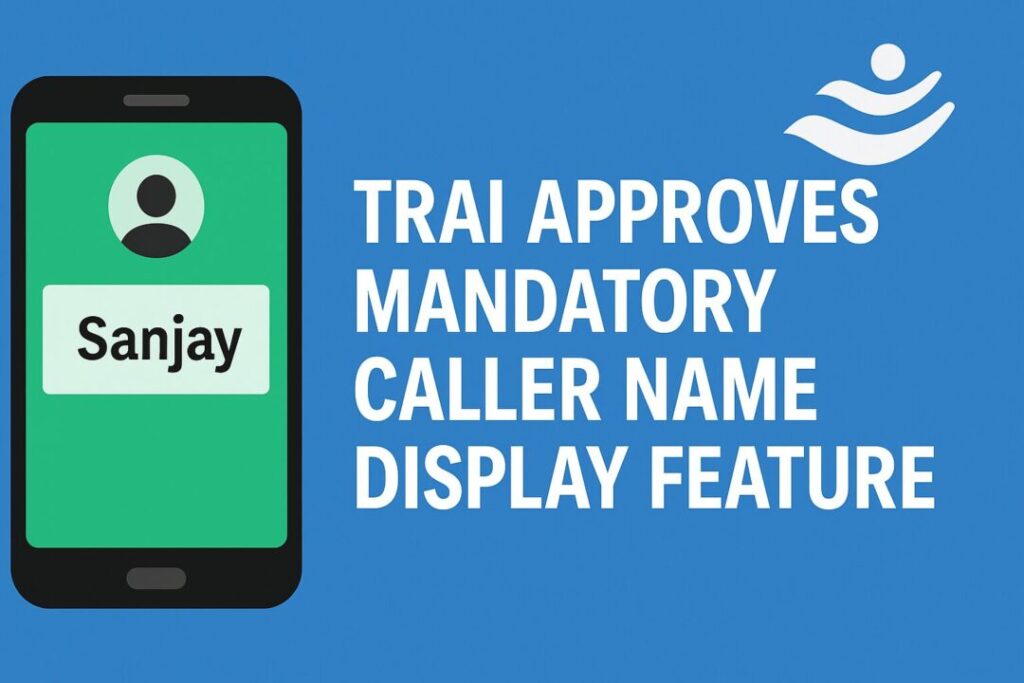
The Telecom Regulatory Authority of India (TRAI) has officially approved a major reform in India’s telecom ecosystem — the Calling Name Presentation (CNAP Caller Id) service. Under this new directive, every mobile user in India will soon be able to see the caller’s verified name on their phone screen by default, eliminating the need for third-party apps such as Truecaller.
This move follows a proposal from the Department of Telecommunications (DoT) and aims to enhance transparency, security, and user trust in the communication network.
Table of Contents
Microsoft Mico: The Animated AI Assistant That’s Redefining Human–AI Interaction
What is the CNAP Service?
The Calling Name Presentation (CNAP) is a supplementary telecom service designed to display the caller’s verified name alongside their phone number during incoming calls.
Unlike existing systems that only show the number — technically known as Calling Line Identification (CLI) — the CNAP feature will use verified data collected during SIM registration to ensure the caller’s name is genuine and accurate.
Essentially, this will function as a built-in Caller ID system, fully integrated within the telecom network.
How CNAP Works
Here’s how the system will function in real-world use:
Caller Identity Verification:
Each telecom operator will maintain a Calling Name (CNAM) database, containing the subscriber’s verified name and registered number.Call Routing and Lookup:
When a call is made, the receiving network (known as the terminating access service provider) will use its Local Number Portability Database (LNPD) to identify the calling network.Display on Receiver’s Phone:
The terminating network will then retrieve the verified name from the CNAM database and display it on the receiver’s phone screen — all in real time.
Why This Move Matters
The introduction of CNAP is a significant step forward for India’s telecom industry for several reasons:
1. Stronger Protection Against Spam and Fraud
By showing verified caller information, users can instantly identify suspicious or spam calls. This could dramatically reduce cases of phishing, scam, and telemarketing fraud — areas where India has seen a rapid rise.
2. Reduced Dependence on Third-Party Apps
With CNAP built into the network itself, users will no longer need third-party caller ID apps that collect personal data or require access to contacts.
3. Transparency and Trust in Communication
Users will have better control and awareness over incoming calls, leading to safer communication and improved trust in digital interactions.
User Control and Privacy Options
According to TRAI, CNAP will be enabled by default for all telecom subscribers across India.
However, users who prefer not to display their name can opt out by contacting their respective Telecom Service Provider (TSP).
This ensures a balance between privacy and transparency, giving subscribers the final choice over their participation.
Technical Implementation & Testing
Before the national rollout, the Department of Telecommunications conducted pilot tests in select cities to assess CNAP’s technical feasibility on 4G and 5G networks.
The initial trials revealed some technical challenges, including:
Lack of required software patches
Need for system upgrades by telecom operators
Compatibility issues with legacy networks
Due to these constraints, testing was carried out only on packet-switched (data) networks, leaving traditional circuit-switched (voice) networks for later stages.
Still, the results of the pilot were encouraging enough for TRAI to move forward with implementation recommendations.
What Telecom Operators Need to Do
Every access service provider — including Airtel, Jio, Vi, and BSNL — will now be required to:
Establish and operate a Calling Name (CNAM) database.
Integrate CNAP with their core telecom services.
Ensure interoperability so that calls between networks (e.g., Jio to Airtel) also display the caller’s verified name correctly.
This integration will operate as a supplementary service, not a standalone feature, meaning users won’t need a separate plan or subscription to use CNAP.
What CNAP Caller Id Is Not
To clarify, TRAI emphasized that CNAP:
Is not a separate paid service.
Will not replace the standard calling functions.
Will not share additional personal information beyond the caller’s verified name.
Essentially, it’s a network-level enhancement, much like caller tunes or call forwarding — only this time, it’s focused on security and transparency.
Comparison with Current Caller ID Systems
| Feature | Current CLI System | New CNAP System |
|---|---|---|
| Information Displayed | Only mobile or landline number | Verified name + number |
| Data Source | Unknown / Unverified | SIM registration database |
| Dependence on Third-party Apps | Yes (Truecaller, etc.) | No |
| Privacy Controls | None | User opt-out option |
| Accuracy | Variable | Verified via telecom KYC |
When Will CNAP Roll Out?
While an exact rollout date has not yet been announced, TRAI’s approval means the implementation process will begin soon.
Telecom companies are expected to start network upgrades and integration work in phases, with a gradual rollout across India once technical readiness is achieved.
Given that testing has already been completed for 4G and 5G networks, the service could become available to users sometime in 2026, depending on operator readiness.
Expert Opinion
Telecom analysts believe this move could transform the mobile communication experience in India.
“The CNAP initiative is a logical next step toward a safer digital ecosystem. It could drastically reduce scam calls and data harvesting by third-party caller ID services,” said a senior telecom expert.
However, experts also warn that maintaining accurate and updated caller databases will be crucial for the system’s reliability.
Final Thoughts
The TRAI CNAP service marks a major milestone in India’s digital communication evolution. By allowing verified caller name display by default, it empowers users with information, enhances security, and restores trust in the calling experience.
With this step, India joins a small group of nations actively prioritizing telecom transparency and consumer protection at a national level — setting a new benchmark for responsible communication.
Trending

Ayush Singhal is the founder and chief editor of TechMitra.in — a tech hub dedicated to simplifying gadgets, AI tools, and smart innovations for everyday users. With over 15 years of business experience, a Bachelor of Computer Applications (BCA) degree, and 5 years of hands-on experience running an electronics retail shop, Ayush brings real-world gadget knowledge and a genuine passion for emerging technology.
At TechMitra, he covers everything from AI breakthroughs and gadget reviews to app guides, mobile tips, and digital how-tos. His goal is simple — to make tech easy, useful, and enjoyable for everyone. When he’s not testing the latest devices or exploring AI trends, Ayush spends his time crafting tutorials that help readers make smarter digital choices.
📍 Based in Lucknow, India
💡 Focus Areas: Tech News • AI Tools • Gadgets • Digital How-Tos
📧 Email: contact@techmitra.in
🔗 Full Bio: https://techmitra.in/about-us/