

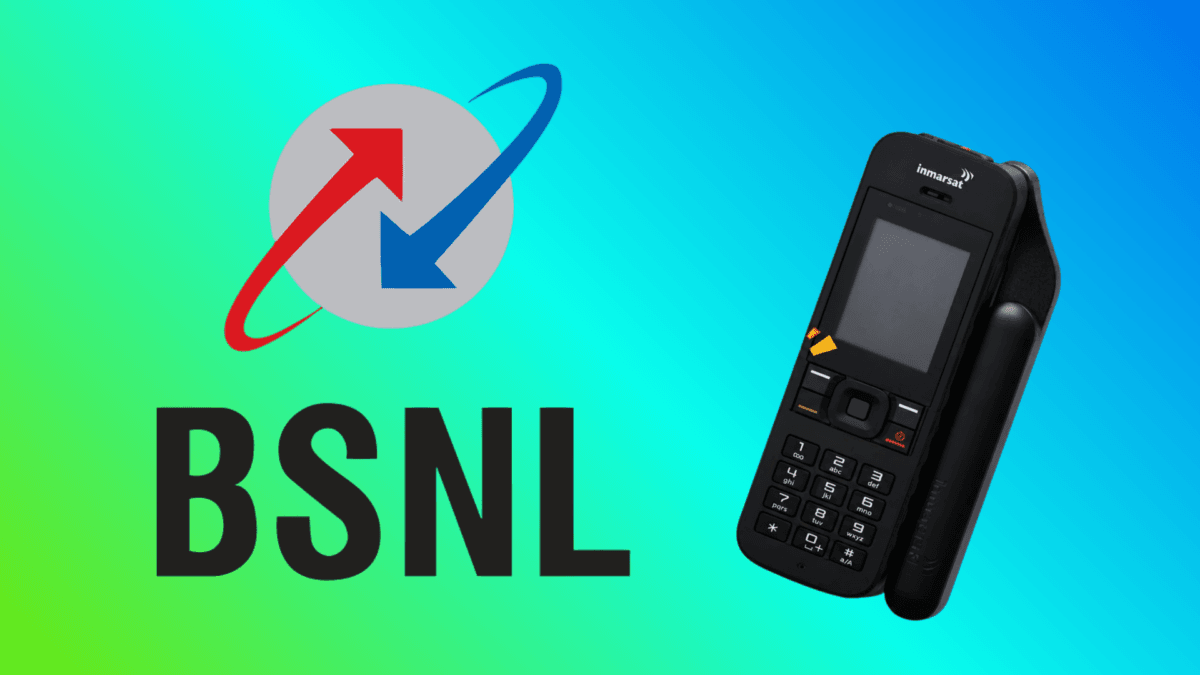
BSNL has launched a new satellite phone in India, built on Inmarsat’s satellite network, priced at ₹1,34,166 including taxes. It’s aimed squarely at defence, maritime, disaster response, mining, and remote fieldwork use cases — not general consumers. Here’s what it actually offers, how it fits into BSNL’s existing satellite lineup, and the legal reality of owning one in India.
Table of Contents
What Is the BSNL Satellite Phone?
BSNL has introduced a satellite handset developed in partnership with Inmarsat, the international satellite communications provider. Unlike a regular smartphone, this device skips mobile towers entirely and connects straight to satellites, which means it keeps working in places where every telecom operator’s signal drops to zero — deep forests, high-altitude terrain, mid-ocean, or areas where towers have been knocked out by a flood or cyclone.
BSNL announced the launch with the tagline “Communication Beyond Boundaries,” and its own messaging is clear about who this is for: Defence, Maritime, Disaster Response, Mining, Remote Operations, and Adventure Travel. If you’re not operating in one of those environments on a regular basis, this isn’t a device built with you in mind — and BSNL isn’t pretending otherwise.
Price
The BSNL satellite phone price ₹1,34,166, inclusive of all applicable taxes. That’s a steep number next to any regular smartphone, but it’s actually in line with what satellite handsets have historically cost worldwide — the specialized hardware (satellite modem, ruggedized shell, dedicated antenna) doesn’t come cheap regardless of the network behind it.
It’s worth noting this isn’t BSNL’s first satellite offering. The company has sold the IsatPhone 2 for around ₹90,000 through its satellite service since 2018. The new Inmarsat handset sits above that as a fresh device option within the same broader service, rather than replacing it.
Key Features
- Direct satellite connectivity — bypasses mobile towers completely, working in zero-network zones
- Voice calling and SMS over satellite — functions independently of any terrestrial carrier
- Dedicated SOS/emergency button — built for critical situations where every second counts
- Rugged, weatherproof design — built to handle dust, water, and physical impact in field conditions
- Extended battery life — designed for long stretches without access to charging infrastructure
- Encrypted communications — all calls and messages over the service are encrypted
Who Is This Phone For?
BSNL has been specific here. The intended users include:
- Armed forces and defence personnel operating in remote or sensitive zones
- Disaster response and emergency management teams
- Maritime crews and shipping operations
- Mining and remote industrial site workers
- Pilgrims travelling through isolated regions
- Adventure travellers heading into areas with no cellular coverage
This is not a phone you’ll casually pick up because you liked the review. It’s a specialised institutional and professional communication tool, and BSNL treats it that way at every step of the buying process.
How to Buy It (It’s Not on Amazon or Flipkart)
You won’t find this listed on any e-commerce site or in a regular mobile store. BSNL requires interested buyers to contact the company directly — either through the nearest BSNL office or a dedicated helpline — and go through a verification process similar to what’s required for a regular mobile SIM, plus additional details about where you intend to use the device, for how long, and for what purpose.
That extra scrutiny isn’t BSNL being difficult. It’s a legal requirement, and it’s worth understanding why before you assume you can just walk in and buy one.
Is It Legal to Own a Satellite Phone in India?
This is the part most coverage of this launch has glossed over, and it matters more than the spec sheet.
Satellite phones are not legal by default in India. The Department of Telecommunications’ own guidance states that satellite phones are permitted only under specific conditions: either with explicit permission or a No Objection Certificate from the DoT, or through BSNL’s own satellite service, which operates under a license the DoT has separately granted BSNL for exactly this purpose, using BSNL’s own satellite gateway infrastructure.
That second condition is precisely why this handset is legal to use in India in the first place. It rides on BSNL’s own DoT-licensed gateway, so the authorization is effectively built into BSNL’s own customer verification process — you’re not separately petitioning the DoT for an NOC the way, say, a foreign traveller carrying in an unauthorized satphone would need to.
This also explains a detail that surprises a lot of people: not every satellite phone brand is legal here. Iridium and Thuraya handsets are banned outright in India. Following the 2011 Mumbai attacks, the Directorate General of Shipping prohibited both networks in 2012, building on restrictions that had already been in place since 2010 under the Indian Telegraph Act. Inmarsat, the network BSNL’s new phone runs on, is the exception — but only with DoT permission attached.
The consequences of skipping that permission are real, not theoretical. Anyone found possessing an unauthorized satellite phone in India can be prosecuted, and the device itself gets seized. A 2010 customs circular specifically requires that any satellite phone declared at customs be cleared only once the traveller produces valid DoT use-permission; without it, the phone can be detained and legal action can follow.
One important distinction to keep in mind: this individual-user authorization process is separate from the bigger regulatory story currently playing out around satellite companies like Starlink, Eutelsat OneWeb, and Jio Satcom. Those companies are dealing with a different set of draft DoT rules around spectrum assignment and security clearances before they can offer public satellite broadband and phone services at all. That’s operator-level licensing — a completely different question from whether you, individually, can own and use a satellite handset. Don’t let the two get mixed up if you’re researching this online; a lot of the coverage on satellite regulation in India right now is actually about that operator story, not about buying a BSNL satphone.
Satellite Service Plans: What Will It Cost to Actually Use It?
Buying the handset is only part of the cost — you’ll also need an active satellite service plan. PTI further reported that BSNL offers dedicated prepaid and postpaid satellite service plans for government and commercial users. Earlier tariff details cited by the agency included postpaid plans priced at ₹3,500, ₹5,835, and ₹11,670 per month, while prepaid plans start at ₹3,500 per month for government users and ₹5,835 per month for commercial customers. The report added that additional prepaid top-up vouchers are available in denominations from ₹200 to ₹10,000.
Since these figures come from earlier PTI reporting on BSNL’s existing satellite service tariffs, it’s worth confirming current pricing directly with BSNL before committing — especially since this new handset launch could come with updated plan structures.
Bottom Line
BSNL’s new Inmarsat satellite phone fills a real gap: reliable voice connectivity in places where Jio, Airtel, and Vi towers simply don’t exist. At ₹1,34,166 plus BSNL’s separate satellite service plans, it’s priced and positioned for institutions and professionals working in defence, disaster response, maritime, and remote fieldwork — not for everyday buyers. If that’s your use case, the next step isn’t an online purchase; it’s a call to BSNL to start the verification process directly.
If you’re curious how reliable your everyday mobile signal actually is before considering something like this, see TRAI MySpeed App review.
This article is based on BSNL’s official launch announcement and DoT regulatory guidance as of July 2026. Contact BSNL directly for current pricing, plan tariffs, and eligibility, as satellite service terms are subject to change.

Ayush Singhal is the founder and chief editor of TechMitra.in — a tech hub dedicated to simplifying gadgets, AI tools, and smart innovations for everyday users. With over 15 years of business experience, a Bachelor of Computer Applications (BCA) degree, and 5 years of hands-on experience running an electronics retail shop, Ayush brings real-world gadget knowledge and a genuine passion for emerging technology.
At TechMitra, he covers everything from AI breakthroughs and gadget reviews to app guides, mobile tips, and digital how-tos. His goal is simple — to make tech easy, useful, and enjoyable for everyone. When he’s not testing the latest devices or exploring AI trends, Ayush spends his time crafting tutorials that help readers make smarter digital choices.
📍 Based in Lucknow, India
💡 Focus Areas: Tech News • AI Tools • Gadgets • Digital How-Tos
📧 Contact: Get in touch →
🔗 Full Bio: https://techmitra.in/about-us/