
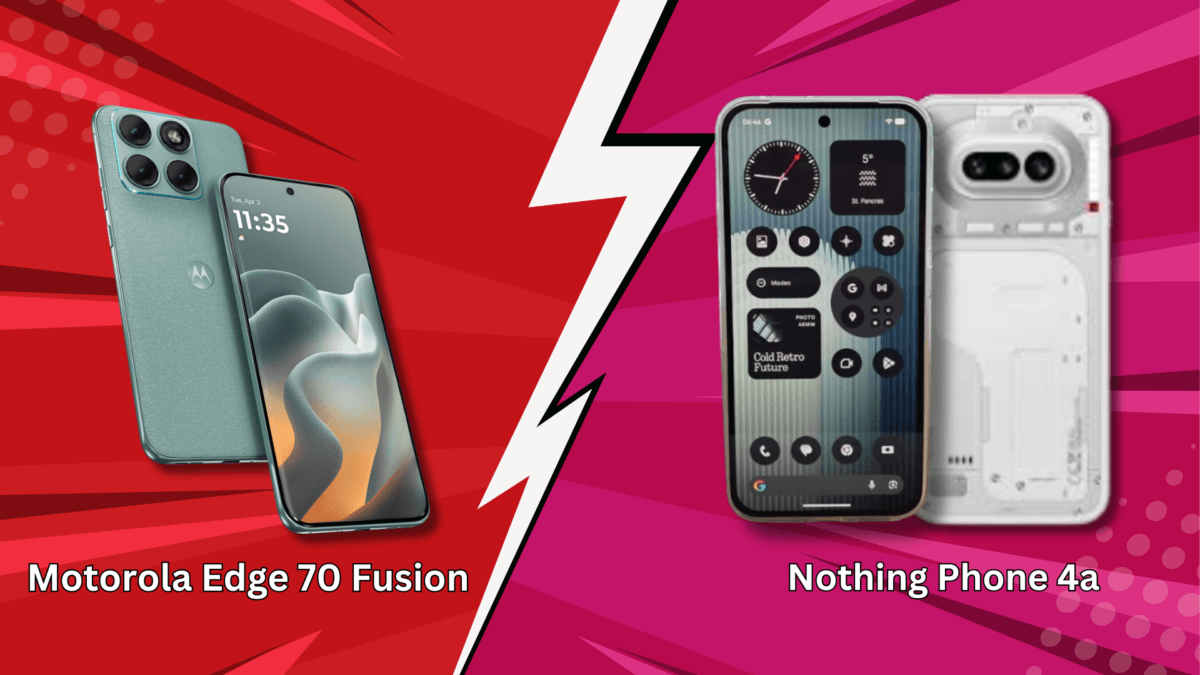
Nothing Phone 4a vs Motorola Edge 70 Fusion comparison: Which new mid-range phone offers better value?
The Indian smartphone market just got two exciting new mid-range contenders within 24 hours.
On March 5, Nothing introduced the Nothing Phone 4a, bringing its signature design and the upgraded Glyph Bar interface. Just a day later, Motorola launched the Edge 70 Fusion, focusing on raw performance, durability, and a massive battery.
Interestingly, both phones share a very similar hardware foundation, including the same Snapdragon chipset and comparable display sizes. However, their design philosophy and user experience are quite different.
Let’s take a closer look at both smartphones and see which one offers better value for buyers in India.
Table of Contents
Nothing Phone 4a: Unique Design Meets Flagship-Like Features
Nothing continues its tradition of standing out in a sea of similar smartphones. The new Phone 4a carries forward the brand’s transparent aesthetic and introduces a refined Glyph lighting system.
The smartphone comes with four color options — Black, Blue, Pink, and White and offers three storage configurations starting at ₹31,999 in India.
Display and Performance
Nothing Phone 4a features a 6.78-inch LTPS AMOLED display with a 120Hz refresh rate and peak brightness reaching 4,500 nits, making it easily visible even in bright sunlight. nothing phone 4a & motorola 70…
Powering the device is the Snapdragon 7s Gen 4 chipset, built on a 4nm architecture. The processor is paired with up to 12GB RAM and 256GB UFS 3.1 storage, ensuring smooth multitasking and gaming. nothing phone 4a & motorola 70…
Nothing ships the phone with Android 16-based Nothing OS 4.1, promising three major Android updates and six years of security patches, which is impressive for this price segment.
Glyph Bar: The Standout Feature
One of the biggest highlights of the Phone 4a is the new Glyph Bar interface, which includes 63 mini-LED lights across six addressable zones. nothing phone 4a & motorola 70…
The Glyph system can be used for:
- Notification alerts
- Timers and progress indicators
- Volume level display
- Camera countdown
- Flip-to-record functionality
It adds a visual layer of interaction that no other smartphone brand currently offers.
Camera Setup
Photography is another strong area for the Phone 4a. It includes a triple rear camera system:
- 50MP main camera with OIS
- 50MP periscope telephoto lens with 70x zoom capability
- 8MP ultra-wide sensor
For selfies, there’s a 32MP front camera capable of 4K video recording at 30fps.
Battery and Charging
The device packs a 5,400mAh battery with 50W fast charging, which can charge the phone from 1% to 100% in about 64 minutes.
Nothing Phone 4a vs Nothing Phone 3a: What Has Changed?
Nothing’s new Phone 4a brings several upgrades compared to the previous Phone 3a, including a faster processor, brighter display, and a larger battery. While the overall design philosophy remains similar, the newer model improves performance and introduces an enhanced Glyph lighting system.
The Nothing Phone 3a was powered by the Snapdragon 7 Gen 3 processor, whereas the Phone 4a moves to the Snapdragon 7s Gen 4 chipset, which offers improved efficiency and AI processing capabilities.
Another noticeable upgrade comes in the display department. The Phone 4a features a larger 6.78-inch AMOLED panel with up to 4,500 nits peak brightness, while the Phone 3a had a 6.77-inch AMOLED display.
Battery capacity has also increased slightly, with the Phone 4a packing a 5,400mAh battery, compared to the 5,000mAh battery on the Phone 3a.
However, the camera setup remains quite similar, with both devices offering a 50MP primary camera and telephoto support, along with a 32MP front camera.
Nothing Phone 4a vs 3a Specifications
| Feature | Nothing Phone 4a | Nothing Phone 3a |
|---|---|---|
| Processor | Snapdragon 7s Gen 4 | Snapdragon 7 Gen 3 |
| Display | 6.78″ AMOLED, 120Hz | 6.77″ AMOLED |
| Rear Cameras | 50MP + 50MP + 8MP | 50MP + 50MP + 8MP |
| Front Camera | 32MP | 32MP |
| Battery | 5,400mAh | 5,000mAh |
| OS | Android 16 | Android 15 |
| Starting Price | ₹31,999 | ₹24,999 |
Should You Upgrade?
If you already own the Nothing Phone 3a, upgrading to the Phone 4a mainly brings better performance, brighter display, and improved battery life. However, users who prioritize camera upgrades may not see a massive difference between the two models.
Motorola Edge 70 Fusion: Power, Durability and Huge Battery
Motorola has taken a different approach with the Edge 70 Fusion. Instead of focusing on design gimmicks, Motorola prioritizes performance, durability, and battery life.
The phone starts at ₹26,999 in India, making it significantly cheaper than the Nothing Phone 4a.
Display and Performance
Motorola Edge 70 Fusion also features a 6.78-inch AMOLED display, but it pushes things further with a 144Hz refresh rate and 5,200 nits peak brightness.
Just like the Nothing phone, it runs on the Snapdragon 7s Gen 4 chipset, paired with up to 12GB RAM and 256GB storage.
The device runs Android 16 with Hello UI and Motorola promises three OS upgrades and five years of security updates.
Camera Setup
Motorola opts for a dual camera configuration:
- 50MP Sony LYT-710 primary sensor with OIS
- 13MP ultra-wide camera with macro support
For selfies, it includes a 32MP front camera capable of 4K recording.
Massive 7,000mAh Battery
One of the biggest highlights of the Edge 70 Fusion is its huge 7,000mAh battery, which is significantly larger than most smartphones in this segment.
It supports 68W TurboPower fast charging, ensuring quick top-ups despite the large battery size.
Durability and Audio
Motorola also adds extra durability features:
- IP68 and IP69 water resistance
- MIL-STD-810H durability certification
- Stereo speakers with Dolby Atmos
This makes the Edge 70 Fusion a great option for users who want a tough and reliable smartphone.
Also Read : Motorola Edge 70 Launched in India: Price, Features, and How It Compares to Edge 60 & Rivals
Motorola Edge 70 Fusion vs Edge 60 Fusion: Is the Upgrade Worth It?
Motorola’s new Edge 70 Fusion introduces several improvements over the previous Edge 60 Fusion, particularly in performance, battery capacity, and display brightness.
The biggest change is the processor. The Edge 70 Fusion runs on the Snapdragon 7s Gen 4 chipset, while the Edge 60 Fusion used the MediaTek Dimensity 7400 processor.
Another major upgrade comes in battery capacity. Motorola has increased the battery from 5,500mAh on the Edge 60 Fusion to a massive 7,000mAh battery on the Edge 70 Fusion, which could significantly improve battery life for heavy users.
The display has also improved slightly. While both phones offer 1.5K AMOLED panels with HDR support, the newer Edge 70 Fusion offers a 144Hz refresh rate and higher peak brightness, making it better suited for gaming and multimedia.
The camera system remains fairly similar, with both devices featuring 50MP primary sensors and ultra-wide cameras, along with 32MP selfie cameras.
Motorola Edge 70 Fusion vs Edge 60 Fusion Specifications
| Feature | Edge 70 Fusion | Edge 60 Fusion |
|---|---|---|
| Processor | Snapdragon 7s Gen 4 | MediaTek Dimensity 7400 |
| Display | 6.78″ AMOLED, 144Hz | 6.67″ pOLED, 120Hz |
| Rear Cameras | 50MP + 13MP | 50MP + Ultra-wide |
| Front Camera | 32MP | 32MP |
| Battery | 7,000mAh | 5,500mAh |
| Charging | 68W | 68W |
| OS | Android 16 | Android 15 |
Should You Upgrade?
For users coming from the Edge 60 Fusion, the Edge 70 Fusion offers noticeable improvements, especially in battery life, performance, and display refresh rate. The massive 7,000mAh battery alone could make it an attractive upgrade for power users.
Nothing Phone 4a vs Motorola Edge 70 Fusion: Key Differences
| Feature | Nothing Phone 4a | Motorola Edge 70 Fusion |
|---|---|---|
| Starting Price | ₹31,999 | ₹26,999 |
| Processor | Snapdragon 7s Gen 4 | Snapdragon 7s Gen 4 |
| Display | 6.78″ AMOLED, 120Hz | 6.78″ AMOLED, 144Hz |
| Peak Brightness | 4,500 nits | 5,200 nits |
| Camera Setup | Triple camera (50MP + 50MP + 8MP) | Dual camera (50MP + 13MP) |
| Front Camera | 32MP | 32MP |
| Battery | 5,400mAh | 7,000mAh |
| Charging | 50W | 68W |
| Special Feature | Glyph LED interface | IP68/IP69 durability |
Which Phone Should You Buy?
Choosing between these two smartphones depends on what matters most to you.
Choose Nothing Phone 4a if you want
- Unique design with Glyph lighting
- Better zoom photography
- Clean Nothing OS experience
- A more distinctive smartphone look
Choose Motorola Edge 70 Fusion if you want
- Lower price
- Bigger battery
- Faster display (144Hz)
- Strong durability and water resistance
For many buyers, the Edge 70 Fusion may offer better value, especially due to its massive battery and lower price.
However, if you prefer design innovation and camera versatility, the Nothing Phone 4a remains a compelling option.
Final Thoughts
The launch of the Nothing Phone 4a and Motorola Edge 70 Fusion shows how competitive the ₹25,000–₹35,000 smartphone segment in India has become.
Both devices use the same Snapdragon 7s Gen 4 processor, yet they target completely different audiences:
- Nothing focuses on design and user experience
- Motorola focuses on battery, durability, and performance
Whichever phone you choose, both offer flagship-level features at mid-range prices, making them strong contenders in 2026’s smartphone market.
Disclaimer: The information in this article is based on official announcements, company statements, and publicly available reports. We have rewritten and adapted the content for clarity, accuracy, and reader experience. All trademarks, brand names, and images belong to their respective owners.

Ayush Singhal is the founder and chief editor of TechMitra.in — a tech hub dedicated to simplifying gadgets, AI tools, and smart innovations for everyday users. With over 15 years of business experience, a Bachelor of Computer Applications (BCA) degree, and 5 years of hands-on experience running an electronics retail shop, Ayush brings real-world gadget knowledge and a genuine passion for emerging technology.
At TechMitra, he covers everything from AI breakthroughs and gadget reviews to app guides, mobile tips, and digital how-tos. His goal is simple — to make tech easy, useful, and enjoyable for everyone. When he’s not testing the latest devices or exploring AI trends, Ayush spends his time crafting tutorials that help readers make smarter digital choices.
📍 Based in Lucknow, India
💡 Focus Areas: Tech News • AI Tools • Gadgets • Digital How-Tos
📧 Email: contact@techmitra.in
🔗 Full Bio: https://techmitra.in/about-us/