
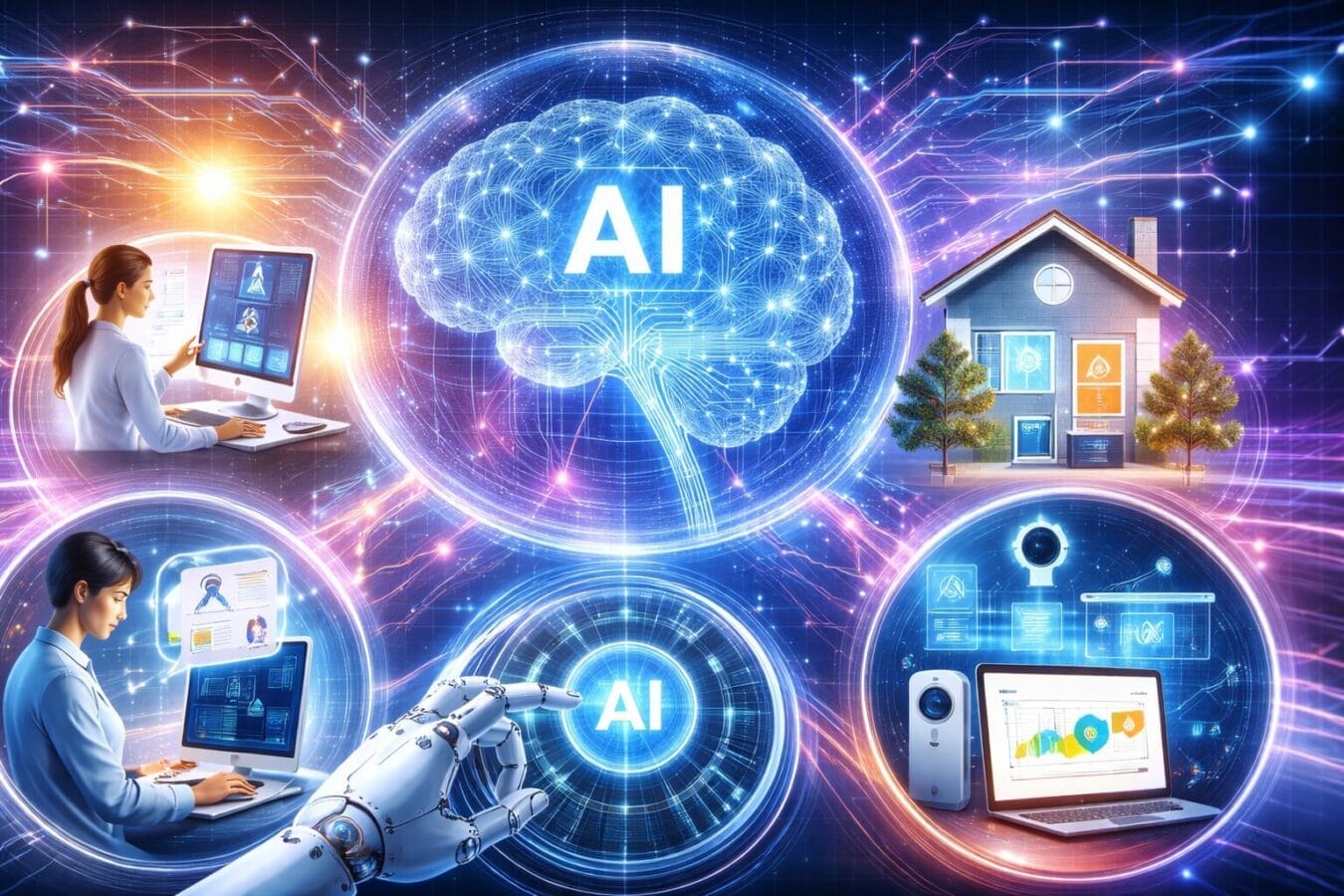
AI reshaping the world in 2025 at a pace never seen before. What was once considered an emerging technology is now deeply embedded in everyday life. At the heart of this transformation lies Artificial Intelligence (AI)—a technology that has evolved from experimental algorithms into a powerful force influencing nearly every sector.
From healthcare and education to finance, cybersecurity, and smart homes, AI is redefining efficiency, personalization, and accessibility. As nations invest heavily in digital infrastructure and innovation, the world is witnessing a technological shift unlike anything seen before.
Table of Contents
Artificial Intelligence: No Longer the Future, but the Present
Artificial Intelligence in 2025 is no longer limited to research labs or tech giants. AI-powered tools are now embedded in smartphones, laptops, vehicles, and even household appliances. These systems can understand user behavior, analyze vast amounts of data, and deliver highly accurate outcomes in real time.
Modern AI models are capable of:
Learning from experience
Adapting to changing environments
Making predictive decisions
Interacting naturally with humans
This has turned AI into a daily digital companion, assisting people at work, at home, and on the move.
AI in Healthcare: Smarter Diagnosis and Better Patient Care
One of the most significant impacts of AI in 2025 can be seen in the healthcare sector. Hospitals and medical institutions are increasingly relying on AI-driven systems to improve accuracy, speed, and patient outcomes.
Early Disease Detection
AI algorithms can analyze X-rays, MRIs, CT scans, and pathology reports faster than traditional methods. In many cases, they can detect early signs of diseases such as cancer, heart conditions, and neurological disorders with remarkable precision.
Wearable Health Technology
Smartwatches and fitness bands now monitor:
Heart rate variability
Oxygen saturation
Sleep cycles
Stress levels
These devices use AI to identify irregular patterns and alert users or doctors before health issues become serious.
Telemedicine and Remote Care
AI-powered telemedicine platforms have made healthcare more accessible, especially in rural and underserved areas. Patients can consult doctors remotely, while AI tools assist in symptom analysis and follow-up care. AI-powered diagnostics and digital health tools are increasingly being adopted in medical systems worldwide.
Education in 2025: Personalized and Technology-Driven
The education system has undergone a massive transformation due to AI integration. Traditional one-size-fits-all learning is gradually being replaced by personalized education models.
Adaptive Learning Platforms
AI-based learning systems assess a student’s strengths and weaknesses and adjust content accordingly. This allows students to learn at their own pace and improves overall understanding.
Virtual Tutors and AI Assistants
Students now have access to:
AI-powered doubt-solving tools
Virtual tutors available 24/7
Automated assessments with instant feedback
These tools have proven especially helpful for competitive exams and skill-based learning.
Teacher Support and Automation
AI helps teachers by automating administrative tasks like grading and attendance, allowing them to focus more on mentoring, creativity, and student engagement.
Educational institutions are also adopting AI driven learning platforms at a global level.
Automation and Employment: Jobs Are Evolving, Not Disappearing
Automation has expanded rapidly in 2025, impacting industries such as manufacturing, banking, logistics, and customer support. While repetitive tasks are increasingly handled by machines, this shift has also created new opportunities.
Emerging Job Roles
AI-driven growth has led to demand for professionals in areas like:
AI system training and monitoring
Data science and analytics
Cybersecurity and digital forensics
Ethical AI and compliance
Content moderation and digital strategy
Skill-Based Economy
The focus has shifted from traditional degrees to continuous skill development. Upskilling and reskilling have become essential for staying relevant in the modern workforce. According to global technology reports, AI is also reshaping employment and skills worldwide.
Smart Homes and Connected Living
In 2025, smart homes are no longer a luxury—they are becoming mainstream. AI-enabled home automation systems enhance comfort, safety, and energy efficiency.
Key Features of Smart Homes
Intelligent lighting and climate control
Voice-controlled assistants
AI-powered security cameras
Energy usage optimization
These systems learn user habits over time and automatically adjust settings to improve convenience and reduce costs.
AI in Finance and Digital Payments
The financial sector has embraced AI at an unprecedented scale. Banks, fintech companies, and payment platforms rely on AI to improve security, speed, and user experience.
Fraud Detection and Risk Assessment
AI systems can instantly detect suspicious transactions and prevent financial fraud by analyzing patterns that humans might miss.
Personalized Financial Advice
AI-driven apps help users:
Track spending habits
Plan budgets
Optimize investments
This has made financial management more accessible to individuals and small businesses alike.
AI In Cybersecurity: Protecting the Digital World
As digital dependence increases, cybersecurity has become a critical concern in 2025. AI plays a dual role—both as a defense mechanism and, potentially, as a tool for cyber threats.
AI Powered Security Systems
Modern cybersecurity tools use AI to:
Detect malware and phishing attacks
Identify unusual network activity
Respond to threats in real time
These systems continuously learn from new attack patterns, making them more effective over time.
Ethical Concerns and Challenges of AI Growth
Despite its advantages, the rapid expansion of AI raises several ethical and social concerns.
Key Challenges
Data privacy and surveillance
Bias in AI decision-making
Lack of transparency in algorithms
Over-dependence on technology
Governments and organizations are now working on AI regulations and ethical frameworks to ensure responsible use of technology.
The Role of Governments and Policy Makers
In 2025, governments around the world are investing heavily in digital infrastructure, AI research, and technology education. Policies are being introduced to promote innovation while protecting citizens’ rights.
Key focus areas include:
Data protection laws
Ethical AI guidelines
Digital literacy programs
Support for startups and innovation
The Future Outlook: Humans and AI Working Together
Artificial Intelligence is not here to replace humans—it is here to enhance human potential. The future belongs to those who understand how to collaborate with technology rather than fear it.
As AI continues to evolve, success will depend on:
Responsible innovation
Continuous learning
Ethical implementation
Inclusive access to technology
Conclusion To How AI Reshaping The World
Technology in 2025 represents a turning point in human history. Artificial Intelligence has become a powerful tool that influences nearly every aspect of modern life—from healthcare and education to finance and home living.
While challenges remain, the opportunities far outweigh the risks. With the right balance of innovation, regulation, and awareness, AI has the potential to create a smarter, safer, and more inclusive future.
The digital revolution is no longer approaching—it is already here.
Trending

Ayush Singhal is the founder and chief editor of TechMitra.in — a tech hub dedicated to simplifying gadgets, AI tools, and smart innovations for everyday users. With over 15 years of business experience, a Bachelor of Computer Applications (BCA) degree, and 5 years of hands-on experience running an electronics retail shop, Ayush brings real-world gadget knowledge and a genuine passion for emerging technology.
At TechMitra, he covers everything from AI breakthroughs and gadget reviews to app guides, mobile tips, and digital how-tos. His goal is simple — to make tech easy, useful, and enjoyable for everyone. When he’s not testing the latest devices or exploring AI trends, Ayush spends his time crafting tutorials that help readers make smarter digital choices.
📍 Based in Lucknow, India
💡 Focus Areas: Tech News • AI Tools • Gadgets • Digital How-Tos
📧 Email: contact@techmitra.in
🔗 Full Bio: https://techmitra.in/about-us/