

Table of Contents
Introduction
Artificial Intelligence (AI) has become one of the most talked-about technologies of the 21st century. News outlets trumpet it as a revolution poised to transform how we live, work, and solve global challenges. Startups boast generative-AI-driven breakthroughs; investors scramble to back anything with an “AI” label. Yet amidst the hype lies an undercurrent of skepticism—experts, analysts, and even cautious entrepreneurs warn of inflated expectations, ethical risks, and possible market correction. In this article, let’s navigate the chasm between AI hype and market caution, exploring how to balance optimism with realism.
The Hype Machine: Why AI Gets Oversold
1. Headlines Sell, Complexity Doesn’t
Simplified narratives win clicks. It’s far easier to proclaim “AI will replace doctors” or “AI conquers creative industries” than to explain nuanced developments like statistical fine-tuning or domain-specific limitations. As a result, headlines feed a sense that we’re on the cusp of a near-magical transformation—overshadowing the hard work and incremental progress that usually underpin AI advances.
2. Buzzy Labels Drive Value
Sticker “AI” onto a product and its valuation might immediately rise. Countless enterprise tools and health-tech platforms have appended “AI” to their branding—not necessarily because they’ve harnessed deep learning, but because the term attracts eyeballs, boards, and budgets. This tends to inflate expectations, sometimes without corresponding performance.
3. Enthusiasm Begets Traffic, Funding, and Momentum
AI is the “king of buzz.” VCs and corporates are drawn into AI-centric investments because they feel FOMO (fear of missing out). As unicorn valuations soar, excitement begets more excitement. But this cyclical momentum can hide real risk: if a promising model fails to deliver, enthusiasm may dry up overnight, and so does funding.
Why Caution Matters: Market Realities to Watch
Despite genuinely transformative potential, AI also carries pitfalls that demand sober consideration.
1. Performance vs. Perception
Generative AI systems can generate impressively plausible text, images, code—but often at the expense of accuracy or factuality. A language model may deliver an eloquent answer that’s completely bogus. Meanwhile, users, media, and decision-makers may perceive fluidity as credibility. This gap between output and truth can lead to flawed decisions, ranging from benign misinformation to serious financial or medical misjudgments.
2. Data Shadows and Biases
AI doesn’t exist in a vacuum—it learns from data that reflect human biases, errors, and historical inequalities. Without rigorous oversight, models can inadvertently reinforce stereotypes or generate discriminatory outcomes. Companies building AI without diligent bias mitigation risk not just ethical failings, but reputational and legal consequences.
3. Regulatory and Ethical Overhang
Public policy is scrambling to catch up with AI’s pace. Governments increasingly discuss safeguards: transparency mandates, accountability for automated decisions, restrictions on deepfakes, and privacy rules related to training data. If companies move too fast without aligning with evolving regulations, they may face fines, forced halts, or public backlash.
4. Economic Disruptions and Job Displacement
Yes, AI could automate routine tasks—affecting jobs in customer service, data entry, even some aspects of legal or accounting work. While new jobs and industries may emerge, the transition isn’t frictionless. Societal caution is warranted to manage displacement, retraining, and inequality. Hype glosses over human costs; caution must grapple with them.
5. Infrastructure Costs and Scalability
Training massive models and running high-throughput inference demand serious computing infrastructure—and energy. Not every enterprise can sustain these costs. Many smaller companies or developers are yet to see profitable paths in building or deploying AI at scale, especially when maintenance, fine-tuning, and model retraining come into play.
6. Profitability Still Out of Reach
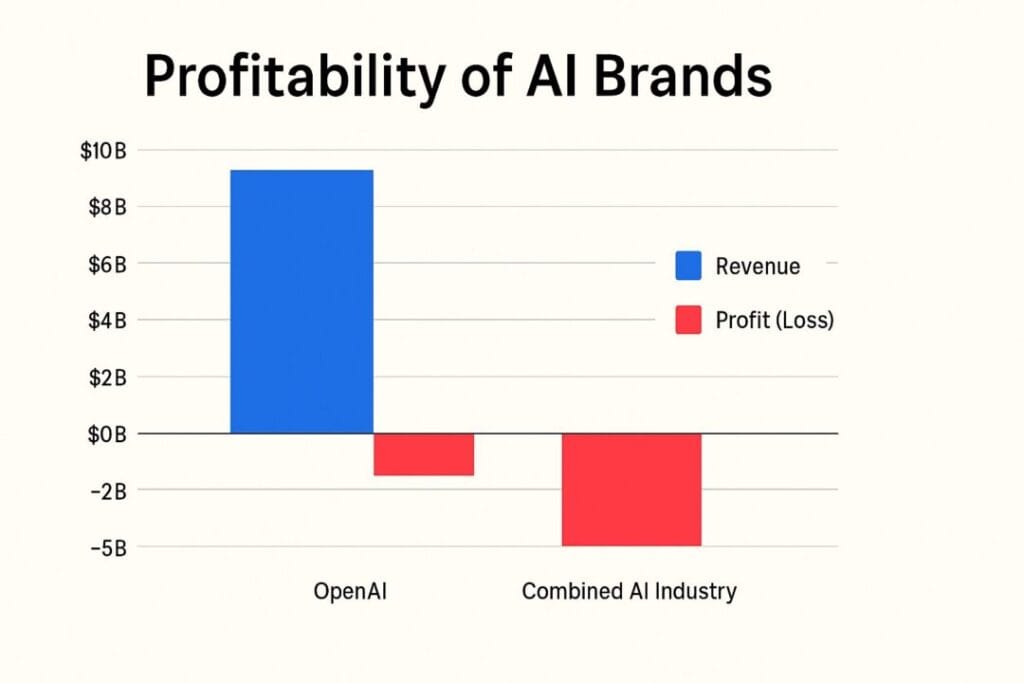
One of the most overlooked realities is that no major AI brand has yet managed to earn a consistent profit. The giants of the AI world—companies building massive language models, generative platforms, and foundation models—burn billions of dollars in training, hardware, and electricity. Even with venture capital, subscription fees, and enterprise licensing, revenue often lags far behind costs.
This means that while AI headlines paint a picture of explosive success, the underlying business models remain uncertain. If the biggest players with unlimited resources are struggling to monetize AI sustainably, smaller startups face an even tougher path. This sobering fact underscores the gap between technological promise and market reality.
Profitability Snapshot: Estimated Figures
Here’s a simplified comparison based on recently reported or projected financials:
| AI Brand / Type | Revenue (2025 est.) | Profitability Status / Net Loss |
|---|---|---|
| OpenAI | ~$10–12.7 billion | Losing ~$5 billion (2024); no profit expected until ~2029 SaaStrTap Twice Digital+1 |
| Combined AI Industry (wider) | $18 billion revenue | Zero profits; significant spending Medium |
| Other AI Ventures (general) | Growing revenues | Most continue to burn cash, unclear path to profit CoinGeek |
Interpreting the Data
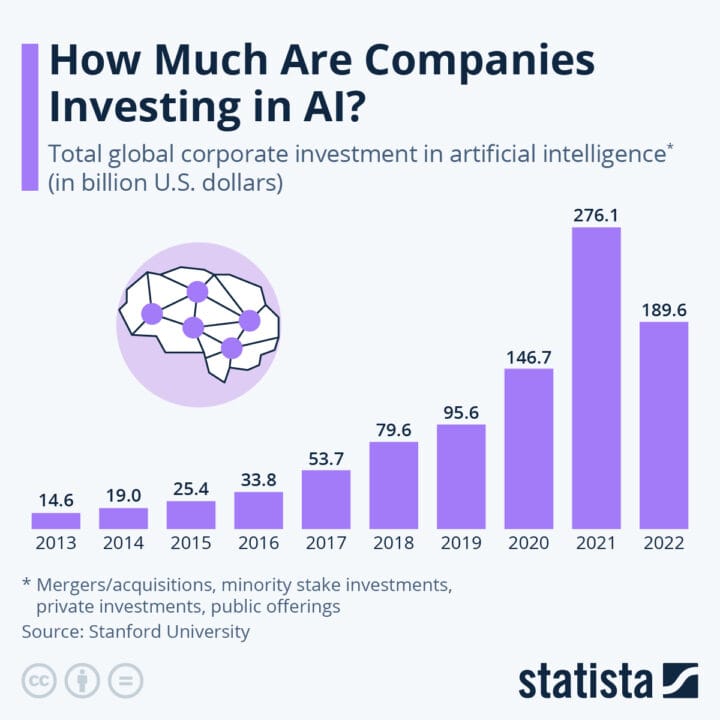
Enormous Investment, Slim Returns: The chart above highlights heavy corporate investment in AI, but the corresponding lower table shows that most AI ventures are operating at a loss or yet to achieve profitability.
OpenAI’s Case: Although OpenAI expects revenues between $10B and $12.7B in 2025, net profit remains elusive, with forecasts pushing profitability out several years. CoinGeekepoch.ai, 3SaaStr, Tap Twice Digital,
Industry-Wide Losses: Even aggregated revenue around $18B comes with zero profit, reflecting how widespread cost overruns still are across the AI industry. Medium
Conclusions: Hype Meets Reality
Growth Without Gains: AI companies enjoy explosive revenue growth, but sustained profitability is still a distant goal.
Spending Outpaces Earnings: Massive investments in infrastructure, talent, and R&D keep cost structures high—especially for private leaders like OpenAI.
Patience Required: While hype may inflate valuations, the market is growing more circumspect; profitability will be the true litmus test moving forward.
Finding the Middle Path: Smart Optimism
How can enterprises, investors, policymakers, and society strike a productive balance between hype and caution?
1. Set Realistic Expectations
Leadership should resist the allure of hyperbolic promises—internally and externally. Instead of saying “We’re going to fully automate customer support next year,” a company might accurately frame, “We’re piloting AI–assisted tools to handle Tier-1 inquiries, aiming to improve response times while retaining human oversight.” Clarity earns trust.
2. Focus on High-Value, Narrow-Scope Use Cases
General-purpose magic is rare. Better to pilot domain-specific solutions—say, fraud-detection in banking, predictive maintenance in manufacturing, or AI-powered triage in healthcare. These constrained applications yield measurable ROI and are easier to validate or iterate than an all-in-one AI dream.
3. Invest in Explainability and Safety
AI outputs should come with context—confidence scores, provenance of data, or explanations for suggestions. Organizations should integrate guardrails: flagging inconsistencies, enabling override by professionals, and auditing decisions over time. Explainability builds trust and aids debugging—especially when things go off track.
4. Prioritize Ethical Design and Bias Mitigation
Human-centered design demands fairness audits, representative data sampling, and diverse teams overseeing model development. It also means embedding stakeholder feedback loops—especially from those who might be disadvantaged or harmed by AI decisions (e.g., job seekers, patients, marginalized communities).
5. Plan for Regulation and Compliance
Stay ahead of the policy curve. Monitor developments—like the EU’s AI Act, US federal or state-level AI rules, or emerging guidelines from industry bodies. Building proactive compliance (e.g., requiring model documentation or “model cards”) avoids reactive scrambling if regulations tighten.
6. Embrace Hybrid Human-AI Systems
Rather than replacing people outright, AI is often most powerful when amplifying human capabilities. For example: doctors supported by AI suggestions, editors assisted by language-model drafts, technicians carrying AI-powered diagnostic tools. These hybrid systems harness AI’s scale and human nuance.
7. Educate Stakeholders
Investors, board members, end-users, and employees all benefit from AI literacy—not just about what AI can do, but where it fails. Workshops, plain-language briefings, ongoing training programs—these reduce unrealistic expectations and help spot blind spots.
Real-World Examples
The Myth of AI-Only Uber
Imagine a ride-hailing platform marketed as “100 % AI-powered routing and pricing.” In reality, logistics and driver supply fluctuate unpredictably: surge pricing is often manually tweaked, dynamic rerouting relies on human traffic analysts, and driver-partner relationships are managed by people. Claiming “full automation” would attract buzz, but—without a solid human-AI blend—it would collapse under real-world complexity.
The Rise of “Explainable AI” Regulators
A bank implements an AI system to approve small business loans. Initially, the model offers excellent throughput—but regulators demand clarity: why was this loan accepted, while that one denied? Without proper documentation or traceability, the bank faces audit risks. By building in explainable-AI modules from the start, it avoids regulatory roadblocks and earns trust with applicants.
AI in Healthcare: Promise, But Not Panacea
Generative-AI tools can draft clinical notes or suggest treatment plans—but the margin for error is slim. Overreliance on automated suggestions without clinician validation can lead to misdiagnoses. In cautious deployments, some hospitals use AI only to pre-populate documents, with doctors doing final edits—combining efficiency with responsibility.
Market Signals: Is a Corrective Wave Looming?
Investor Selectivity Is Rising
Lately, some funding rounds have tightened: investors are asking tougher questions—How much real adoption? What’s the cost-benefit poster child? Gone are the days of “spray AI onto your pitch deck, and we’ll fund.” That shift signals maturation: the market is returning to fundamentals.
IPOs Under Strain
AI startups going public must defend strong valuations—not just with growth narratives, but solid revenues and margin paths. In cases where enthusiasm outpaced substance, valuations have been recalibrated. That doesn’t stifle innovation—but it does weed out hype-heavy ventures.
Public Sentiment Swinging from Awe to Wariness
Initial excitement around AI-fueled chatbots or creative systems is now tempered by pushback—whether over content hallucinations, deepfake fears, or surveillance concerns. Rising debates about copyright, misinformation, and human-AI rights indicate a more tempered public mood.
Profitability Question Marks
Even Wall Street analysts are increasingly skeptical. The current wave of AI enthusiasm resembles earlier “dot-com” bubbles where companies had strong visions but weak balance sheets. Until AI firms demonstrate clear, scalable profitability, markets will remain cautious. Share prices and valuations may face corrections if earnings don’t eventually match expectations.
Public Sentiment Swinging from Awe to Wariness
Initial excitement around AI-fueled chatbots or creative systems is now tempered by pushback—whether over content hallucinations, deepfake fears, or surveillance concerns. Rising debates about copyright, misinformation, and human-AI rights indicate a more tempered public mood.
Looking Ahead: What Smart Stakeholders Should Do
| Stakeholder | Recommended Approach |
|---|---|
| Investors | Back teams solving specific, verifiable problems—not just marketing spin. Demand progress metrics. |
| Startups/Companies | Build sustainable tech; reveal both strengths and limitations. Balanced messaging wins long-term trust. |
| Policymakers | Frame adaptable, clear rules—so innovation isn’t stifled, but harms are prevented. |
| Media/Journalists | Report beyond miracle stories—include pitfalls, unintended consequences, and real-world complexity. |
| General Public | Remain curious but critically informed—understand hype, look beyond headlines when evaluating AI claims. |
Conclusion: Caution Doesn’t Undermine Innovation—It Strengthens It
AI is undoubtedly one of the most powerful technologies of our age. Its capacity to enhance medicine, optimize logistics, uncover scientific insights, and empower creativity is real. But we can’t sugarcoat it: hype—if unchecked—can mislead, misallocate resources, tarnish trust, and generate backlash.
And perhaps the biggest warning signal is financial: so far, not a single major AI player has proven that it can turn hype into profit. Until that changes, investors and businesses must tread carefully, balancing ambition with pragmatism.
The future of AI depends on smarter, more grounded stewardship. When optimism is tempered by pragmatism, and vision paired with ethics, we don’t just chase buzz—we build systems that truly serve society. The trick is not to extinguish enthusiasm, but to channel it through the lens of responsibility and realism.
That’s how we avoid another hype-bubble collapse—and instead cultivate sustained, widespread benefits from AI’s incredible potential.
Disclaimer
The information provided in this article is for educational and informational purposes only. While every effort has been made to ensure accuracy, the financial figures, revenue estimates, and profitability insights of AI companies are based on publicly available reports and industry analyses at the time of writing. They should not be interpreted as financial advice or investment recommendations.
Readers are encouraged to verify details independently and consult with qualified professionals before making any business, financial, or investment decisions related to AI technologies or companies. TechMitra.in does not hold responsibility for any financial loss or decisions made based on this content.
Recent Posts

Ayush Singhal is the founder and chief editor of TechMitra.in — a tech hub dedicated to simplifying gadgets, AI tools, and smart innovations for everyday users. With over 15 years of business experience, a Bachelor of Computer Applications (BCA) degree, and 5 years of hands-on experience running an electronics retail shop, Ayush brings real-world gadget knowledge and a genuine passion for emerging technology.
At TechMitra, he covers everything from AI breakthroughs and gadget reviews to app guides, mobile tips, and digital how-tos. His goal is simple — to make tech easy, useful, and enjoyable for everyone. When he’s not testing the latest devices or exploring AI trends, Ayush spends his time crafting tutorials that help readers make smarter digital choices.
📍 Based in Lucknow, India
💡 Focus Areas: Tech News • AI Tools • Gadgets • Digital How-Tos
📧 Contact: Get in touch →
🔗 Full Bio: https://techmitra.in/about-us/