

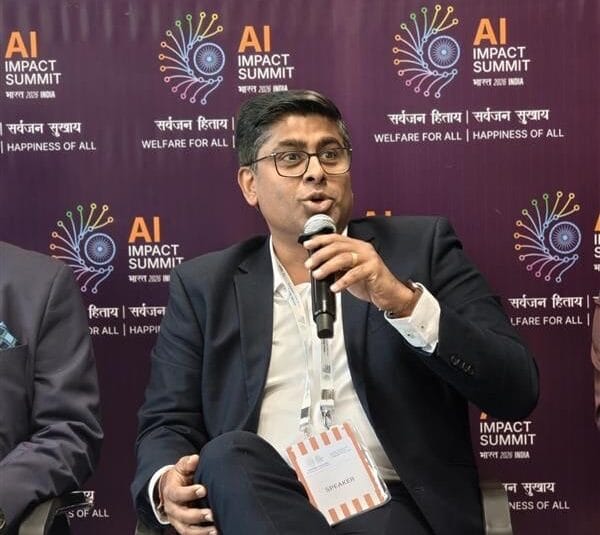
Jay Bavisi speaks at the India AI Impact Summit 2026, calling on India’s IT industry to lead the national AI workforce transformation
The India – AI Impact Summit 2026, hosted by the Government of India under the India AI Mission at Bharat Mandapam, New Delhi, wasn’t just another technology conference. It marked a decisive shift — from AI ambition to real-world execution.
Framed around the themes of People, Planet, and Progress, the summit positioned artificial intelligence not merely as a tool of innovation, but as a national capability that must deliver measurable enterprise and societal outcomes.
And the timing couldn’t have been more dramatic.
A Global AI Moment — With 300,000+ Voices
Within just three days, the summit drew over 300,000 attendees, making it one of the largest AI gatherings globally. The guest list read like a who’s who of the AI world:
- Jensen Huang (NVIDIA)
- Sundar Pichai (Google)
- Bill Gates
- Sam Altman
But beyond the star power, what made this summit different was the mood.
This wasn’t about speculative AI demos. It was about economic survival, workforce transformation, and enterprise-scale implementation.
IT Sector Shock: AI Fear Hits the Markets
The summit unfolded against a turbulent backdrop.
In the days leading up to the event, global investors reacted sharply to AI-driven disruption fears. India’s Nifty IT index fell nearly 19% across eight trading sessions, wiping out an estimated ₹4.8–5 lakh crore in market capitalization.
Several major IT firms:
- Saw double-digit stock corrections
- Hit fresh 52-week lows
- Faced heavy selling in overseas markets
For the first time in years, serious questions emerged around the long-term sustainability of India’s labour-intensive outsourcing model.
And this isn’t a small sector.
India’s IT-BPM industry:
- Generates approximately $283 billion in revenue (FY2025)
- Contributes 7%+ to national GDP
- Employs nearly 5.8 million professionals
AI isn’t just another tech wave here — it’s potentially a structural reset.
Crisis or Once-in-a-Decade Opportunity?
While markets reacted with panic, many leaders at the summit saw something else: opportunity.
The same AI systems that threaten traditional outsourcing models are also creating enormous demand for:
- AI deployment specialists
- Cybersecurity experts
- Governance and compliance professionals
- AI program managers
- Enterprise AI architects
The key question isn’t whether AI will transform India’s IT sector.
The real question is:
Can India reskill 5.8 million professionals fast enough to lead the transformation instead of reacting to it?
Jay Bavisi: “Execution Maturity Will Define AI Leadership”
One of the strongest voices on this topic was Jay Bavisi, Founder and CEO of EC-Council.
Speaking at the panel “Responsible AI at Scale: Governance, Integrity & Cyber Readiness,” Bavisi shifted the focus from AI experimentation to AI execution.
His core message was clear:
“AI has the potential to cause mayhem if it is not implemented properly. When AI becomes embedded into systems, responsibility becomes critical.”
He emphasized that AI is already entering:
- Financial systems
- Healthcare infrastructure
- Manufacturing ecosystems
- Digital governance platforms
- National security frameworks
At this scale, workforce discipline becomes the defining factor.
India’s Talent Advantage — But With Conditions
Bavisi also highlighted India’s global positioning:
“India has a phenomenal opportunity to be a supplier of talent to the world… This is a moment for India.”
According to him, India already has:
- Strong language model proficiency
- Large-scale technical talent
- Enterprise deployment experience
But leadership won’t be determined by speed alone.
It will be determined by:
- Governance maturity
- Cyber readiness
- Ethical deployment frameworks
The Workforce Blueprint: Adopt. Defend. Govern.
Under Bavisi’s leadership, EC-Council unveiled a major expansion in its AI training ecosystem — the largest in its 25-year history.
The organization introduced its structured Adopt. Defend. Govern. (ADG) framework for enterprise AI capability.
New credentials include:
- AI Essentials (AI|E)
- Certified AI Program Manager (C|AIPM)
- Certified Offensive AI Security Professional (C|OASP)
- Certified Responsible AI Governance & Ethics Professional (C|RAGE)
- Modernized Certified CISO v4
The focus is simple:
AI is scaling faster than the workforce trained to run and secure it.
The session saw standing-room-only attendance, with extended Q&A interactions — a strong signal that professionals aren’t just curious about AI; they’re concerned about career relevance.
TechMitra Take: India’s AI Moment Is Real — But Execution Will Decide
Here’s what stood out for us.
The summit wasn’t about flashy AI demos. It was about national capability building.
The correction in IT stocks reflects fear.
But fear often precedes structural evolution.
If India successfully:
- Retrains its 5.8 million workforce
- Embeds AI governance frameworks
- Secures enterprise AI systems at scale
- Builds export-ready AI talent pipelines
Then the $283 billion IT industry could become even larger in the AI era.
If not, disruption could outpace adaptation.
The India – AI Impact Summit 2026 made one thing very clear:
AI leadership won’t be defined by who builds the biggest model.
It will be defined by who builds the most capable workforce to deploy it responsibly.
And for India — this is more than a tech opportunity.
It’s an economic inflection point.
About EC-Council
Founded in 2001, EC-Council is the creator of the globally recognized Certified Ethical Hacker (CEH) credential.
The organization has:
- Certified over 350,000 professionals worldwide
- Served government agencies and Fortune 100 companies
- Earned ISO/IEC 17024 accreditation
EC-Council remains one of the most recognized names in cybersecurity certification and applied enterprise security training.
Source & Disclaimer
Source: Press Release by NewsVoir
Disclaimer: This article is based on a syndicated press release from NewsVoir. TechMitra has edited and optimized the content for clarity, readability, and SEO. All facts, claims, and data are the responsibility of the source organization.

Ayush Singhal is the founder and chief editor of TechMitra.in — a tech hub dedicated to simplifying gadgets, AI tools, and smart innovations for everyday users. With over 15 years of business experience, a Bachelor of Computer Applications (BCA) degree, and 5 years of hands-on experience running an electronics retail shop, Ayush brings real-world gadget knowledge and a genuine passion for emerging technology.
At TechMitra, he covers everything from AI breakthroughs and gadget reviews to app guides, mobile tips, and digital how-tos. His goal is simple — to make tech easy, useful, and enjoyable for everyone. When he’s not testing the latest devices or exploring AI trends, Ayush spends his time crafting tutorials that help readers make smarter digital choices.
📍 Based in Lucknow, India
💡 Focus Areas: Tech News • AI Tools • Gadgets • Digital How-Tos
📧 Contact: Get in touch →
🔗 Full Bio: https://techmitra.in/about-us/