
The 10th Annual TalentNomics Conference 2025 brought together India’s top tech and corporate leaders to examine how AI acceleration is affecting gender equity in work, wealth, and wellbeing. Speakers highlighted task level automation risks for women, the importance of responsible AI governance, the gender wealth gap, and the need for stronger representation in data stewardship and AI decision making. The conference emphasized moving from mentorship to sponsorship to ensure women shape India’s AI future.
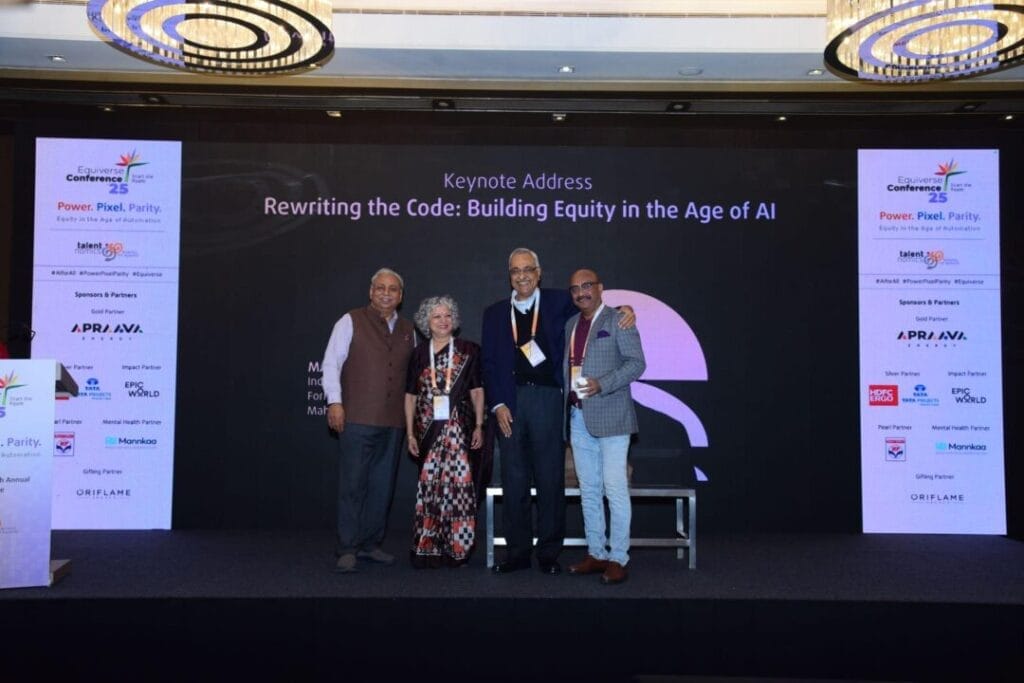
The rapid rise of Artificial Intelligence (AI) has unlocked new opportunities across industries — but it also presents one of the biggest challenges to achieving gender equity in work, wealth, and wellbeing. This was the central theme of TalentNomics India’s 10th Annual Conference — “Power. Pixel. Parity.”
The event brought together top leaders from technology, corporate India, investing, policy, and social impact to move beyond fear and build a proactive roadmap for Responsible AI, while ensuring that India’s AI-powered future is equitable for women.
AI, Ethics, and Equity: The Leaders Who Set the Tone
The conference featured insights from three of India’s most respected business leaders — CP Gurnani, Manoj Chugh, and Jagdish Mitra — who joined Ipsita Kathuria to discuss the responsibility organizations hold in shaping fair AI systems.
CP Gurnani: Ethical AI begins with intentional data training
Gurnani highlighted the importance of preserving human capabilities in an AI-driven world — curiosity, creativity, learning, and critical thinking.
He said:
“AI is all about training the data, and if AI is all about training the data, then I need to pick up instances where I can power it.”
His message reinforced that for AI to be equitable, its foundation — the data — must be consciously and responsibly designed.
Manoj Chugh: “Are we interrupting the bias?”
Chugh’s question served as a powerful call to action.
He stressed that since AI systems learn from historical data — which often reflects societal biases — leaders must take responsibility for interrupting and correcting these patterns.
His emphasis:
Leadership accountability
Sponsorship over tokenism
Deliberate design for equity
Suparna Mitra: Gender norms will reshape — unless we intervene
Mitra explained that every technological revolution resets societal norms.
With AI, the reset is already happening — and without intentional strategy, the gender gap could widen.
She said:
“The AI revolution does not just belong to the people who work on the technology, but all of those who use the technology. The moral and ethical dimensions need to be examined for us to ensure that the gender gap is balanced, rather than get worsened.”
The Future of Work: Understanding Task-Level Disruption
The panel “Work Rebooted – Breaking the Digital Ceiling,” moderated by Lata Singh, examined how AI will impact workforce structures — especially for women.
AI disrupts tasks, not just roles
Jagdish Mitra emphasized that AI disruption is task-specific, meaning roles heavily composed of repetitive tasks are at higher automation risk.
Key data he shared:
Women hold 35% of IT jobs
Nearly 70% of these roles are task-heavy, making them more vulnerable
His recommendations:
Perform task-level audits for reskilling
HR teams must intentionally build gender-diverse reskilling strategies
Individuals should understand which tasks in their job are automatable and prepare accordingly
Inequity is an investment risk
Investor Dr. Archana Hingorani highlighted a critical financial angle:
Ignoring gender displacement leads to systemic market instability, reducing overall talent availability and increasing risk for investors.
Her message:
Businesses that do not prioritize gender equity in the AI era will struggle to remain competitive and resilient.
Women must shape the AI ecosystem early
Shalaka Verma outlined three major opportunity segments of the AI economy:
Builders of AI (model developers, engineers, data scientists)
Maintainers of AI (product managers, cybersecurity experts, analysts)
Users of AI (professionals across sectors leveraging AI tools)
She urged women to proactively enter these spaces before the ecosystem solidifies — ensuring representation and influence at every level.
AI, Wealth, and Wellbeing: Fixing Structural Gaps
Reducing the Gender Wealth Gap with AI
A powerful session led by Soumya Rajan and Anita George addressed the structural causes of the gender wealth gap.
They explained:
Women often end up as savers, not investors, due to cultural conditioning and limited access
AI can act as a ‘copilot’, nudging women toward smarter financial decision-making
Behavioural biases must be corrected through data-driven, personalized financial tools
Anita George emphasized that:
“Investing is self-care.”
They also stressed the need for strong governance, trust-building, and secure digital financial ecosystems.
Rebalancing care through tech and rural healthcare innovation
Panels on healthcare highlighted how AI-enabled systems can dramatically improve access for women — especially in rural India.
Key insights:
Moving diagnostics from hospital to home reduces burdens on women caregivers
Hybrid phygital models using women community leaders can expand rural healthcare reach
Solutions must focus on closing the loop — diagnostics, medicine access, and ongoing care
Mental Health: AI can assist, but not replace empathy
Dr. Dev Brar delivered one of the most human-centered reflections of the day:
“AI heard my words, but not my silence.”
Speakers, including Bhavana Issar and Shilpa Ajwani, agreed that while AI can support emotional wellbeing, it cannot replace the empathy, nuance, and connection that human care provides.
AI must be used as a tool — not a replacement.
Governance & Guardrails: Making AI ‘Equitable by Design’
The panel “Unbiased by Design” delivered a strong consensus:
AI replicates human bias unless actively prevented.
Key takeaways:
1. Mandatory AI audits
Organizations must audit AI systems regularly for:
Bias
Error-rate disparities
Unintended discrimination
2. Equal error rates across demographic groups
Simply removing gender labels from datasets is not enough.
Models must produce equitable outcomes, not just “neutral data points.”
3. More women as data stewards
Representation matters most at the source:
Data collection
Data annotation
Model training
Testing and regulatory feedback
Panelists Kiran Chhabra, Renu Menon, Uma Rani, and Arjun Venkatraman underscored the theme:
“Nothing About Us Without Us.”
4. Societal accountability, not just corporate governance
Sunaina Kumar highlighted that patriarchal norms reflect directly into digital systems.
Without strong governance, AI could weaken women’s economic security.
Ratnesh Jha added that fixing this requires a people-driven movement, where:
Consumers demand accountability
Organizations commit to bias-free decisions
Policymakers co-create inclusive frameworks
Conclusion: From Dialogue to Action — Sponsorship Is the Missing Link
A powerful theme emerged across sessions:
Mentorship is not enough. Sponsorship is essential.
Sponsorship means:
Advocating for women
Opening doors to real decision-making rooms
Ensuring women participate in shaping India’s AI landscape
The event closed with Neeta Boochra, member of the TalentNomics Advisory Board, who reminded attendees that:
Influence must turn into opportunity
Conversations must translate into measurable change
Equity must be built intentionally into India’s digital future
About TalentNomics India
TalentNomics India is a non-profit organisation dedicated to making gender equity the norm.
Since 2016, it has run leadership development programs for women, produced research, and hosted policy-level conferences bringing together corporate, government, and civil society leaders.
Website: india.talentnomics.org
Instagram: instagram.com/talentnomicsindia
LinkedIn: linkedin.com/company/talentnomicsindiate
Source & Disclaimer
Source: Press Release by NewsVoir
Disclaimer: This article is based on a syndicated press release from NewsVoir. TechMitra has edited and optimized the content for clarity, readability, and SEO. All facts, claims, and data are the responsibility of the source organization.
Trending

Ayush Singhal is the founder and chief editor of TechMitra.in — a tech hub dedicated to simplifying gadgets, AI tools, and smart innovations for everyday users. With over 15 years of business experience, a Bachelor of Computer Applications (BCA) degree, and 5 years of hands-on experience running an electronics retail shop, Ayush brings real-world gadget knowledge and a genuine passion for emerging technology.
At TechMitra, he covers everything from AI breakthroughs and gadget reviews to app guides, mobile tips, and digital how-tos. His goal is simple — to make tech easy, useful, and enjoyable for everyone. When he’s not testing the latest devices or exploring AI trends, Ayush spends his time crafting tutorials that help readers make smarter digital choices.
📍 Based in Lucknow, India
💡 Focus Areas: Tech News • AI Tools • Gadgets • Digital How-Tos
📧 Email: ayushsinghal@techmitra.in
🔗 Full Bio: https://techmitra.in/about-us/